Nice France

Rue Droite - our Airbnb street in Nice

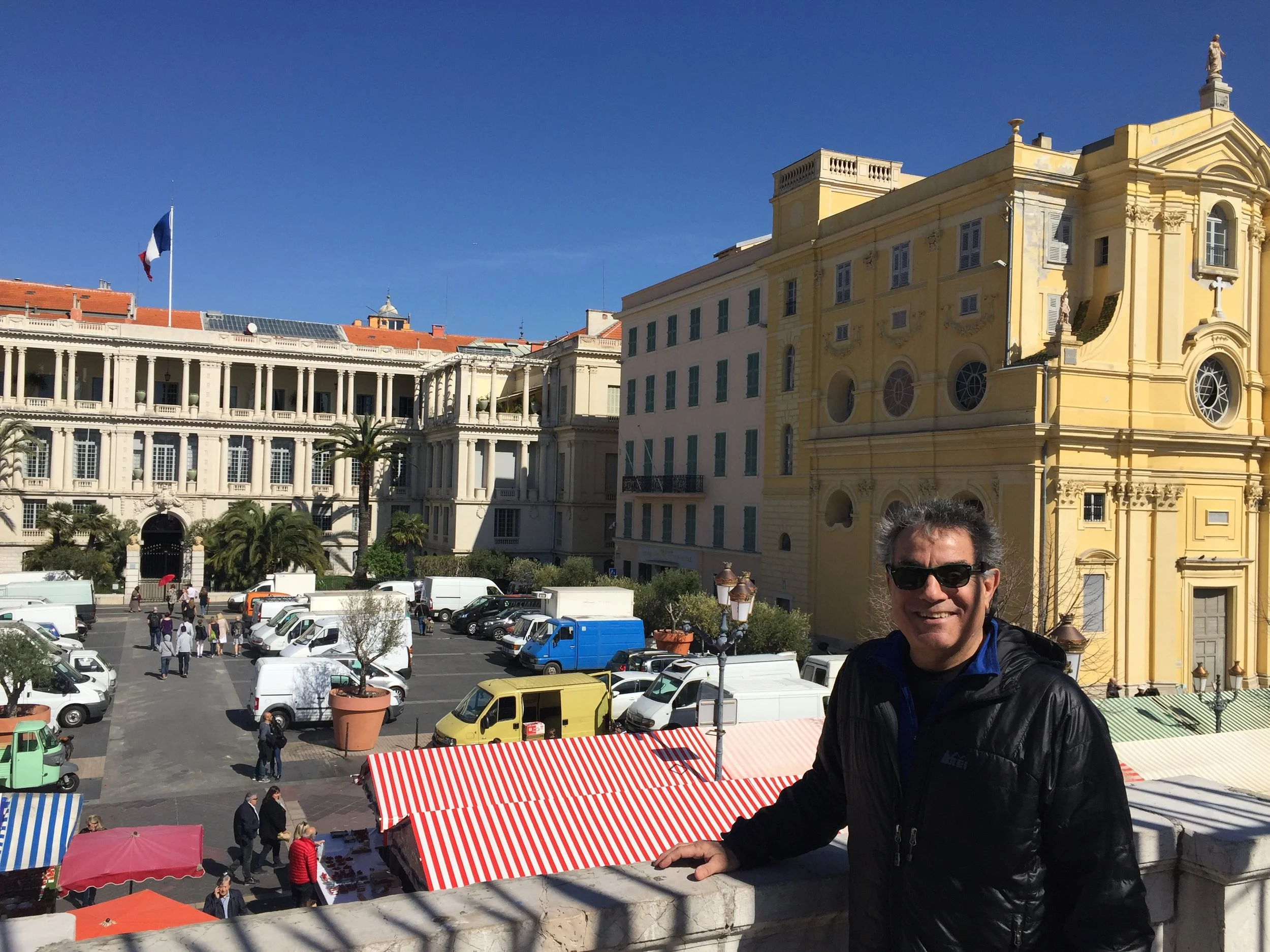
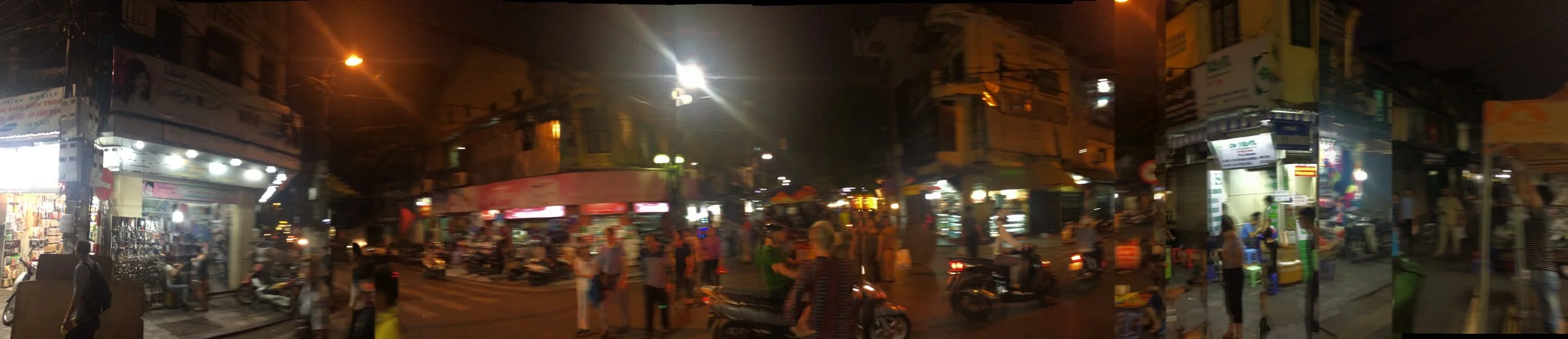
Our destination is Nice. After freezing in Turkey, Germany and parts of France we have sun and it is warm! We love this place. Our Airbnb is in old town on a narrow hilly street called Rue Droite. This is a second floor flat in a 5 story building with those traditional windows that have shutters. When we exit on to the narrow cobblestone street, there are pasta shops, bakeries, and restaurants nearby. We are only 2 blocks from the central plaza that has been built over a river that runs through the town. Today in the plaza was the Paris/Nice bicycle races meeting point and retailer/equipment area. As we waited for the our customary walking tour to begin, a procession of multiple buses with cycle team members and trailered team colored bikes passed by. It was tremendously colorful and excitement was in the air. The races had several starting and ending points throughout southern France. 

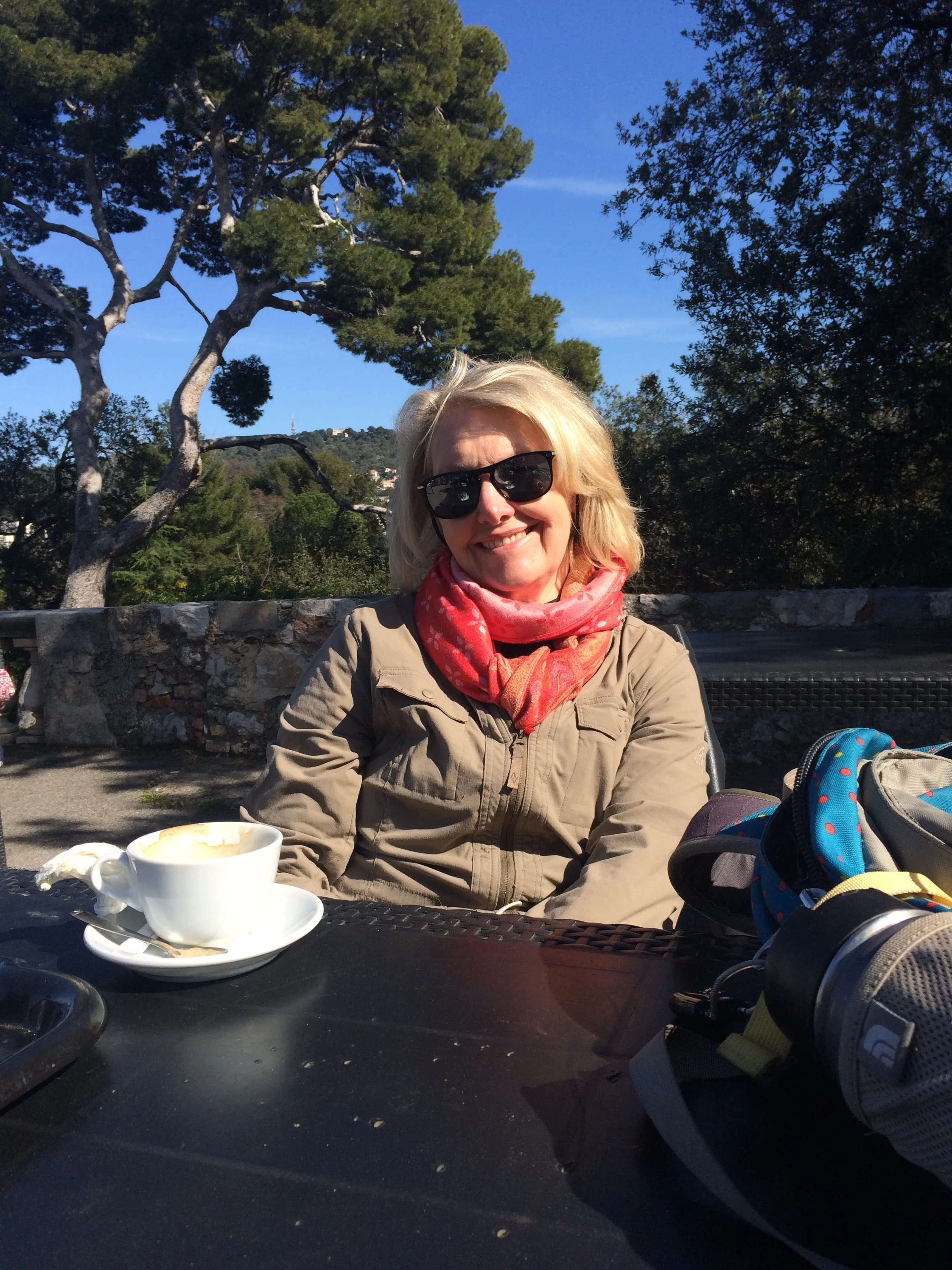
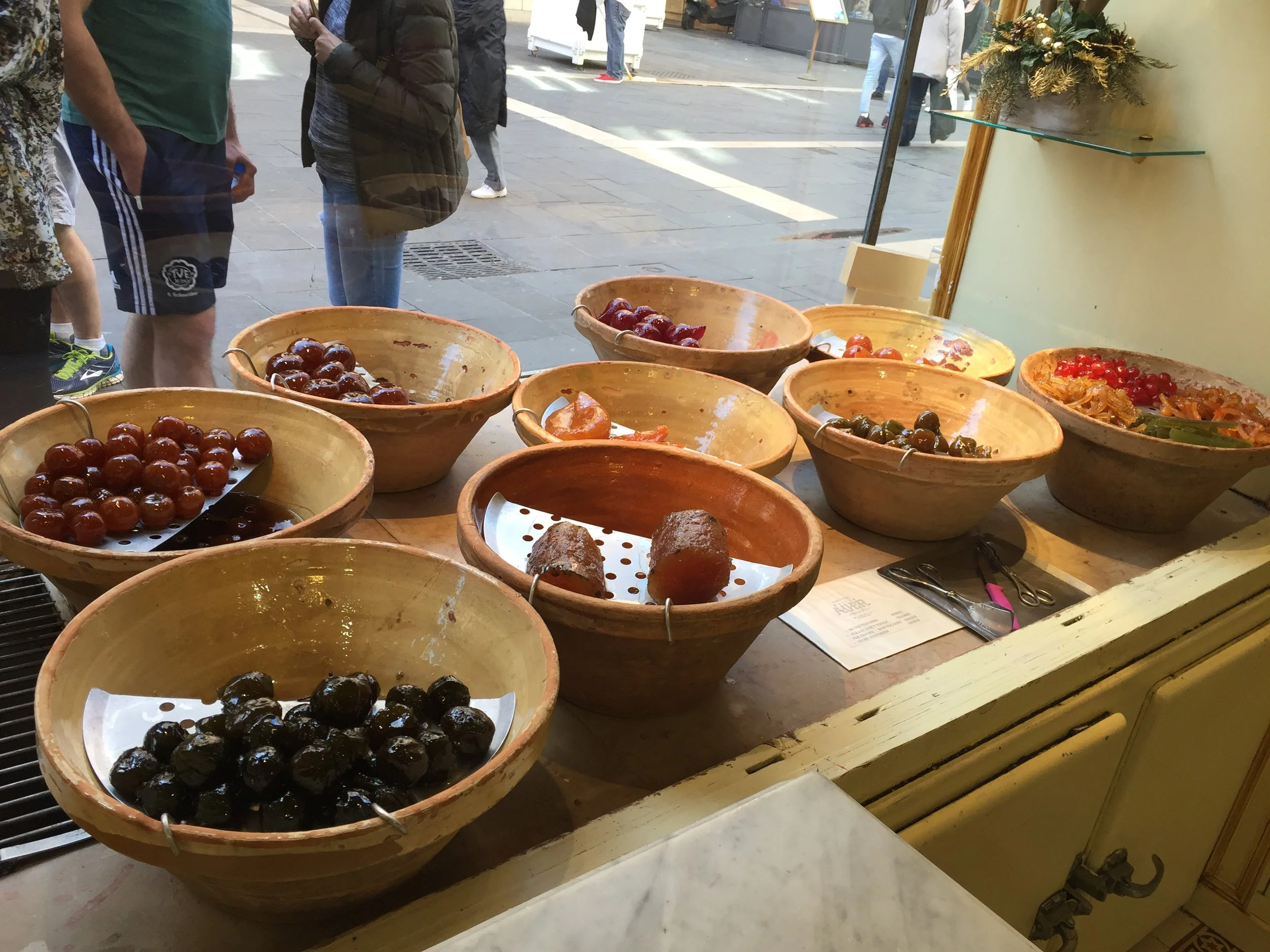
The walking tour was led by the cutest little Bulgarian transplant who had lived in Nice 6 years. She was very bubbly and entertaining. We walked all over the the traditional town, waterfront, and finally fortress hill where the view was spectacular. This is a really beautiful place and tasty. We had samples of French gelato, then a full scoop, then chick pea cake which tastes like fried chicken—extra crispy, then samples of special candied fruit. Our guide kept on asking if we enjoyed our energy food because we were going to keep walking. At the end of the tour, we stayed at fortress hill and had café latte while we enjoyed the sun and views. We eventually walked down and shopped for fresh pasta and red sauce, fresh bread, and dessert for dinner. We also purchased some of the wonderful lavender sachets that Nice is famous for.  Our suitcases can get stinky from long term travel. It was late afternoon by now, so we went home and did some homework. Someone (aka Janet) put together a marvelous dinner accompanied by the Rose’ wine the host gave us. This was a fun day! 
 

At the market

Day two.  Today we went to the farmer’s market in the center of town, 3 blocks from our place. The weather is beautiful and sunny. One of Janet's favorite things on this trip is to shop for local food. The setting here is so different from the markets of South America, pristine clean, no stray dogs, no haggling prices, but it is still a great way to mix with the people and get an understanding of the culture through the food.  Here we purchased fresh fish, veggies, cheeses, olives, bread and fruit for the next 4 days.


This was a leisurely activity, so when we finished it was time to use these items for lunch. Someone (aka Janet again) put together a scrumptious lunch of fresh food so we would have energy for our next excursion.

This is a office building and art


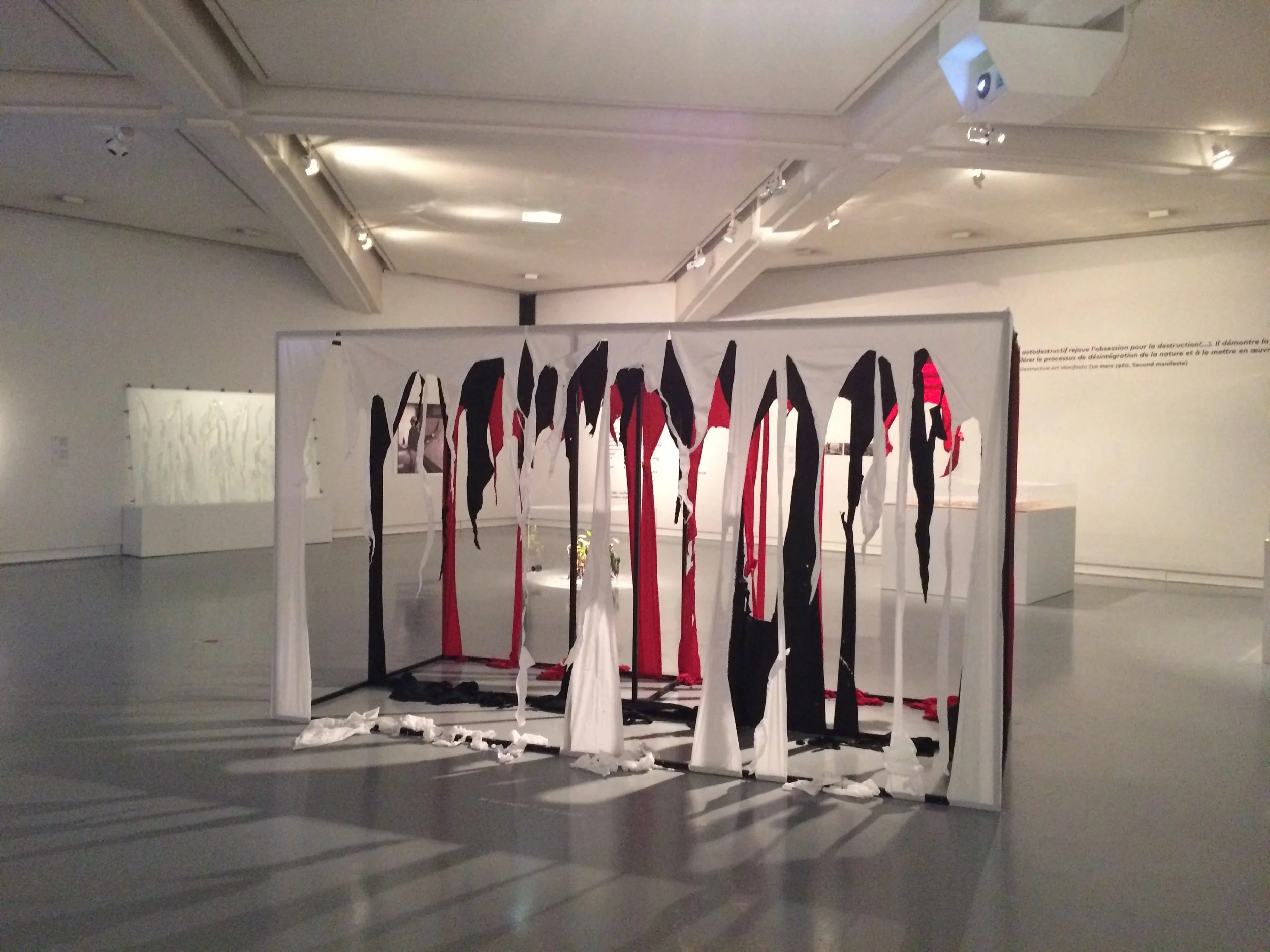
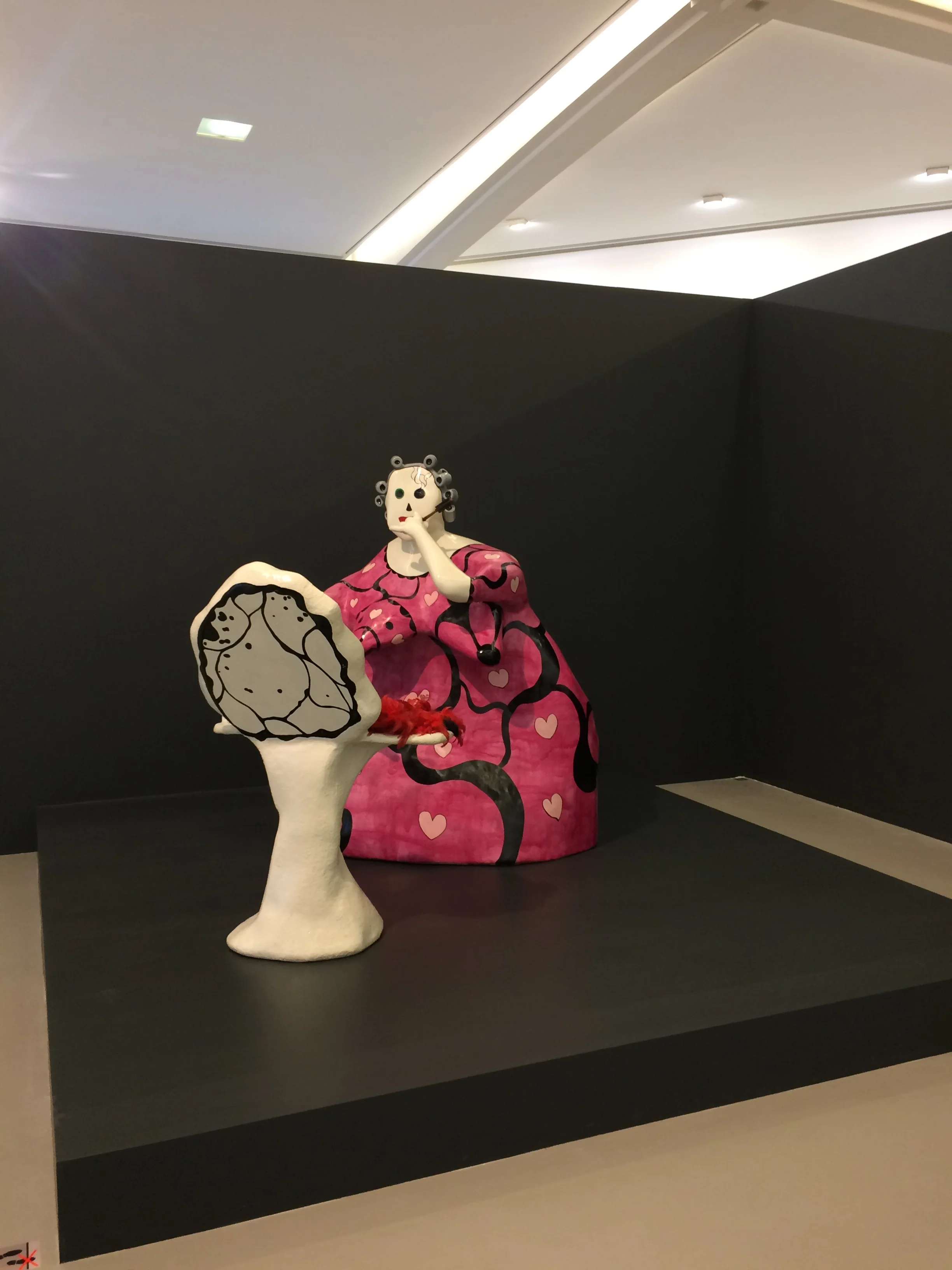
This afternoon we chose to go to the MAMAC, or Museum of Modern and Contemporary Art. The core of the collection for the 21st century came from “European New Realists” Yvette Klein and Nikki de Saint Phalle. The stuff is pretty weird, and a huge change from all the masters we saw in Paris but it is clever and provocative. We also enjoyed the so called “Auto-Destructive Art” of Gustav Metzger, a German living in England, and the street art of “ BEN”, a guy from Nice, who use to have a cutting edge second hand record shop in town that was home to local artists. Outside this museum is also a sculpture park with some crazy stuff. 
 

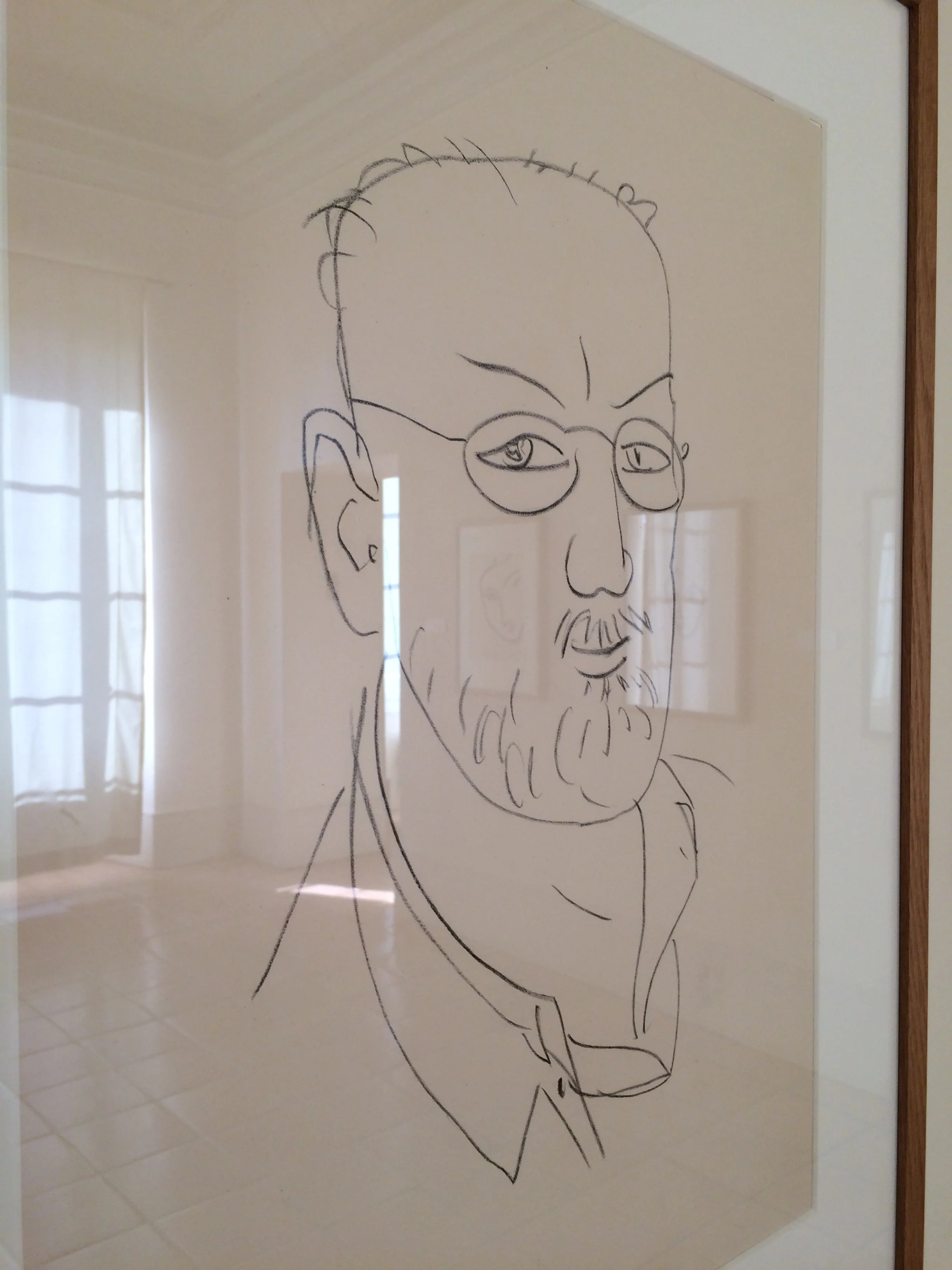
On our third day we visited the Matisse Artist Museum.  Nice has 12 recognized art museums so choices had to be made. This was a leisurely day, we started off late, but the bus trip was quick and took us to the hills north of the seashore. Very nifty housing and a Roman city to boot along the way. This museum is housed in a beautiful Villa and the display demonstrated the growth of Henri Matisse and the changes in his artistic thought over an extended career.  Many sketches of models that became paintings, many style shifts, and many favorite locations for inspiration, such as Tahiti and Nice, where highlighted. The painter was certainly a cool dude, who made fun of himself in numerous self sketches. Check out some photos.

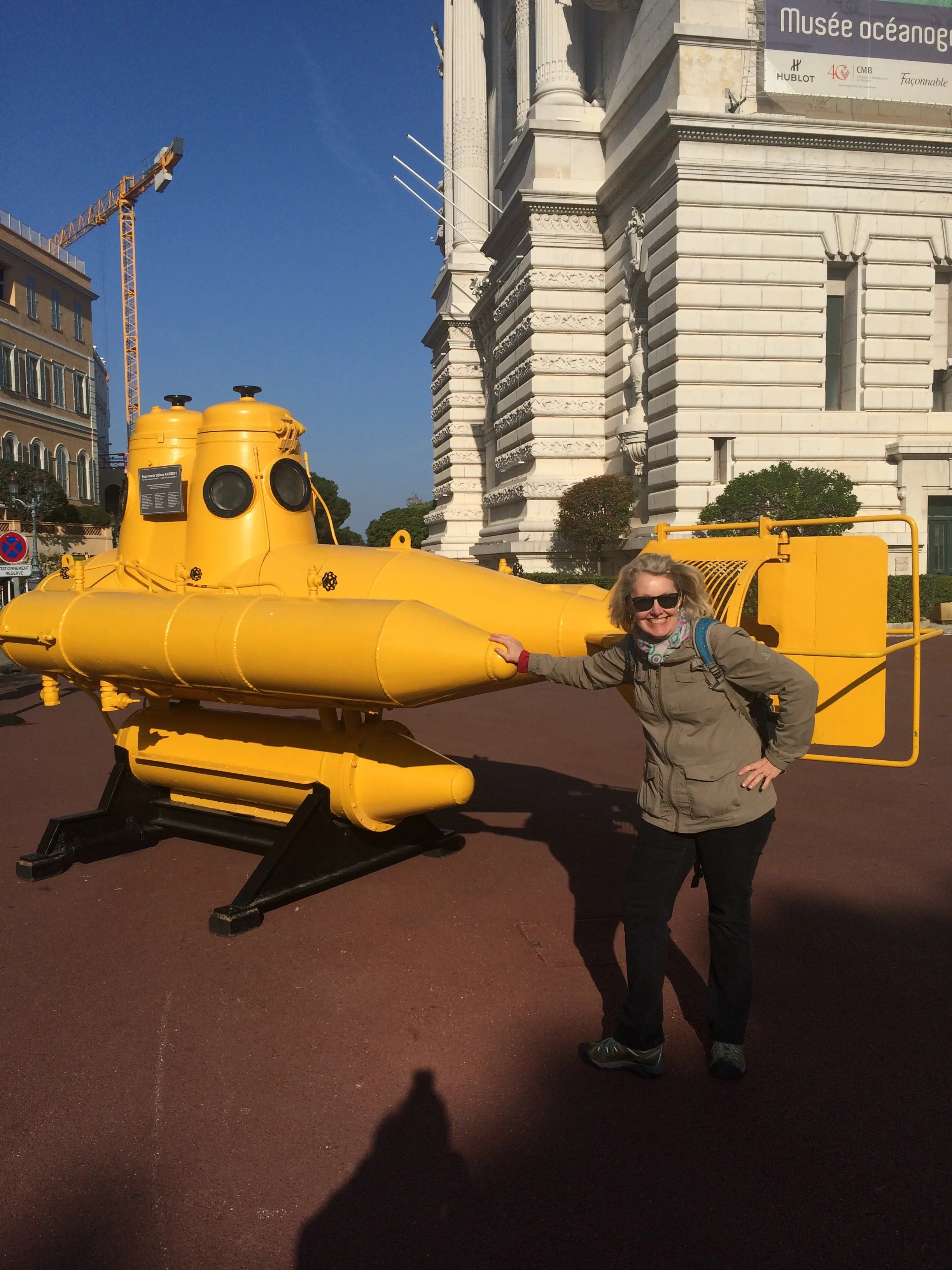
On day 4 we are finally ready to explore the region, back on the bus and off to a day trip to Monaco. The capital is Monte Carlo, the worlds second smallest city is home to 33,000 residents. Monte Carlo’s high rise buildings and gorgeous waterfront with large yachts get your attention, as do the astronomical prices. We however, paid only a buck 50 ($1.50) for bus tickets to this Cinderella land with the million dollar views of sea and villas on the winding shoreline road. We arrived in front of the famous Casino, which is also the Opera House. Everything is pristine the Rolls Royces are spit and polished. The sun was magical so the city and marina glistened. We chose not to enter the Casino but instead walked the beautiful Roman pathway along the shore and cliffs to reach the world renowned Musee Oceanographic de Monaco.


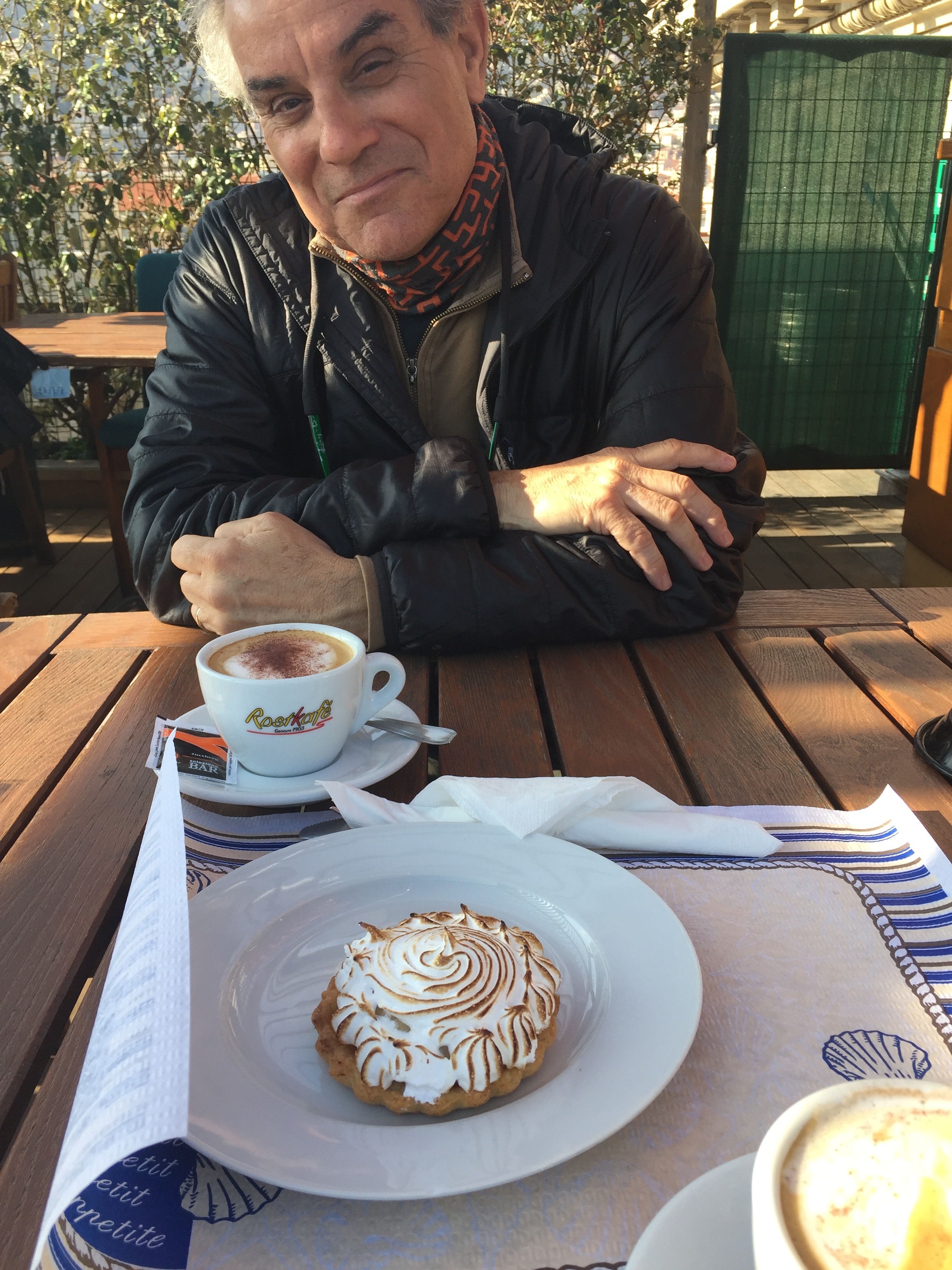
The Museum and its center piece aquarium were run by mariner Jacque Costeau for many decades. The Museum is housed in an elegant baroque styled building and is partially built overhanging the cliffs. The large interior lagoon has sharks, sharks, and sharks, and giant piranhas. The whole set up is great. We visited the rooftop terrace for cappuccino and sweeping views of Monaco and the Mediterranean Sea. Very magical.
Princess Grace's tomb

As we walked back to the bus stop on Garibaldi Blvd., we stopped at the 1875 Monaco Cathedral to check out the mosaics and to view with respect the grave sites of the King and Princess Grace (Kelly). She is an American Oscar winning actress and is the mother of the current King Albert III. 

The bus was packed, so we stood all the way back to Nice. Again, the shoreline view of the shiny sea from the cliff heights was fantastic, one little village and marina after another. The evening was completed with a fantastic home cooked meal and sparkling Rose wine.


Monaco harbor


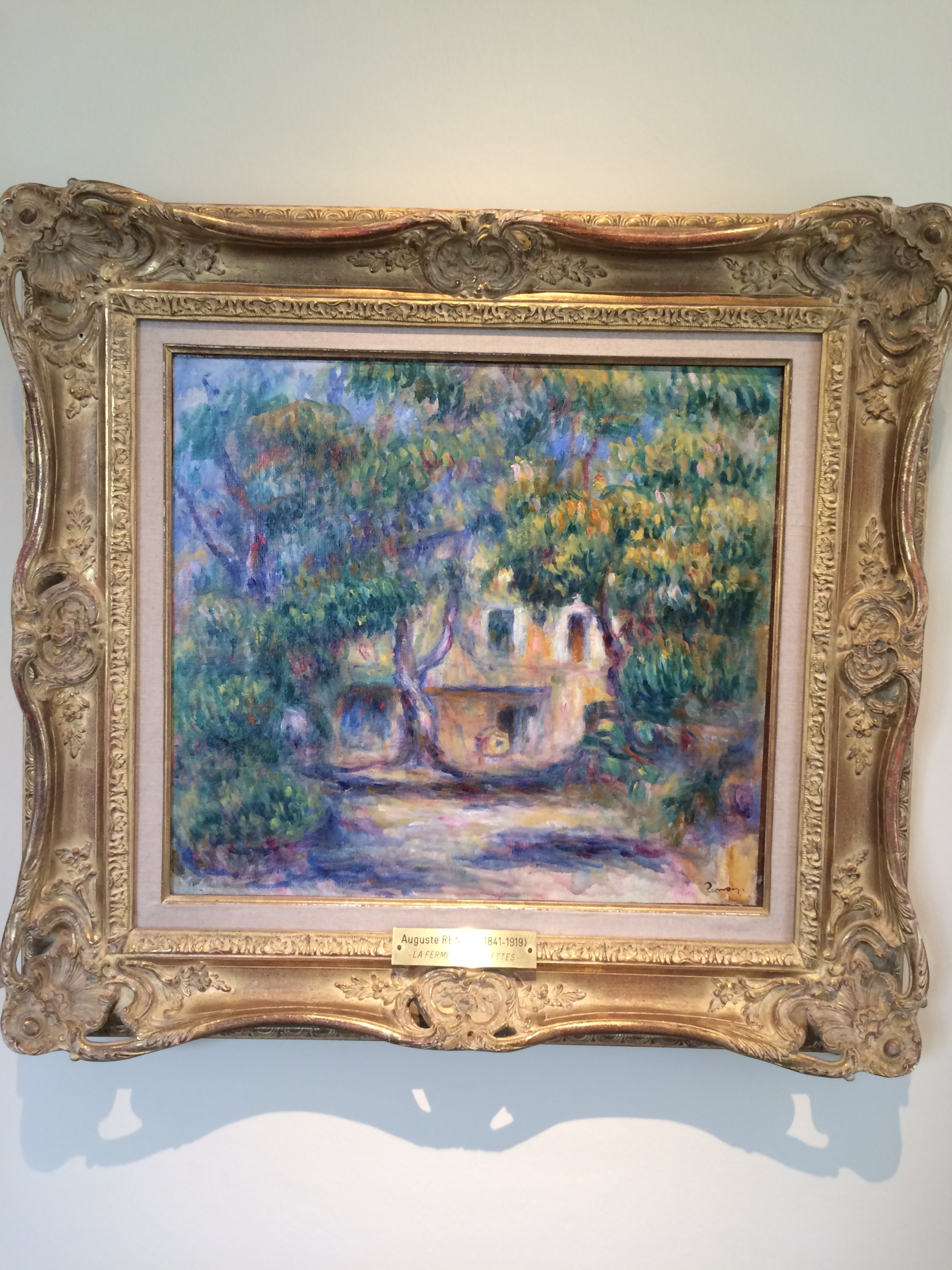
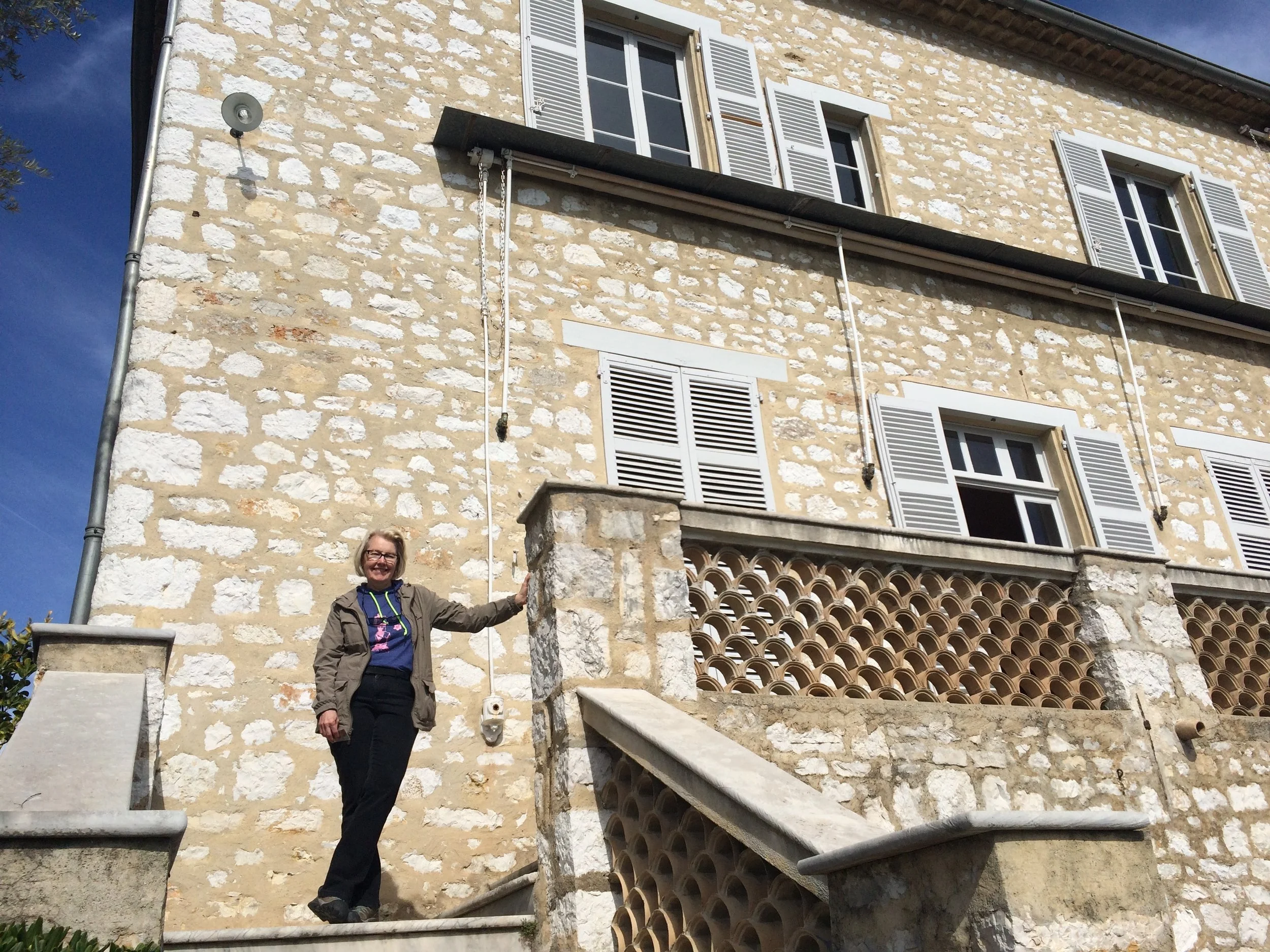
On day 5 we take another day trip. We decided to move west this time for a short jaunt to another shore side town, Cagnes Sur Mer. Another bus, another $1.50. As well as the view of the countryside, we went to see two specific sites. First, we enjoyed the Pierre Renoir homesite and museum. There were duplicate paintings set up outside at the point the artist sat when painting. The before and after of the location was still very similar.

A print of the  painting set at the site


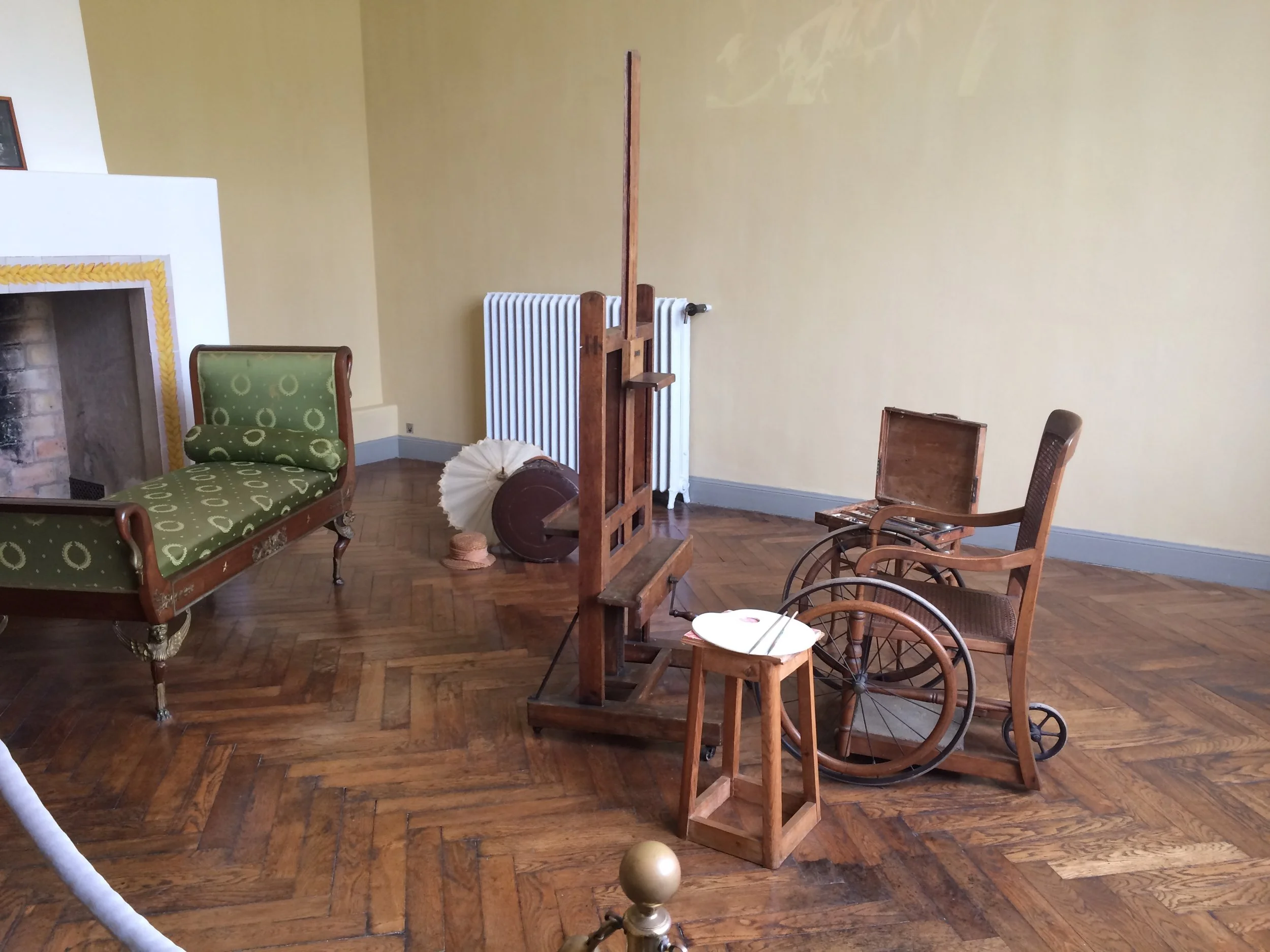
Renoir was born in 1841 and died 1919. He was an “impressionist” in part, but used many styles over his career. He looks like an “artist”. Photos of some of his paintings are provided. Most interesting was how he extended his career even with the infliction of severe arthritis in his hands and legs. The hands where wrapped and his brushes secured so he could continue. He also painted from a wheelchair in later life and his studio was presented with easel and wheelchair.  The overall experience was enjoyable.  Then we walked to town center and picked up the free shuttle to The Haut-De-Cagnes Castle located at the top of the steep hill that overlooks the town. This was first a a small fortress that was updated to a Chateau overtime with painted ceilings and wall tapestry, and an art museum of modern art. The castle also includes the old sub level mill for pressing olive oil. A small ancient neighborhood surrounds the castle, which we could see from the top rooftop turret of the castle. The long distance view of the Mediterranean Sea was also great. Check out some photos.
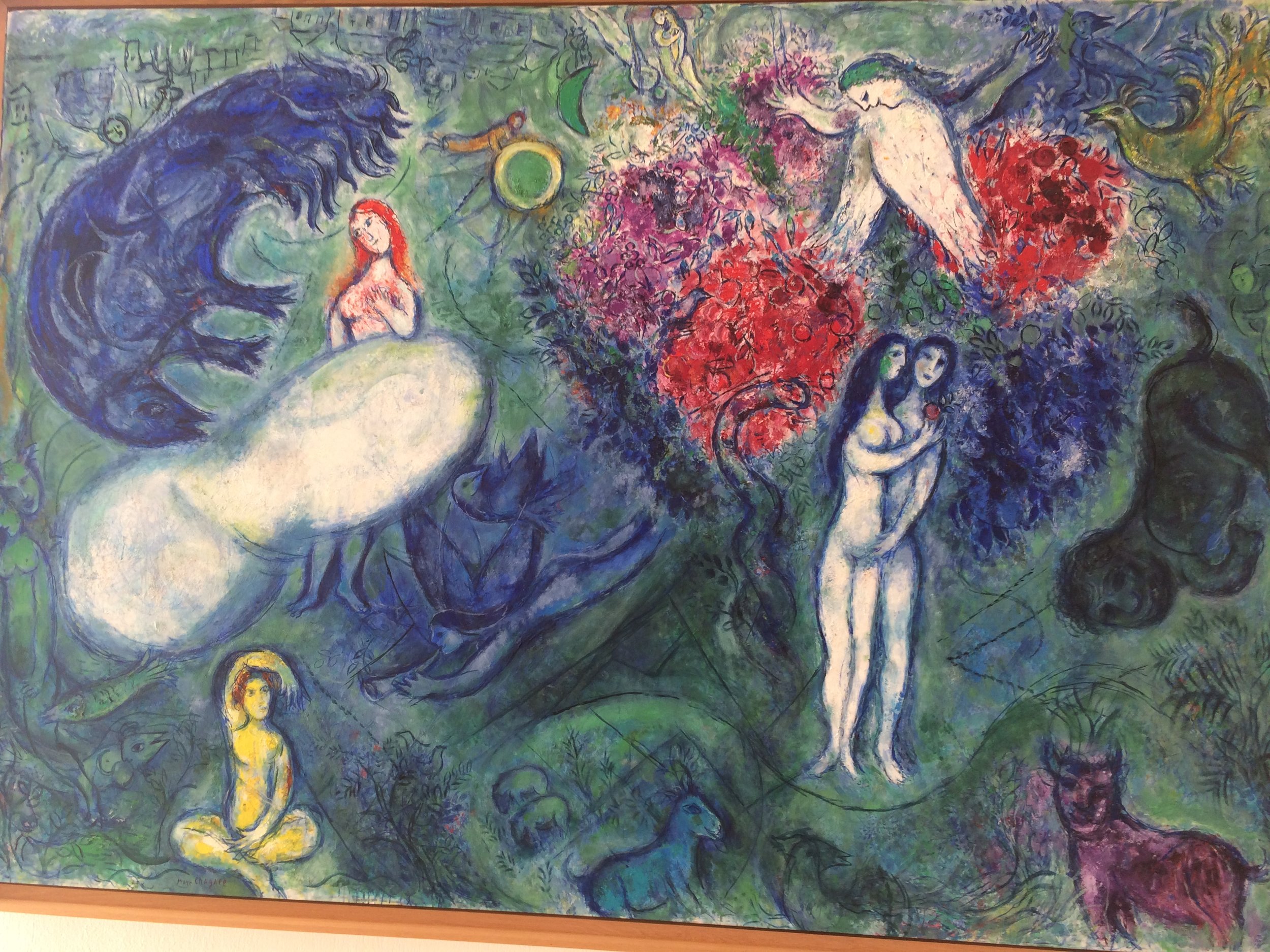
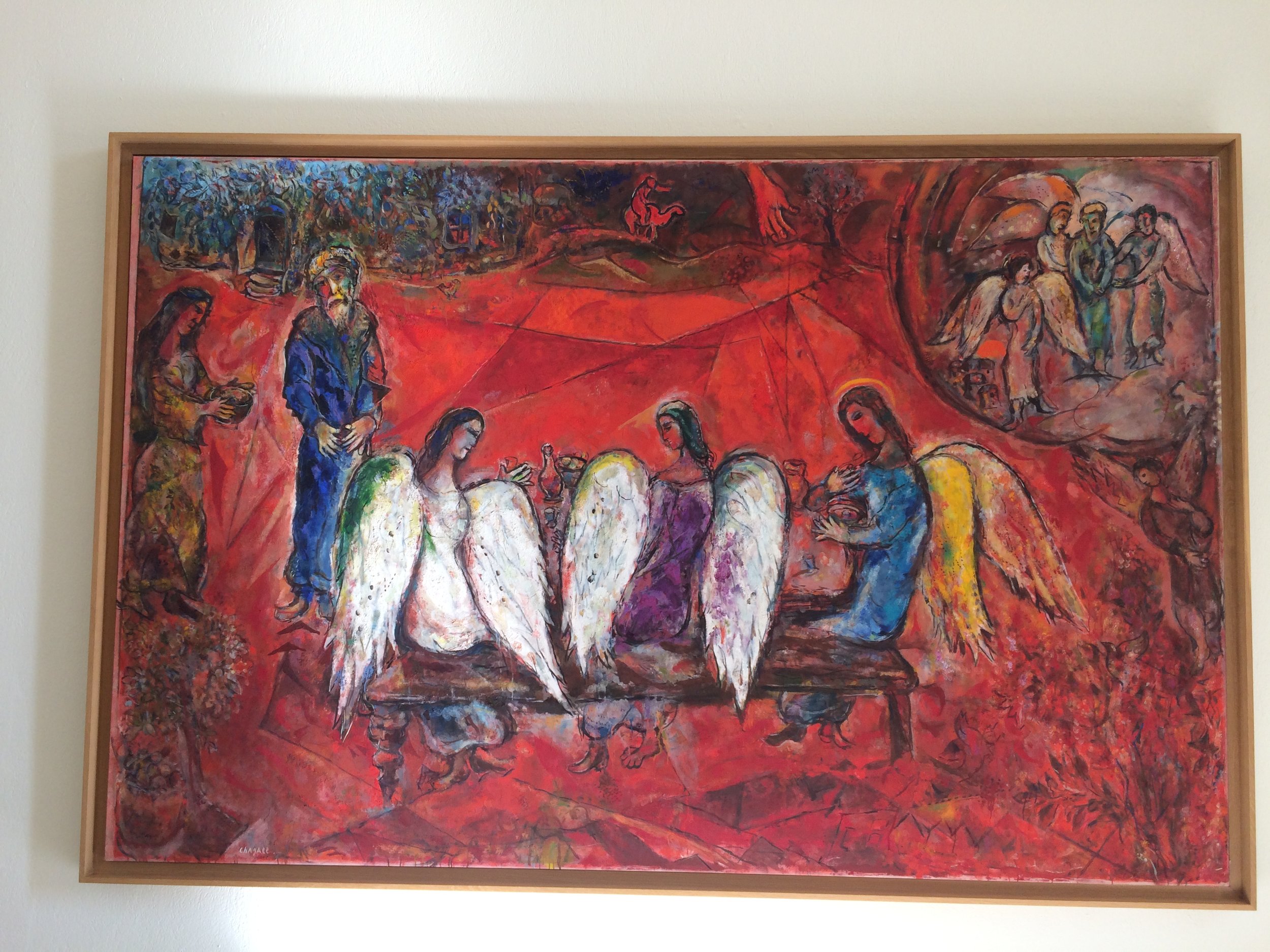
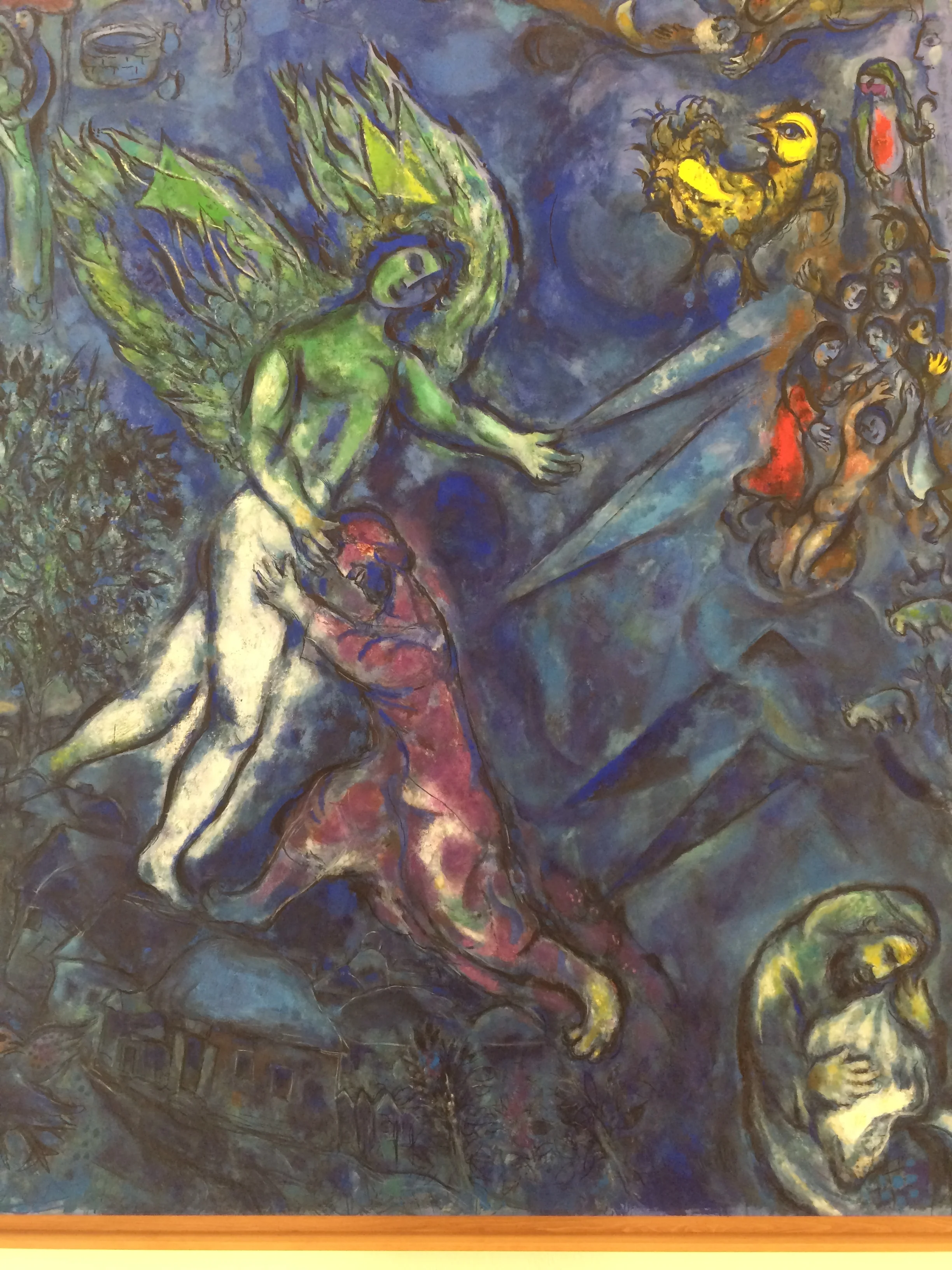
Day 6 and our last day in Nice, and France. and we went to see the Marc Chagall Museum. Chagall is a more contemporary artist than the other artist homes we have seen. This particular exhibit displays really large canvases presenting a biblical theme of the Old Testament in a modern format. These paintings where striking. With the help of an audio guide the complexity and creativity of the artist’s works were explained. This was a very enjoyable outing. Check out some examples of this work
We jumped on the local bus and made it back to out flat by noon. We know this because the city fires a cannon shot at noon everyday. We grabbed some towels and a backpack of snacks and headed down to the waterfront to sun on the beach. After shucking off our shoes and socks and rolling up our pant legs we absorbed the sun rays and sea breeze. It is said that in high season every square foot of the beach is filled with blankets and people. We had a lot more room to stretch out and watched the limited activity on the beach and seashore. Nice really is a great town and the sea and weather add to the charm.


Nice has been a great visit, it is also the 6 month mark on our trip.  We needed the sun, the down time and rest after how quickly we have traveled since entering Europe in December.  Tomorrow we fly to Rome, Italy and will be joined by our son and his girlfriend.  We really enjoyed France, but we cannot wait for time with family, more sun, pizza, and gelato


Normandy and the Loire Valley

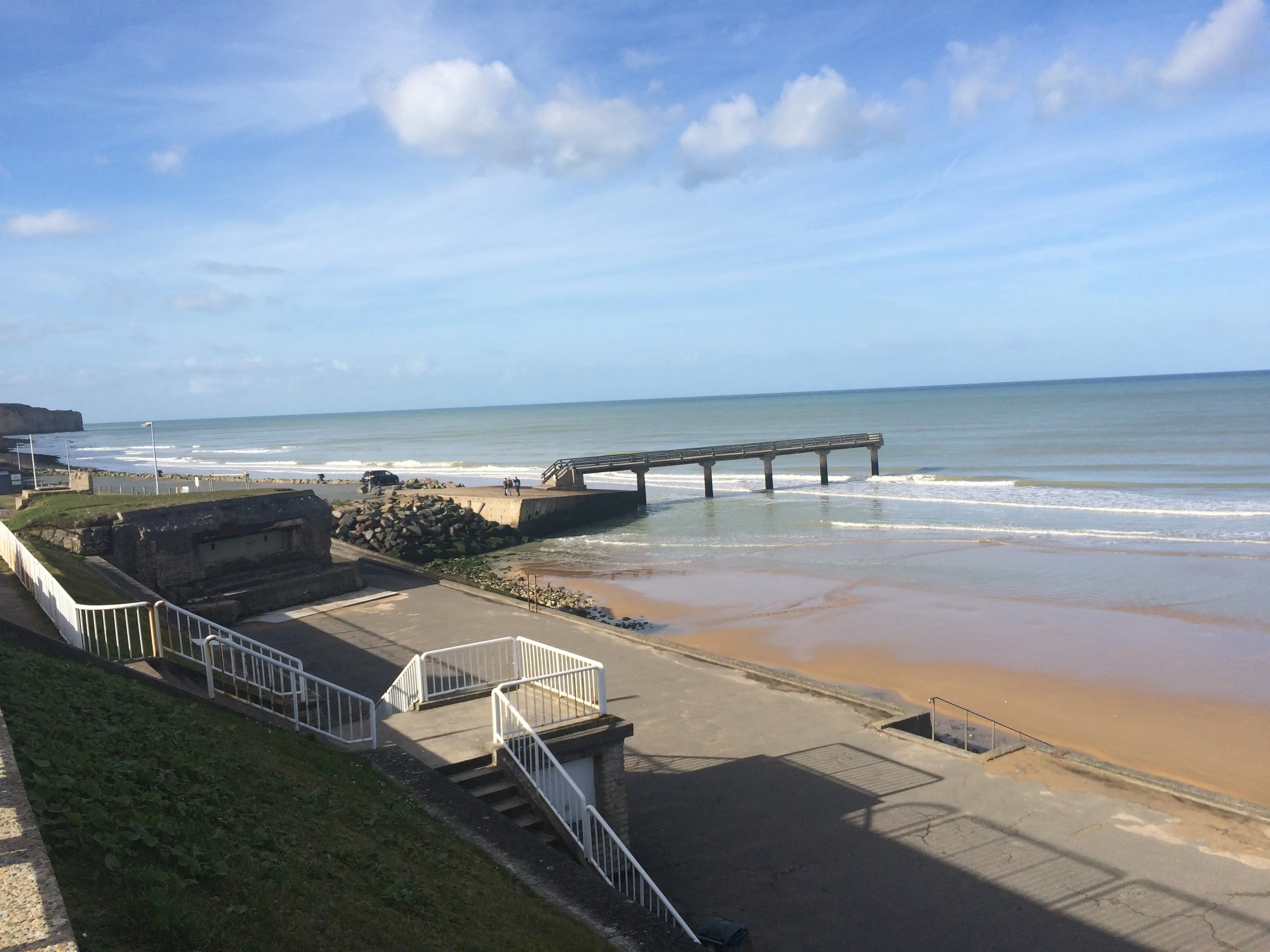
Utah beach, the holes are from the bombing

Bayeux France

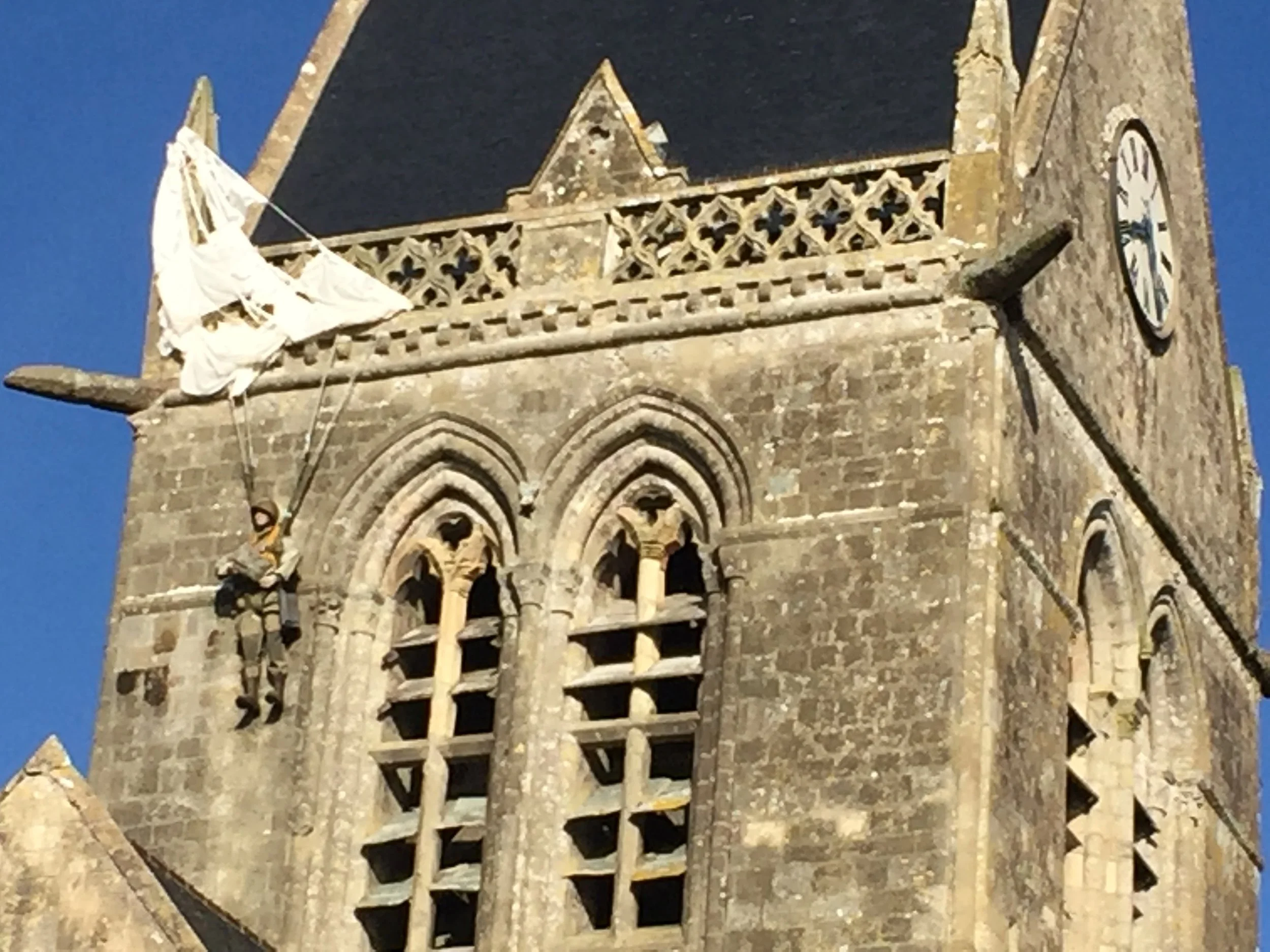
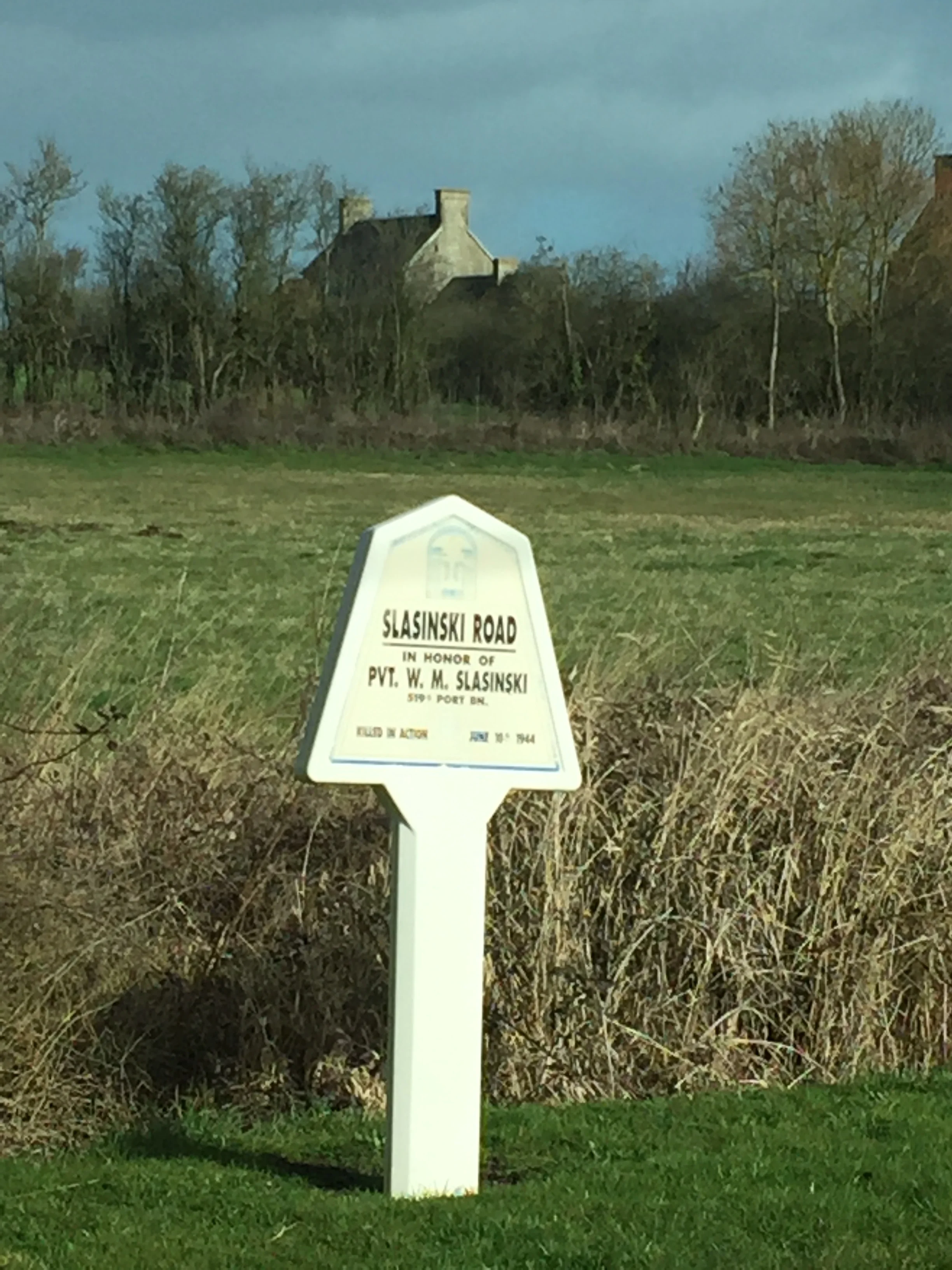
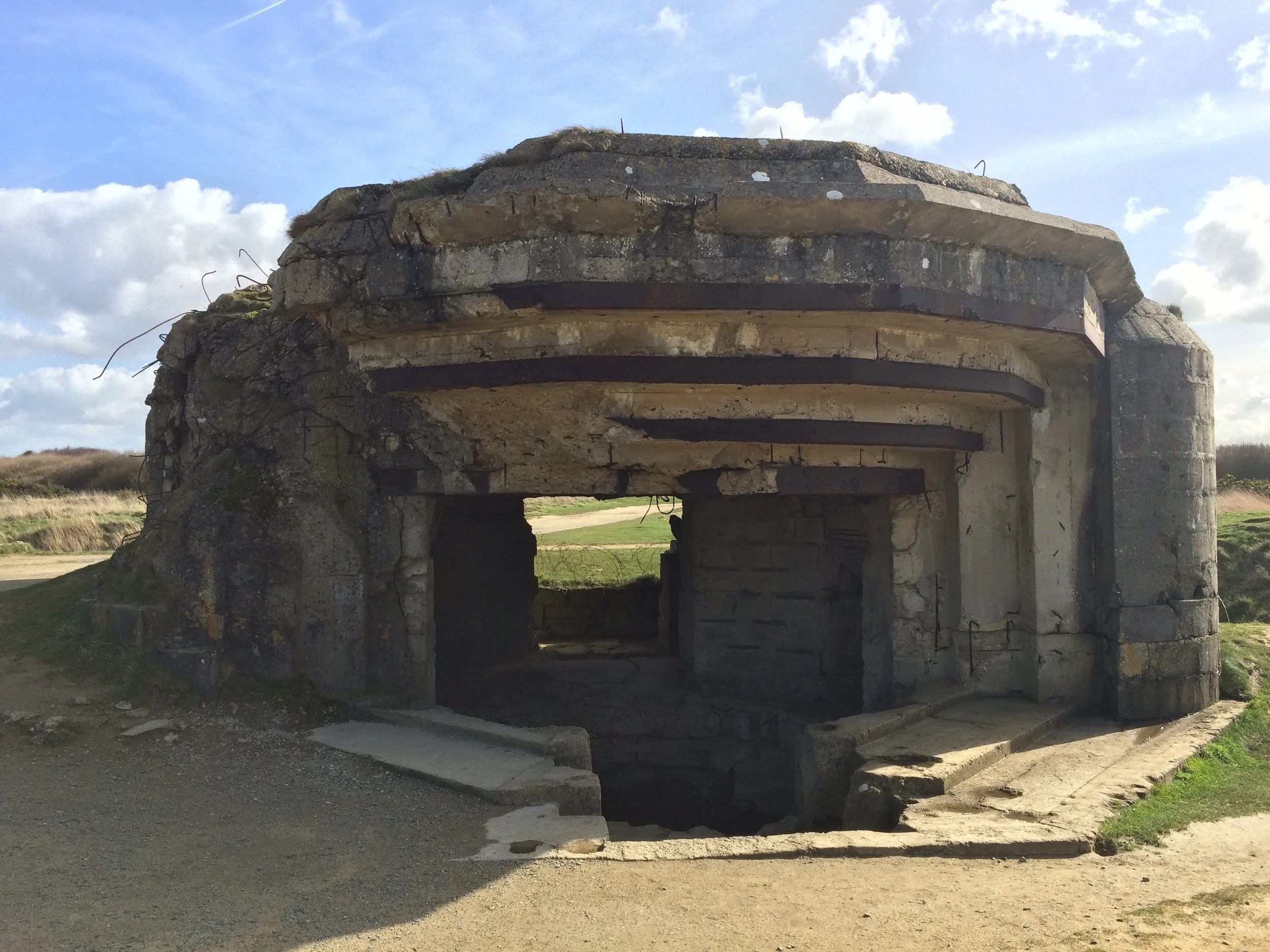
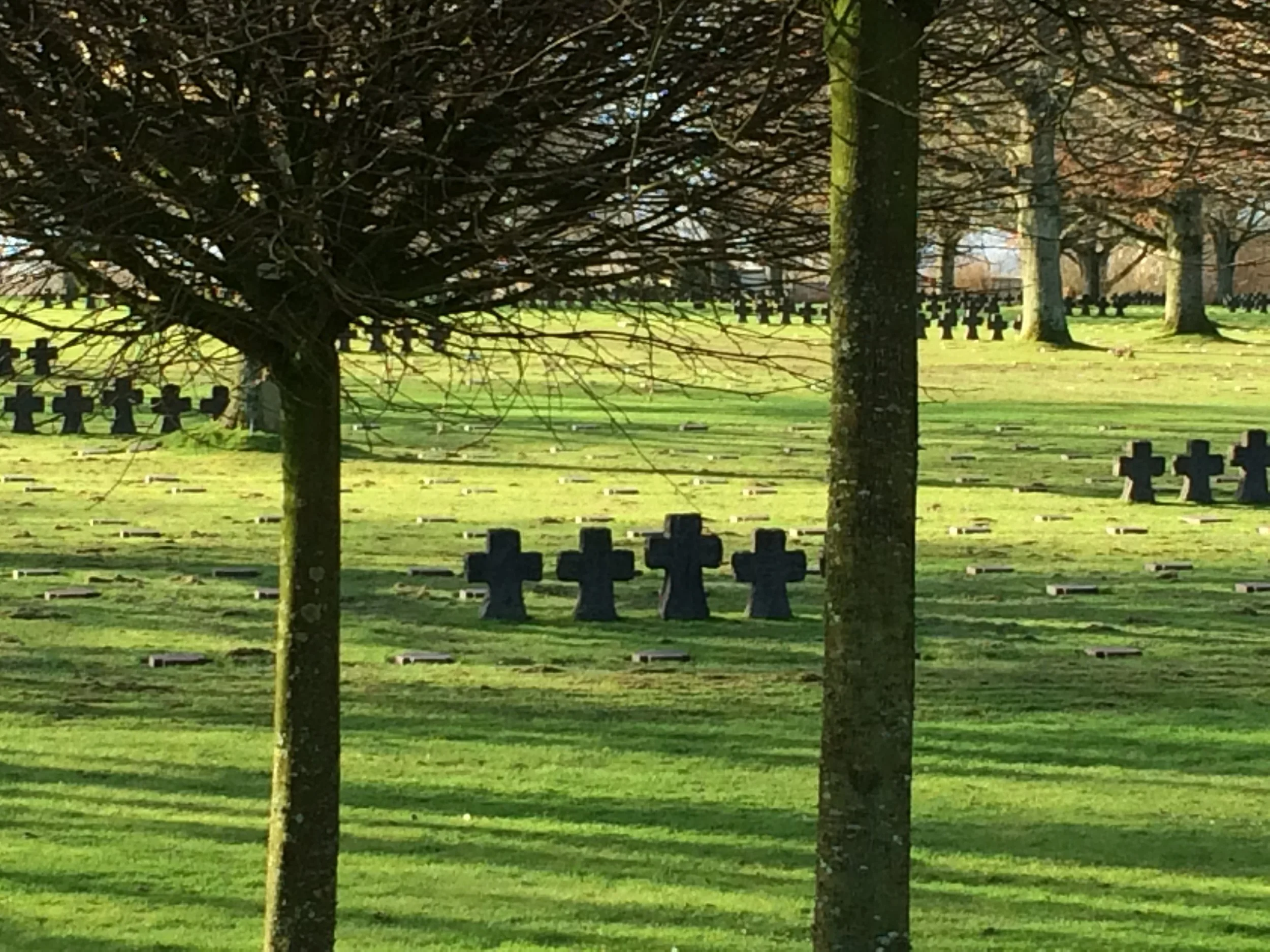
There are numerous cities you may choose to stay if interested in the WWII battlefields. We chose Bayeux, Pop. 14,400, that sits within 80 KM south from the farthest Normandy beaches code named Utah, Omaha, Gold, Juno and Sword; the site of the D-Day landings that ultimately led to the liberation of Europe from Nazi occupation. The most brutal fighting on D-Day took place just 15 KM northwest of Bayeux along the coastline known as Omaha Beach, re-enacted in “Saving Private Ryan”.  We toured the waterfront and beaches, and walked through bunkers. Then we toured the various towns inland where the paratroopers dropped, including the massacre site at the town of Ste. Mere Elise, German and American cemeteries near Bayeux and then other pertinent sites. These excursions were thought provoking, inspirational, patriotic, but also brought upon much sadness.


Our tour started at 8:00. We were joined by only one other traveler. He was a Big 10 college student from Wisconsin who had really studied the history of WWll. Coincidently, his Grand Dad and my Dad were both Naval aviators in the Pacific theater and both flew PBY “Catalina” sea planes.

Our guide was very knowledgeable and offered a nice presentation. We went to many sites and were provided anecdotal information. For “Band of Brother” fans, we walked near the fence line where the 4 big German guns where hidden in the hedgerow.  We were with our guide all day and ended the day at the US Military Cemetery situated by the shore as the sun set. It is an overwhelming experience. 

Frank at the American cemetery memorial

The town of Bayeux had been miraculously saved from the ravage of war. The Nazis left to defend Caen, a bigger city with a railroad hub, so the allies just passed through. Its narrow streets are bordered by original row houses with cute shops, one after another, hotels and restaurants, a gem of a historic museum, and a Norman Gothic Cathedral. This is a great little town.

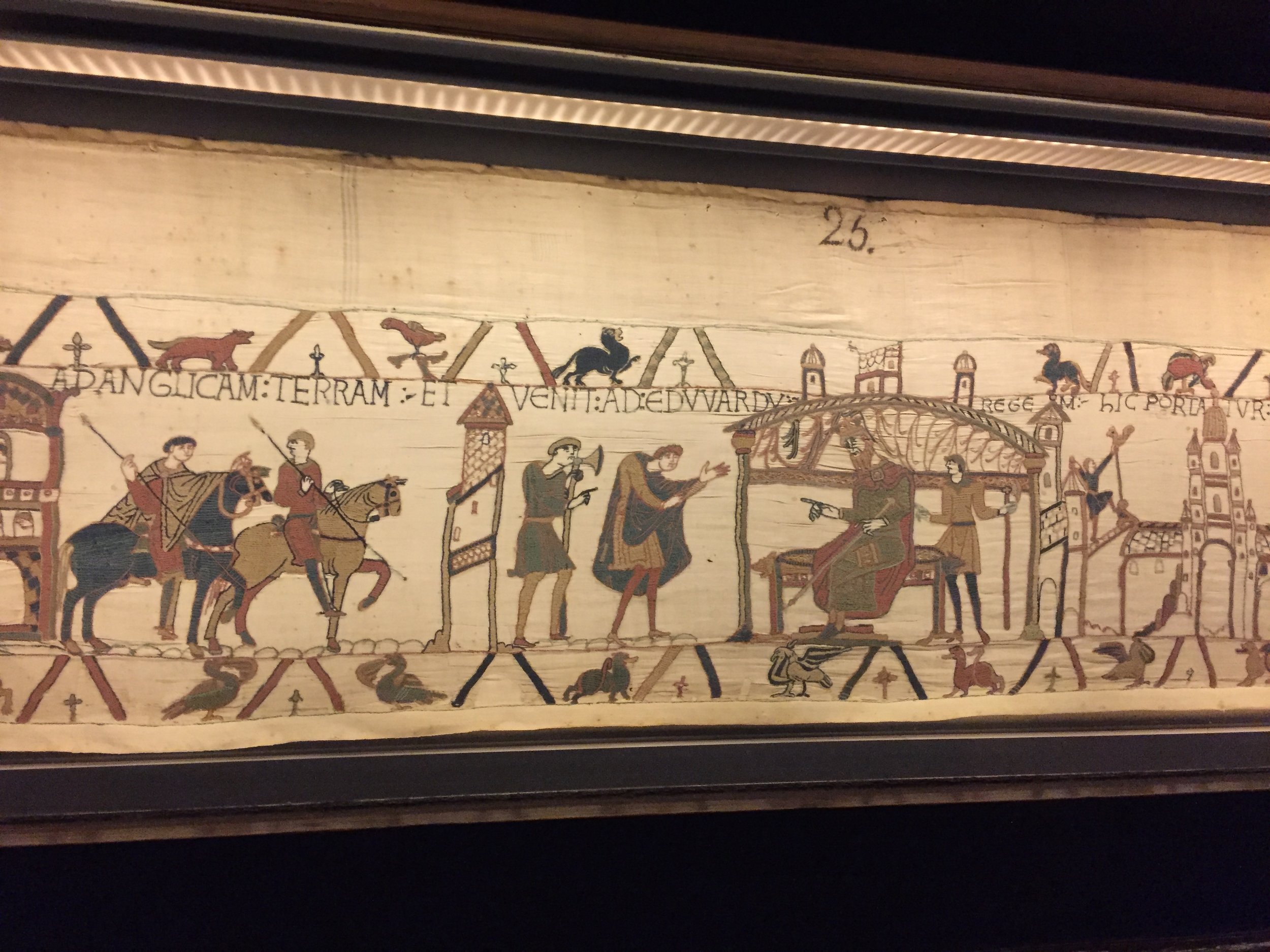
Bayeux first became famous from the 11th-century tapestry embroidered to tell the story of the Norman invasion of England in 1066. The Brits know this as the Battle of Hastings, where

Dinner with new friends

William the Conquerer, from Normandy, defeated the interloper King Harold, took control of England, and changed the line of succession of future Kings. There are 58 graphic scenes in this 50 meter tapestry that we were surprised was so interesting. It has been described as the first comic strip in history.

We were also lucky to meet a charming American couple from Virginia. We really hit it off and had dinner together after we toured the Bayeux Military Museum; the museum displayed key information and photos about the invasion as well as a lot of equipment, tanks, and guns. The museum was a good preamble to our tour of the actual battle sites. As well, that night we downloaded the 1960’s film “The Longest Day” about D-day as a brush up on key events.


Mont St. Michel

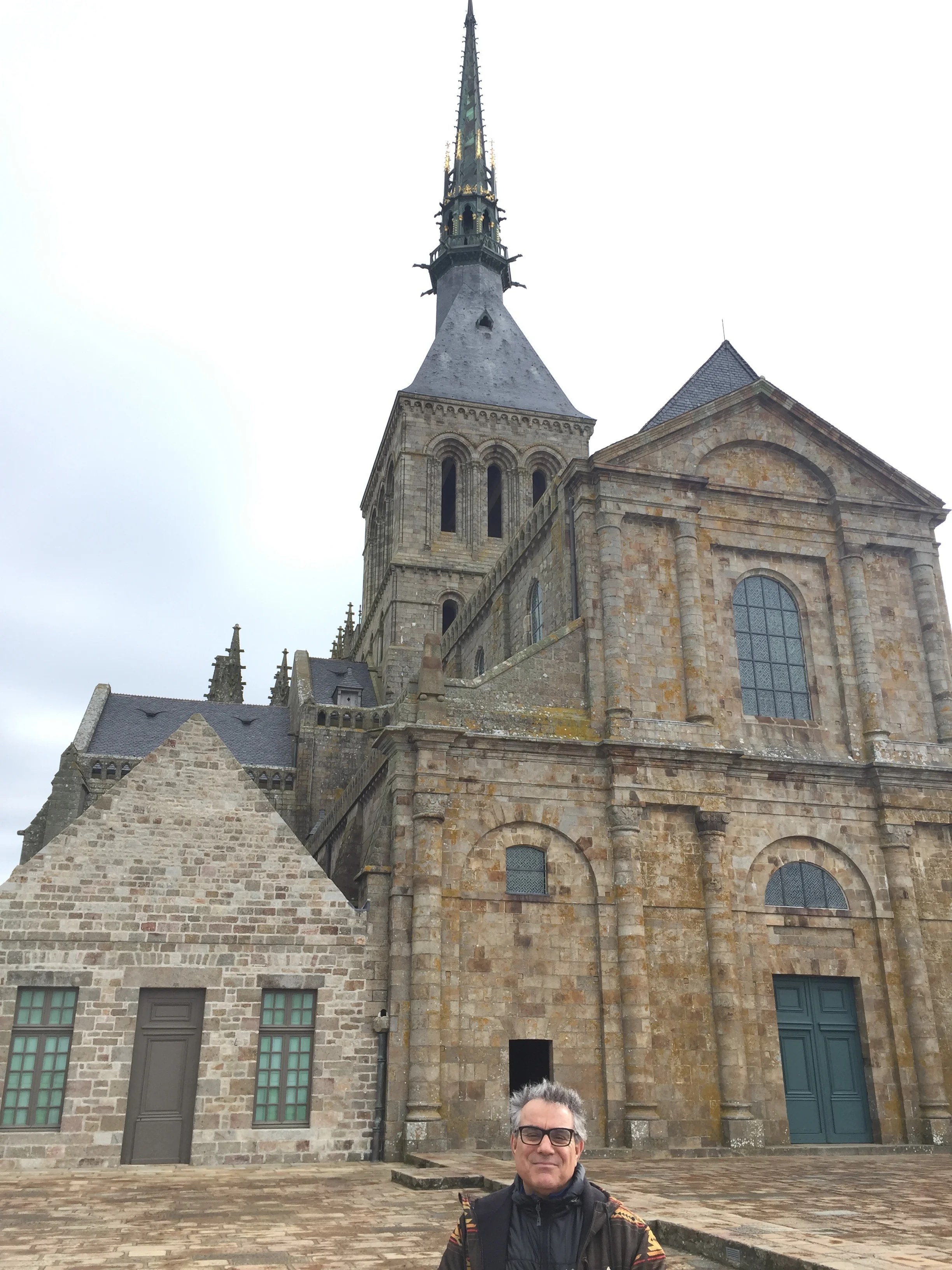
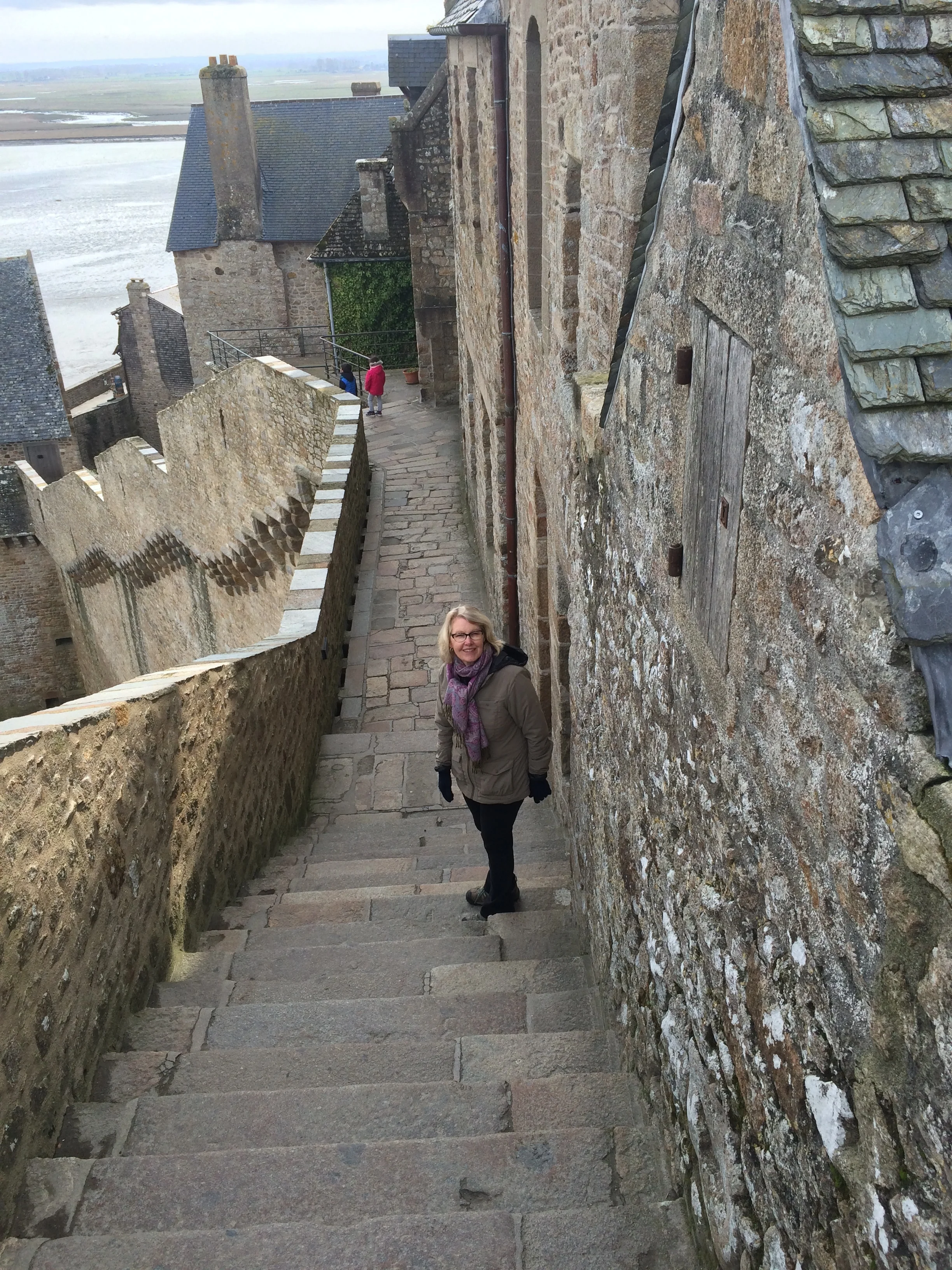
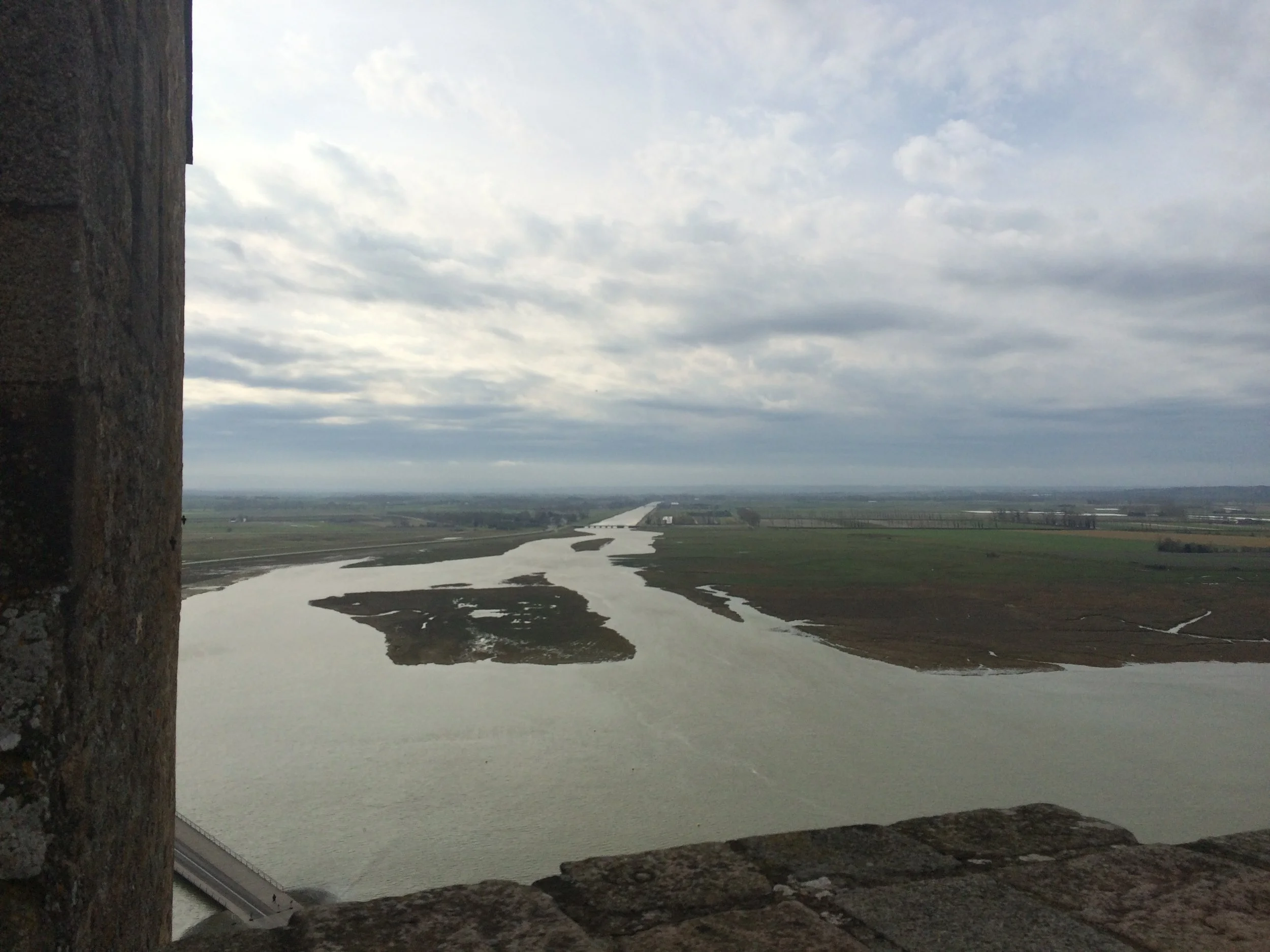
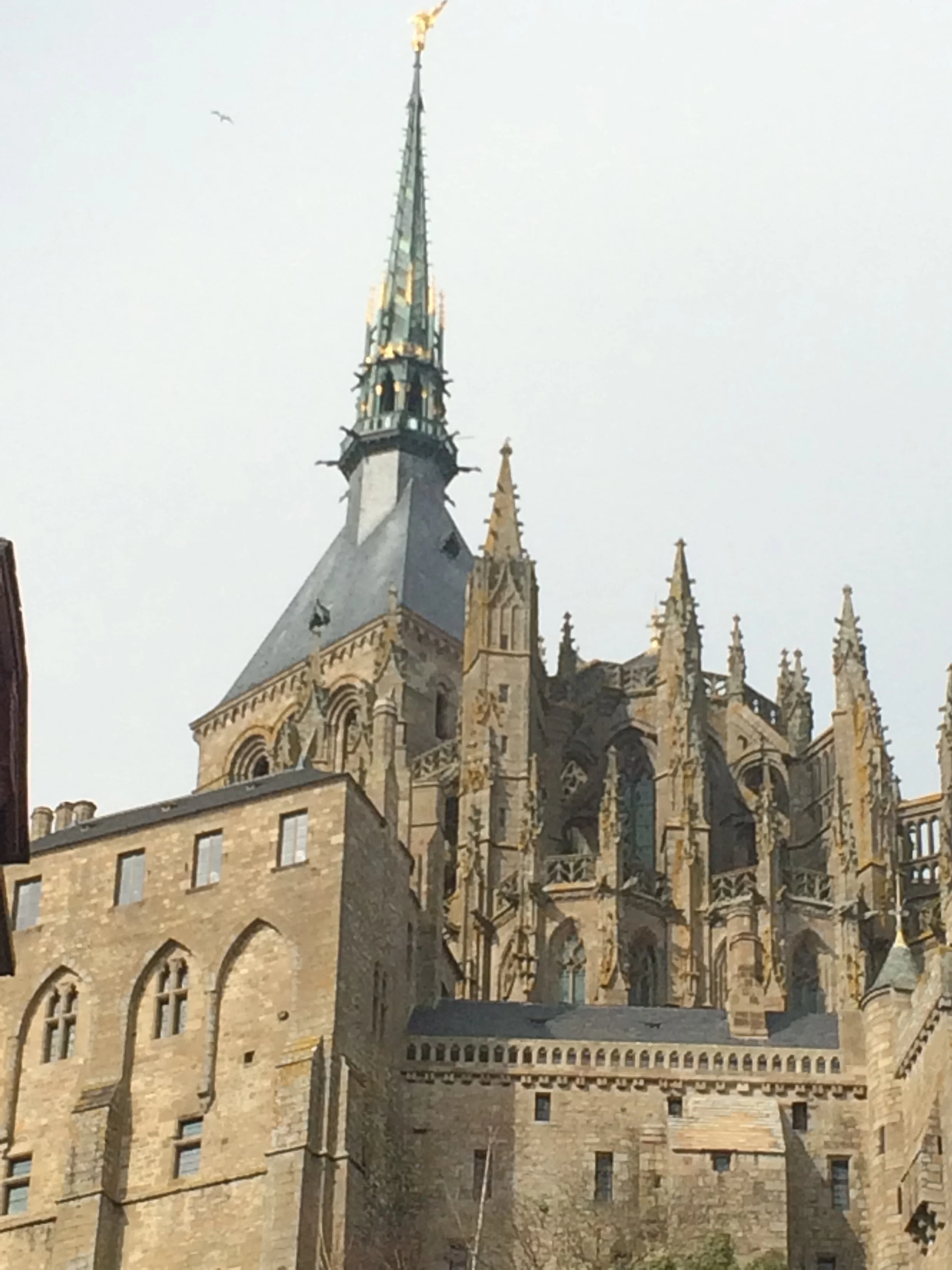
The next day we left the beach area and toured the magnificent Mont St. Michel, an abbey fortress built on a rock island in the middle of the bay. The construction was allegedly demanded 3 times by the Arch Angel St. Michel who in exasperation poked a hole in the Bishop’s forehead to make his point. Isn't there an American saying “I need an excuse like I need a hole in my head”?  Historically, visitors and/or attackers could only reach the Mont during low tide, when surrounded by bare sand and bogs for miles around. However, the bay is notorious for fast raising tides that swallow and drown all visitors. Now there is a single causeway for easier access.

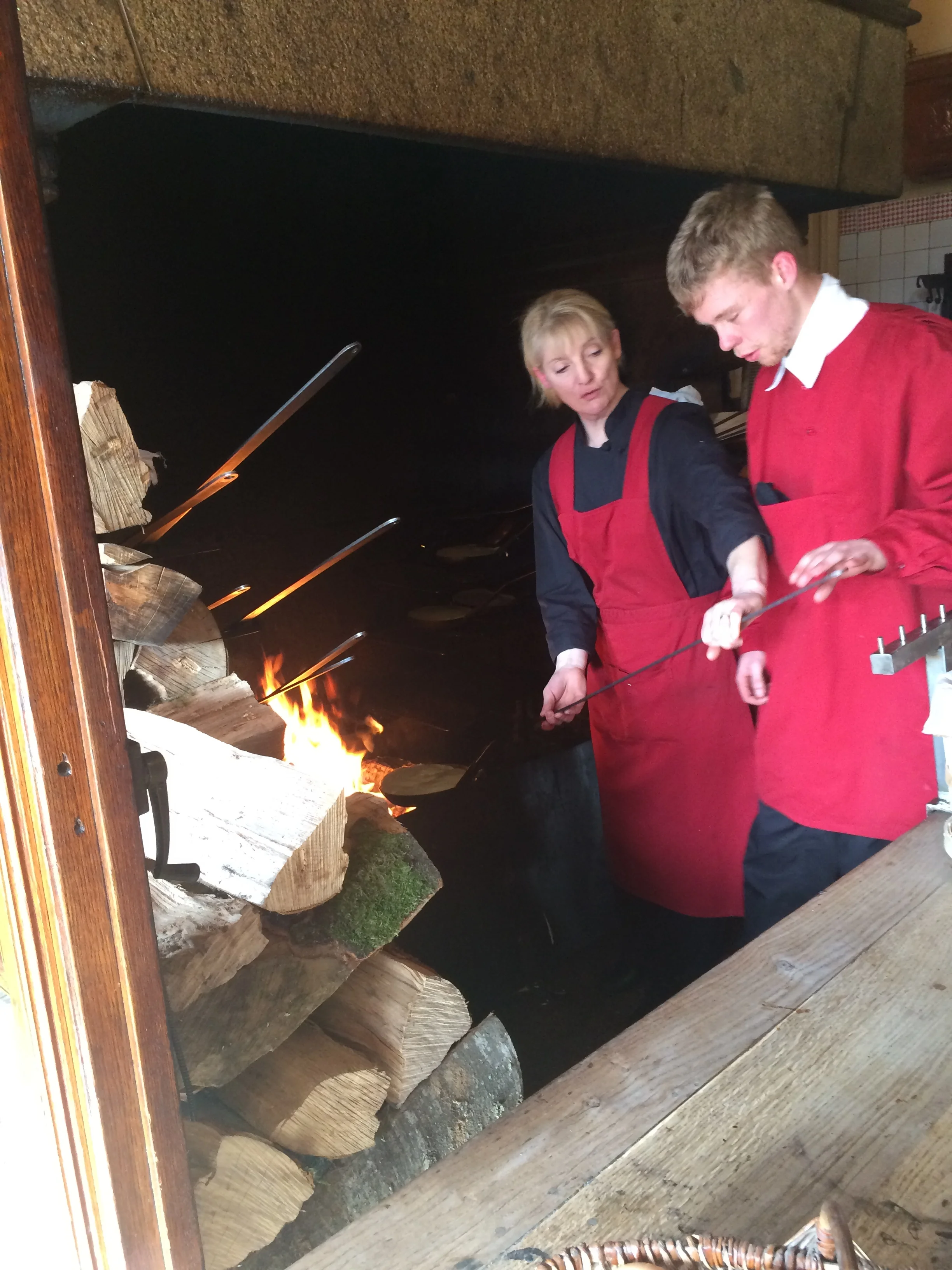
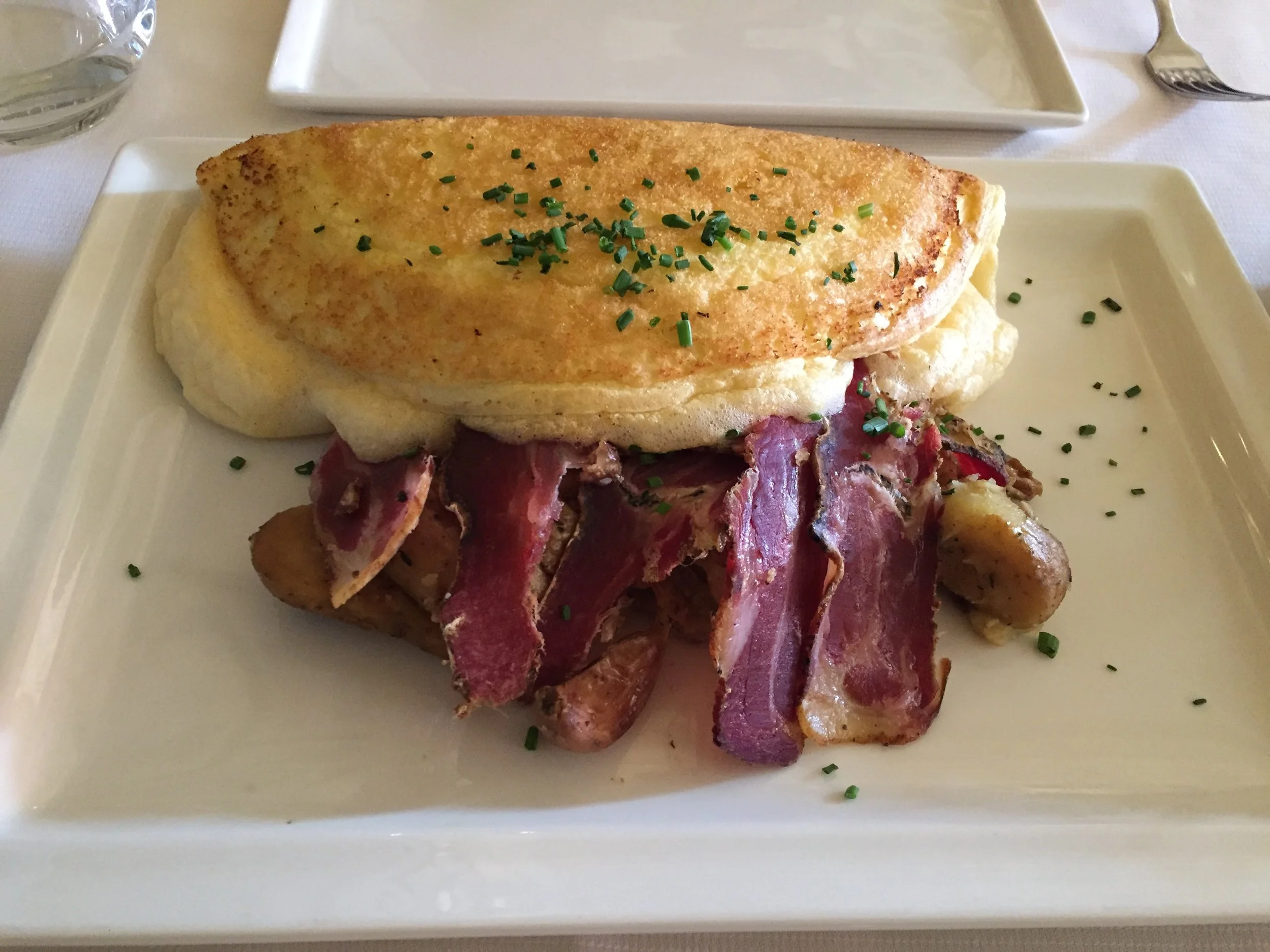
You are just mesmerized as you drive up to the sight of this towering structure with its sky scrapping turrets. Over the centuries the monastery has been rebuilt, one church over another, and expanded.  There is also a small village at the base of the island below the monastery with its own small church, residences and restaurants.  We treated ourselves to lunch at the famous “La Mere Poulard”restaurant that specializes in world renowned soufflés omelets 5 inches thick cooked over an open fire in copper pans and stuffed with any delicious thing you would want. There is a musical cadence in whipping the eggs that you can hear and see as you enter the restaurant. With a glass of Rose’ wine and décor of signed celebrity photos the place is the best. 

We caught the tram to our transport pickup spot, after finding the tram stop with the help of some young American gals from California on holiday. It has been nice to interact with some Americans lately; there is an instant bond. When we got back to Bayeux we spent the last part of the afternoon visiting the city’s historic museum, a real gem, and the Cathedral as we walked to the hotel. That night we packed for our trip to the Loire Valley, the place where nobles established their country getaways.

Breakfast at the Anne Bretagne Hotel

Loire Valley

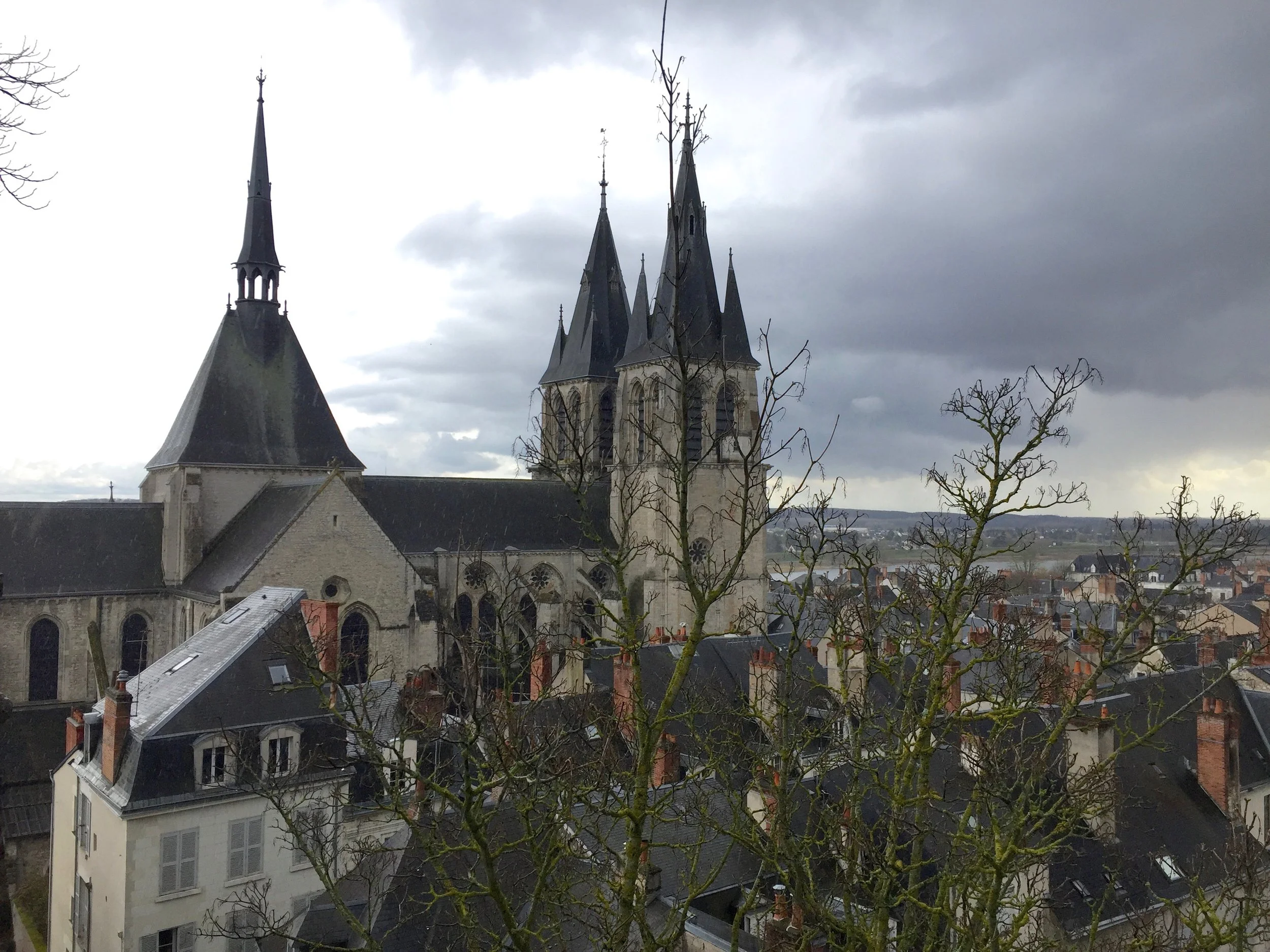
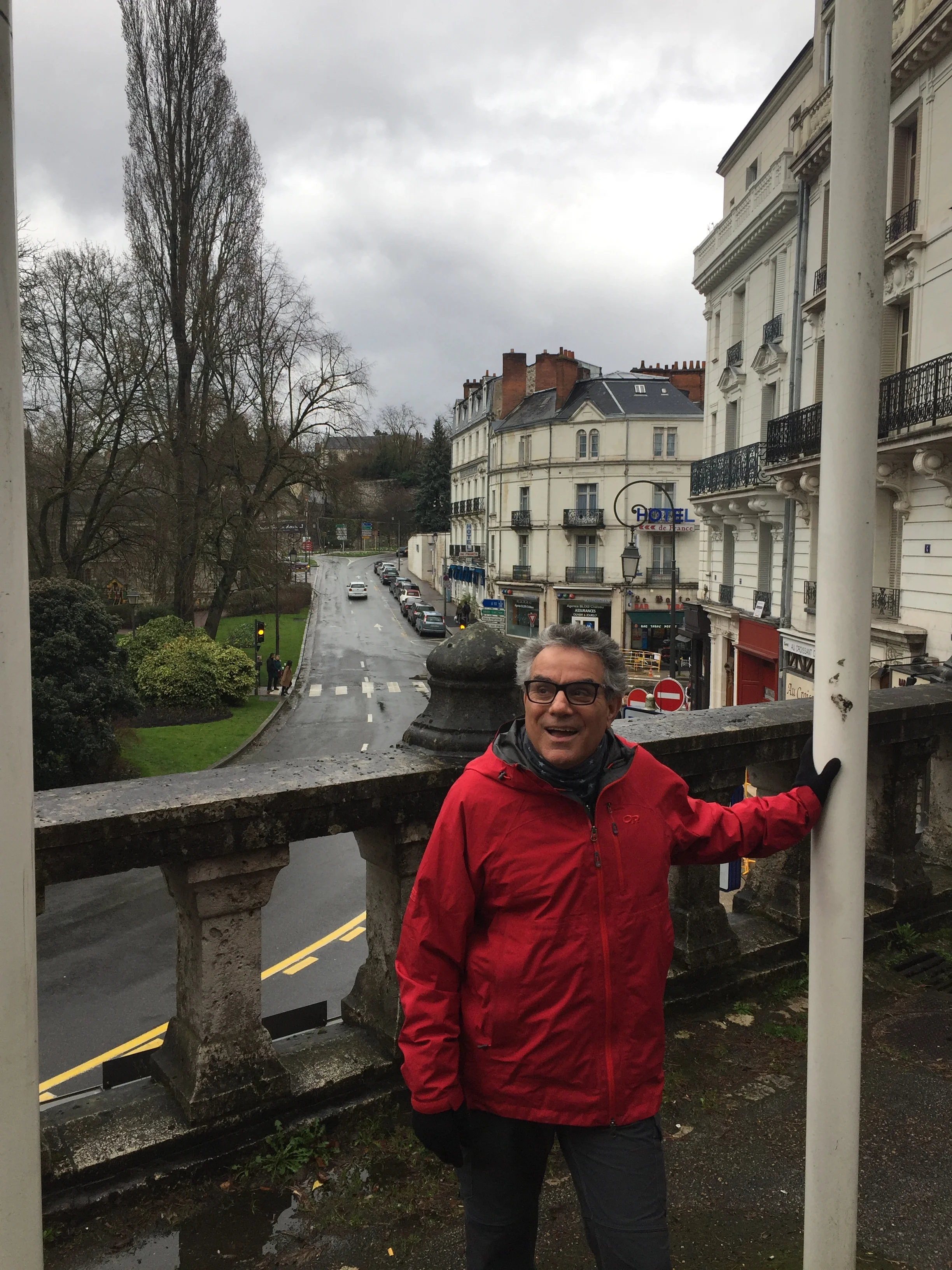
We got up really early and walked through the town to the train station. We had to catch the earlier train traveling to the cities of Caen, then Tours, and then finally Blois, a town of 40,000 pop., where we stayed at a really cute hotel called the “Anne Bretagne”, on the 3rd floor with a view of the Chateau Royal de Blois. The hostess was particularly friendly and we would certainly recommend staying there.


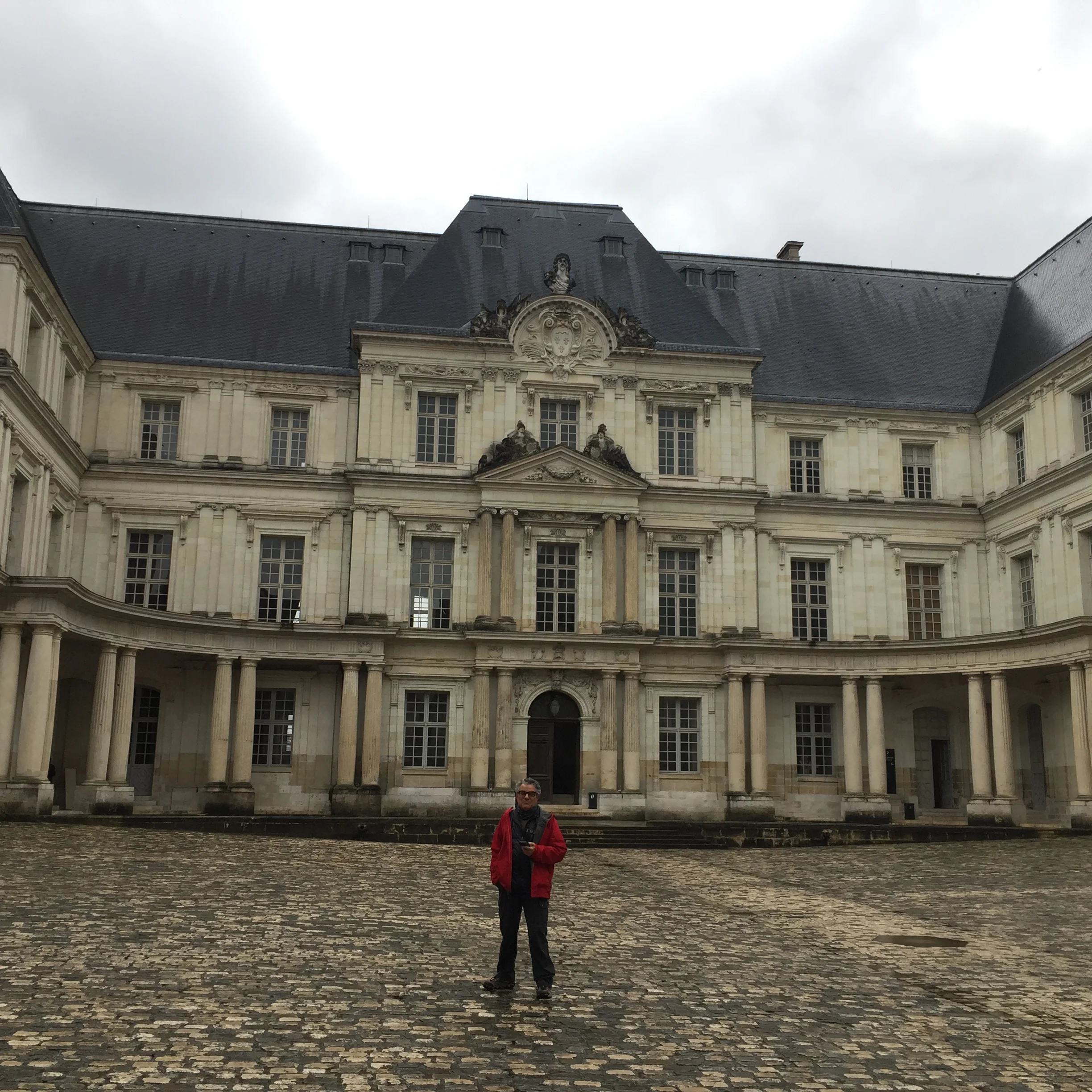
The Chateau Royal de Blois was the feudal seat of the powerful counts of Blois. This is the first of the summer Chateaus we will see that are said to have the most extravagant architecture out side of Versailles. Here, the 4 grand halls were built in stages between 13th and 18th centuries by various Royals that leads to a merger of the architectural styles of Gothic, Renaissance , and Classical in the great halls and residences that are plushly decorated and harken back to their extravagant living style.

The next day, our hostess helped secure transfers to two other phenomenal Chateau. The first transfer was to Chateau de Chambord, initially constructed by King Francis I at the dawn of the French Renaissance it was an affirmation of his royal power. The Chateau is massive and impressive. The central grand double helix spiral staircase is a key architectural feature which some have attributed to Leonardo Da Vinci who lived nearby for 3 years until his death. All floors are connected by this twisting stairway. As well, the royal apartments of the first floor are plushly decorated, it took about 100 years later when the Sun King Louis XIV made his mark, and the second floor keeps have impressive barrel vault coffered ceilings with Francis’ trademark of “Salamander”  carvings. There is an Italian influencedrooftop terrace with cupolas, domes, and chimneys where the royal court assembled to watch military exercises and returning hunting parties. We too looked out over the grand vista of the garden from this vantage point.

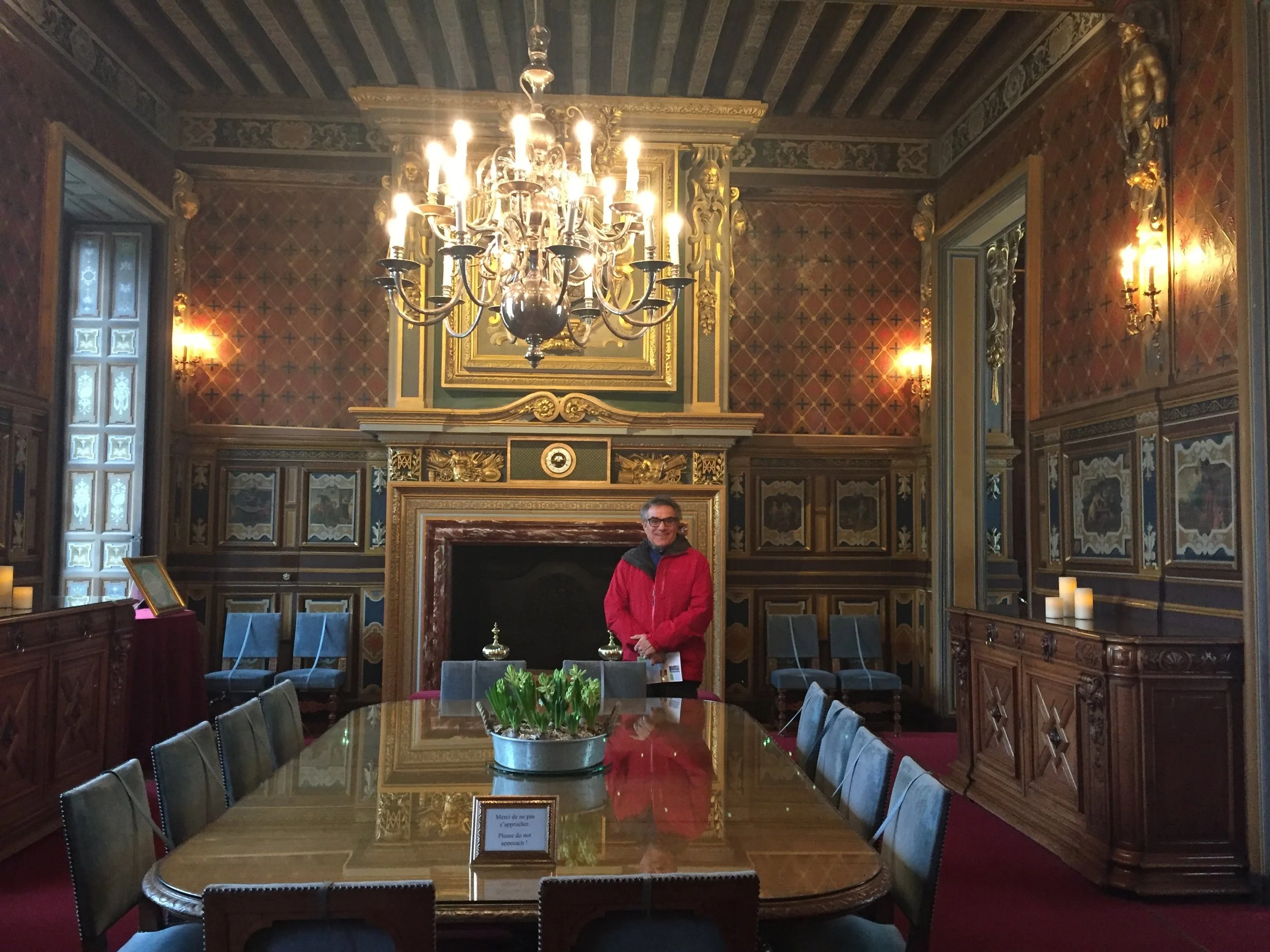
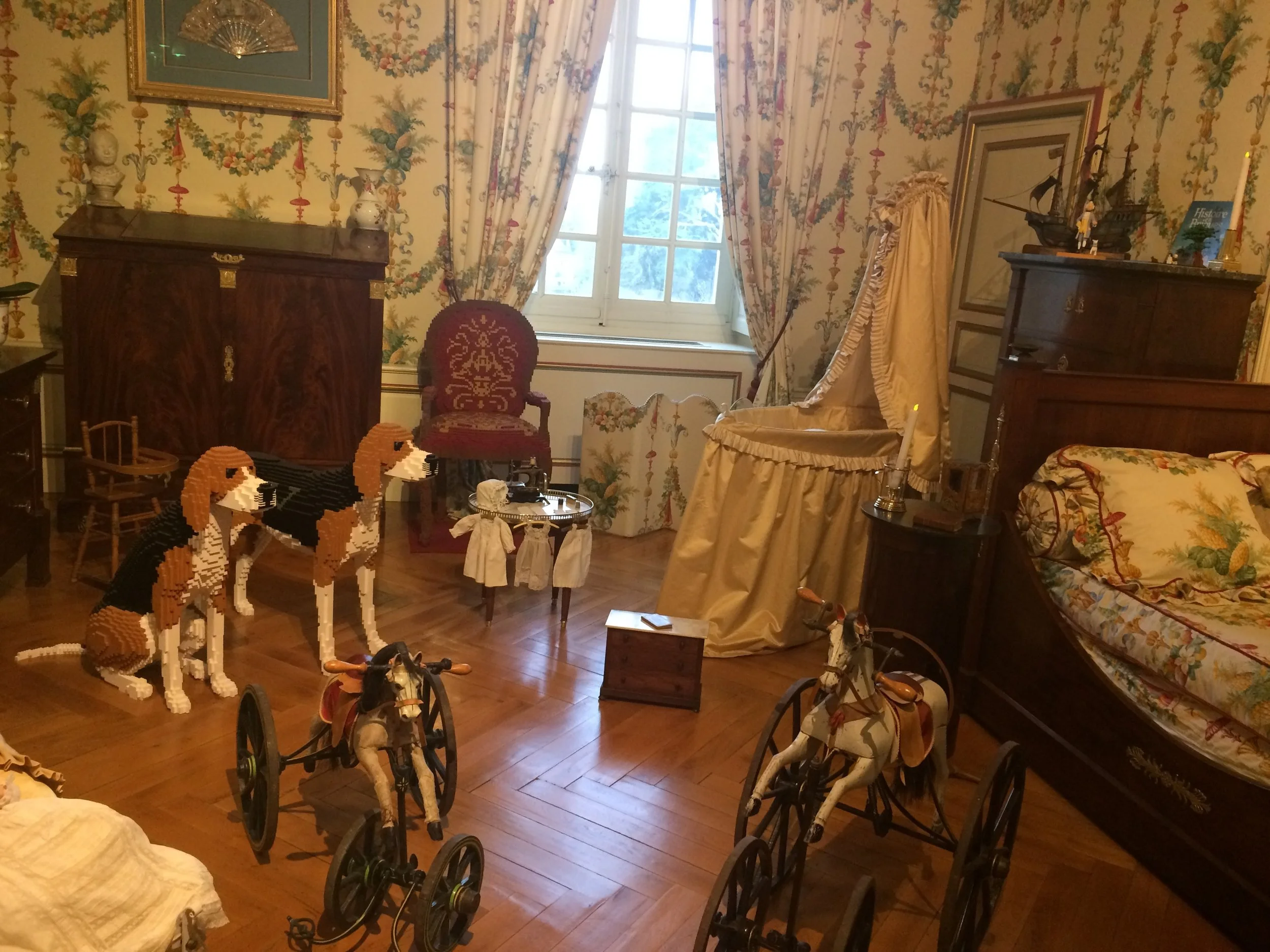
In the same day, we travelled to the much smaller, but certainly equally elegant Chateau de Chaverny. The estate has been in the same family, the Marquis Hurault, for more than 6 centuries, and descendants still live in the right wing of the Chateau. The Chateaut has hardly been altered since constructed in 1625. The exterior is elegant. Significantly, the interior décor of the rooms has been maintained and the dining room, bridal chamber, chapel, as well as a guard room with armor and weapons, are striking. Great fun is to go to the kennels where 50 pedigreed French Pointer Fox Hounds bark and howl in friendly fashion at visiting guests. We missed the public feeding that can be watched at 5:00 pm. 

There are several other Chateau nearby that we were unable to schedule, but we enjoyed the opulence of what we saw and were ready to return to Blois for a fancy French dinner. Very rich. We might not be fans of froig qua, i.e., duck liver, that is considered a delicacy, and expensive. The veal and mushrooms sprinkled in brown sauce was tasty.

On Day 3—Monday, we had to get up real early and leave to go back to Paris to get new Passports. We where running short on pages to stamp as you know. We got an email that the passports where ready for pickup and figured this was the most convenient time to go and then leave Paris by train to reach our next southern destination of Lyon, the third biggest city in France, population 488,000.

Lyon

This city has been a commercial, industrial and banking powerhouse for the past 500 years. It is also suppose to be the “ gastronomic” capital of France. Generally, we found the city dull. But people were very friendly. We did our best to walk the “Vieux Lyon” or old town which includes Roman ruins, and medieval and renaissance houses below the key landmark of Fourviere Hill. The nearby St. Jean Baptiste Cathedral is the typical buttressed Cathedral with large stain glass windows, but higher up the hill a newer Cathedral de Fourviere is the mind blower.

This Basilica of Notre Dame de Fourviere is purposely opulent as it was built as a testament to French greatness just after the war against Prussia had been LOST—kind of a moral booster. In any event, this may be one of the most beautiful churches we have seen. We actually started ranking churches as we admired the immense mosaic murals on all the walls, ceiling, and dome. There is a second full church built as the foundation under the grand cathedral, again just beautiful, and then a separate large side chapel. Funny thing is—this Cathedral is not listed in our guide books. It is ignored. We saw it's striking exterior as we walked the Hill, and we were really elevated and a long way from our Airbnb. Luckily, at dusk we found the “funicular”which is a tram for the Hill that connects to the metro and allowed us to get home really quickly—saved our legs. 

We should mention that our Airbnb in Lyon was one of the best places we stayed. It was fully equipped and being on the eleventh floor we had great views. We used a lot more of our time in this city for scheduling travel and booking Airbnb's for Italy and Slovenia. Upon leaving we had an easy walk to the bus station too; good ole’ FlixBus with German origins, took us cheaply and comfortably from Lyon to the French Riviera.


Paris France

We took a 200 mph train from Stuttgart, Germany to Paris and arrived in 3 hours. The train looks like a bullet or shiny spaceship and travels with only a whisper of sound. The train station has a metro level. Once you arrive you can walk to the underground metro and take the subway to your neighborhood. We took the metro to “Republique” station and walked 2 blocks to our very cool Airbnb. We met our concierge, a young lady working for the owner, who set us up in the apartment. With a circular stairway and two windows overlooking the bustling street the apartment was very inviting. The fact that we were living so close to the metro station made the place even more stellar, and boy did we take advantage of this convenience. You can go from one end of the city to another for $1.90. But this first afternoon we walked. After settling in, we took a long walk toward the Seine river, and actually made it there. This route was interesting in a surprising way.


 We passed many cabinetry and kitchen renovation shops displaying the flashiest set ups. Apparently, there is a lot of updating going on. We also passed many scooter shops with some really funny looking models, but reasonably priced. Across the street were show rooms for Harley Davidson and Triumph motorcycles, probably not so cheap.


Parisian Houseboats

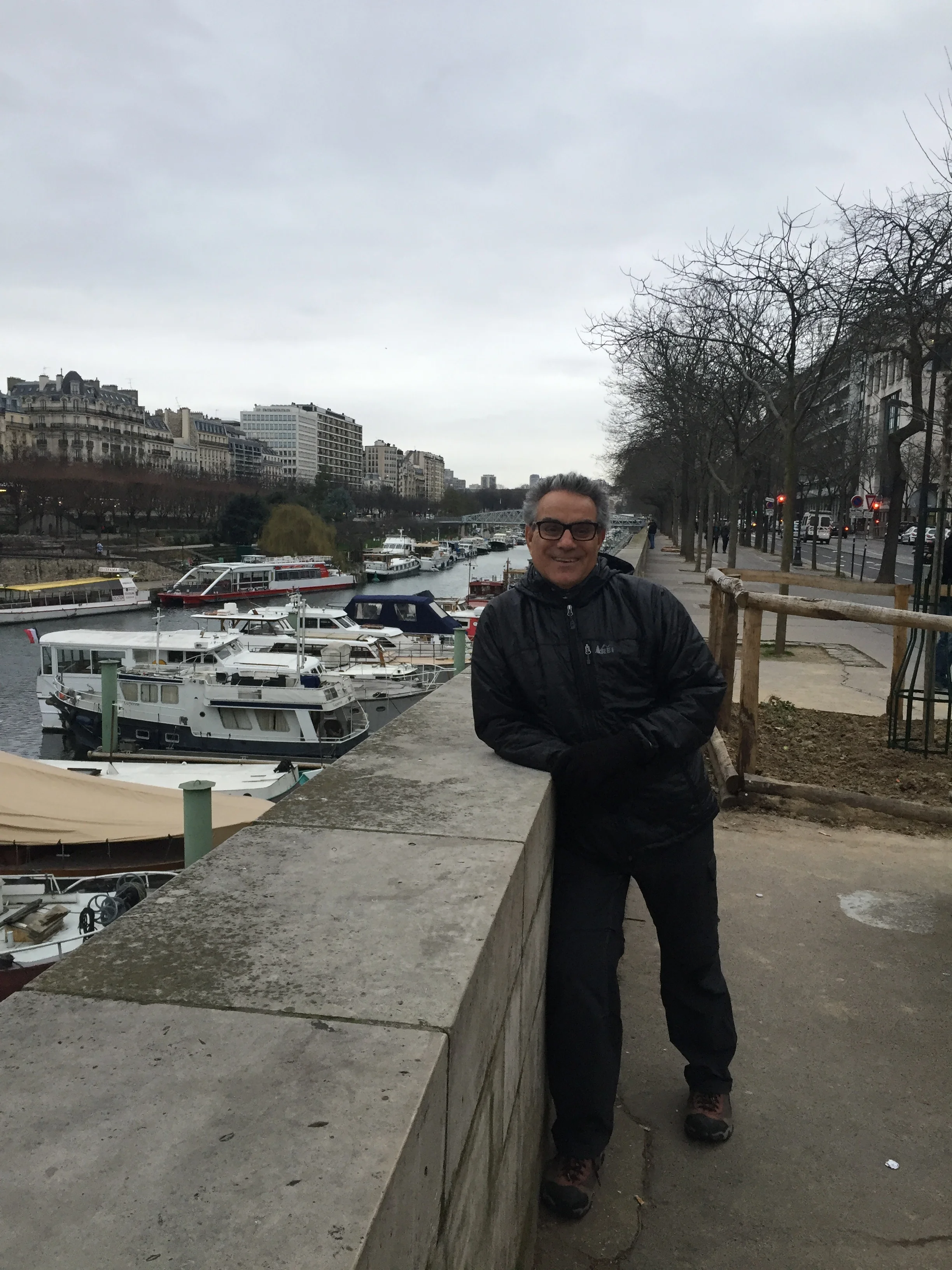
These scooter and bike shops were situated in customary Parisian store fronts alongside restaurants or other businesses. We also walked by government buildings alongside wide boulevards and traffic circles. When we reached the Seine river, we observed a wide river contained by carved cement walls with walkways and docking on each side. There appeared to be docked residential houseboats as well as typical river cruise commercial boats and nightclub boats. As we looked down the river, we saw the Notre Dame Cathedral in the distance. That was a first “WOW” moment, but not the last

Arielle and Janet

We had walked so far that we decided a metro return was needed. We found the closest metro station, purchased 2 tickets from a live teller, and got back home quickly and warmly.  Our long term friend and coworker from Belgium, Arielle came for dinner and an overnight stay.  This is our first visit by friends from home.  What a great treat, we talked late into the night, catching up on politics, people and our crazy travel adventures

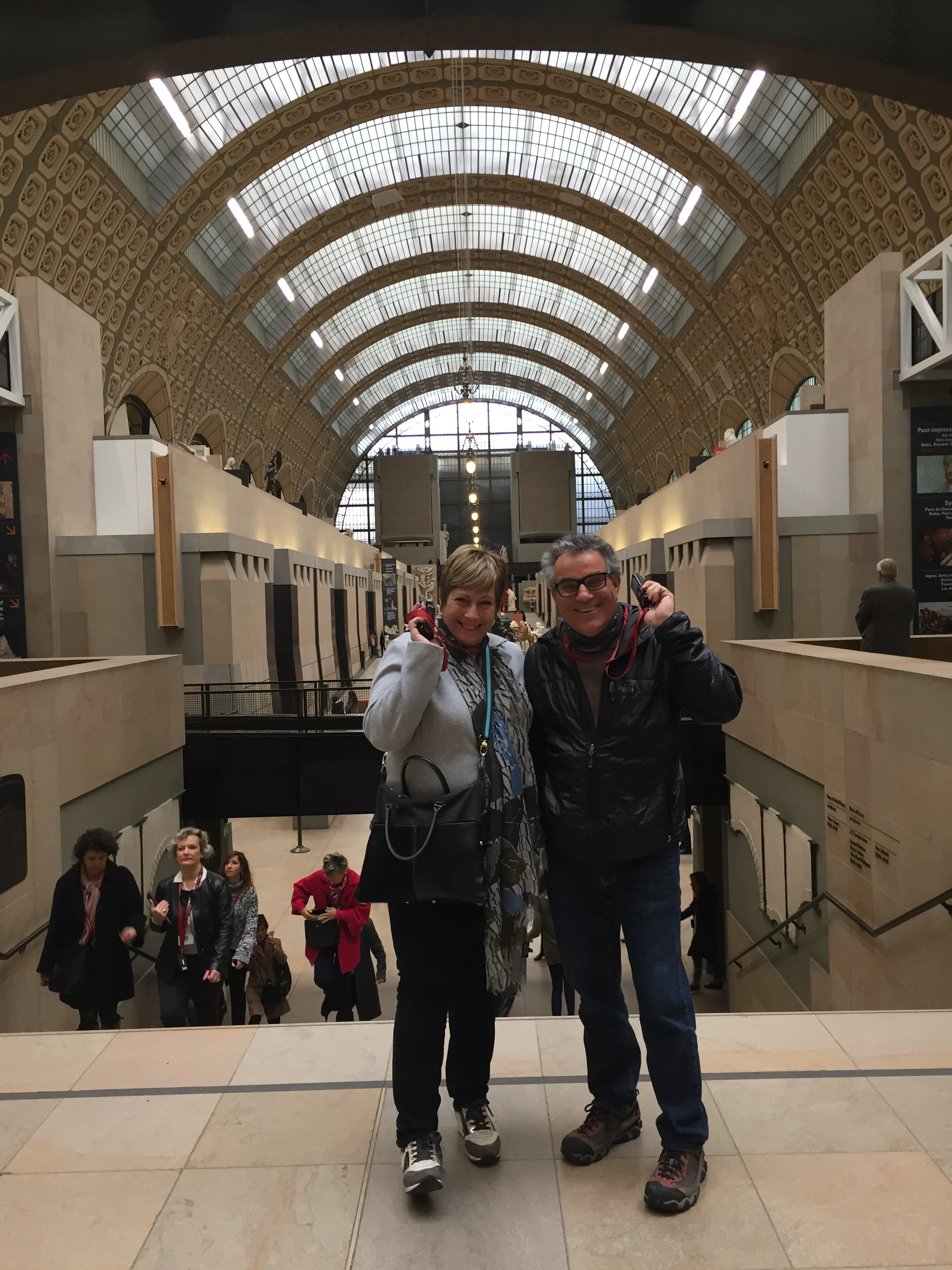
We spent the first half day with Arielle investigating the Orsay Art Museum, a former train station that was wonderfully renovated.  We had lunch there and then had to say goodbye, back to just the two of us.  Thankfully only a few weeks until our kids arrive in Rome!!  We cannot wait!!


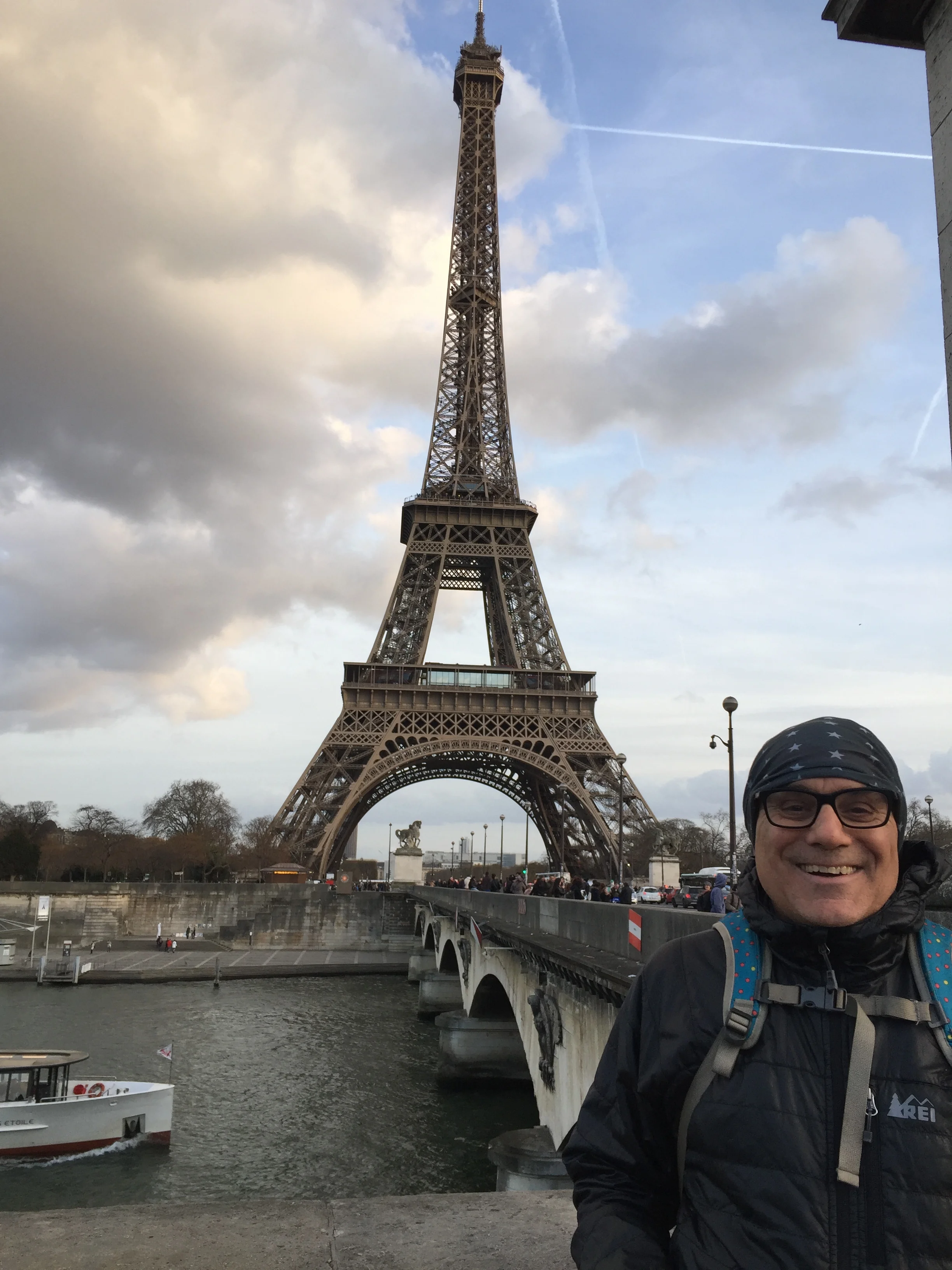
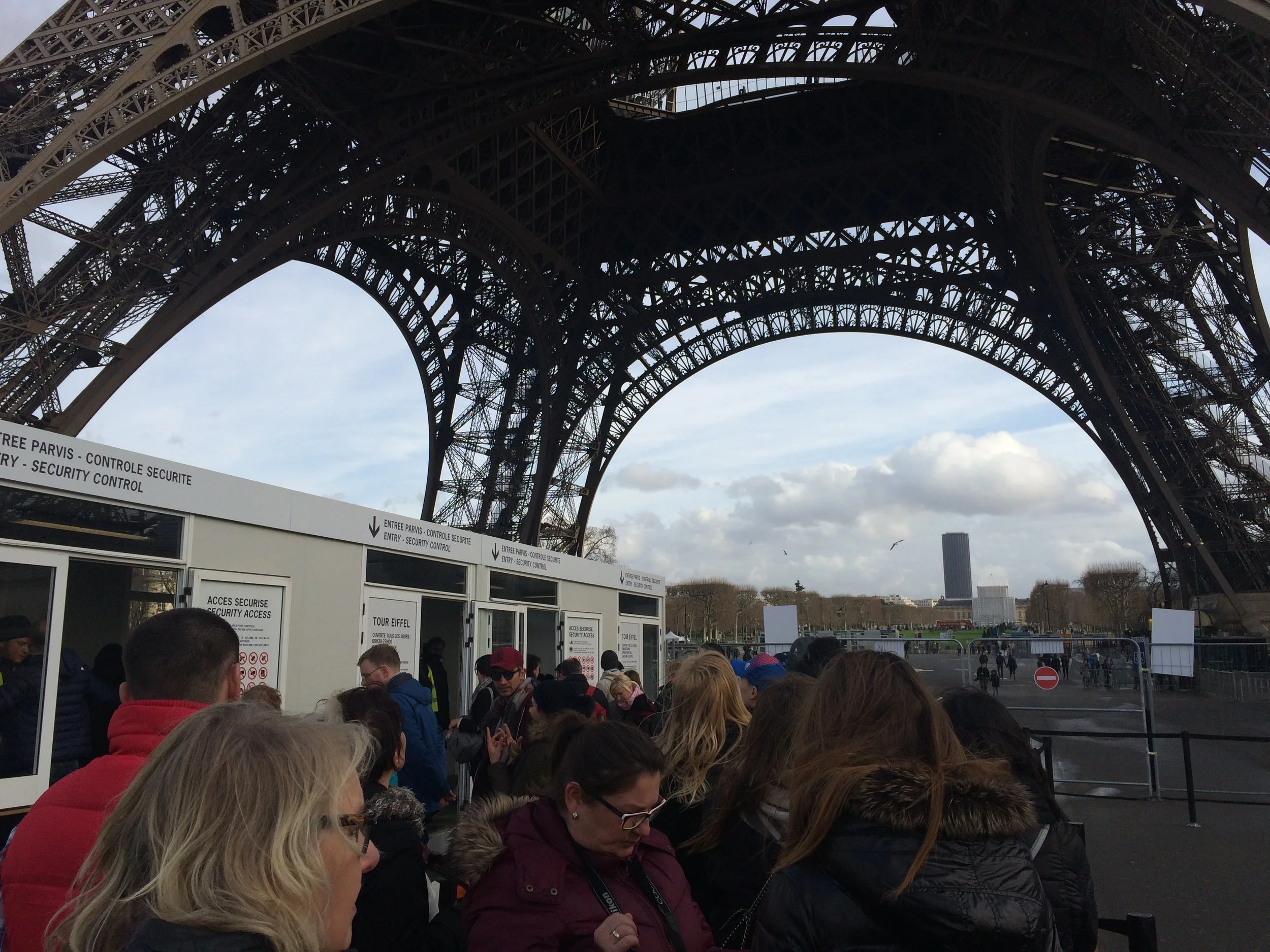
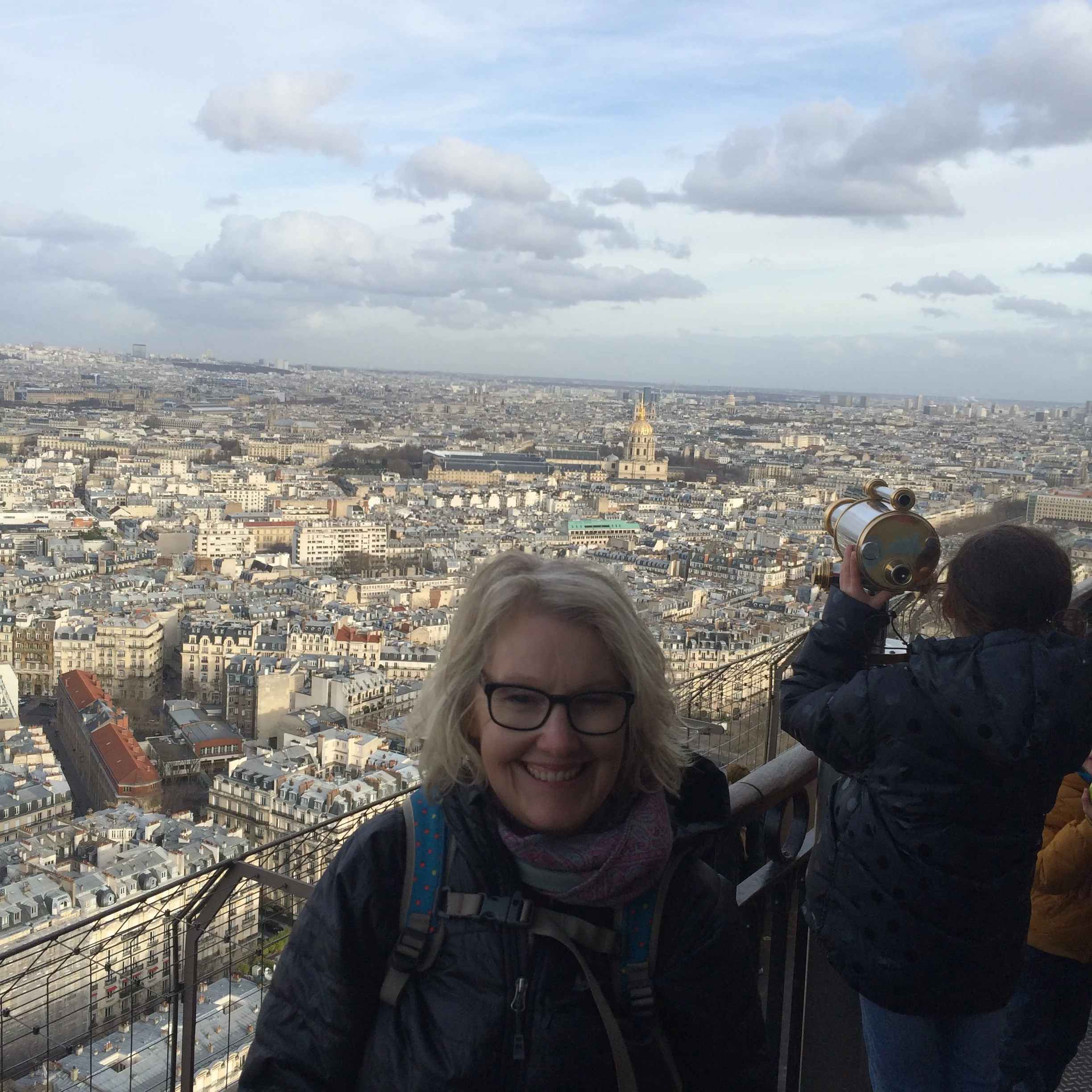
Next we walked down the busy boulevard to the Eiffel Tower. We picked the best month to come to Paris. The weather is clear, sky blue, with only a bit of a chill, but most importantly there are NO LINES. Our experience is that a winter season visit to Paris is very convenient and certainly outweighs the cold.

We stood under the Eiffel Tower for only a few minutes before we rose up on the pulley elevator to the second deck. The structure and views are equally magnificent. The wind was so strong the peak was closed.

We purchased 10 pack Metro tickets and 4-day Museum passes earlier in the day, which made it easy to get around and get through the entry lines for all the sites. We also explored our neighborhood and found bakeries, butchers, and grocery stores which made it easy to cook really great dinners at the Flat, and drink a little wine and have desserts with our meals. What a great day in Paris


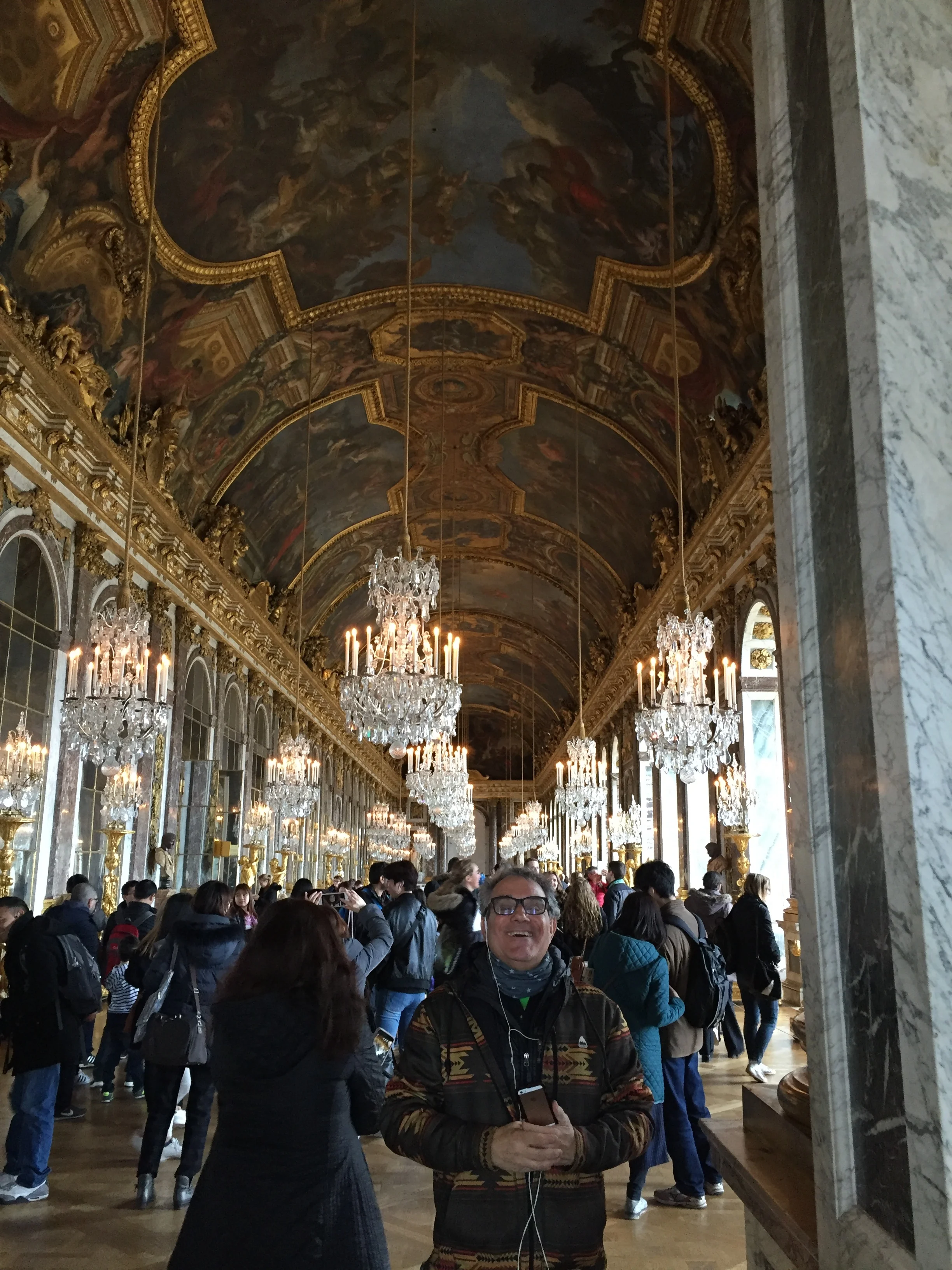
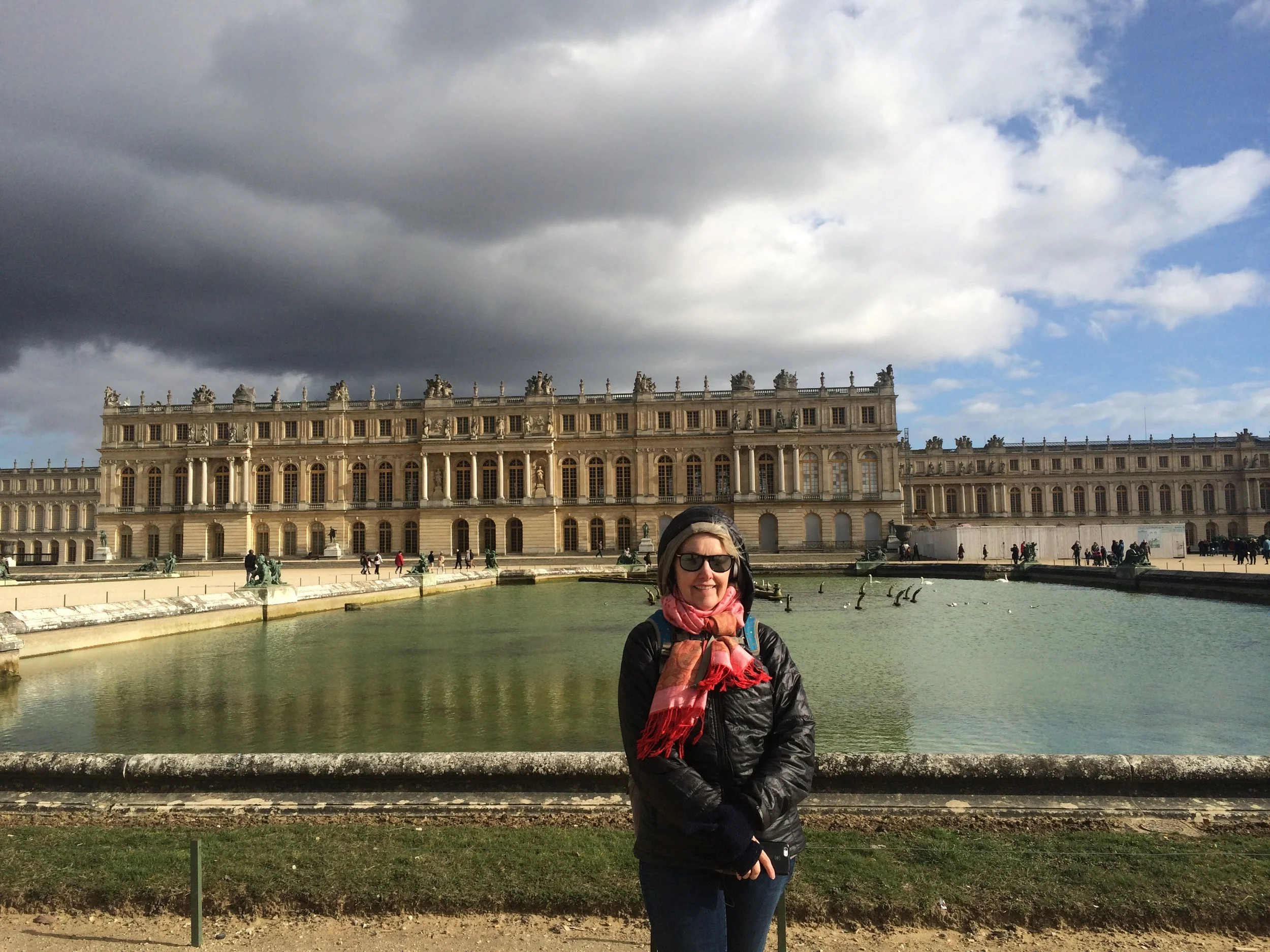
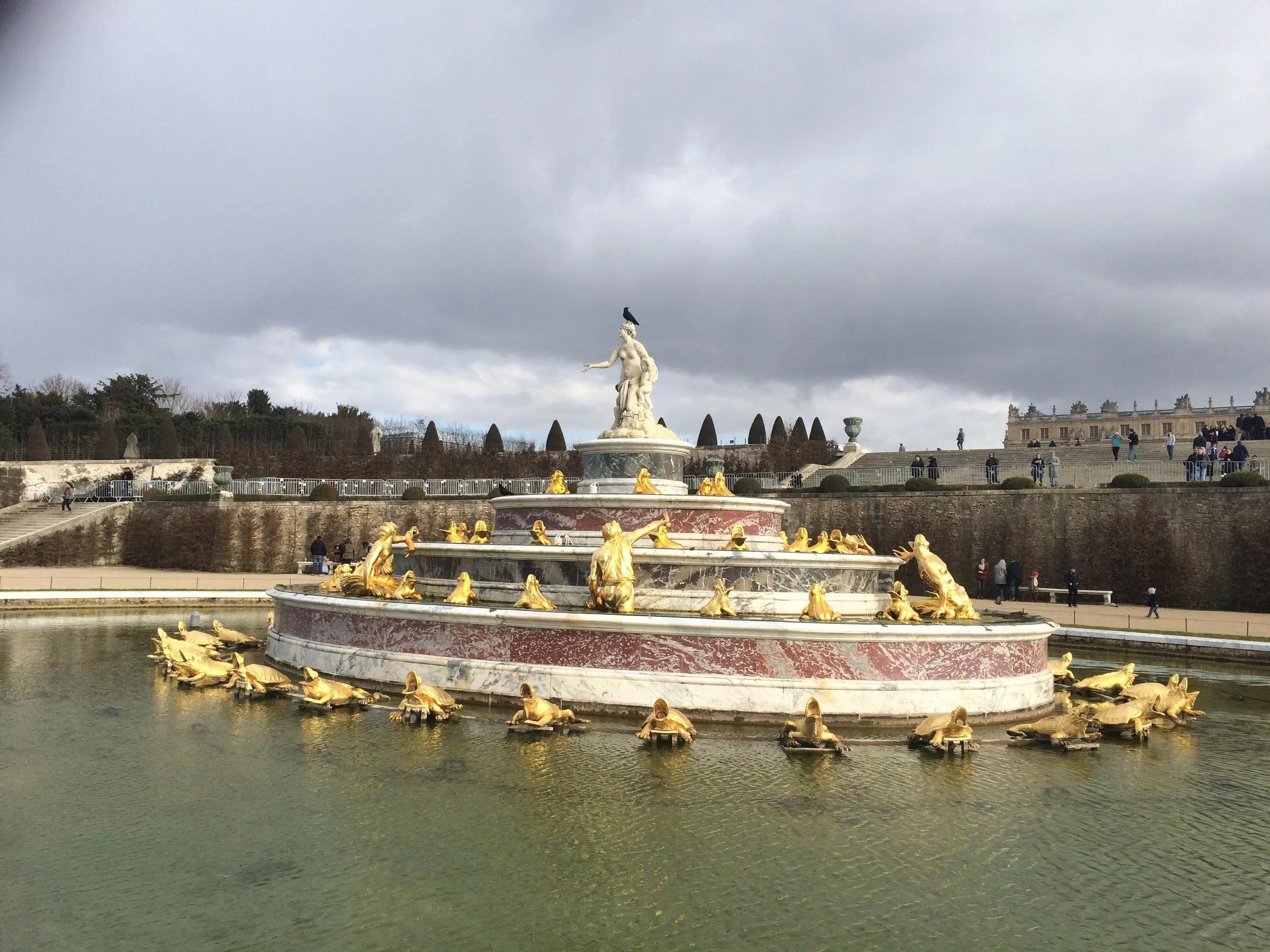
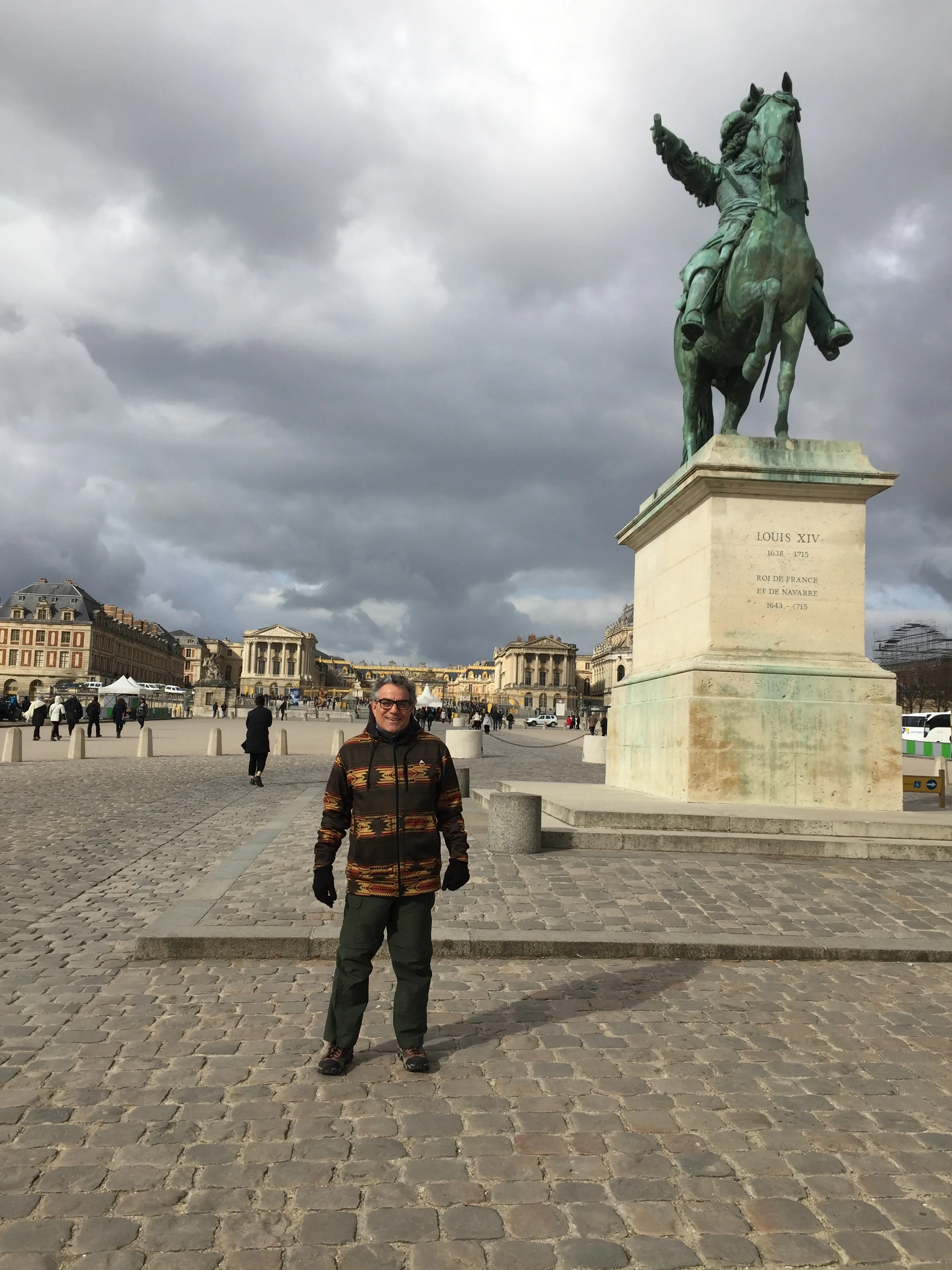
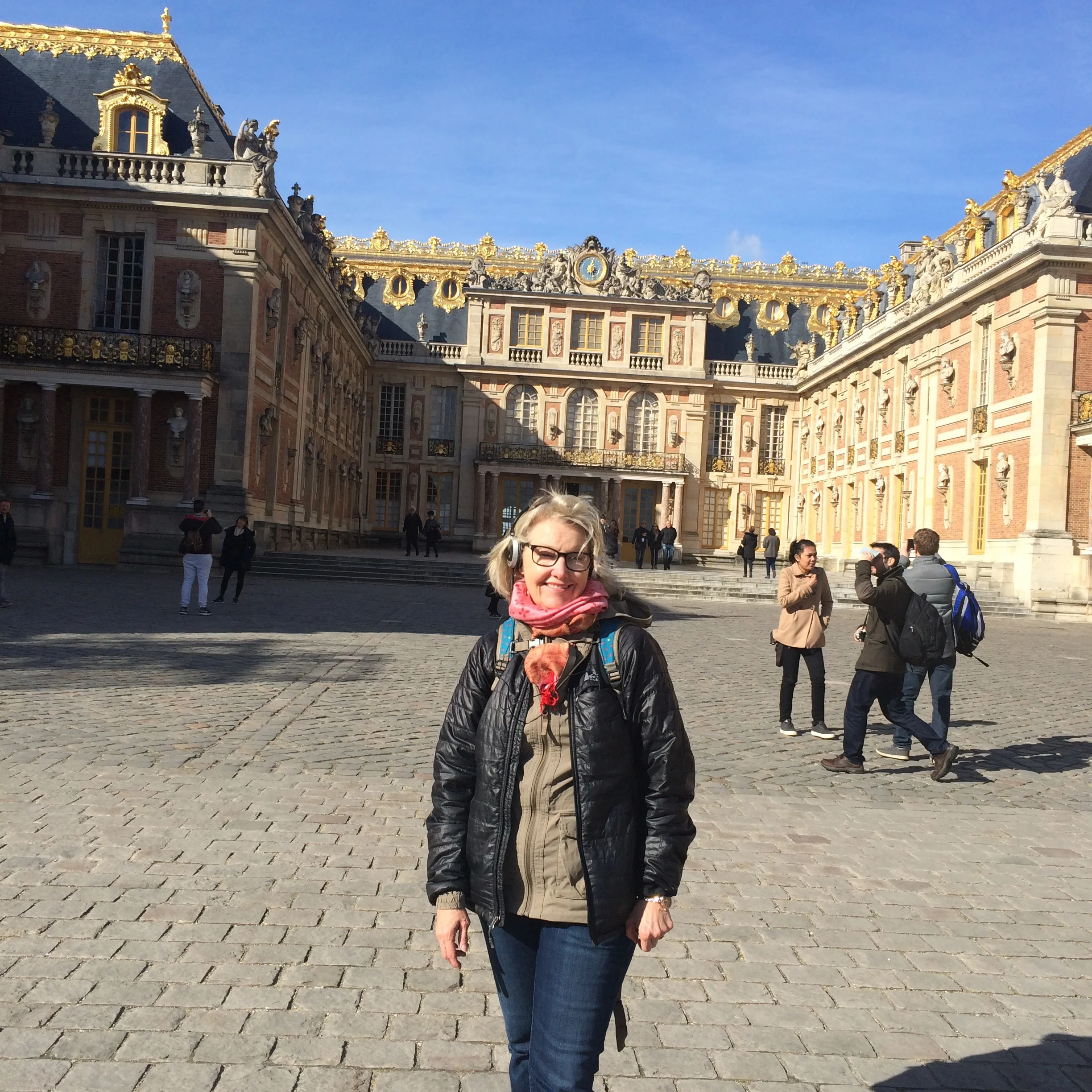
We decided to visit Versailles the next day by taking the RER train 10 miles outside of Paris. This was Louis XIV’s magnificent palace situated on a park larger than Central Park in NY. Again the lines were manageable. We did an audio tour of this opulent palace and also enjoyed the large paintings in the Gallery of Battles. We then walked in the palace gardens to the Mari Antoinette’s hide away cottage. The fountains and canals and manicured landscapes reinforced Louis XIV’s mastery over nature as divinity on Earth.


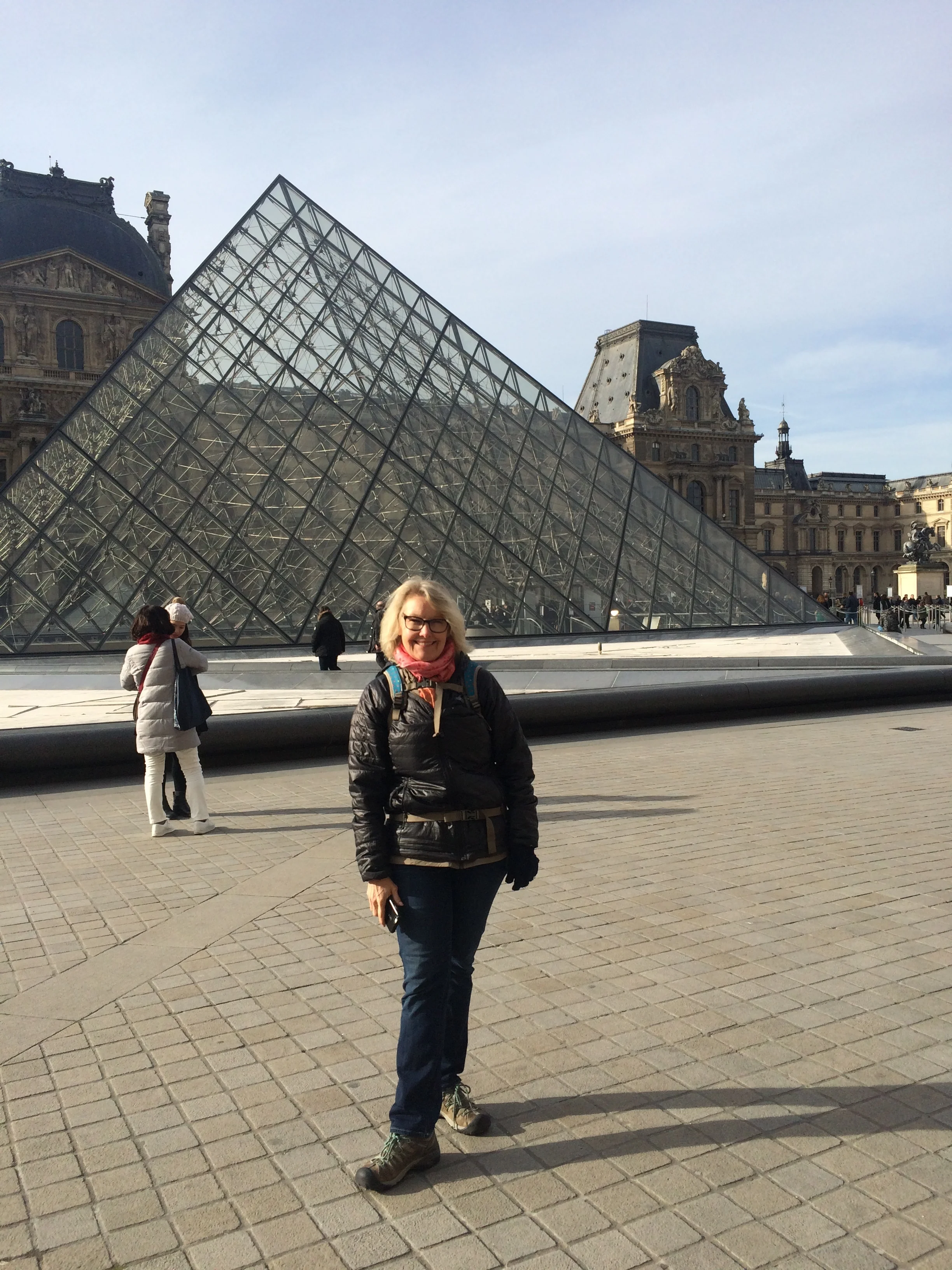
The next time day we went to The Louvre in the morning by Metro. The street level view is impressive by it sheer size. This was King Louis XIV's first Palace until he built Versailles and took the government with him. The magnificent courtyard displays glass pyramids that where designed by an American architect. These where controversial structures for the French, as was the Eiffel Tower when first completed. We liked them. Under the Pyramid was a giant sub level reception area with entrances to the museum collections. Very cool.

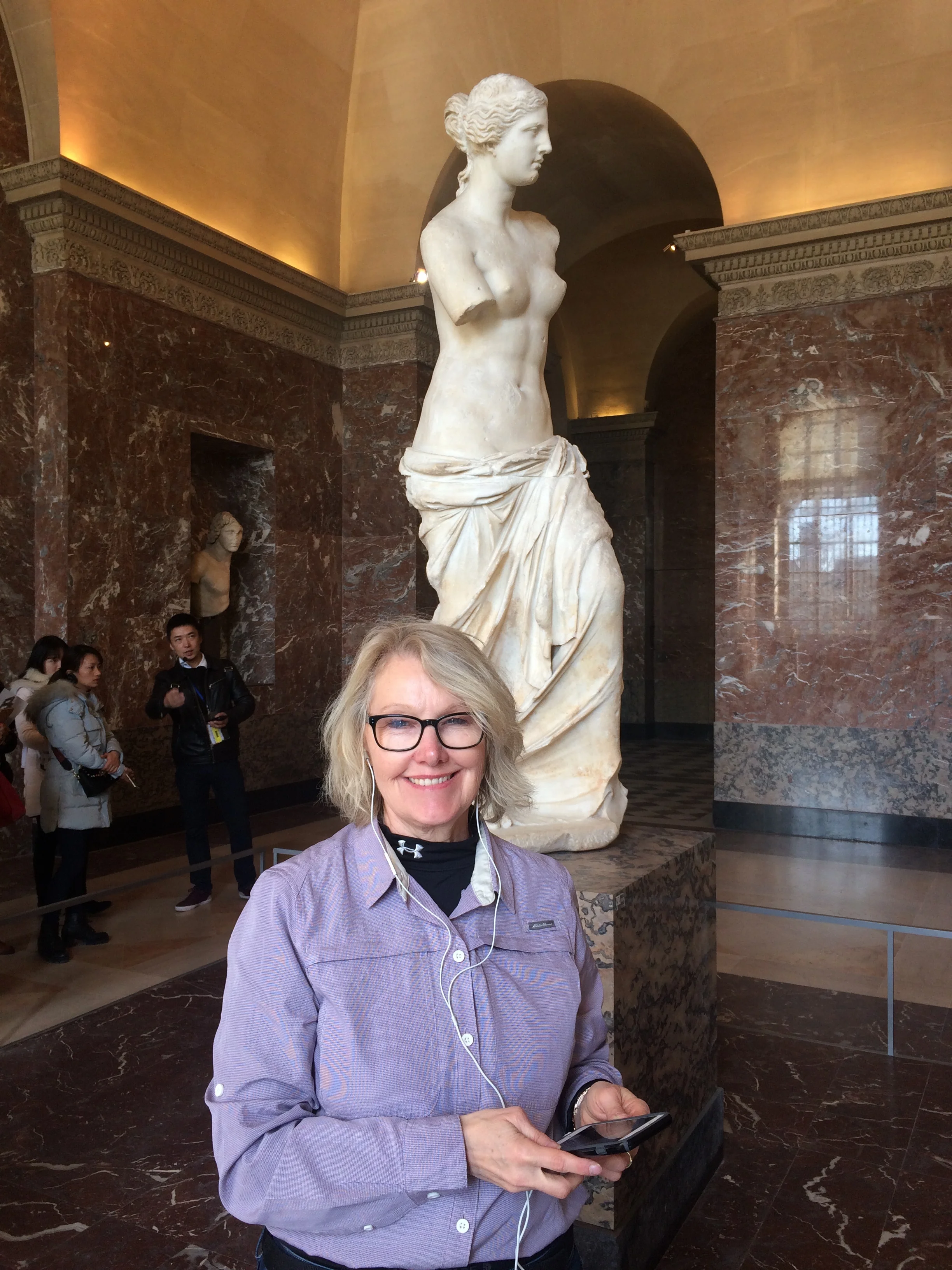
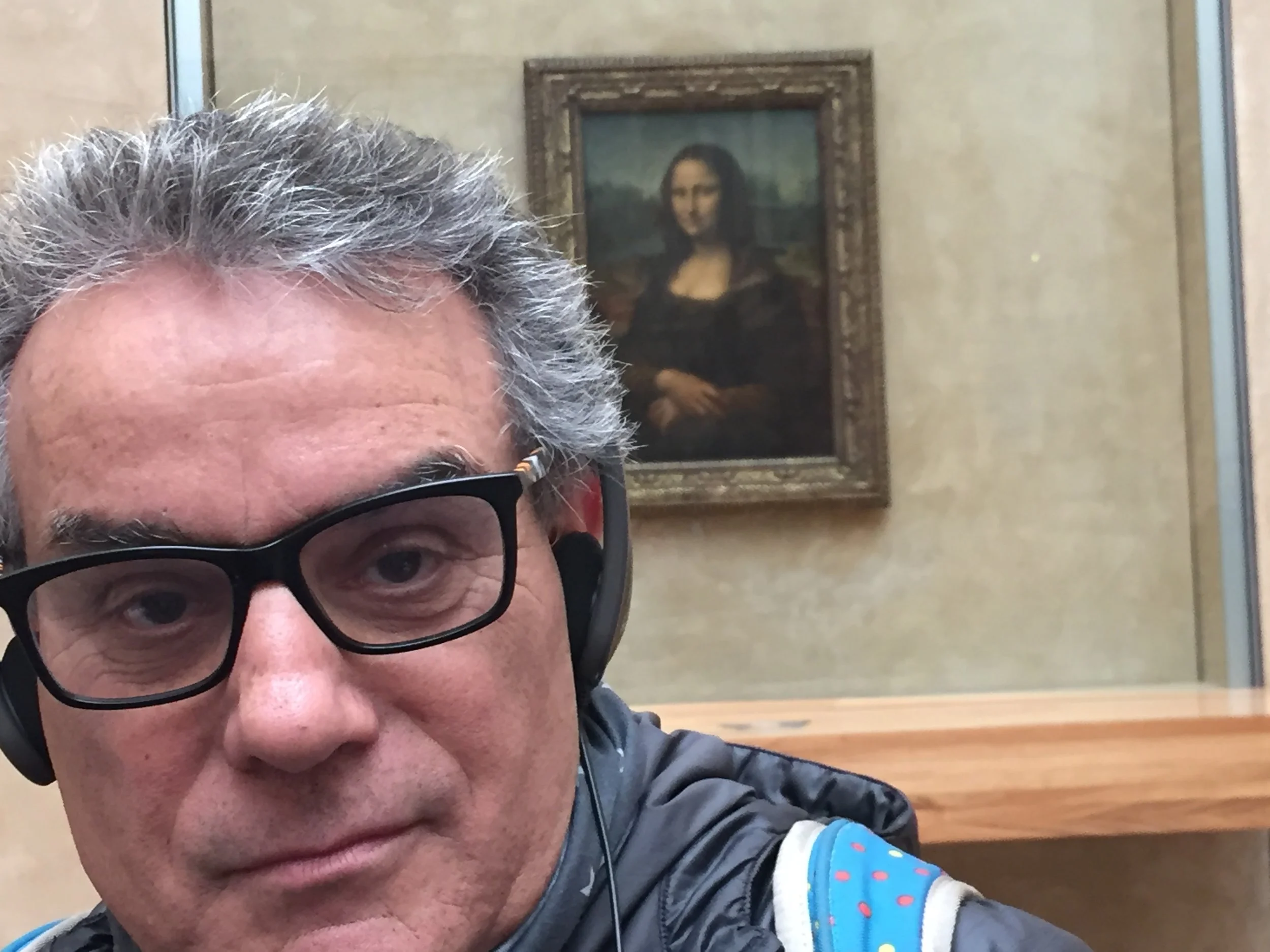
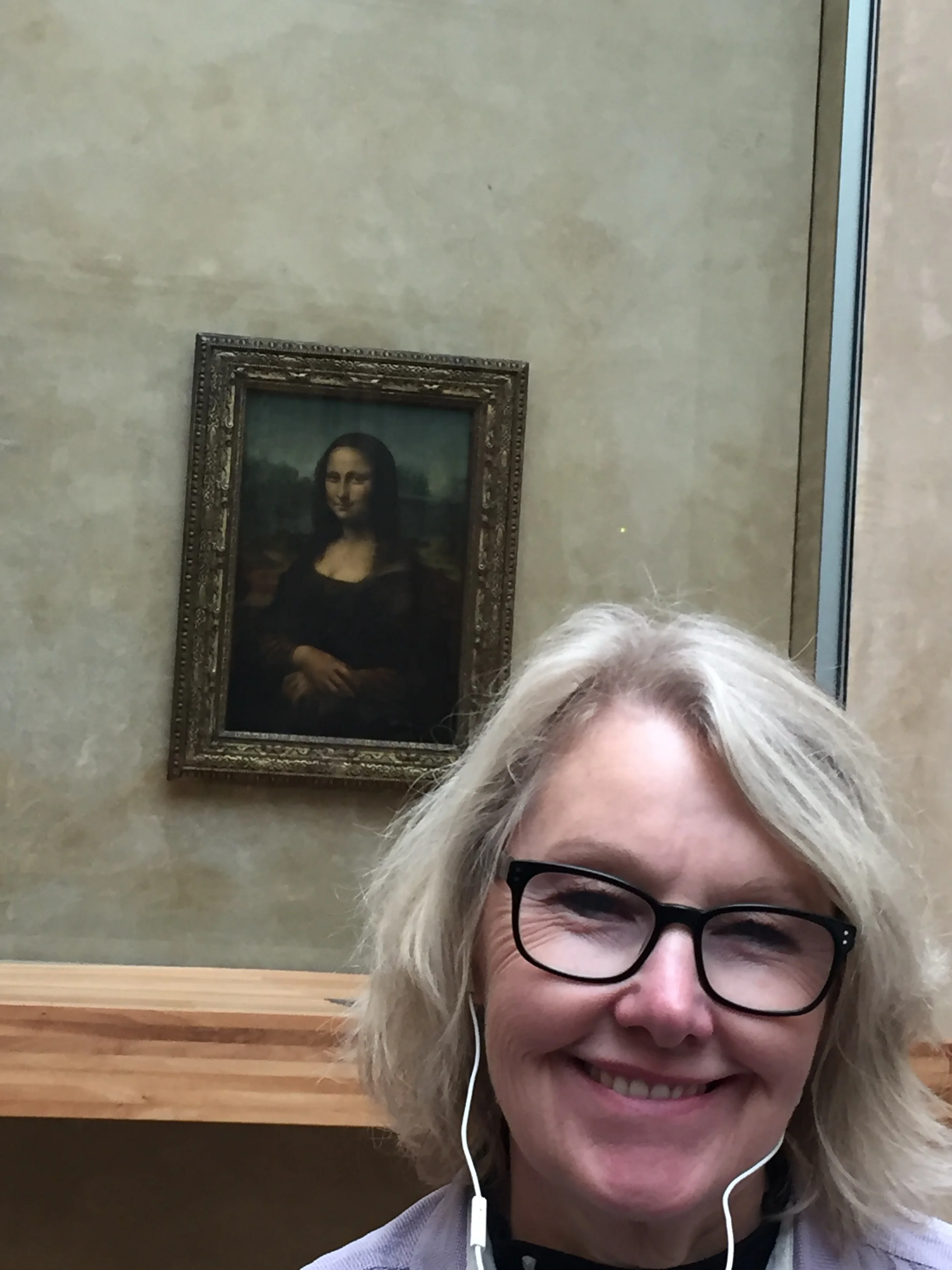
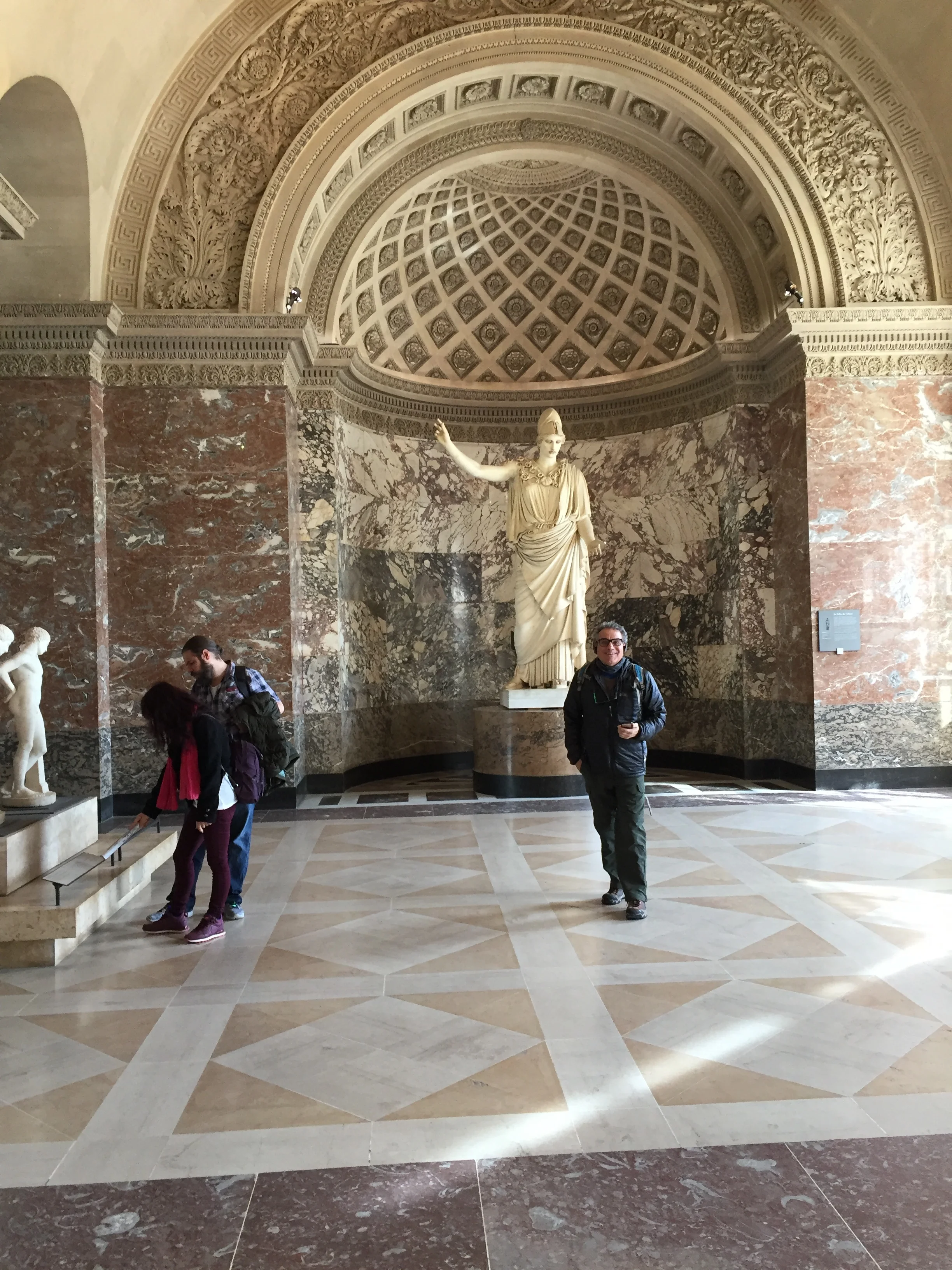
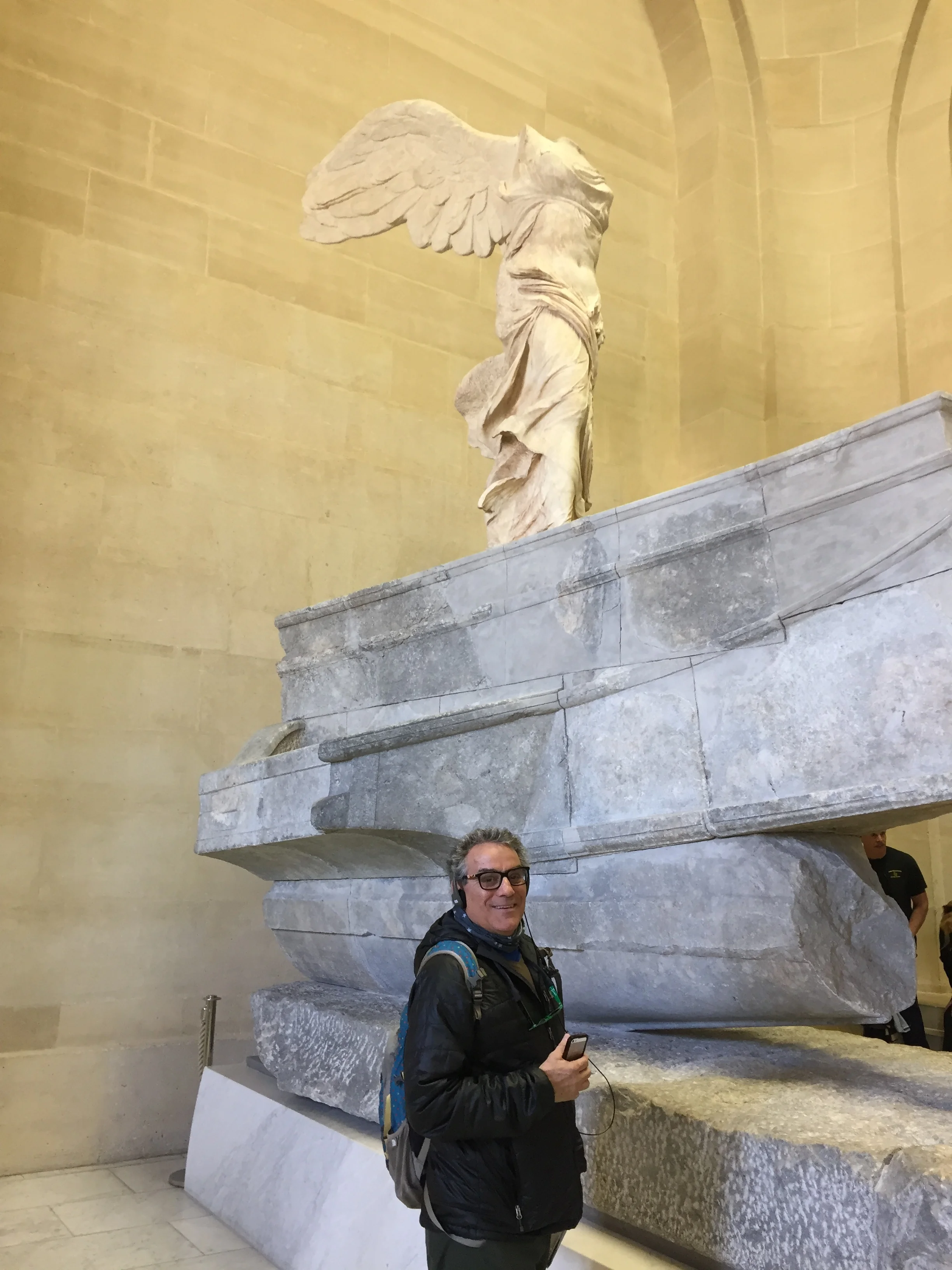
As you know, the collection of art is so massive that it would take weeks to see.  We decided to use an audio tour from the Rick Steve's series that was organized to show and discuss a series of essential master sculptures and paintings. This tour included, of course, the Mona Liza, Venus De Milo, Winged Victory, and paintings of French battles and Napoleons’ Coronation.  See some photos below


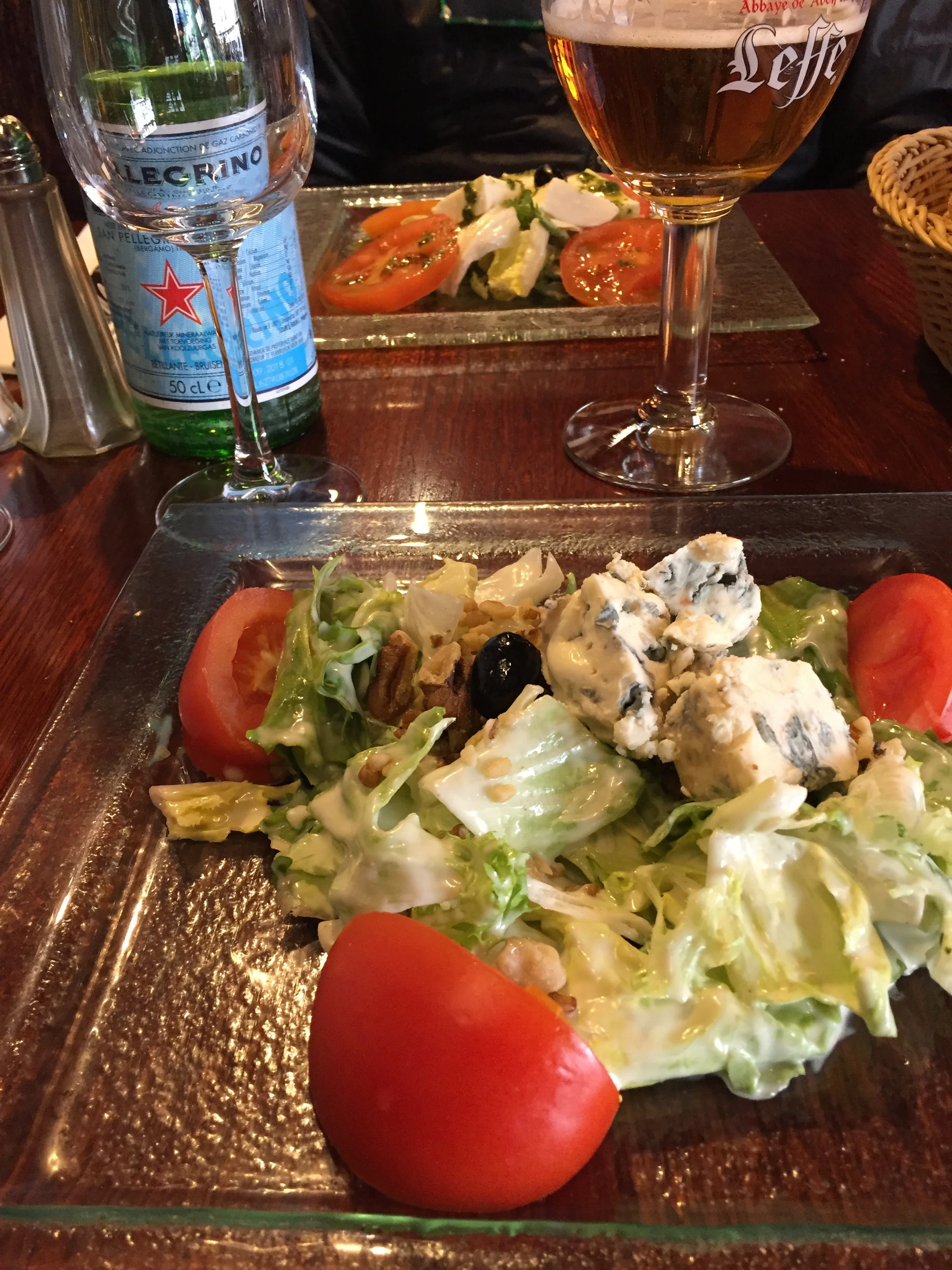
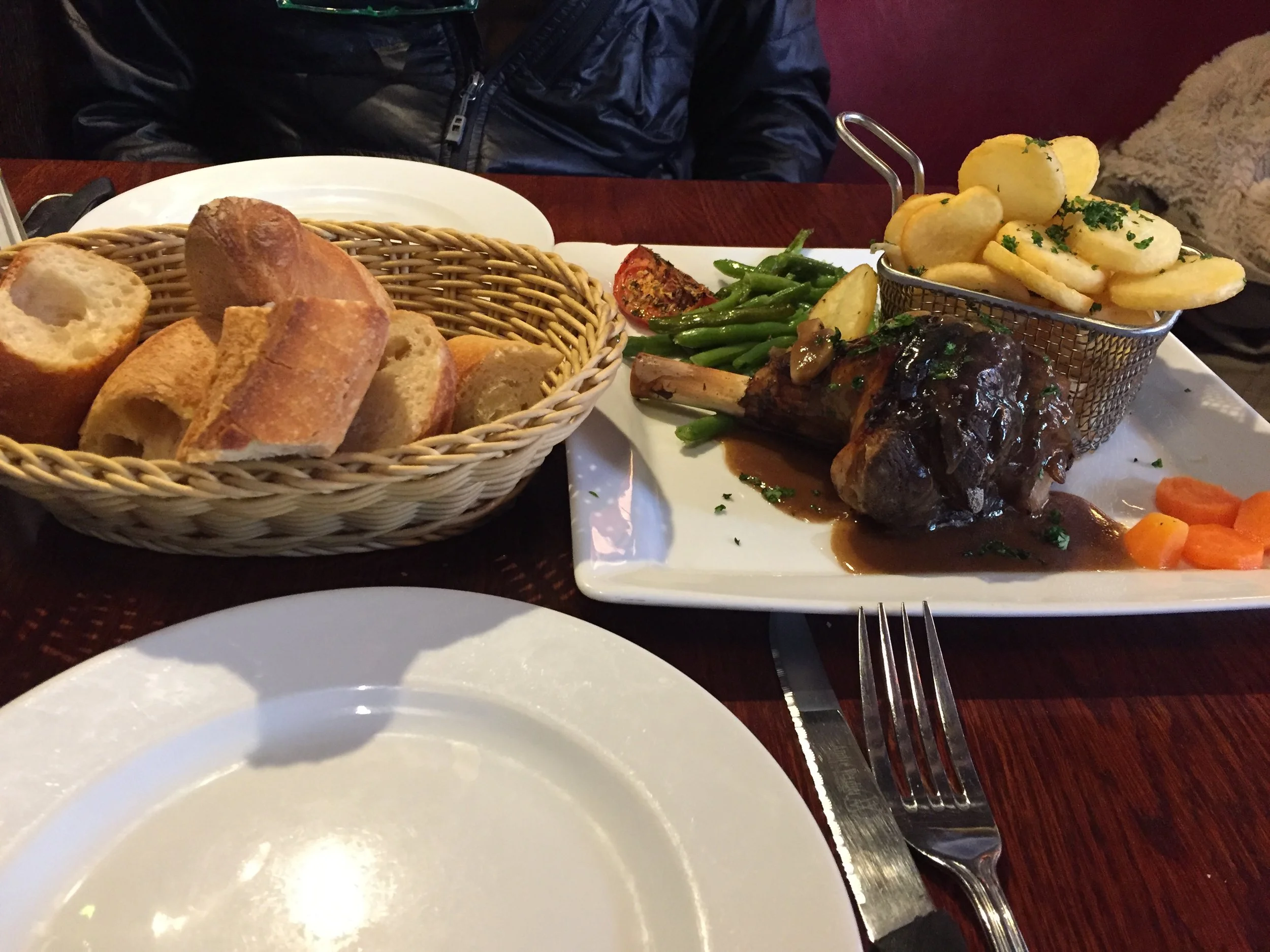
After the Louvre, we ate at a lovely French bistro and decided to have roast lamb and the fix’ens. For most meals we split a main and order two starters, this proved difficult in France.  We had fun with this waiter, who finally allowed it.  When he delivered our meal he ask "Americans?" when we said yes he replied, of course, I know your disposition, very funny.

Forearmed with extra energy we continued our city tour of Paris.

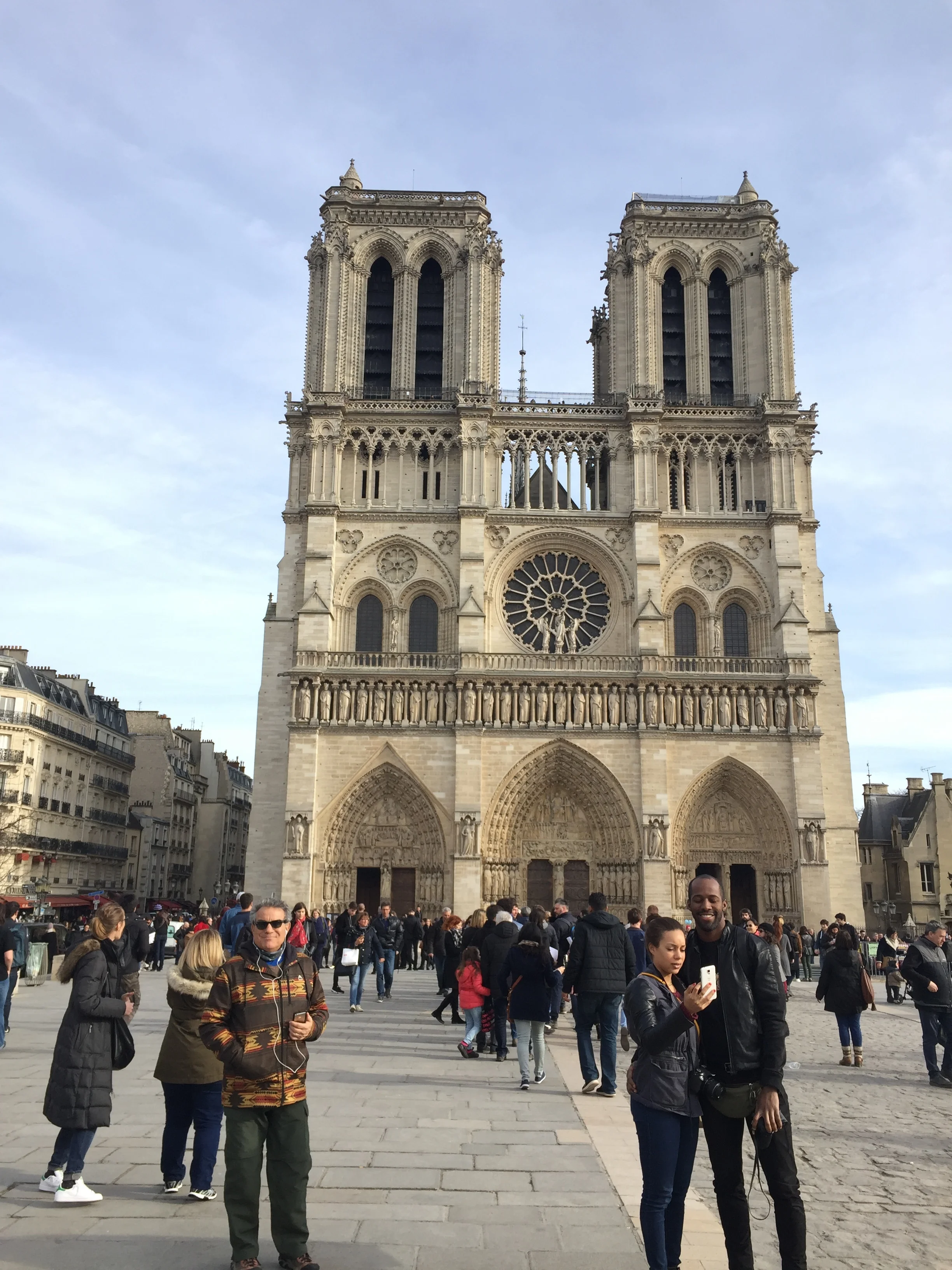
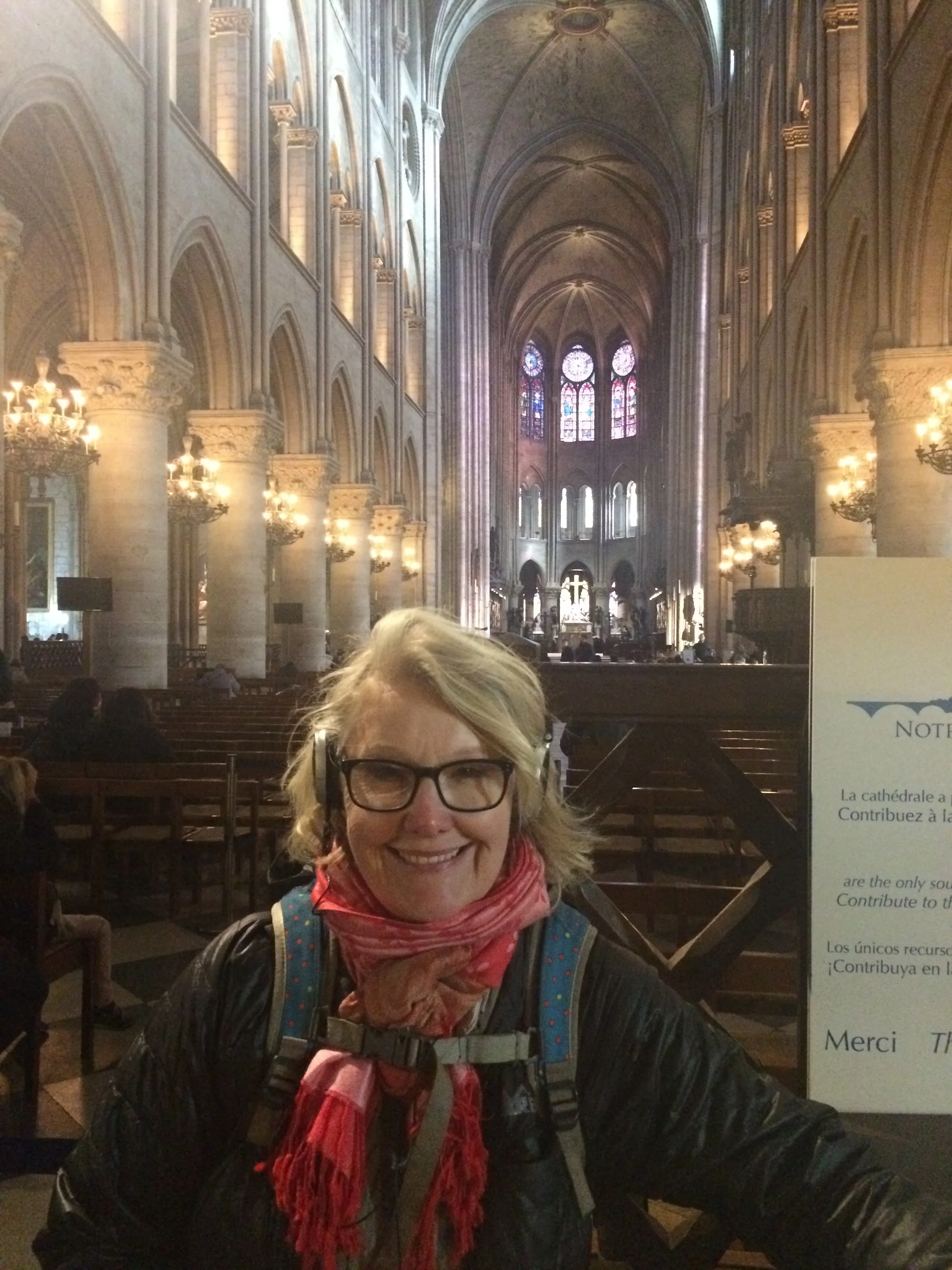
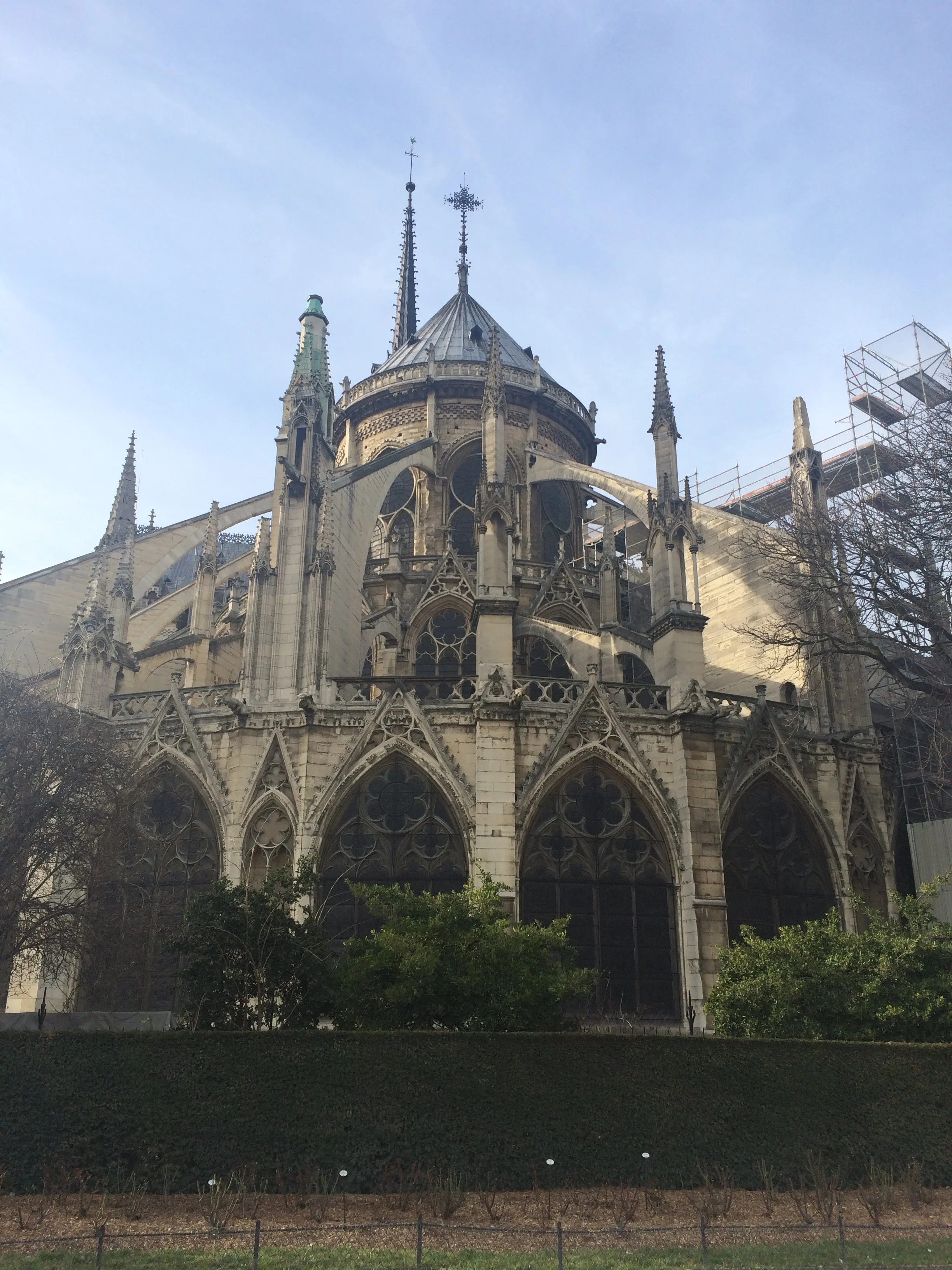
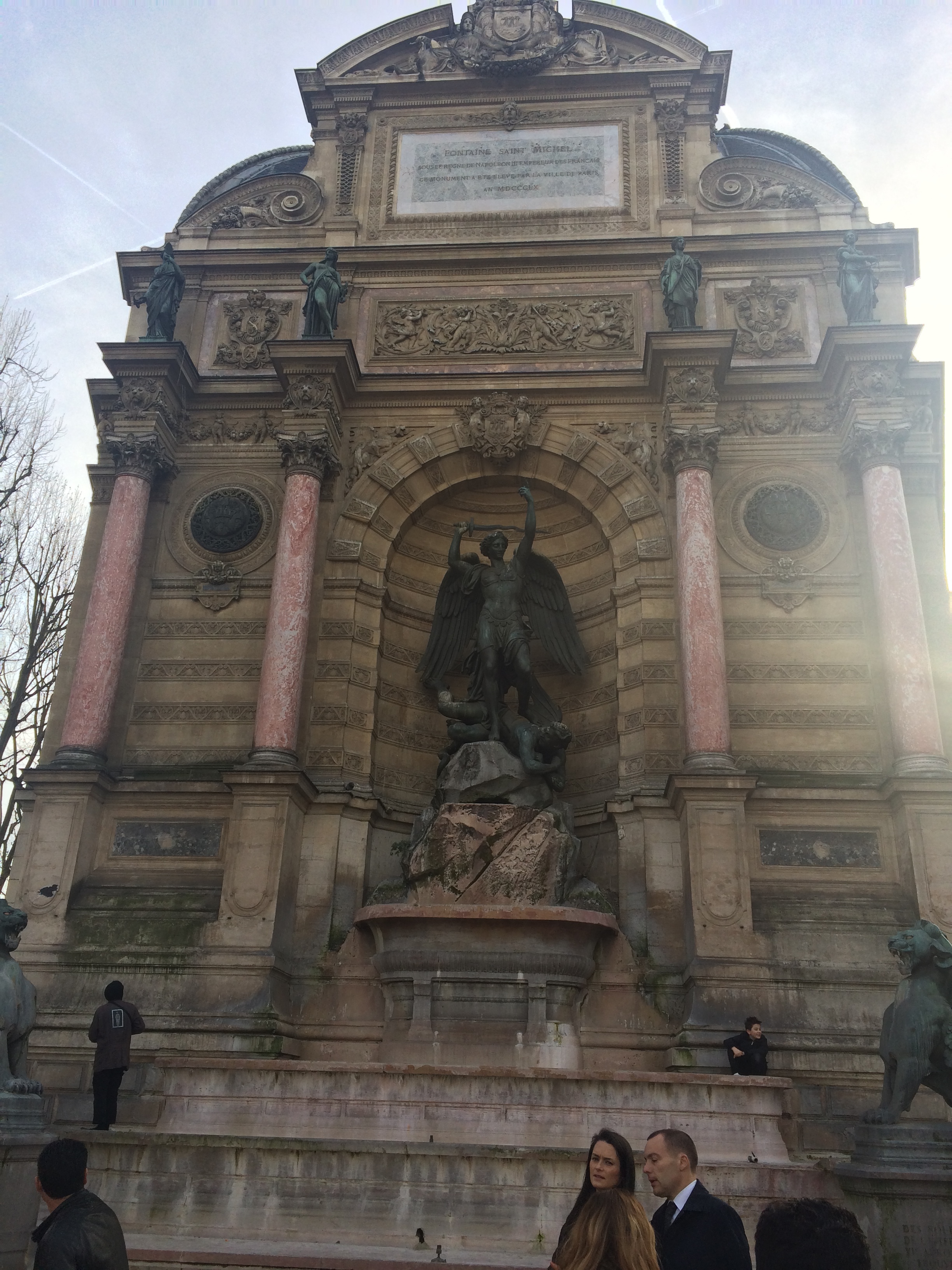
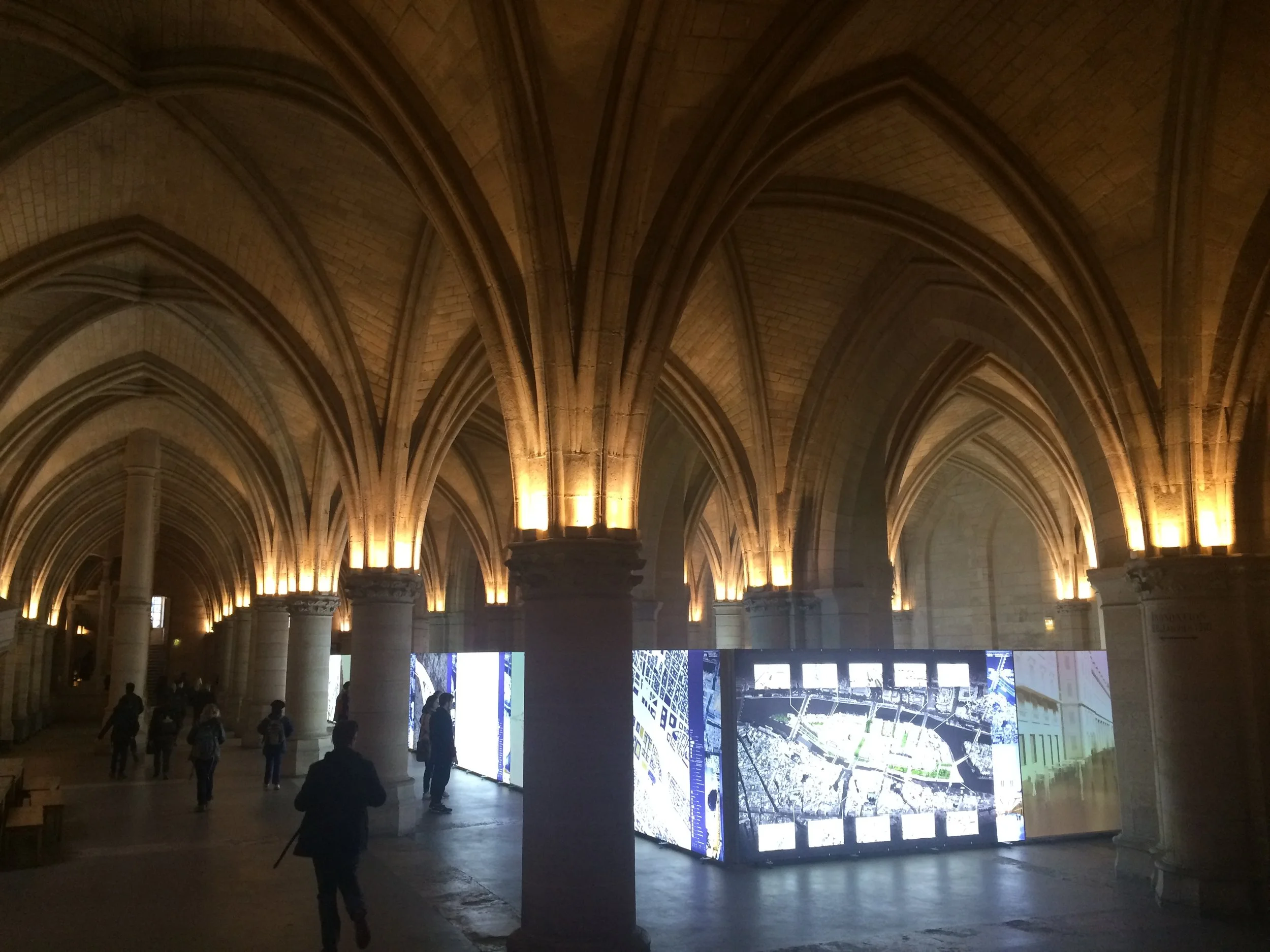
Again using a downloaded Rick Steve's audio walking tour we trekked to the massive Notre Dame Cathedral with the flying buttresses, the Jewish Deportation Monument, then the Latin Quarter, Conciergerie, St. Julien-le-Pauvre, Place St. Michel, then ending at the Pont Neuf bridge over the Seine. The streets were full of Parisians and tourists scurrying to their destinations on this sunny afternoon.  See some photos below

End of a long great day

Our legs were tired so we hopped onto the Metro and got home quickly. At home we cooked a simple dinner, drank some wine and port, and downloaded some American films to watch. Tomorrow will be Sunday, which is a work day of laundry, planning, computer work, and phone calls to family. We have an appointment with the US Consulate for new passports. Our passports have so many stamps that we need more pages. Unfortunately, the rules have changed. No pages, but only newly issued passports and as of November 2016, one month after we left, photos must be without glasses. The extra photos we brought are with our normal glasses. Since it’s Sunday, there are no studios open for photos—we checked. Hopefully all will work out as the needed forms have been completed and downloaded.

Protesters at the end of our street

We finished Sunday dinner when we overheard chanting crowds and drumming. Looking out our street side windows, we notice a large peaceful gathering of people at the intersection. They were involved in a choreographed march in place where the main action was upper body movements coordinated with the beat of the drums. Later there was singing in unison. We could open our windows and we were able to look at and hear them better. It was an interesting congregation of spirited people. Well it's now 10 pm and the crowds are now chanting, but no music--bad sign, as well police cars are at the end of the street. We’ll keep you posted. The crowds left without incident. Apparently, the right to strike and protest is accepted in France.

It's morning. After the passport stuff, we hope to see Sainte-Chapelle, and do some general sightseeing before we move on to Normandy, the site of the D-Day landing. We may add some other information to the blog.

No photos allowed at the Consulate, but this is the view across the street


There was 2 lines at the US Consulate, one for passport issues and the other longer line for Visas to enter the US. We met one gal who had her purse and passport stolen and then another gal who had moved to Paris with her little daughter and needed a renewal. The little girl was sharp as a tack and had absorbed the French language in her classes.  The line moved quickly and luckily the US furnished a photo booth to resolve our glasses issue. Our forms were good, but because we were not seeking emergency passports on the spot, our request had to go back to the States to be reviewed and then reissued. They promised to email us within 3 days if approved, ok—no problem, then contact us upon receipt so we could pick them up. What can you do? We will have to backtrack to Paris for the pickup.


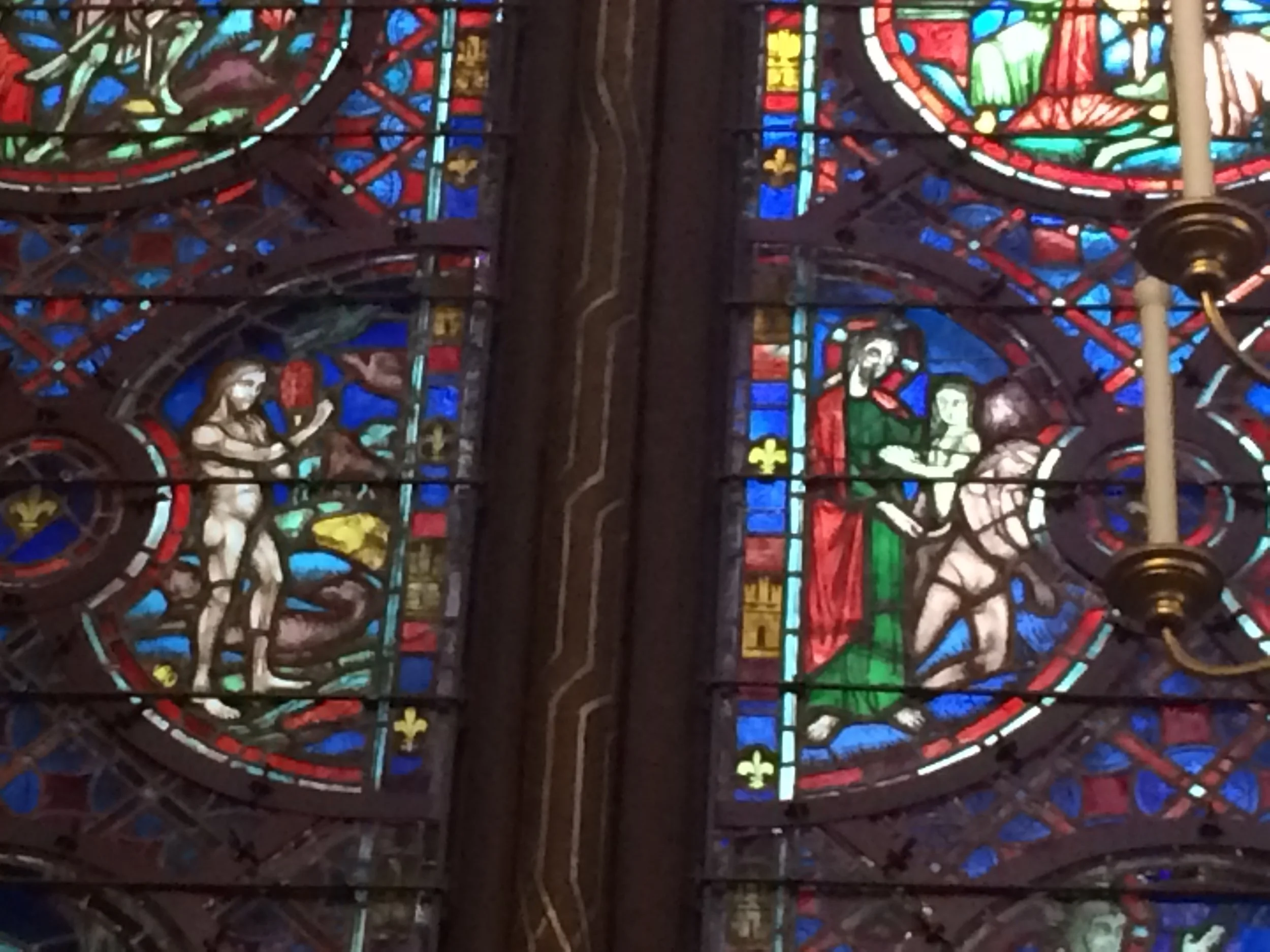
With business done, we went to see Sainte-Chapelle. It is a buttressed structure that allows for 15 towering stained glass windows. It is very beautiful inside and had been recently refurbished. The Chapelle was built at the request of an earlier king, King Louis VI, as a place to harbor the “thorn crown of Jesus “which he purchased from Judaea. He paid more for the crown then the Chapelle cost to build. Hope it was authentic, but in any event the thorn crown is now kept at Notre Dame.

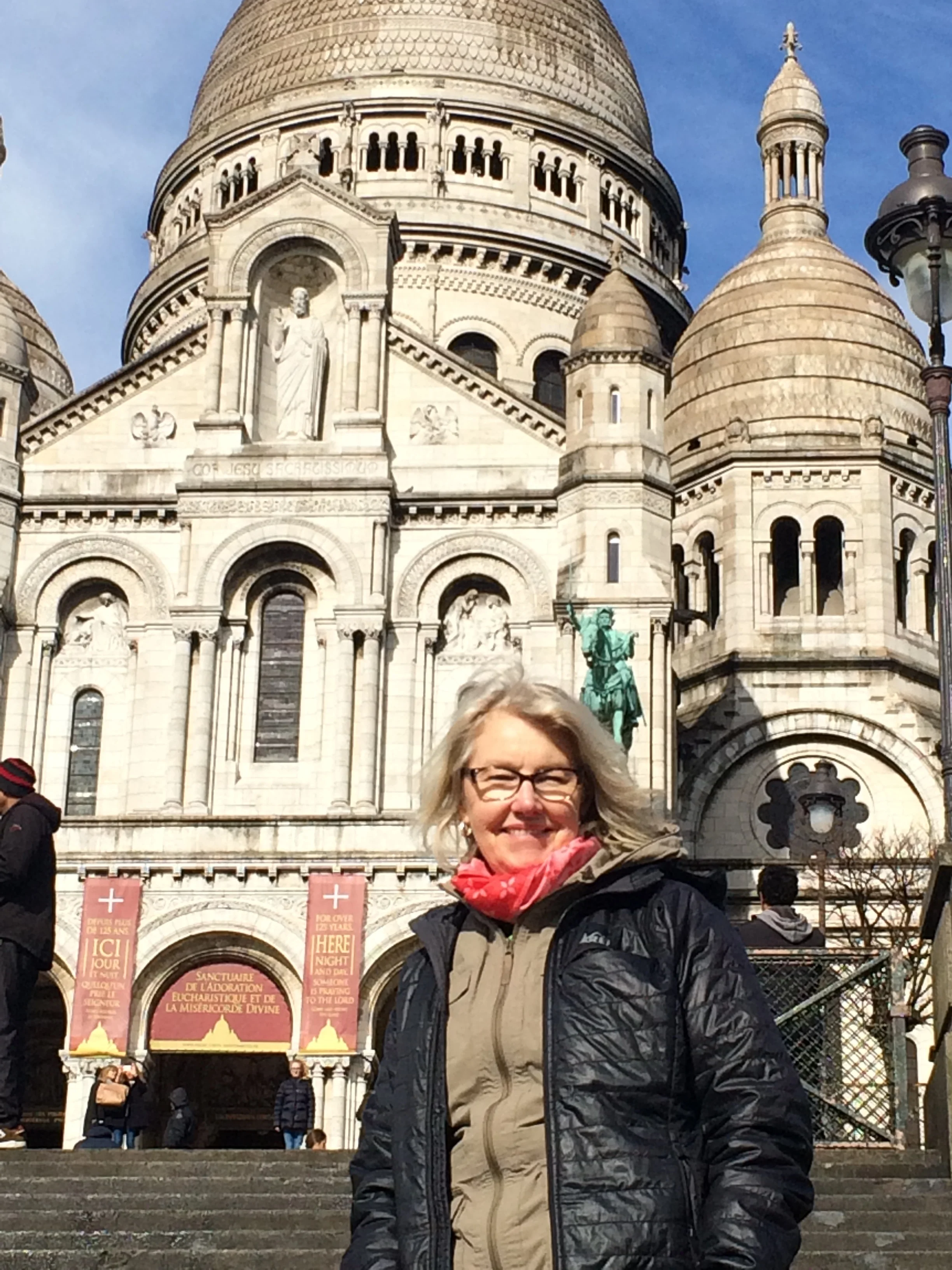
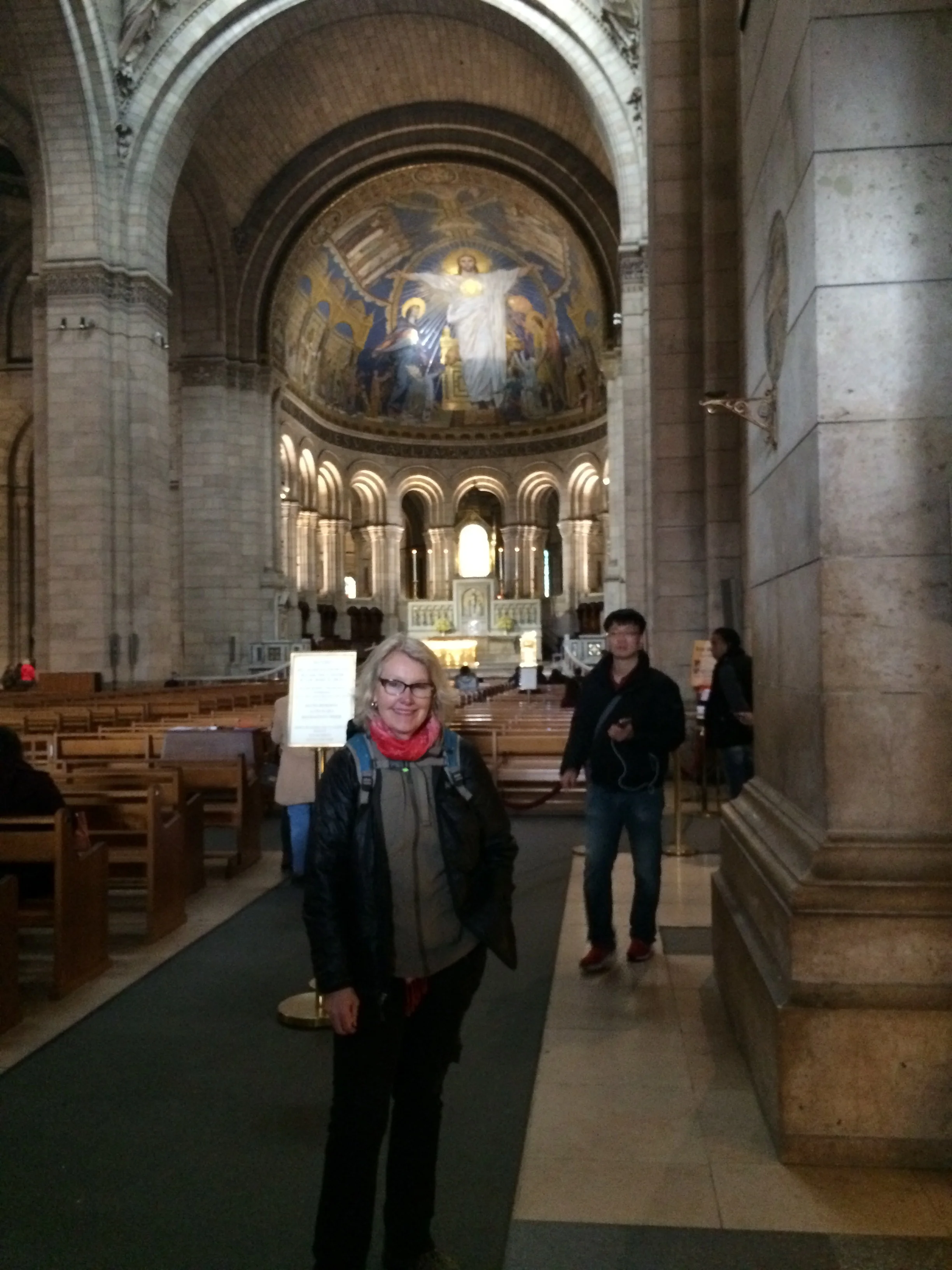
On our final day in Paris, we visited the Arc de Triomphe, a war memorial for lost soldiers commissioned by Napoléon, which is the centerpiece of the Champs-Elysee, a broad boulevard built by King Louis XIV, and where 12 streets come to this single point and roundabout. Then we traveled on the Funicular, a cable car, to the highest point in Paris known as Montmartre to obtain another high panoramic view the city and to visit the Sacre-Coeur Basilica, aka Sacred Heart Basilica. This church interior uses massive mosaic scenes to honor Christianity. The dome was particularly splendid. We walked down the hills to the surrounding   neighborhood that is historically known for its artist colony and bohemian culture, also night life, as it was the location of the Moulin Rouge.  

Traditional French lunch


We chose this neighborhood for late lunch and were rewarded by great food and views of the street life. We rode the Metro subway all over the place to see these sites and also managed to get back to the Republique station without problems. Our neighborhood is great, being so convenient for travel and with easy shopping. We saw many of the most famous sites of Paris, but there are tons of other stuff to do and see on a future trip.


Tomorrow we check out and catch the train to Normandy and the D-day battlefields.

Bavaria and the Black Forest

MUNICH

The Mayor of Berlin may talk poor, but certainly the Mayor of Munich wouldn't. This is a rich town of 1.4 Million people. It actually has two Apple computer stores. Even though bombed in WWII, it was part of Western Germany and not under the control of the Soviets. This is the home of BMW. Historically, this region was very rich due to the East and West salt trade routes, aka white gold, and the perfection of liquid gold, ie., Beer. Sorry beer fans, the Samaritans discovered beer first, the Egyptians taxed it first, but admittedly the Germans do have a magic touch. Hordes of folks come to Munich for “Oktoberfest”and expect mobs and expect to meet new drunken friends. We came in February, but the beer is still great. As well, this city was the home of the royal family of Bavaria which created palaces and went to war. When you think of Germany, you think of Bavarian landscapes.

A united Germany did not come together until Otto Von Bismarck moved with force in 1866. In 1871, Germany emerged under the reign of Kaiser Wilhelm I.

Before this unification, the regions of Germany were separate states that spread into Poland and were governed by separate leaders, called Electors, but who often said “I’m King” of my own fiefdom. In Bavaria, and its capital city of Munich, the Wilhelm and Ludwig clan governed from 1385 until 1918. They built a marvelous palace in stages called simply the Schatzkammer der Residenz. Yeah, real simple. You know German is as hard as the Portuguese language.

Main Square in Munich

Our first day starts with another walking tour This was a large group of 30 english speakers, only 4 Americans. Our guide was a funny bloke from the UK who had married a German girl and moved to Munich. He led us around the several squares that make up the historic district, being “cheeky”when the story needed some humor. On the other hand, he did remind us that Munich was the hometown of the National Socialist Party of the 1930’s and we walked through a neighborhood of Munich that suffered the “Night of Broken Glass”, as many cities did. Shortly thereafter,  jewish populations were relocated. The night before we did see one of Hitler’s former residence, a two story, white stucco, apartment building. No photo. This part of trip has made us remember our history lessons about the rise of Adolph Hitler. The “Kristallnache”was spurred on by the murder of a Nazi official in France by a single Jewish man. It was an extrapolation of a fraudulent conspiracy scenario directed toward the Jews. Find a scapegoat, then blame the entire group. 

Finally for fun, our guide helped us time our videos and photos of the moving Glockenspiel. It was a hoot waiting for the 43 hourly clock chimes to sound and then watch 32 figures perform two historical events, round and round, including a jousting match. This tower is part of the new town hall aka Neues Rathaus.   

The Glockenspiel - Part of the city hall.  The "dancers" perform on the hour

Our other major sites visited on day one include:

St. Peterskirche. The church of Saint Peter is Munich’s oldest church, first built in 1150, but reconstructed several times, The Gothic altar, baroque ceiling fresco and Rococo sculptures are quite lovely. What was interesting to us, was the fact this church and others were Catholic, not Protestant, as we saw in Dresden and Berlin. Granted, there were no icons, but the prominent confessionals gave it away. Here, the Germans were more aligned with the Swiss and French regarding religion. 

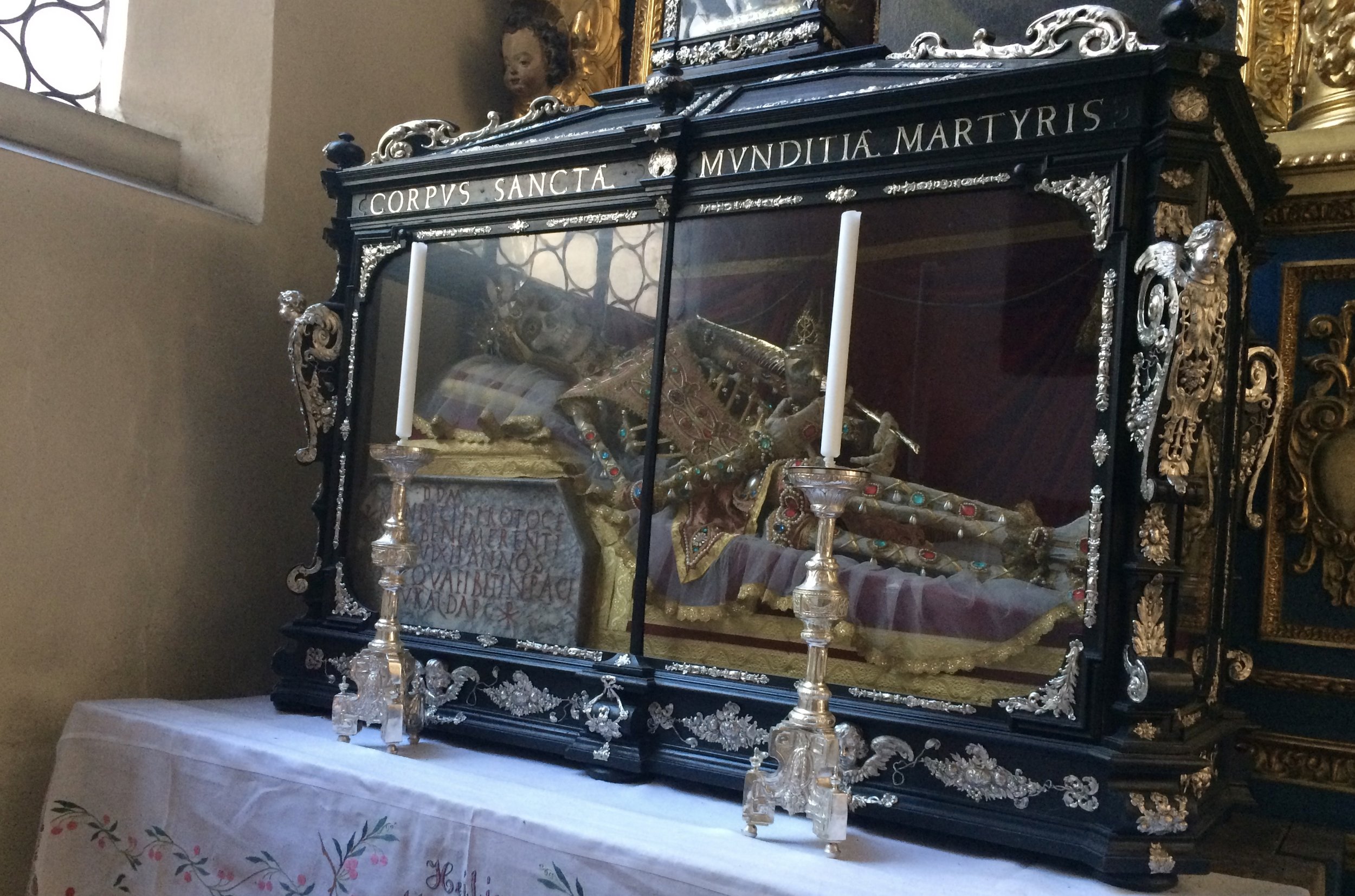
Frauenkirche. The Church of Our Lady was another large Catholic church, almost cathedral size, and sporting the tallest domed twin towers. Interestingly, there is a glass crypt displaying the full skeleton ofthe patron saint of single women. Those who ask in pray many find romance. This church is also quite lovely, except for the bones. We later learned that 30 percent of Munich residence are Catholic, and actually a lower percentage are Protestant. 

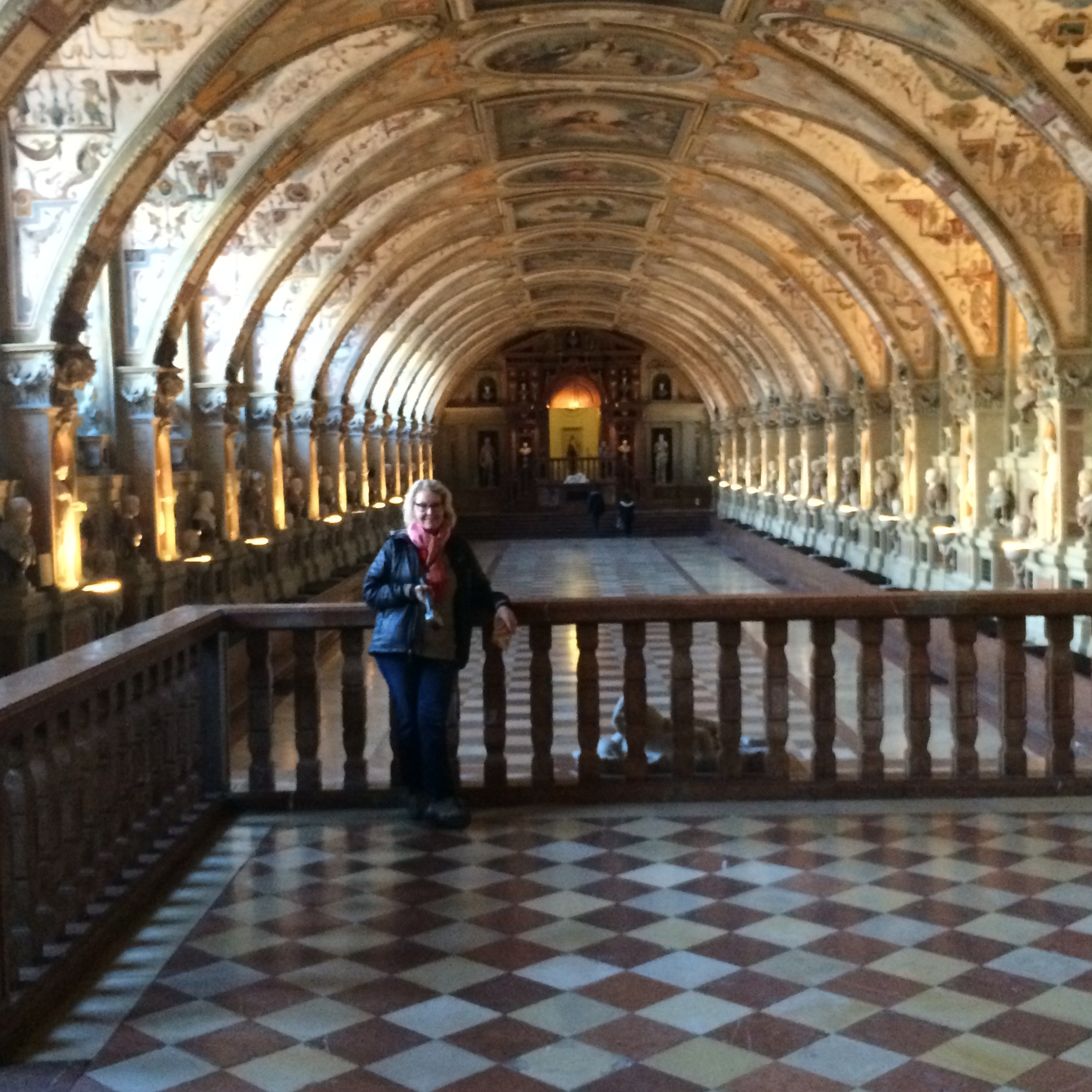
Schatzkammer Residenz. This palace is so big that we became weary walking from wing to wing. The opulence could only be surpassed by the French Kings, who apparently all the Bavarian kings wanted to emulate. We saw the Antiquarium and Reich Zimmer. These are fancy German names for the barrel vaulted hall with beautiful painted frescos, and the extravagantly decorated “ Rich Rooms” of Rococo art. Forget the Chinese porcelain and French furniture collections. Tired of the opulence, there is always a “Bier Garten” close at hand. In fact, the soccer hooligans were in town today, drinking early, as Munich was playing the UK Arsenal side.

Day 2 Off to see Castles.

We are driving through Bavaria on the so called Romantic Road on a tour to see castles. There are 200 castles in Germany, but we are concentrating on 2 castles that were built at the direction of Ludwig II, the King of Bavaria for 22 years, and are within 100KM of Munich. Ludwig II was an eccentric loner who idolized King Louis of France, known as the Sun King, and the German Composer Wagner. This combination of hero worship caused him to pursue fairy tale architecture, inside and out, at these summer palaces, which he occupied without the queen nor large entourage. We drove toward the Swiss Alps that are really magnificent with jagged edges and snow caps, and evergreen trees. The valleys are dotted with small and large farmhouses and fields, they are postcard pretty, see some photos below

Schloss Linderhof.  We pass through a small Bavarian village and turn off onto a windy side road and park. Once out of the bus we take a short walk until we round the corner and see this small white gem of a castle. The grounds and landscaping encompassing the smallish structure are stellar. The Linderhof was the favorite hiding place of the eccentric King Ludwig II, who had visited this landmark for a combined 14 years, and mostly by himself but with servants he rarely saw. There is a large formal double stairway in the center of the Castle and then the spaces connect room to room by doorways in a circular flow. There are no hallways and the castles structure is basically round. Each room, especially the bed chambers and chapel, are outrageously decorated in gold leaf and rococo figures which matching or coordinated drapes and wall coverings, and mirror after mirror. The dining room displayed the table on an elevated platform so it could be set up and supplied with food from the lower level without the King’s direct interaction with the wait staff. Unfortunately, no photos were allowed inside. 

Schloss Neuschwanstein. This snowy white palace surrounded by close mountain peaks and its long winding access road used by Ludwig II for summer getaways is the inspiration for Disney world. Enough Said. This massive palace may have been larger had Ludwig II lived to see its completion. It was interesting to see a video about “What was not Built”. This plan included a complete cathedral and several extra spires. Again the original had splendid detail and was beautiful, but was surprisingly dark inside, with lots of carved wood and smallish windows. The king stayed at the site 14 days. The construction took 10 years. This is one of the top 10 castles in Europe, which probably means one of the top in the world.

At lunch we sat with 3 lovely flight attendants on a 5 day layover. They had traveled a lot but still were surprised by our vigorous travel schedule. We have been on the road for 5 months, but there hasn't been much slowdown. Today's journey, for example, filled out 12 hours from portal to portal. The views of the landscape were a treat and the castles did bring visions of fairy tales, but also warrior knights in shining armor. Guys can like castles too. 

see the pics below of the castle, the walk up and two inside photos

Coffee and cake treat for our hard work


3rd day. Is this a down day or another Castle day?

This turned out to be a working day. We did locate another castle close by, but then we decided there was other stuff to do. We worked out some details on the final 2 legs of our German excursion. Then, we really pushed it to plan the route and locked down the housing accommodations for the upcoming French Adventure. We also did some work on the blog and published. Finally we had some laundry thrown in for style points. We are planning to take the Flixbus to Freiburg Im-Breisgau in the Black Forest area at 10.00 AM tomorrow.


One of the many great views from the bus

Freiburg

The bus to Freiburg was a nice experience, really easy to get the right bus, with a calm and fast and quiet roll, that got us to the station which was only several blocks from our hostel. This was a modern hostel with straight line architecture, heated bathroom flooring, and separate rooms occupying 3 floors. The staff was very friendly and the guests were of all ages.

There was a community kitchen like we had used in the past, and we do like the ability to cook our own meals when desired. There is a large walking bridge over traffic that starts near our place but ends immediately in town right by a modern opera house and the fantastic new glass library built for Albert Ludwig University. The school buildings intertwine with the city scape and allow the 24,000 students a grand place to study. As a college town this place is marvelous, with shops galore, a giant Cathedral, market around the Cathedral, bookstores with english sections, other splendid churches and public buildings, bikes and bike paths everywhere, two cinema multiplexes, and a lot of restaurants to mention a few things. We actually took advantage of the movie choices and saw La La Land in English, but with German sub-titles. Fun Musical film and the popcorn, after months without, really tasted good.

Freiburg

"Salad in Germany, fried potatoes and sausage strips

"Salad in Germany, fried potatoes and sausage strips

We found a hip German pub and ate tasty local food and drank some great pilsner beer. We walked all over the city and really enjoyed the ambience, energy and active people.


This city is in the middle of the Black Forest region. The pine trees are amazingly tall, straight, in rows, and dense, thereby casting dark shade in the forest. We wanted to enjoy this nature more so we caught a day train to another cute little Bavarian village for a bit of trekking. We wanted to stretch our legs a little like we did in Patagonia. Another train ride and we arrived in “Titisee”, which had more snow than we had observed before, but the sun shone, the sky was bright blue, and the air was clean and fresh. A glorious day. We had planned out about a 6km trek through the forest and around a lake by the village before we left. Our hand scribbled directions worked, as we turned left and right at the designated landmarks. Not to say that we did not question ourselves once or twice, but we knew we were on the right track when we observed a giant ski jump, actually four ski jumps side by side at the “Europa Ski Park”, clearly used for competitive training. Remember that ABC promo, “the agony of defeat”, well this sight gave us shivers. It was pretty cool though. Our trek got a little more hectic as the sky clouded up, temperatures dropped, and the packed snow got ice. We were walking on the crest of a hill path that was on the decline and had to be very careful, maybe ok for cross country skiing, not so good for hikes. We slowed down and made it to a manicured path that made the end to the trek fun again.

See our photos of the trek

Black Forest cake

Back in the little village we had a bite to eat, including “Bavarian Chocolate Torte Cake” with its drop or two of Schnapps, very tasty. Back on the train and back to Freiburg by 5.00 PM. That final evening was when we saw our movie and then, surprise, we found a Vietnamese Bistro for a late snack. It was really good. In fact we have seen many Vietnamese restaurants around Germany. Go figure! 


Our bus to Stuttgart was scheduled for late afternoon, so we had time to do more sightseeing in this great little city. We made sure we walked from end to end to see as much of the university as possible and discovered many more charming side streets and historic city entrance gates where taxes where once collected. We actually spied a small fort that was elevated above the city. We could climb to it, but our legs where a bit too sore from the forest trek, so that was a no.  We traveled back to our hostel to pickup luggage and walk back to our bus stop. Janet made friends with our receptionist and gave her some suggestions for getting a J1 Visa for a stateside internship. She was a sweet girl, very thankful, and spoke excellent English. 

The town is again postcard pretty, see below


Stuttgart

Back on the bus to Stuttgart and headed for the northern edge of the black forest region. This is an industrial city, better known as the homes of Mercedes Benz and Porsche.

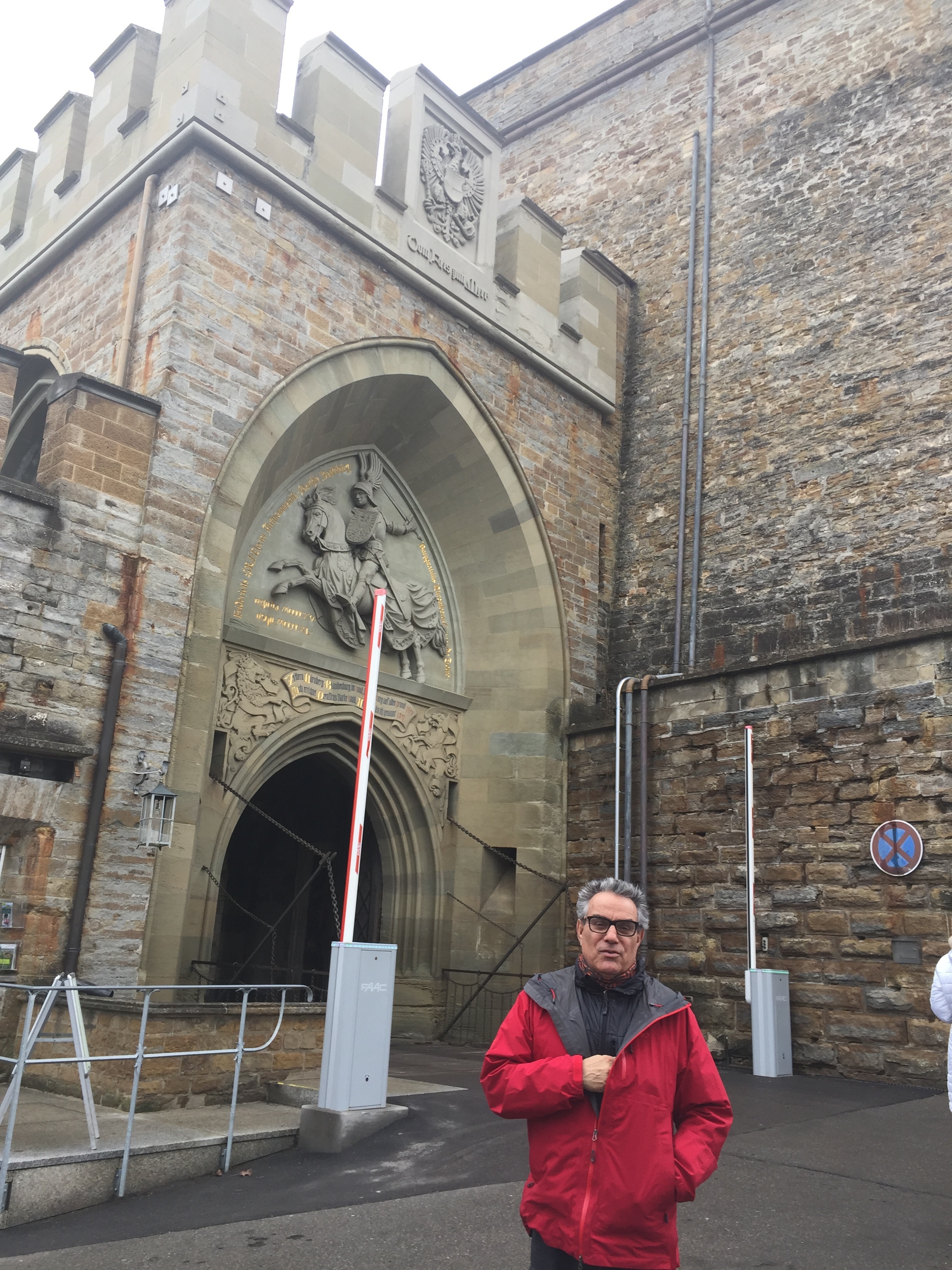
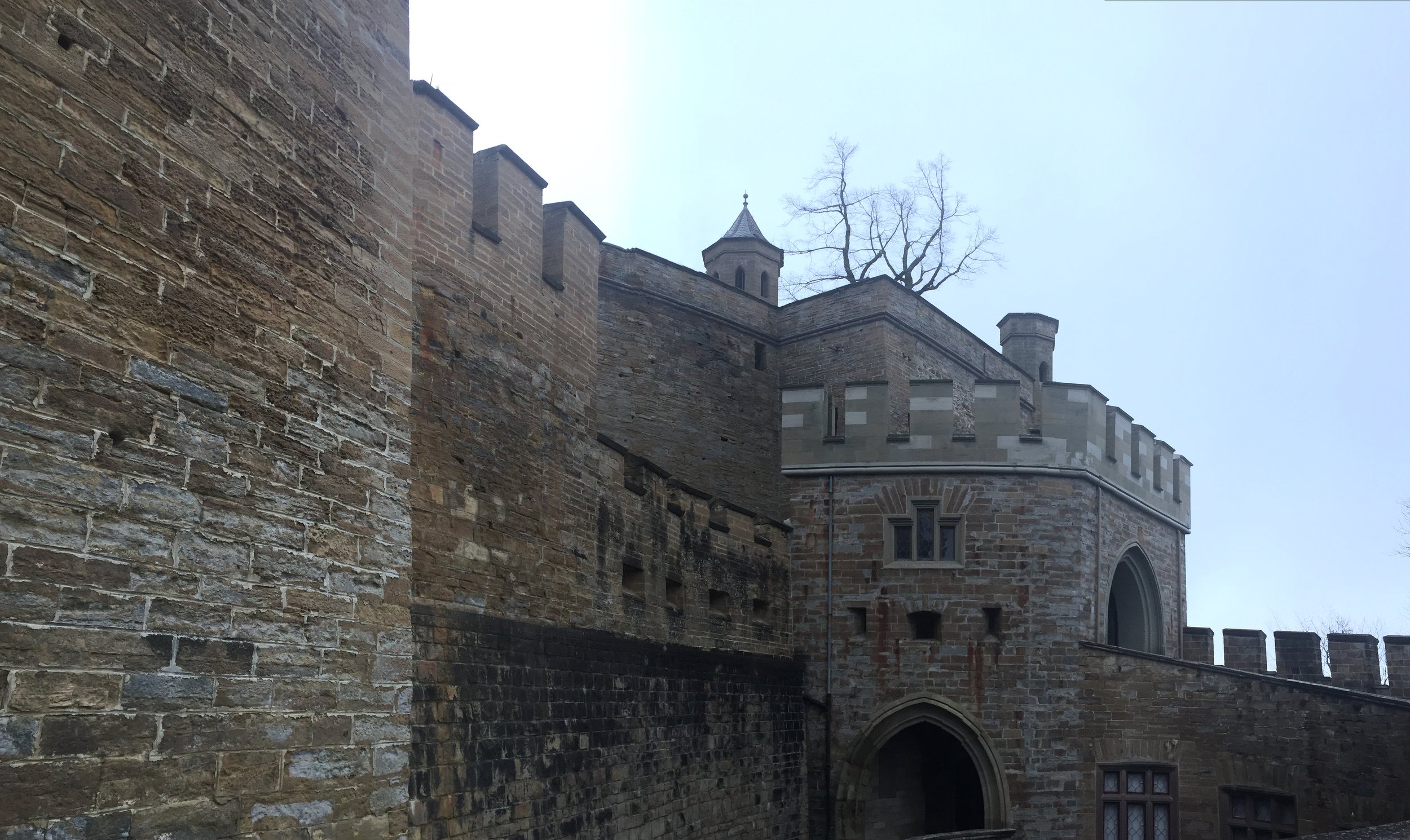
We probably would not have chosen to come here but for the important fact that the super high speed train, ICE, travels from there to Paris in like 4 hours. The city has the MB and Porsche Museums that we were told are really good, as well as the Kaiser’shouse, aka Residenzschloss, and an opera house. We decided instead to spend our time in Stuttgart on a day trip to one of the most renowned castles in Europe, so that probably means the world, a top ten. We planned and took the metro, then train 40 KM, then bus, to the Hohenzollern Castle, for a tour. This massive castle was located at the peak of a small mountain overlooking 360 degrees of expansive valleys that lodged two separate towns. The views were tremendous. It was far bigger than the Neuschwanstein Castle, of “Disney” duplication fame, but not as pretty. For example, It had 3 moats and 2 kill zones at the entrance, it had two chapels-Catholic and Protestant that were immaculately decorated, and numerous spires and towers. It was constructed of darkish brown stones and bricks, not the white sandstone of the Neuschwanstein. The interior was well appointed with the Kaiser’s actual furniture, art and portraits, and other period furnishings. The Kaiser Wilhem I’s crown and some jewels were on display as this castle is still owned by his lineage and not the government. It was a nice outing and a nice way to end our stay in Germany. Tomorrow, we are off to Paris, France.

See photos below, sorry for the quality, it was cold and cloudy again

Dresden Germany

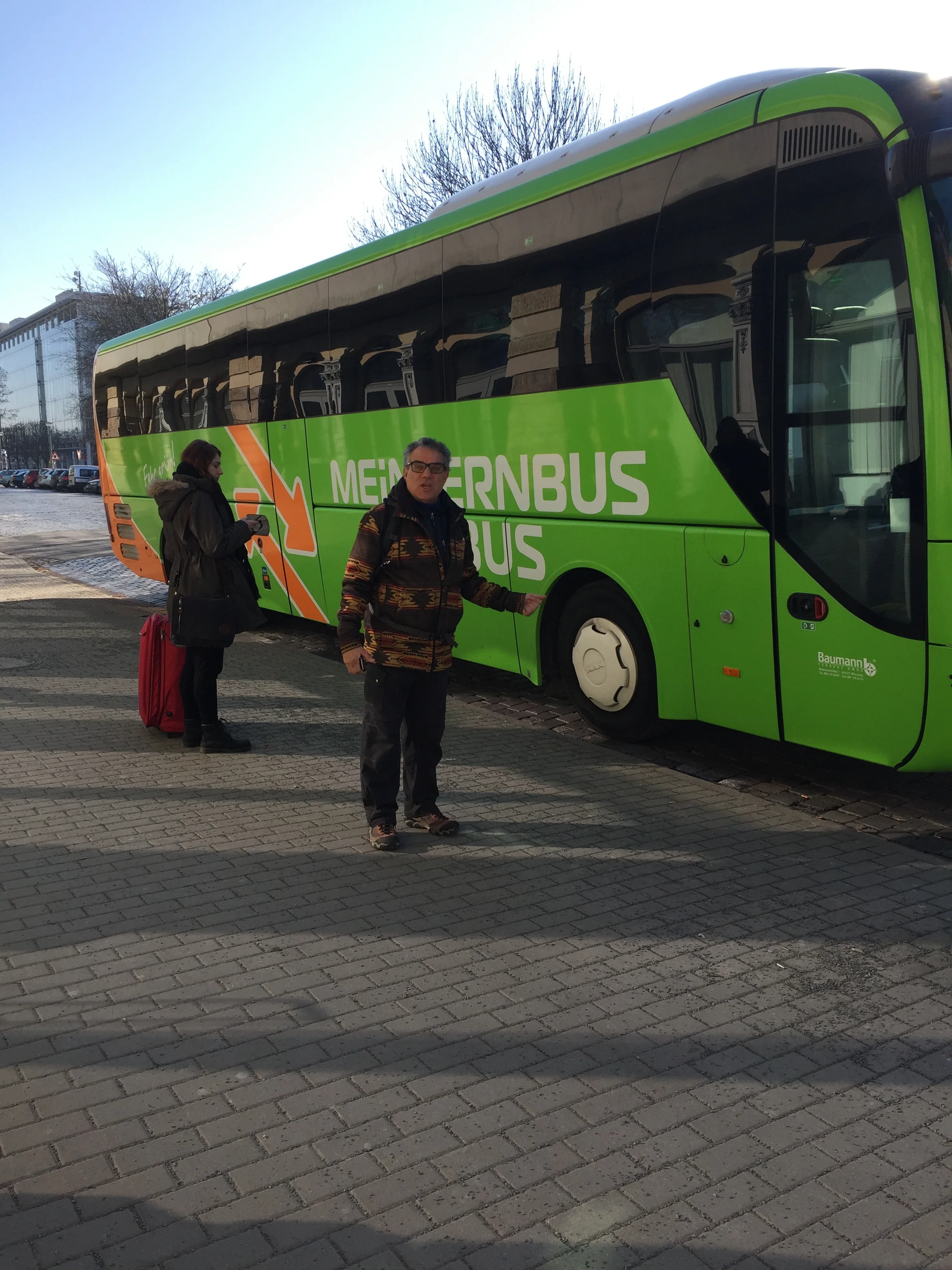
Frank boarding the bus

Frank boarding the bus

We decided to take the FlixBus from Berlin to Dresden. It cost only $15 for 2 tickets rather than the $50 for the train. We left Berlin in the Brandenburg Region and now have moved south to the Saxony Region, known for its castles, cobbled marketplaces and churches. In a few days we will move to Bavaria and then finish in the Black Forest of the Baden-Wurttemberg Region.

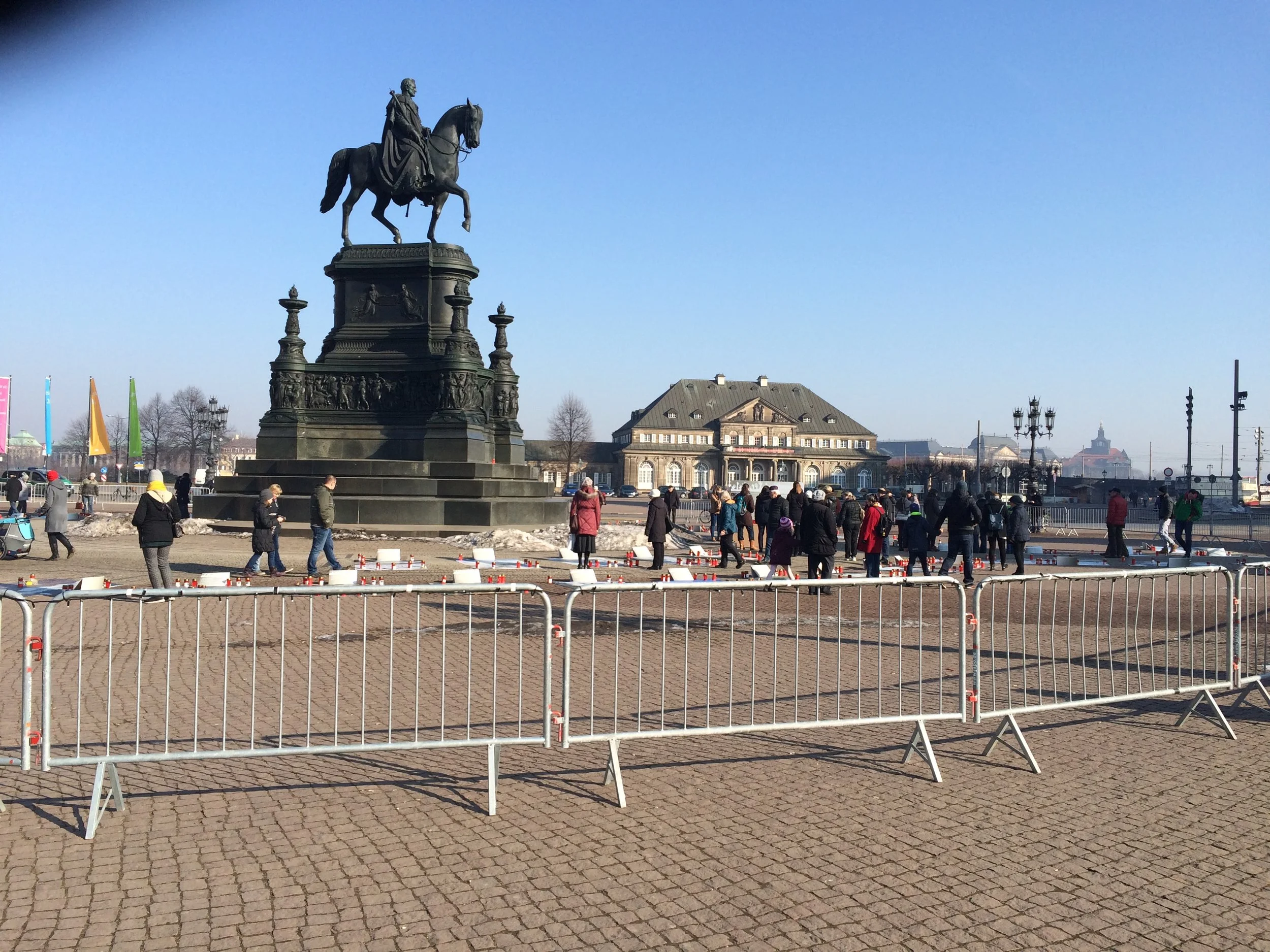
Dresden was devastated by a controversial bombing in WWII.  Over 90 percent of the historic area was destroyed.  The important landmarks have been rebuilt, but only relatively recently as Dresden was in East Germany and controlled by the Soviets who had neither the will nor money to do so. The motive for bombing so late in the war has raised issues about military strategy verses revenge and punishment. After arriving late in the day, we walked around the central city square, which is visible from our hotel window. People where all around, strolling on this Sunday afternoon. We organized our thoughts about the sites we would see. 

Dresden Center Square where our hotel is

On first full day in Dresden is February 13th. This is the 72nd anniversary of the bombing that continued 3 days by UK and US forces.  There is a special ceremony scheduled for the evening at the town central.  After breakfast we decide to visit a few important sites, then an afternoon walking tour.

We circled the city center and received historical information from the local information center.  

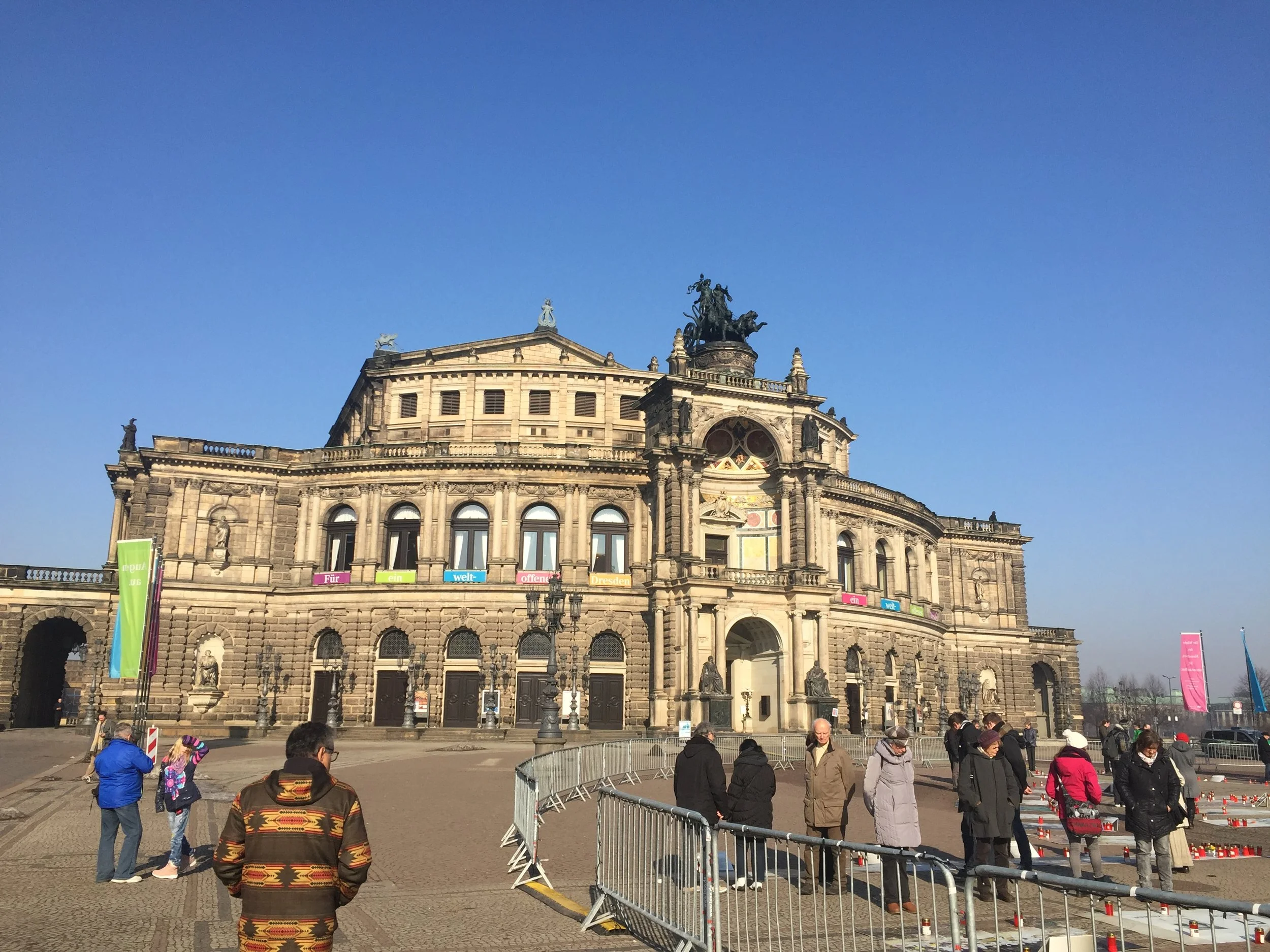
The city of Dresden first gained notoriety by charging merchants who needed to use its Bridge across the Elbe River as part of the trading routes through Europe and was the home of Saxony’s royal family. Later, August III, wanted to expand the fame of himself and Dresden and built wonderful palaces and churches, and the Opera House.  He also became King of Poland which required him to become Catholic.  But Saxony was the home of Martin Luther, the Protestant reformer, so the King had to keep his subjects happy by building the protestant Cathedral known as Frauenkirche. 

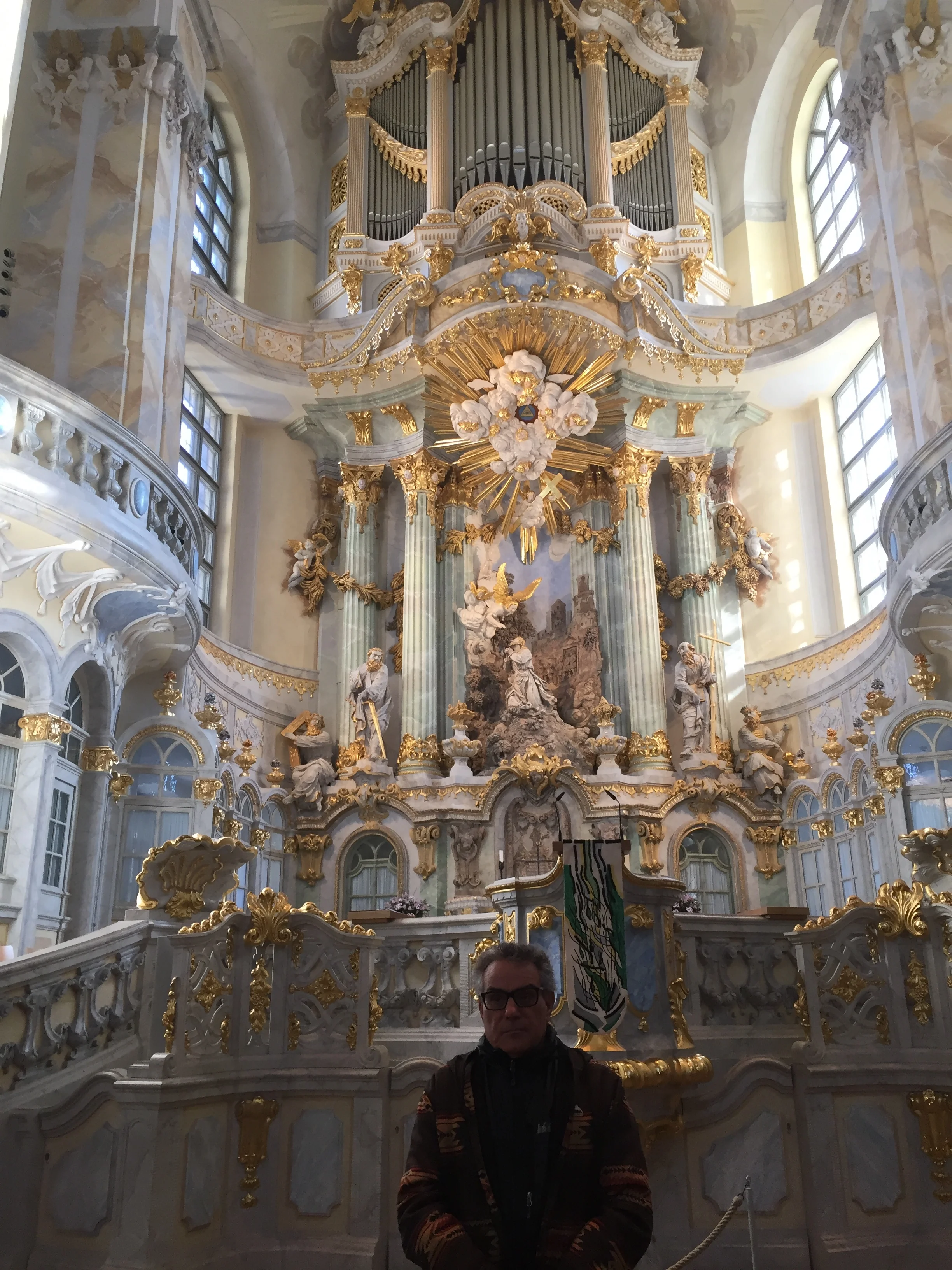
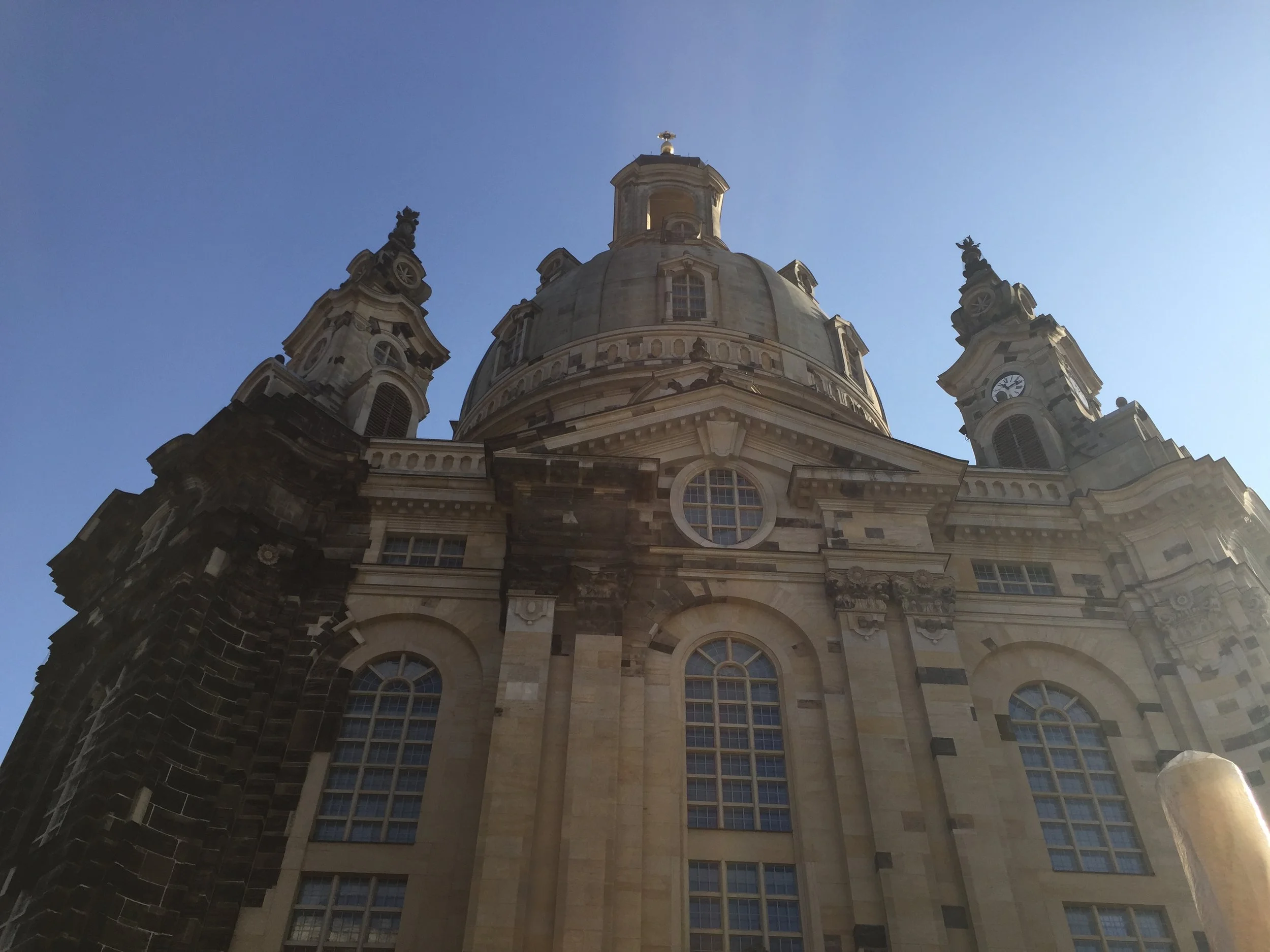
Frank outside the Frauenkirche.  

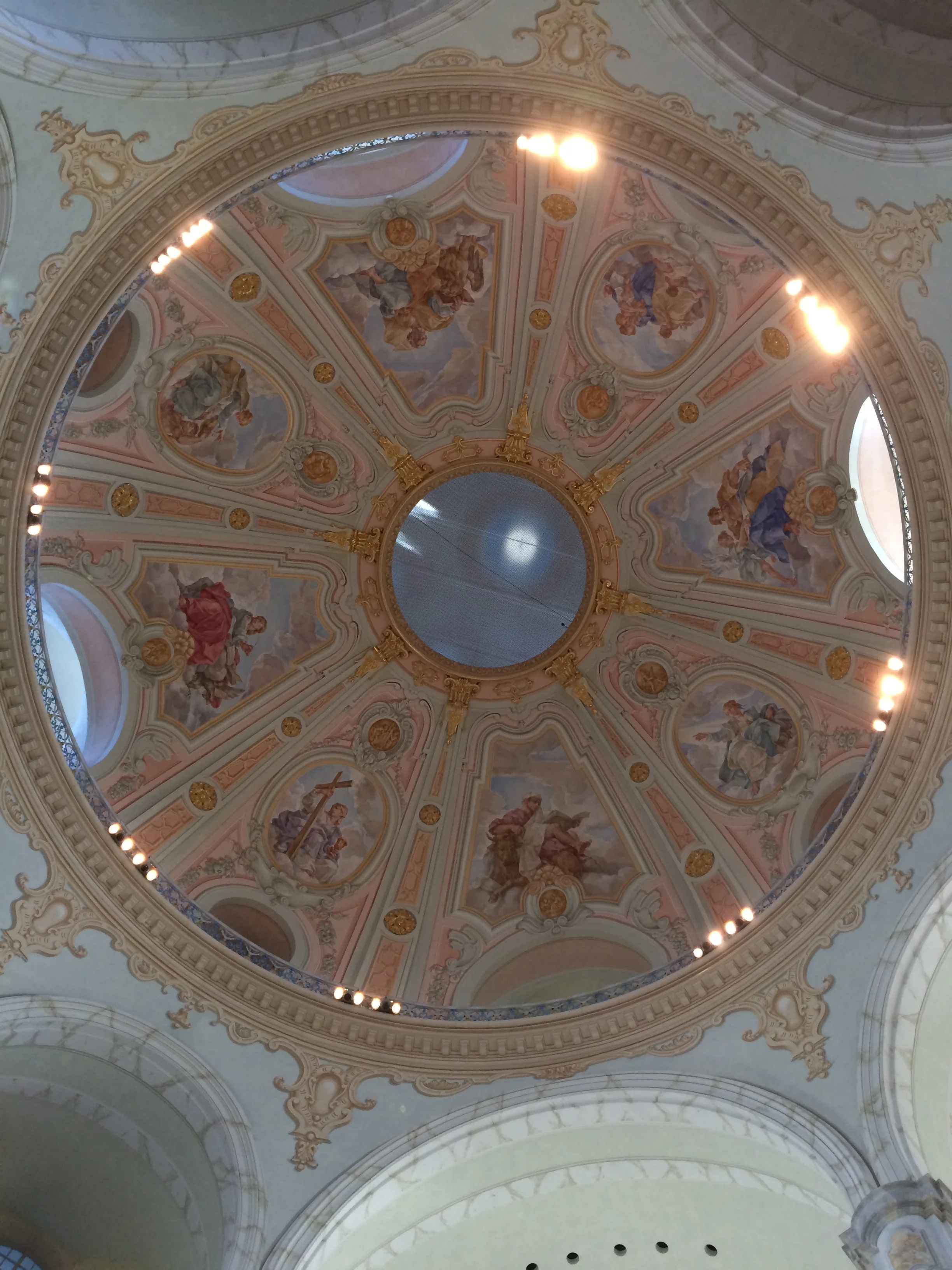
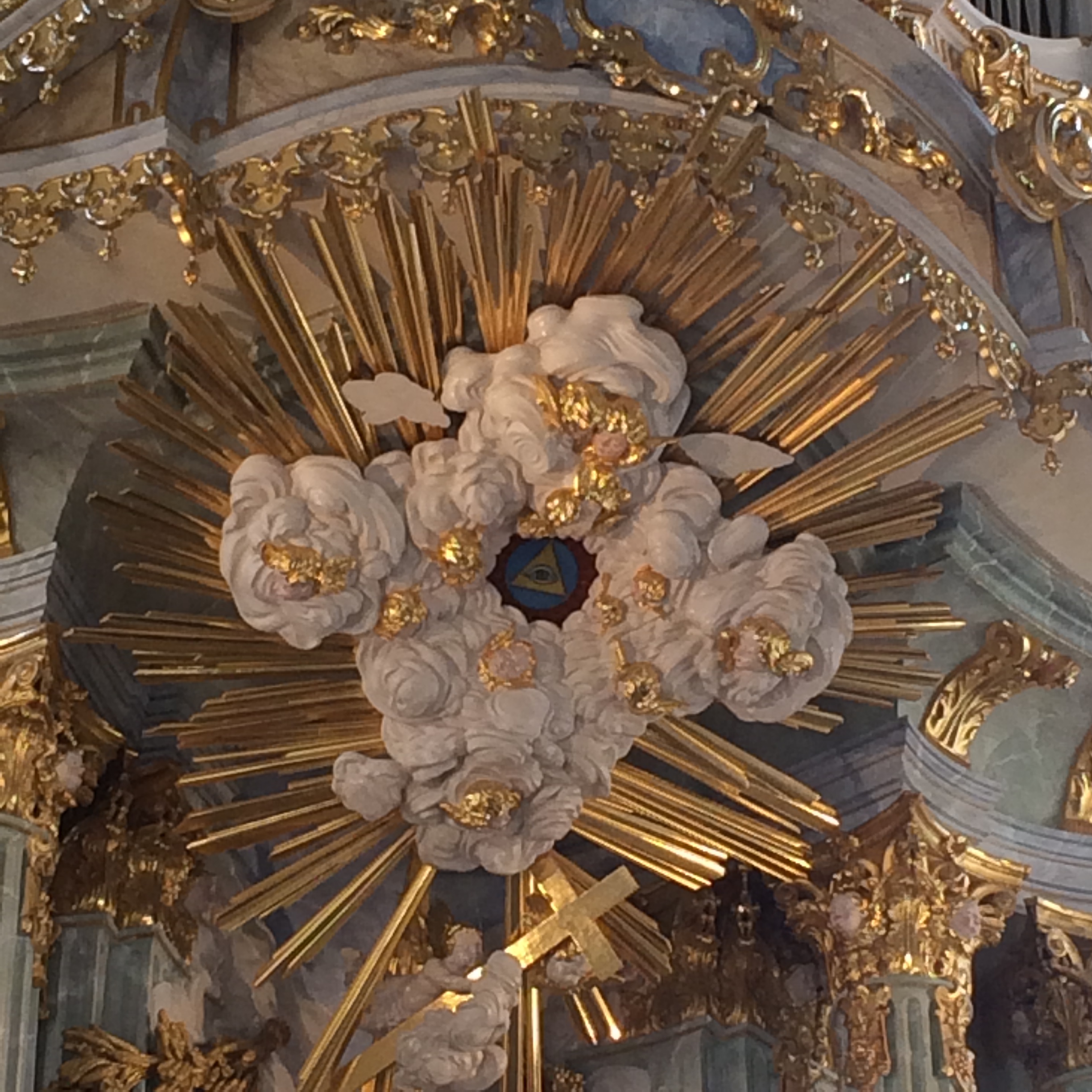
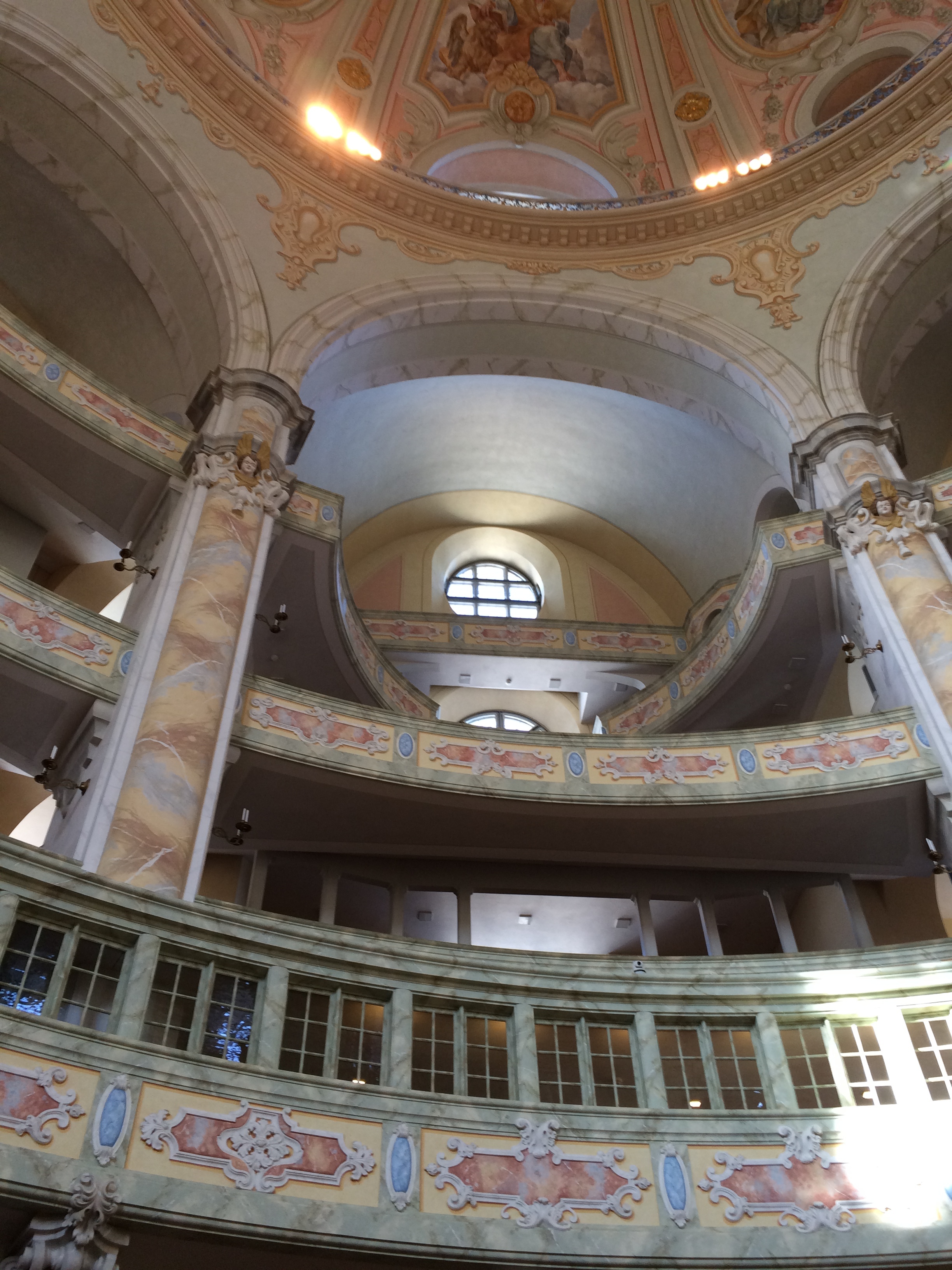
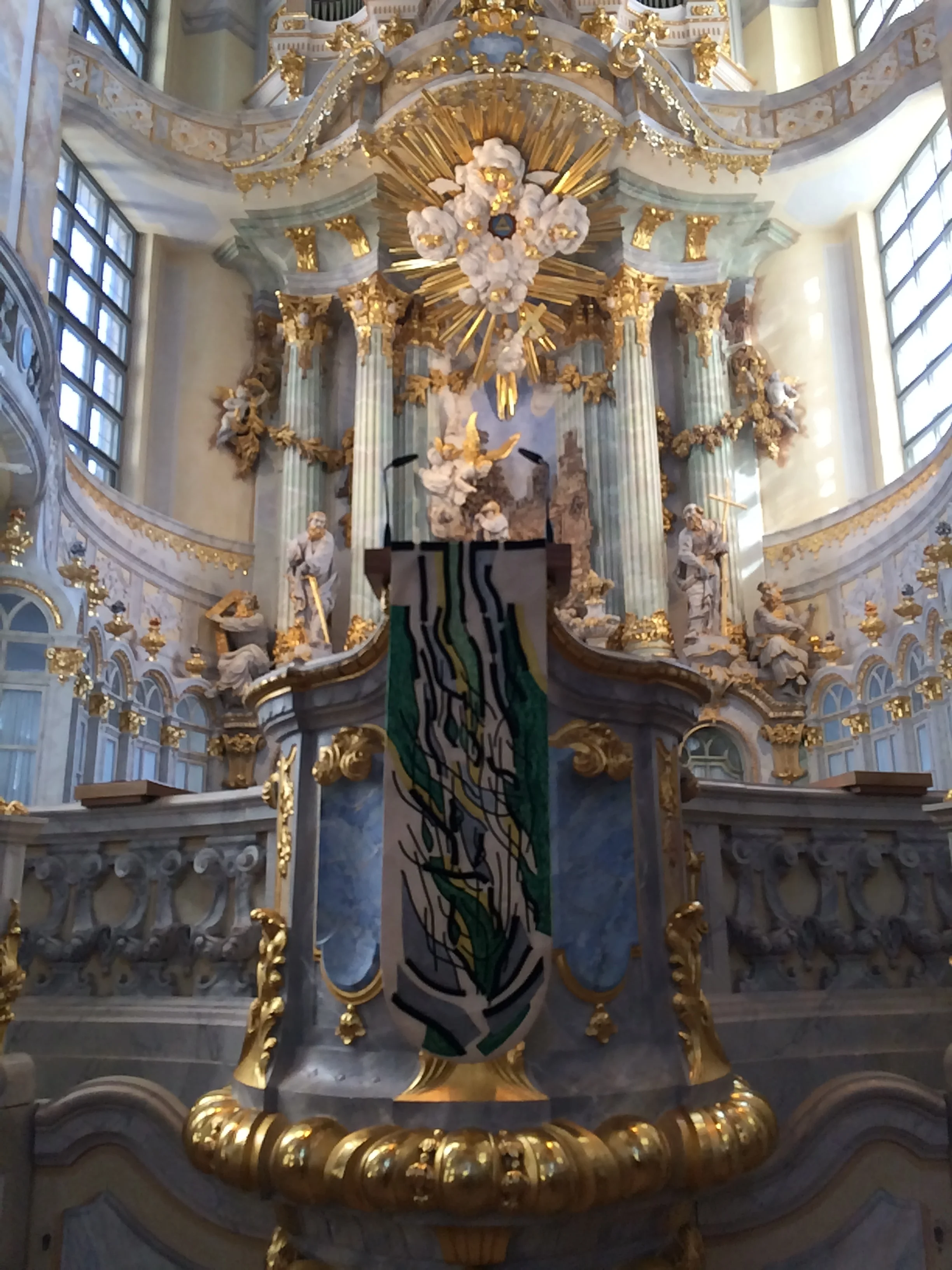
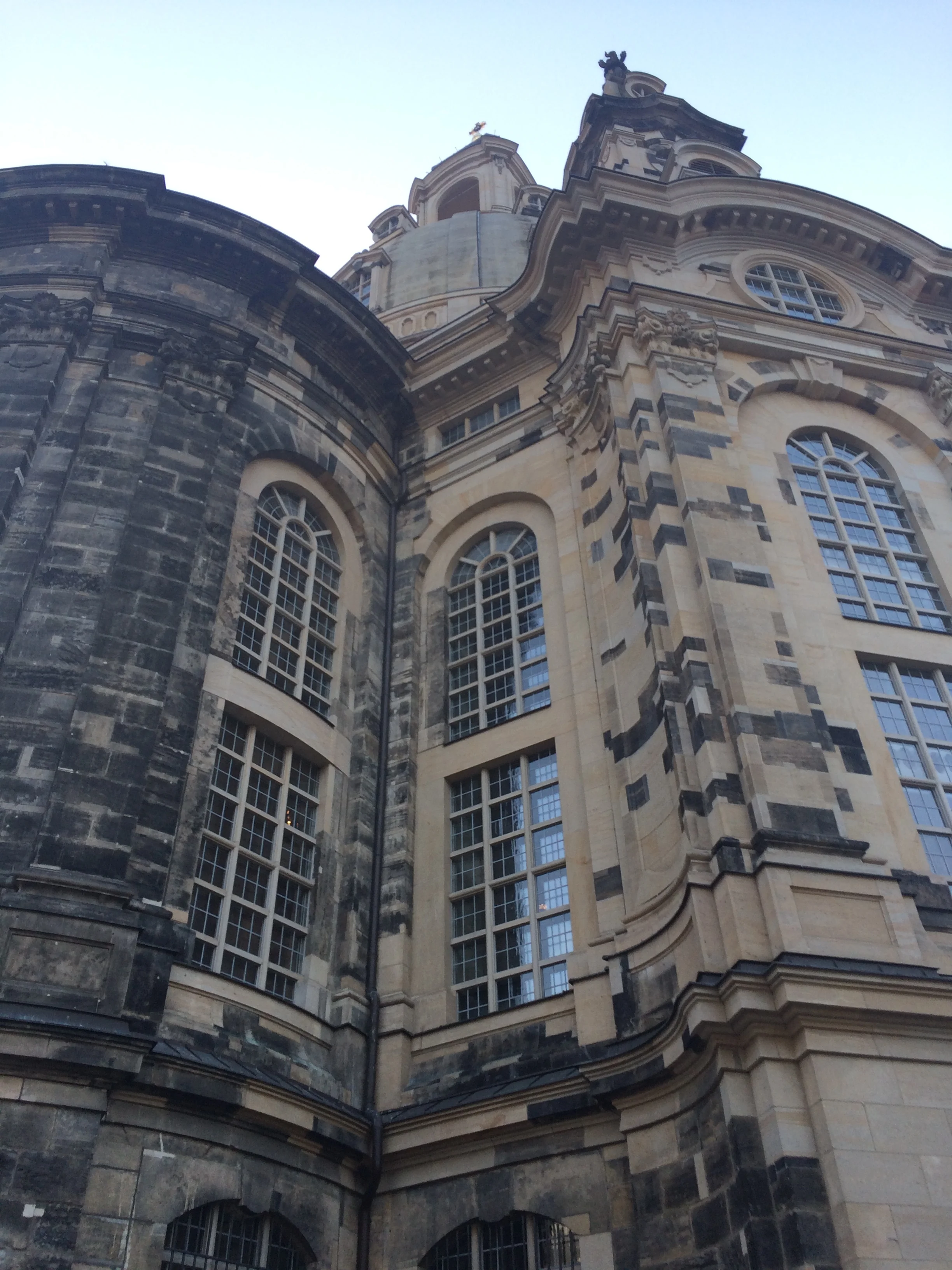
So for our first stop, we visited this cathedral and we were really amazed with the beauty.  The entire church was renovated in the late 1990’s. The reconstruction cost $180 Million, most of the money coming from the UK and USA. The exterior still contains blemishes from the fire that followed the bombing as do most buildings in this town. It is impressive. We saw a short movie about the history and reconstruction. The host verified, “English”, we said yes, but added “ American”. The old guy replied, “Love, Love”. We felt good about that.  Guess he might feel different about Brits.

The black stones are original the light are new

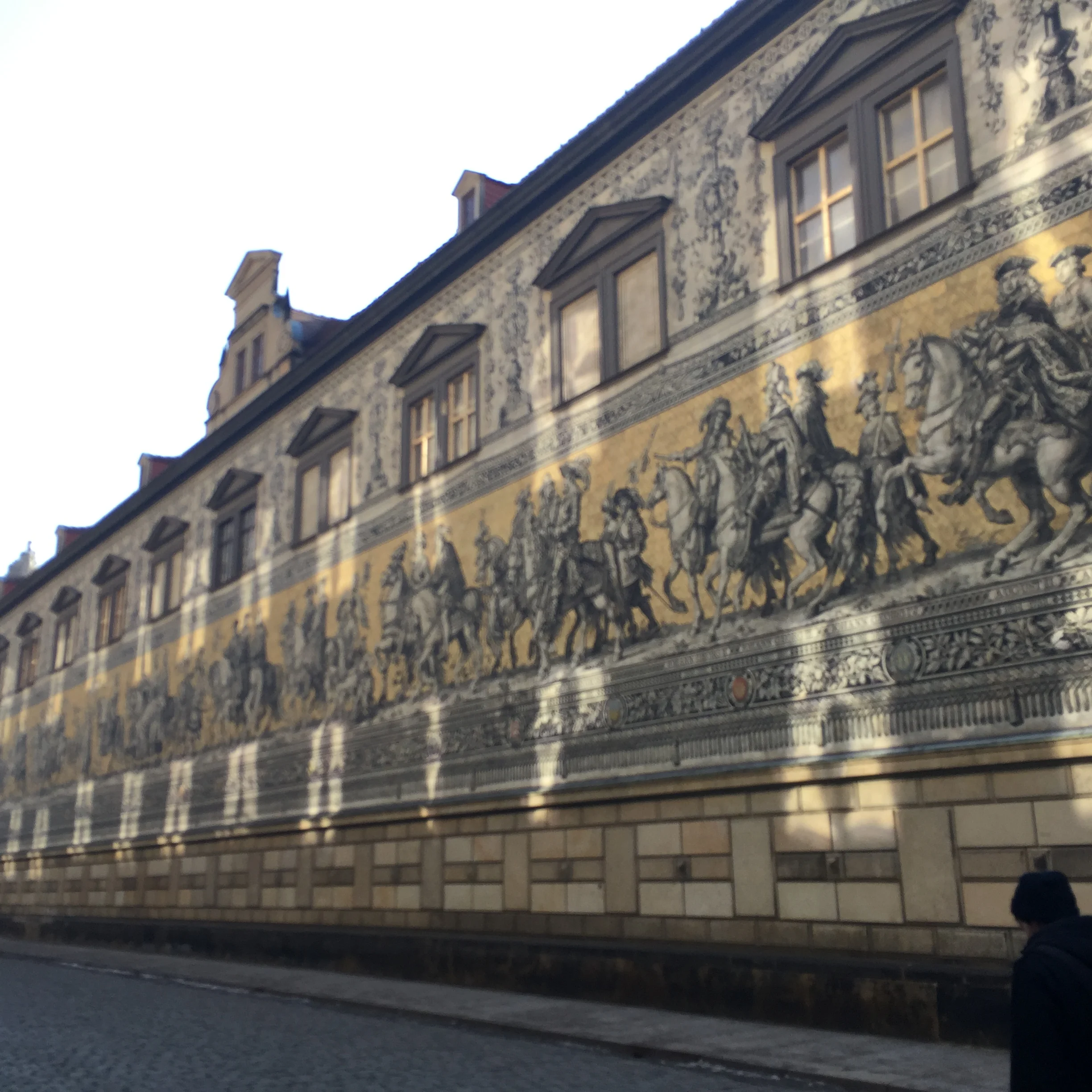
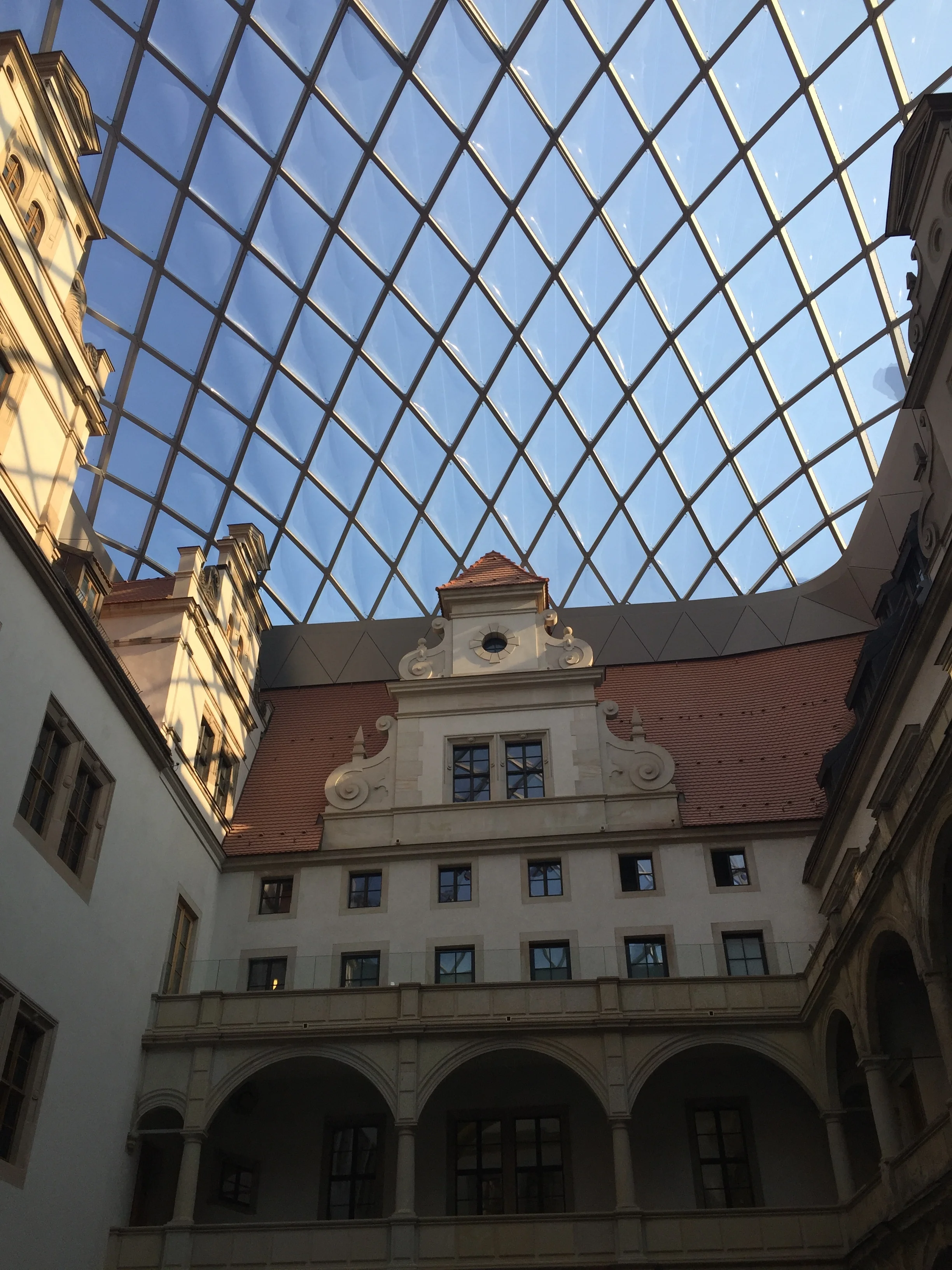
Our  walking tour was small, just us and a fellow American from California who was on an extended travel schedule.  Nice guy who was moving around the planet on a reverse course from us.  We spent the afternoon visiting all the major sites.  First  the former Palace residence of August III aka “August the Strong”, who ruled this area, Saxony, for 60 years. The Palace, once it was rebuilt, has now been turned into a wonderful 3 story Museum of royal jewels and art, and statuary, and weapons, and other royal gifts accumulated during his reign. The court yard has been covered by a clear geodesic dome designed by an American architect. There is still work to be done in the second courtyard. It is really a very interesting display that shows the wealth of the King.  See the below pics as great examples of the Baroque style buildings lining the historical city center

Our pub lunch of sausage, pickles, pretzels and beer

After our tour we had a traditional german lunch and beers with our fellow american tour mate.  We discussed our travels and exchanged suggestions. It was a relaxing stop before more sight seeing.  One of the great benefits of our slow travel style is meeting and sharing time with other travelers.  


Since yesterday a large sand scape has been built in the square which will be used for a lighted candle memorial. The residents are set to stand hand in hand and encircle the city. After a day of sight seeing, it is now 6.00 P.M., and the bells of the many churches start to chime as the memorial begins.


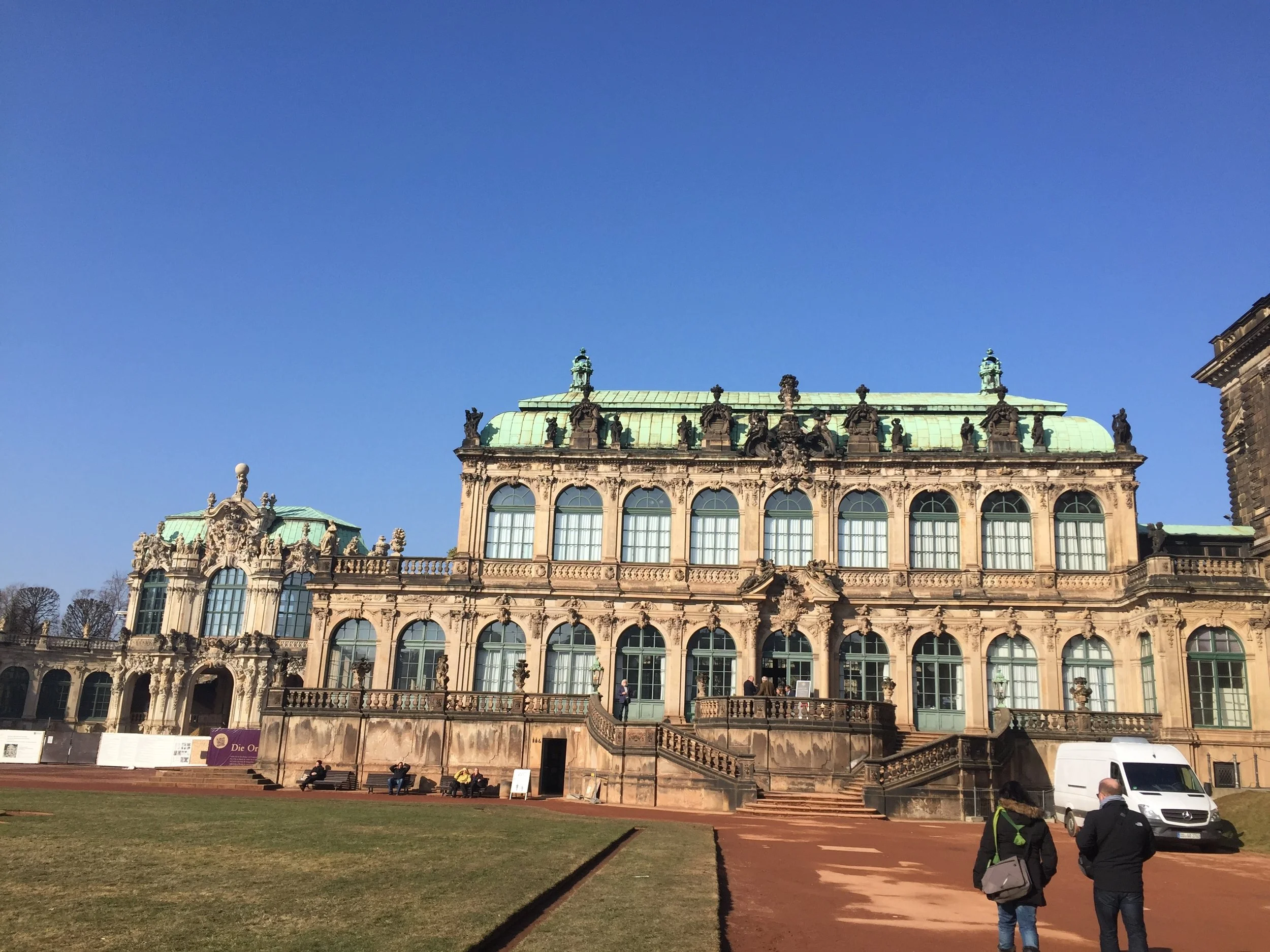
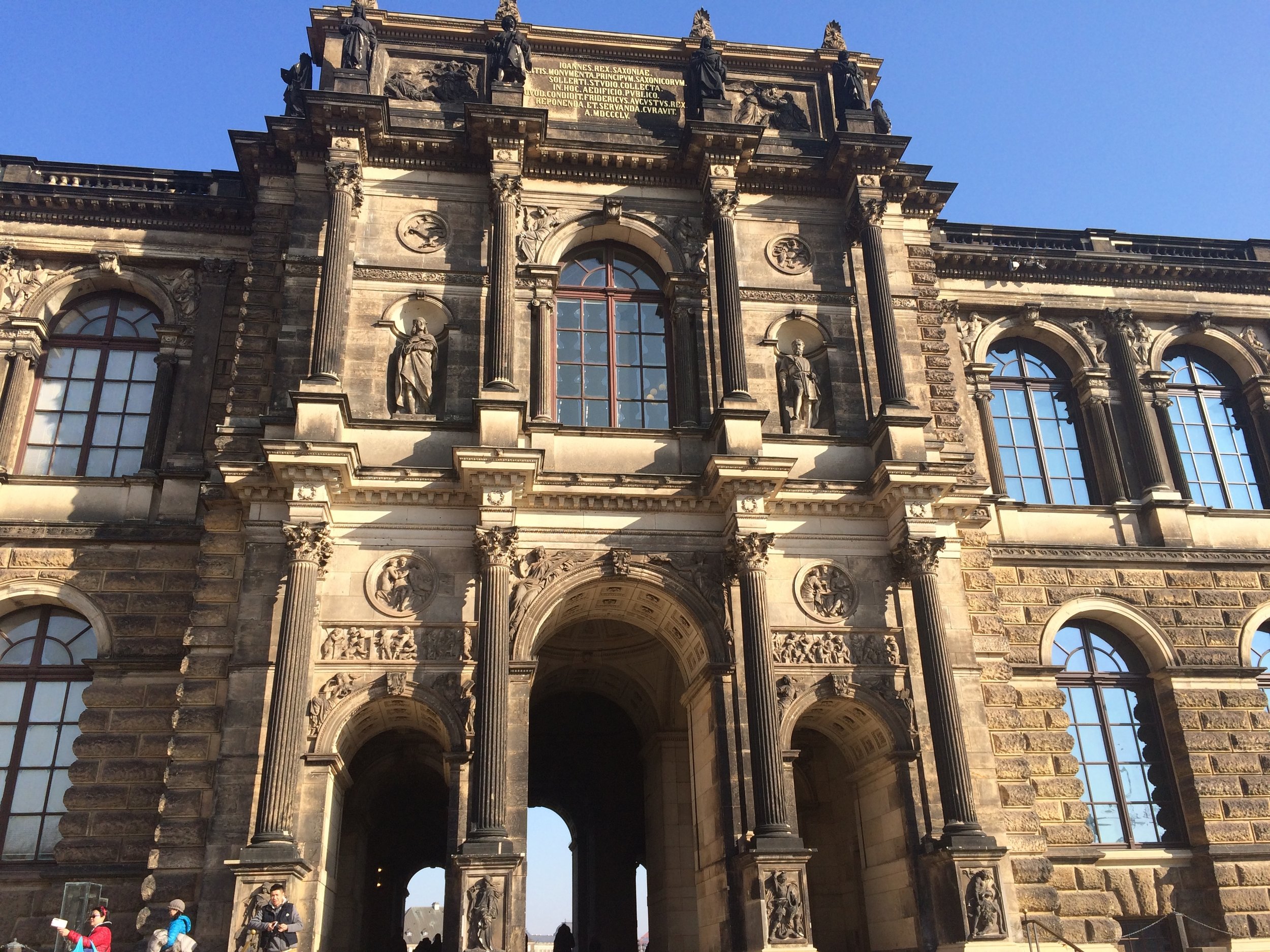
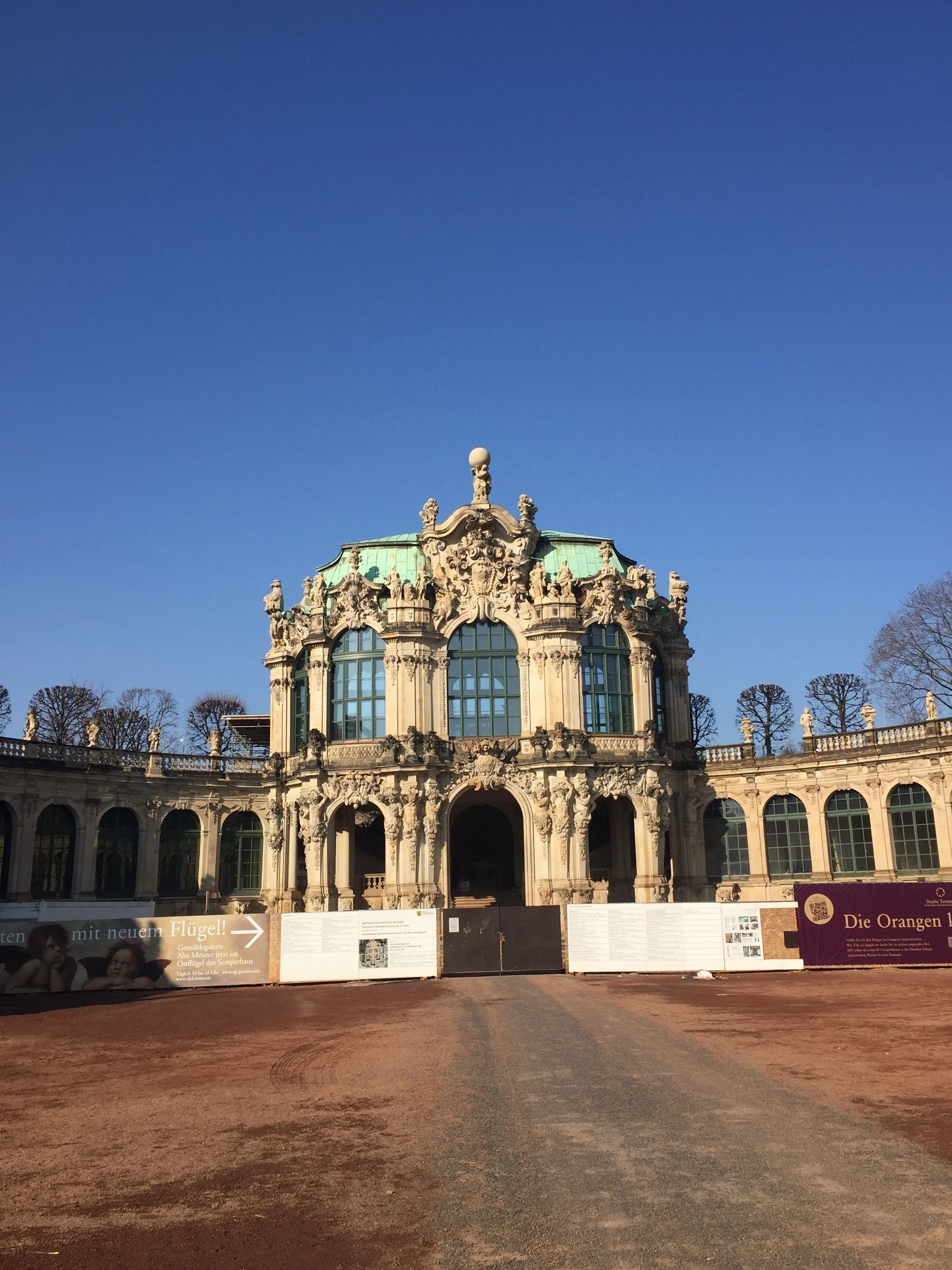
On our second and last day in Dresden. We are taking the Bus at 12:30 to Munich. Just enough time to get a couple more hours of sight seeing in. There is spectacular museum that we will run through before we take off, the Zwinger.  The Zwinger, is a marvelous palace initially built in a “U” shape by August III, with the open end facing the river Elbe. This was August’s magic fair ground and play area where royal outdoor activities took place and gardens viewed. This is a marvelous area with expansive lawn and fountains surrounded by the Baroque architecture of the palace. Interestingly, the term “Zwinger” is derived from the German word describing the “dead zone” between castle walls. Later a fourth building was erected that closed the U and that is where the Art museum is located. This was our target,  where the works of great Old Masters were displayed. Unfortunately, the Porcelain collection from China was not open, though visible through the courtyard windows. We where able to see works by John Paul Ruebens, Bernardo Belleto aka Canaletto, the landscape painter, and Raffael, and other masters from Europe, derived from the 15th to 18th century and usually depicting some religious theme or landscapes. We had to cut the visit short in order to get to our Flixbus for the cheap 7 hour drive to Munich. We thought about taking a train, but the cost was substantially more and the time frame not substantially better, along with a change of trains, no thanks.

The museum was a no picture zone but we managed these two

Times Up! We are off to Munich in the Bavarian province of Germany.

Berlin Germany

Frank's first German beer

We landed in Berlin. It is very cold. We immediately navigated the metro system and got to the apartment for $5.60, rather than a $60.00 taxi ride. We have a great Airbnb located near a main road that ends at the Brandenburg Gates in the Charlottenberg district. The area has small restaurants on the corners and after the plane flight we had our first meal at the local pub. We liked the overture of a celebratory small glass of beer that was offered for free and set in front or us as a sign of welcome as soon as we sat down. We walked the neighborhood and shopped at the local grocery in order to make our own meals.


Brandenburg Gates

We signed up for our customary walking tour that started at the Gates.  These have magnificent columns which you must pass through on foot. It was so cold that we all had to stop for several warm up breaks. We did get a energetic tour guide from England who lived in Berlin and had obtained her Masters degree in German history. She was a pistol. The tour was made very interesting by her knowledge and insightful comments. She talked about Berlin’s prior history and then about the rise of the Nazi party. Of note for WWII buffs were several items:

  • The Holocaust Plaza designed by an American artist was powerful and controversial; it looked like a grave yard with blocks of granite of various sizes situated in walkways of different depths; so you can envision a vast grave yard yet also stand by a single tombstone and reflect upon the tragedy.
  • All the Nazi buildings were destroyed in the war and thereafter, except for the Air Force building. This large office building was too functional so even the Russians used it. Some say there was a gentlemen’s agreement between the Germans and Brits not to bomb each other's headquarters, but that is hard to prove.  

See the pics below, so sorry on the quality, it was so cold on our tour that our camera lens kept fogging up.

The pathway marking where the wall was throughout the city

As you know the  Berlin Wall split the city. We saw parts of the actual wall and also a pathway of bricks that run through the streets to mark the path of the wall and the accompanying “dead zone”; people shot on sight in the area. There were a series of crossing checkpoints between Russians and the French, English, and American controlled sectors of Berlin. Check point C, or “Charlie”,  the crossover between the Russian sector and US sector is still dramatized with bunker in the street and pseudo soldiers.

Check point Charlie

Hitler's "bunker" parking lot

The parking lot

In a nondescript, dirt parking lot maybe 4 lanes wide is the site of “Hitler’s suicide”. Under our feet on the muddy surface was the location of the bunker where Adolph Hitler and Eva Braun, his long time girlfriend and one month wife, killed themselves with poison capsules and for Hitler, a shot to the head. The Russians destroyed the large Nazi office building that covered the site after uncovering the bunker and flood the area. Hitler’s body was cremated and the ashes thrown into the Rhine river. The plan, then and now, was to disallow Hitler a burial place to martyr. The German government concurs.


Charlottenberg

Our second day was very cold again so we opted for a short 10 minute walk to the magnificent palace of Schloss Charlottenberg,  the summer home of many Kaisers.  There are so many King Wilhelms and King Frederichs in the German hierarchy that we can't keep them straight. This palace was used by Frederich I , the “Soldier King”, and his wife Sophie Charlotte, and the disappointing non-soldier son, Frederich II, and follows the baroque style of Germany. Each room is themed and connected to the next room by door, not hallways. The place is stunning. For example, the grand ballroom is ornately decorated in green with gold sculptures in the shape of floral trestles attached to the walls. The idea was for guests to feel like they were dancing in the gardens. The furniture that has survived are pieces of art.

Market Gate of Miletus

Museum Island

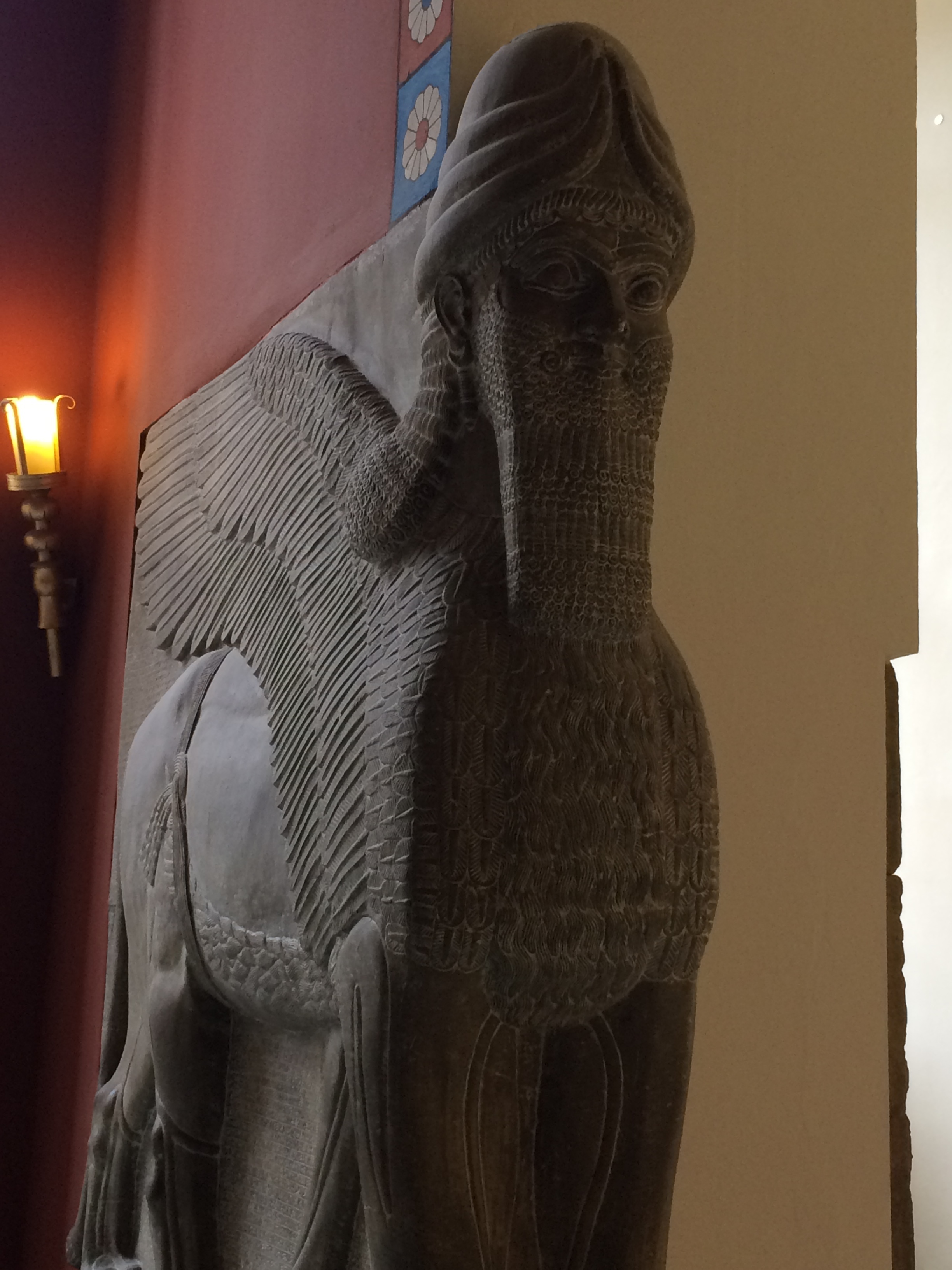
On the third day we went to the well known “museum island” located in the middle of Berlin surrounded by the river of Spree.  Berlin has about 50 museums, but on this day we chose to visit 3 museums of different types that were situated next door to each other. The first was the Pergamon Museum, which has antiquities from the Assyrian area of the Middle East, now Syria and Iraq. The structures and artifacts on display are similar to Egypt, but the kings and gods are different. The most amazing presentation are the “Ishtar Gate of Babylon” and the “Market Gate of Miletus”. The Germans have erected structures that display these gates as in ancient times. Unfortunately the Pergamon Alter, pride of the museum and namesake, was not available as it is under renovation. FYI, there is a lot of construction and restoration in Berlin, including a brand new science museum that may be done in 2018.

The second was the Neues Museum, which displays artifacts from ancient Egypt and its Nubian culture. Since we had already been in Egypt, we were most interested in seeing the bust of Egyptian Queen Nerfertiti, 1340 BC., and the Golden Hat, 1000 BC., a predictor of solar movement. We had a nice lunch and dessert here and also chatted with a friendly Munich resident who told us about the things we should see there.

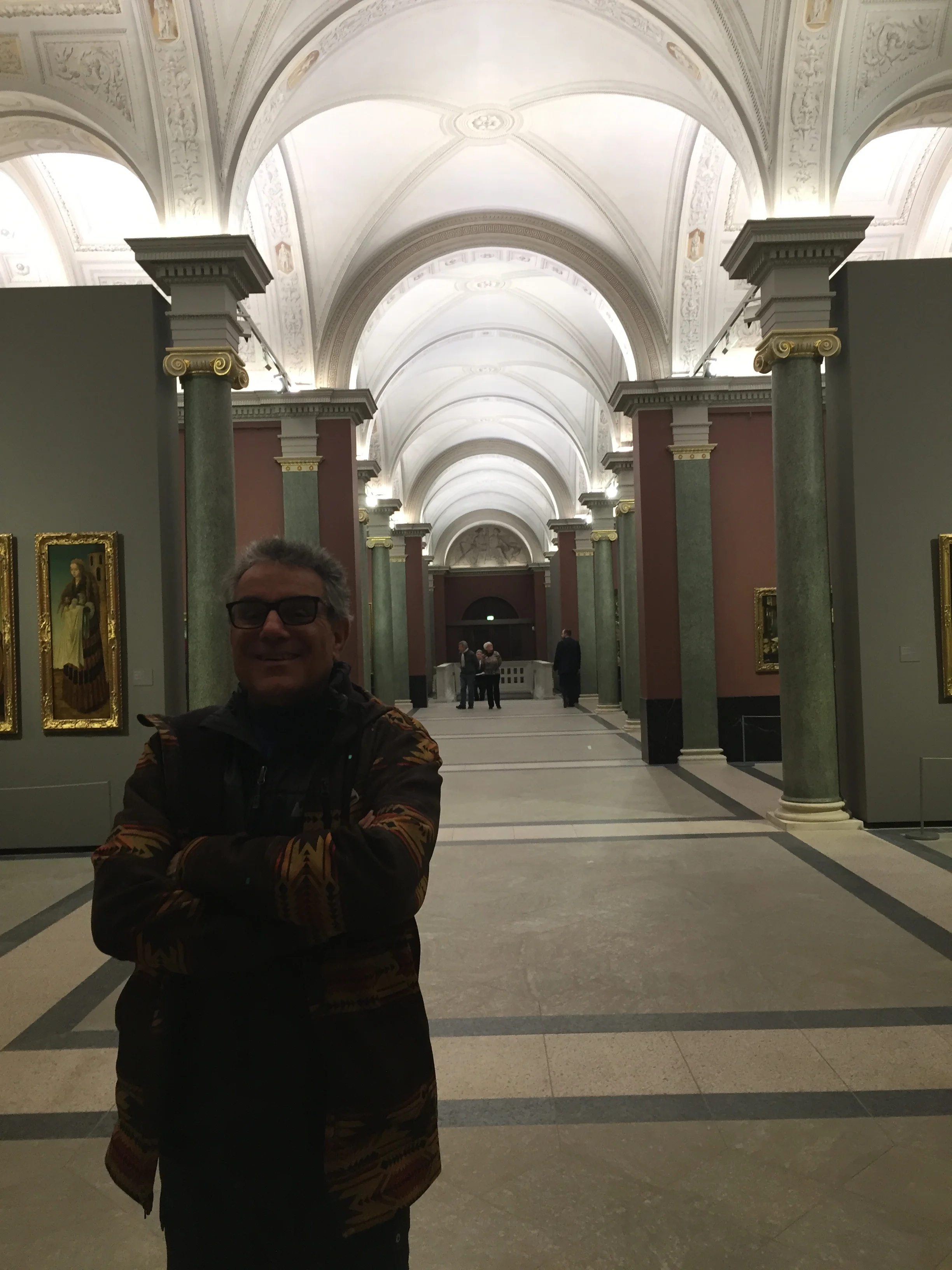
The third was the Alte National Gallery.  The building is spectacular, inside and out.  The wide central staircase allows you to climb 3 floors displaying the beautiful works of well known German and European painters and sculptures.  This exhibit was really a treat, especially the sculptures.  We especially enjoyed Manet's "In the Conservatory and Sculptor Johann Schadow's "Double Statue of the Princesses".  We purchased a 3 day museum pass and cannot wait to pick up the other museums.

Potsdam travels

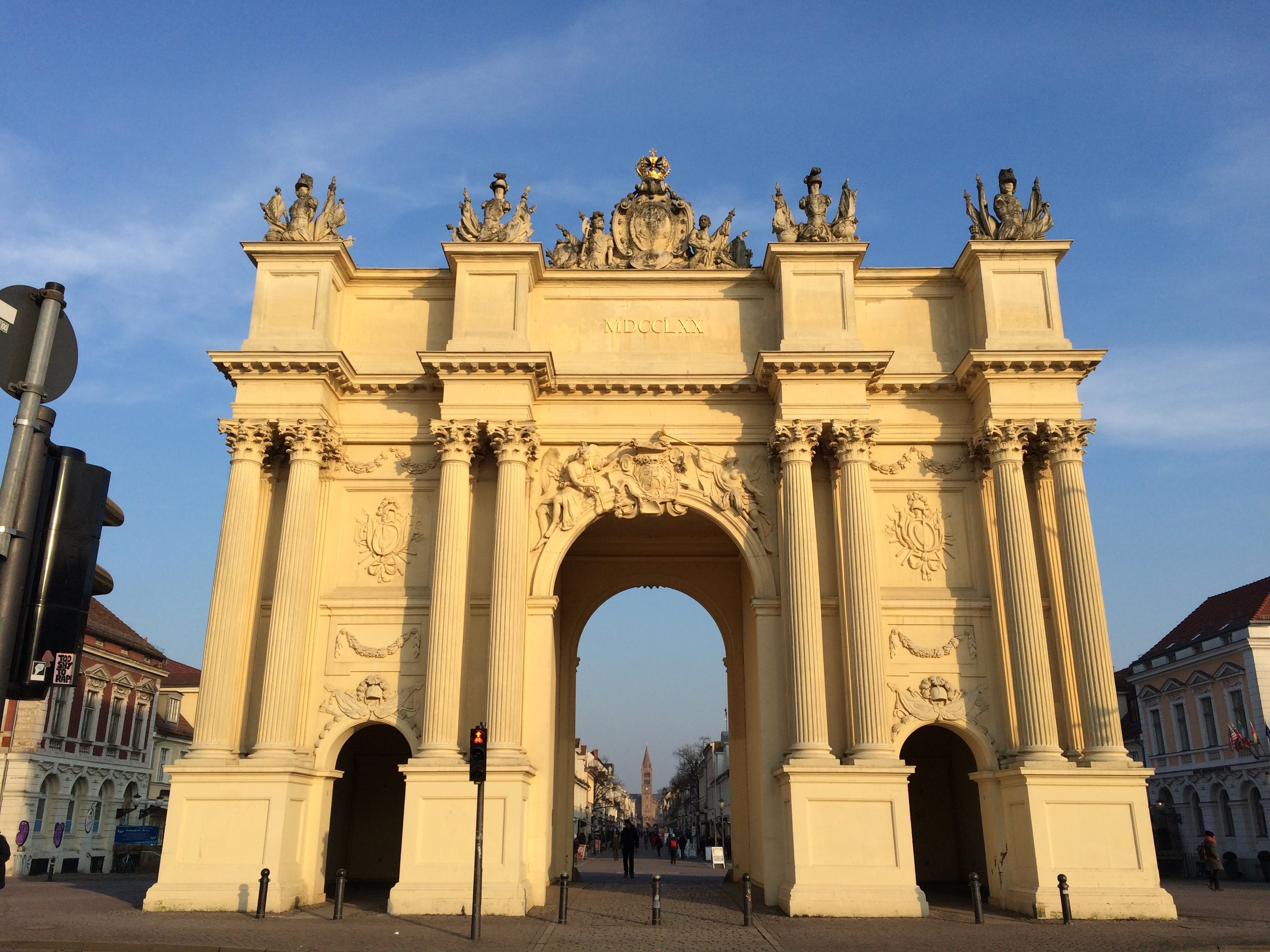
We took another walking tour to the former East Germany town of Potsdam, which started with a bus ride then on a train ride. Potsdam was destroyed significantly by Allied bombing in the war. It has been rebuilt extensively. Potsdam has the famous "Bridge of Spies" also from the Tom Hanks movie last year.  It is also the site of the “Potsdam Accord” where Truman, Churchill and Stalin met to decide how to divide post war Germany. We saw the historic photo site of the 3 sitting together. This city was also the summer home and getaway of Kaiser Frederich II, who built the “Sans Souci” palace and estate. It has fantastic gardens adorned with sculptures and ornate frivolities decorating the walls and roofline. The interior, at this time, was not as opulent as his other palace in our neighborhood. He did no government work there, but did entertain the artists, musicians, and philosophers of the day, while his wife had been allowed her own dwelling elsewhere. Fred II never had kids. FYI, Fred II, though more a philosopher than a soldier actually expanded the Prussian territorial empire and saved Germany from famine with the introduction of potato crops, among other attributes. He is know as  Frederich the Great, surpassing his father’s achievements.
Salad Bavarian style for dinner

We met some American expats on this tour and hit it off. After the tour we all went to a nice Bavarian restaurant with authentic German cuisine. We really like Schnitzel and veal. Best wishes to Steve and Gloria as they wind down the overseas assignment. Their grandchild was due to be born any minute.


Back to Museum Island

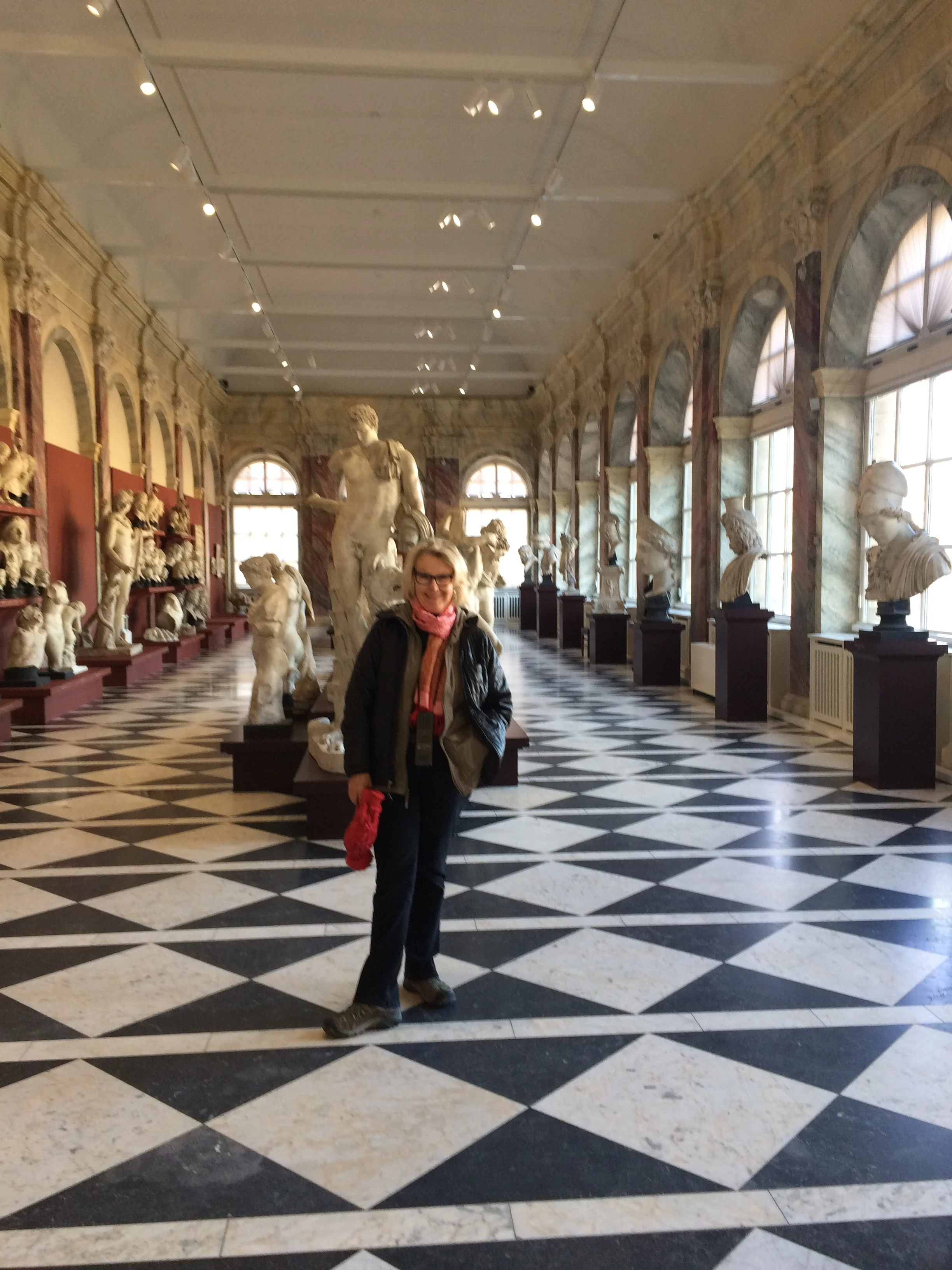
The next day we took the subway to our destination; to revisit Museum Island. We first visited the Alte Museum of Greek and Roman history with its ancient artifacts and sculptures gods that we could compare with our views of Egyptian antiquities. We did not overdo it, but selected the major pieces to contrast. Then we visited the Bode Museum with its Sculpture collection. More sculpture, wow! The building was gorgeous with two domes and circular staircases within a classical triangular building. But the sculptures were from renaissance artists and just inspiring.

We also visiting the German National Cathedral. It has been renovated and is magnificent on the inside with painted dome, sculptures of Calvin and Luther the originators of their faith, and beautiful religious paintings. The exterior is also impressive, but has some where and tear from the war and could use a good scrub. We walked up the winding staircase to the dome walkway that allowed us a stellar view of the city.

Alternative Berlin

Today is our last day in Berlin. We have planned our route, laundered and packed. We went on an “alternative Berlin”walking tour where we experienced the wacky stuff of this vibrant city.

The Berlin Wall with Street Art

We purchased another AB transport pass that allowed us to jump on and off metro trains until 3:00 AM. We traveled to the former East Berlin. The Friedrichshain side of the Wall where we landed is still erect and has 1/4 mile stretch of street art that was authorized and is of high quality, even if not as political as other areas. Hackescher Market has an alley by Café Cinema where there are some crazy, radical art forms and statements, and not far away is YAAM, an African youth enclave on the river Spree that has joined others in fighting rampant renovation of the waterfront. We walked through other neighborhoods that had turned former abandoned buildings into squatter cooperatives. Talk about alternative living. But it is the oddity and hipness of Berlin, especially the eastern side that draws people here. We are told Berlin’s mayor has said: “we are poor, but sexy”.

See the pics below of this area


We are off to Dresden!

Turkey

Istanbul


We traveled from the Cairo airport for our Turkey flight in a transport van with half of our group.  We have some trepidation, traveling the day after Trump  announced a ban on Islamic people into the US.  This is a challenging time to visit Islamic countries.

The airport was extremely busy due to extra security.  In Cairo you now enter the first screening as soon as you enter the airport; shoes off, electronics out, belts off, and pockets empty. This was a long wait but professional.  The second screening was at the gate and was very thorough, it included a full body pat down and they questioned Frank inhaler and the the portable speaker.  It was also interesting to have the females in a separate line where Janet was told to wait for the female officer. She also went through pat down.

In Istanbul, like Cairo, due to the political climate we chose to stay in a new fancy Hilton and opted for a full paid tour of the city rather than our normal free walking tour.

Our tour guide, Emre Onal, picked us up and we traveled to the historic district. He is a very learned guide and a husky man that makes you immediately feel safe. Our first impressions of Istanbul are very positive. It looks more like a European city than like the Islamic cities we have seen before. It appears very modern and clean, without overly bad traffic. Our guide pointed out where the New Year’s Eve bombing occurred; in a fashionable area at the foot of the bridge spanning a narrow part of the Bosporus Straights. This was the beginning of several discussions about the effect terrorism was having on the tourism business; same as in Egypt.

The guide, throughout the day pointed to all popular sites on how empty they were, he said at big sites, there should be 1,000 people here, and lines.  For us there was just a few people and no lines. Sad for him; good for us, maybe. We ask if he had any American tourist since New Year and he told us no, and we think he had not many clients from anywhere yet this year.  

The historic district is very walkable. We started at the  and moved to the Hagia Sophia (closed for day) to the Blue Mosque without any delay. 

The “Blue Mosque” It has a Byzantine like dome and 6 minuets. In ancient times this caused a problem for a while, because the Mosque of Mohammed in Mecca, Saudi Arabia, also had 6 minuets and to be equal was seen as disrespectful. The sultan of Istanbul, Ahmed Sultana, sent the supplies and workers and money to build 4 more minutes at Mecca. Problem solved without bloodshed, just money.

We are allowed to enter, without shoes and Janet's head covered, and take in the mosaic of blue porcelain tiles that cover the entire gigantic structure. Some 3000 can pray inside, and on Ramadan an additional 10,000 can pray in the court yard, with another 10,000 attending on closed streets. Beautiful and impressive , but not as big as the newer Hasan ll mosque in Casablanca, Morocco.


Typical Dessert of figs, ice cream and oranges

We had a wonderful lunch in a small café where the hosts were very open to discussions about Turkish politics, as was our guide. They recognize the difficulty that Turkey has by being a progressive country interacting with Europe, maybe joining the EU, and then adjoining the Arabic countries of the Middle East. They remind me that the USA has military bases here and that the Turks are fighting on the borders of Syria. They seem to hope that their government doesn't trend more toward an Islamic state. They speak fondly of General Ataturk, the founder of modern Turkey in 1922, whose photo is in every shop. He was evolutionary, not revolutionary, and became president. 

We then are able to walk to the Palace of Ahmed Sultana, which overlooks the Golden Horn Bay. Though the Treasury and Harem suites are closed for restoration, darn it, we saw the Royal quarters, the state rooms, council rooms, weapons museum and museum of Islam artifacts. The structures were grand, but the stories behind the rise of power were the most interesting. Here are some photos.

Next we visited Yerebatan Sarnici Cistern, the ancient underground water system that was featured in the final scenes of the “Inferno “film based on Dan Brown’s book. It is up lighted and eerie. The Medusa heads are placed upside down or sideways, but apparently when the water level is high the reflection makes them appear correctly, for fun we rented the movie the next day, although not a great movie it does look authentic to the location.

Our last visit for the day was the famous Istanbul Bazaar.  We have been in many markets and Bazaar’s this month so we are not buying, but it was fun to look and have some friendly banter with the sales guys trying to lure us in to their shops.  Back to our hotel to pack up again.

Cappadocia aka Kopadokya


Fairy tale land. Back on track with our next guided tour, we get up at 5 AM and catch a 2-hour plane ride from Istanbul to the Cappadocia region in the center of Turkey. It was very cold with 6 inches of snow on the ground. We stayed in the cave city of Goreme. This land is right out of a fairytale. It has geologic and religious importance. Due to centuries of erosion, gigantic spires of volcanic ash have been formed throughout the valleys in this area. Some are topped with harder minerals lending a phallic appearance to these structures. More stunning are the seemingly infinite cave dwellings carved into these spires and the surrounding plateaus. You can observe innumerable cave doorways and windows. We have aerial and ground level photos. Note the pigeon stands in the rock. The guano is used for fertilizer.


Here is the kicker. These caves were first fashioned by the early Christians that were hiding from the Roman Empire and the Hittites of the area. In one settlement entitled the “Open Air Museum”, there were a series of primitive churches carved out of the rock with interior iconic paintings displayed. The colors were worn after centuries, but the paintings were not destroyed albeit for the typical pageant action of scrapping out the eyes of the figures---it has been said “eyes are the window to the soul”.

The next day, early morning, we went for a hot air balloon ride. The view was made more glorious by watching the sun rise over the plateau that abuts this fairyland valley. Our captain also maneuvered us at lower altitudes through the valley and landed the passenger gondola right onto a flatbed. We had 4 layers of clothes on to fight the cold, which was -10 degrees F. Only our feet and camera clicking fingers were frozen, but all is well. We recommend balloon rides.

We were also fortunate to visit an underground city carved 5 stories under the earth; we only went down 3 stories, thank you. It is a catacomb, with kitchens, sleeping rooms, storage areas for wine and water and food, ventilation shafts, secret and narrow passages, and large round stone doors to close off areas. It was a little claustrophobic bending down and shuffling along the passageways, but we were primed from our Pyramid experience and did not hyperventilate too much. What the early Christians did to save and practice their new religion should be an inspiration to us all. Check out some photos.

We are on a whirlwind schedule in Turkey. At the end of the day we are transported back to another small airport fly to the Mediterranean coast of Turkey, unfortunately having to go through Istanbul, changing planes, to get to Izmir.  This airport is empty, see the photo as an example of how bad the tourism is in Turkey.  


Ephesus

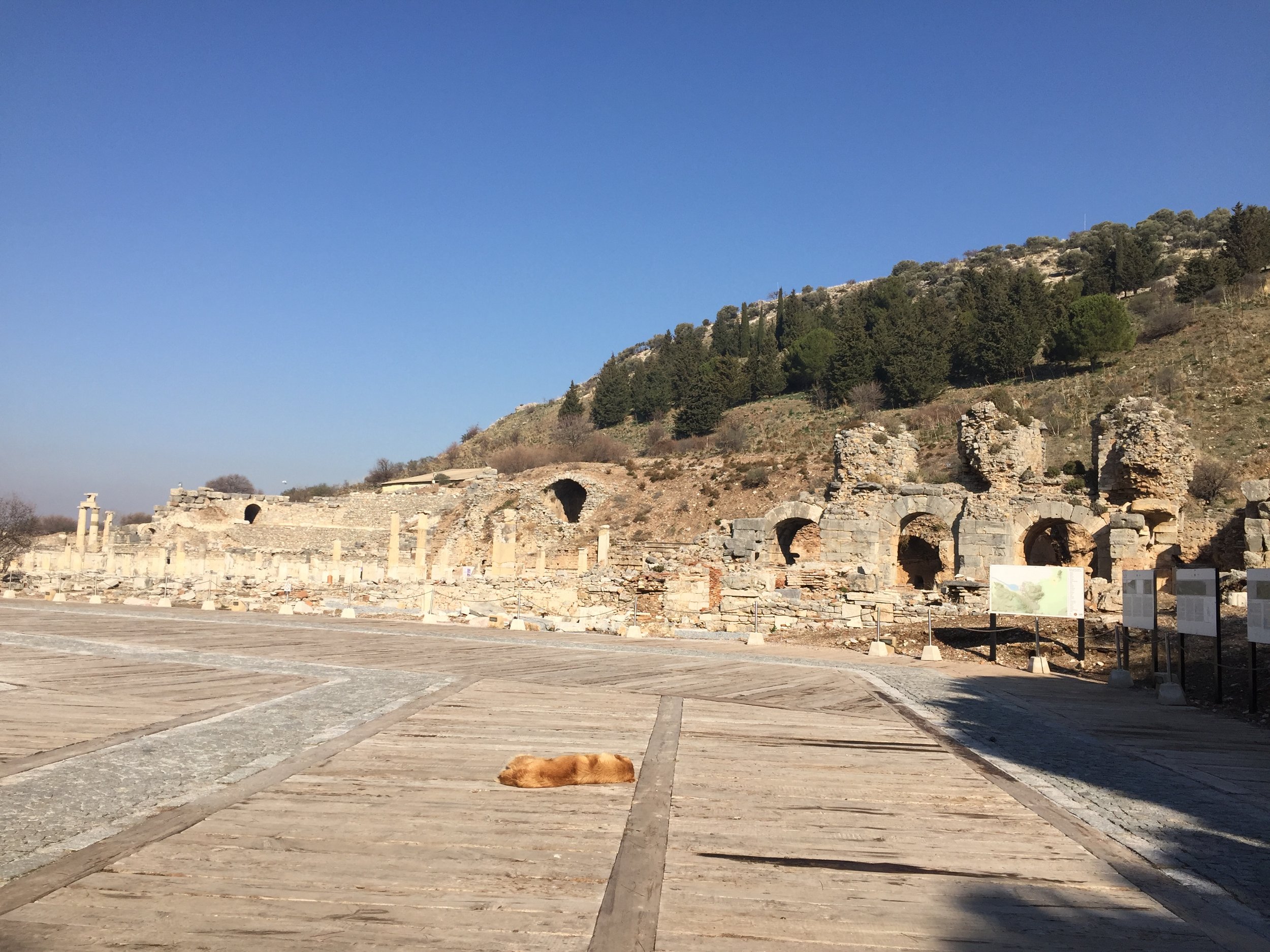
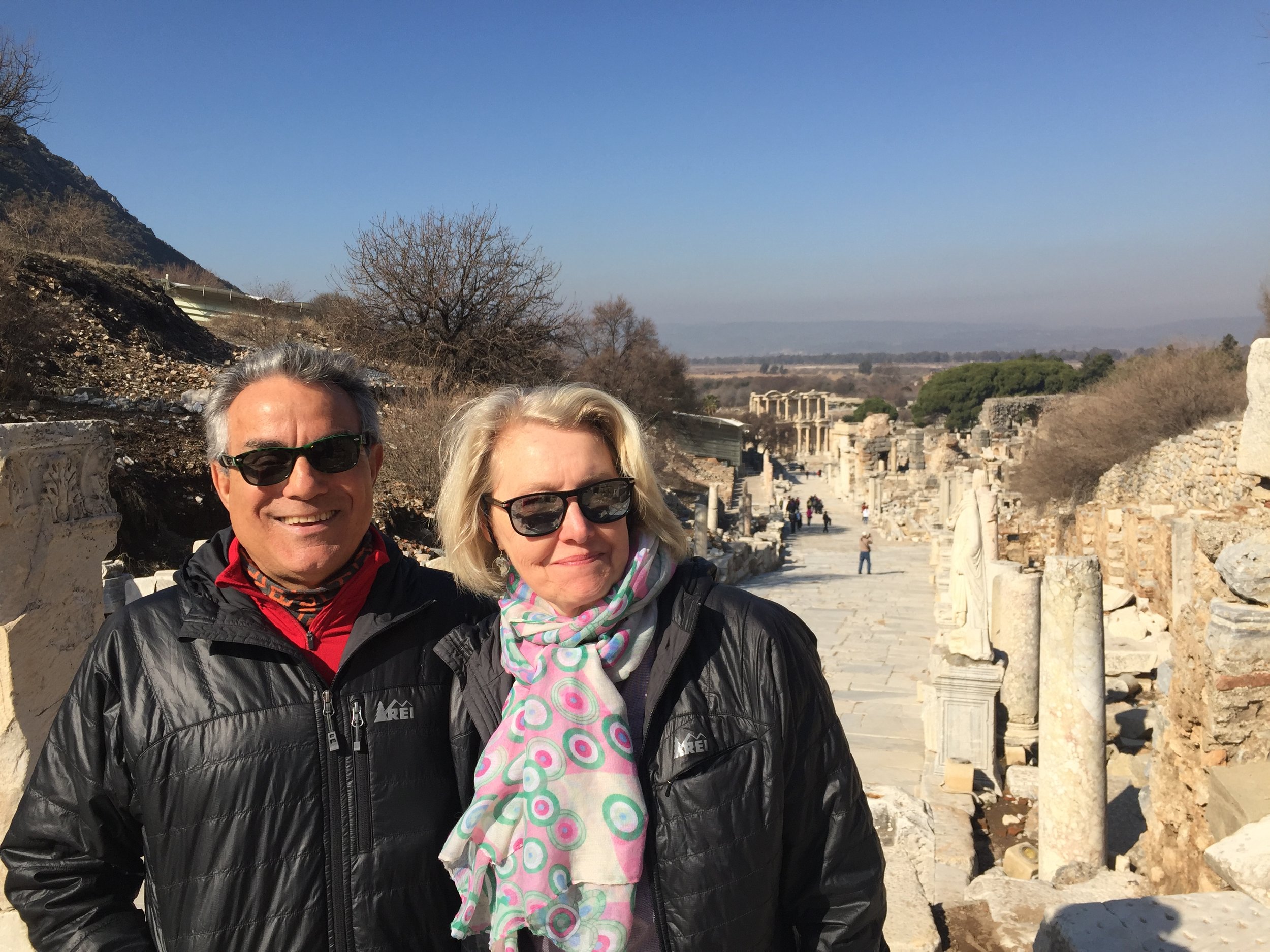
The next day brings on another fantastic adventure. We visit one of the 7 wonders of the ancient world. Ephesus is an ancient city first settled by the Greeks and then taken by the Romans and then the Ottomans. It was an important seaport that allowed goods to be transferred between Asia and Europe. It was very large and populated by as many as 250,000 persons in its heyday. The most remarkable structures arose during the Roman period, that included a colosseum, wide paved streets, Roman bath, Roman toilets, rows of storefronts, Temples to Artemis and Apollo, council chambers, and of course, the magnificent Library. The library was the 3rd largest in the ancient world, following closely behind the libraries in Alexandria, Egypt, and Rome, Italy.   Check out the photos.

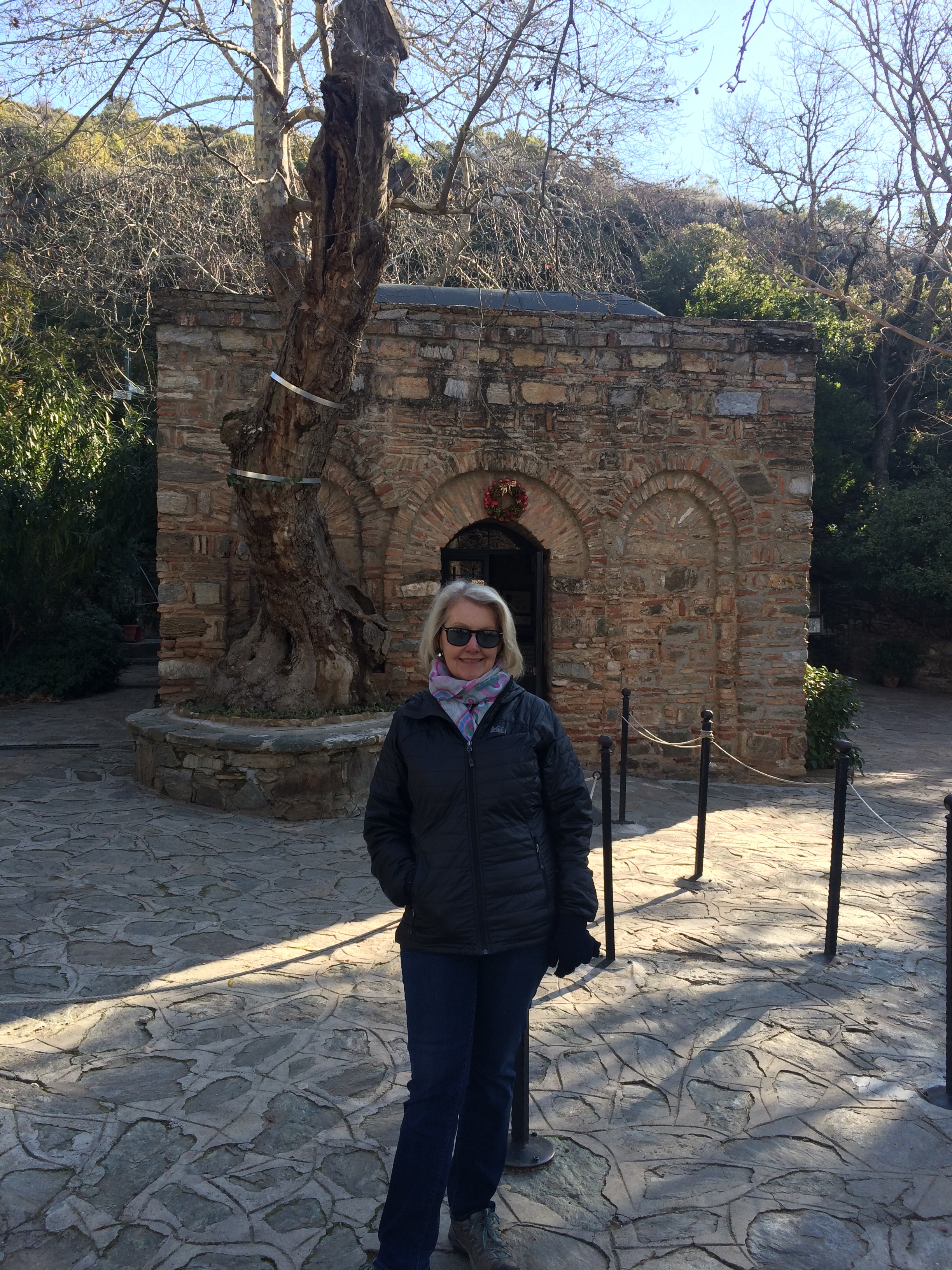
We also took an interesting religious side trip today. As we had visited the Coptic church in Egypt that was supposedly the hiding place of the Virgin Mary when she fled to Egypt after the birth of Jesus, we visited another site important to the Christians. Near Ephesus in the village of Meryemana located at high ground in a valley that meets the Aegean Sea, is currently situated a small brick structure, now a church, that is purported to be the last home of the Virgin Mary before her death. Several Catholic Popes have visited the site. There are 3 factors that support this opinion.  We are informed and understand that the historical record supports the fact that Mary did spend her last days in Turkey. Significantly, the historic record supports the fact the Apostle John, tasked by Jesus to care for Mary, visited Turkey at this time and met with St. Phillip.  Phillip lived in this village. We entered the church and paid our respects.


At this time, we drove back toward our very modern Hotel in the city of Kusadasi, a wonderfultimes. It has been completely renovated with nice gardens. Most impressive were the sunshine and the reflection on the crystal clear waters of the Aegean Sea, turquoise in color, that allow you to see through to the rocks under the water.  We did not expect to see a full skeleton of a Whale displayed, but there it was. Interesting. We then enjoyed the walk on the market street, stopping to buy fruits, cheese, olives, and fresh bread for a quiet evening meal. This was a very fulfilling day.


The next morning, we were awoken by the strangest thing. In the dead of night, the mini bar in the room started to flash through its glass door like a beacon or something. It did not stop by slamming the door and we thought it was an emergency signal at first, then we had to flick every light switch in the place to get it to stop.


Pumukkale

The next day we had a long drive to Pumukkale, i.e. “Cotton Castle”, the site of ancient village of Hierapolis, with its Colosseum ruins and Calcium lake and terrace hot springs derived from a dormant volcano. This place was known for healing waters, but also, as happens with sick people, death, and was commonly known as Necropolis. Today, part of the site is a health spa.

This in country tour was whirlwind. We flew in from one airport and are flying out of another to return to Istanbul. The airport seemed in the middle of nowhere, and we feared a propeller plane would be our transit. No, nice jet plane and we got back to our bed in record time.


Istanbul

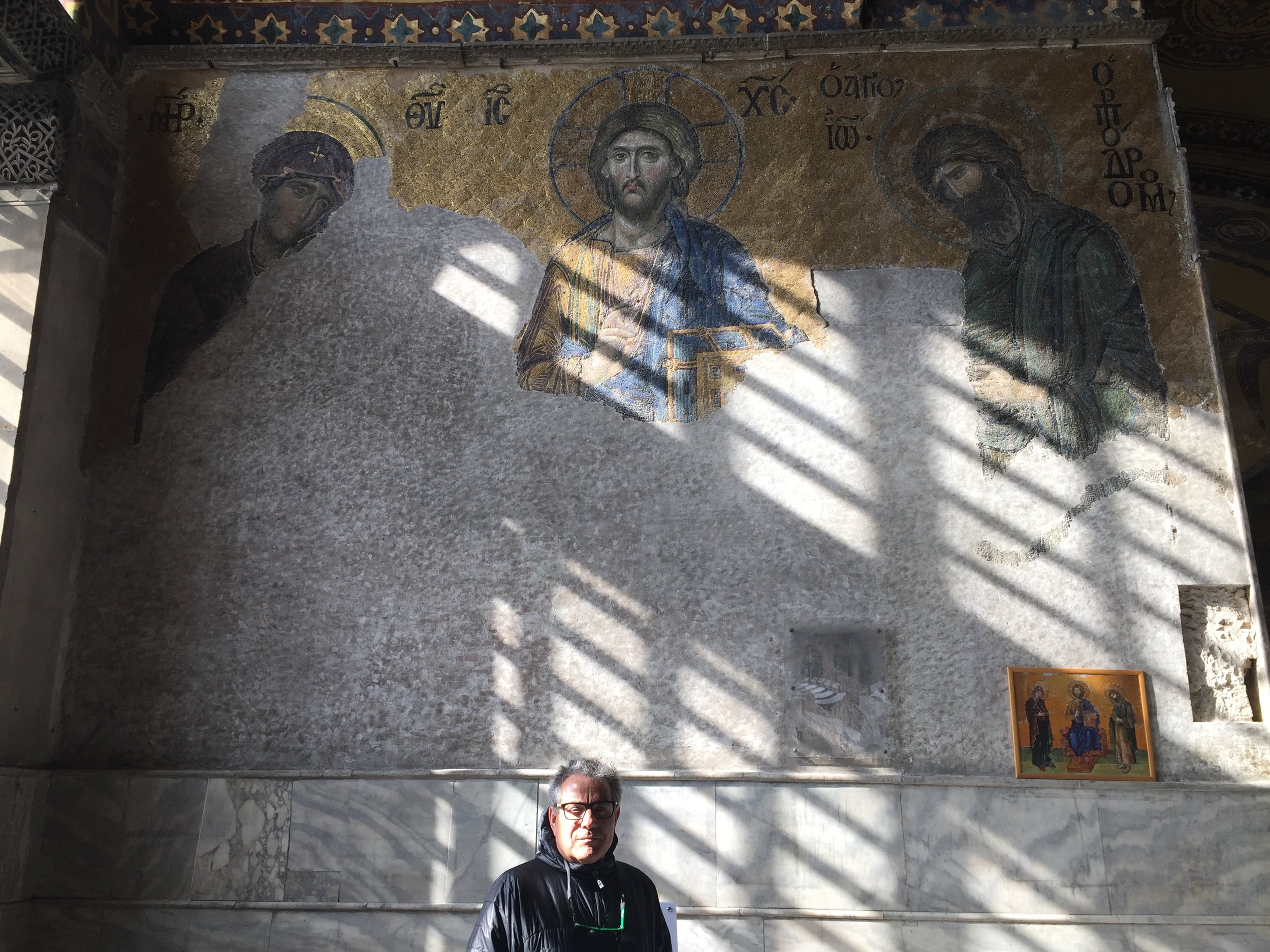
The final active day was reserved to see the famous Hagia Sophia, aka Holy Wisdom in old Istanbul. We selected a guide for info and to beat the lines. How spoiled! In any event we were told that in prior years 20,000 patrons per day visited the site. Now its 2000 patrons.  The structure is enormous inside and bigger then the Blue Mosque, even if the exterior view seems to match the Blue Mosque. Roman Emperor Justinian ordered this church to be built in 380 AD and brought 10,000 Greek artisans to town to complete the church within five years. The short time of construction was aided by recycling, i.e. stealing, many giant pillars from other temples, including Delphi in Greece. The Dome is free standing, supported by buttresses, whereas the Blue Mosque has 4 interior pillars. The walls are covered in gold leaf and color mosaic which sometimes present holy figures. Most of these figures were cover with plaster for many years as the Islamic faith prohibits icons displayed, but are now being restored. One exception, the figures of Jesus and Mary, both persons recognized in the Koran, were not defaced. At this alter only in the world, you can see the written symbols for Ala and Mohammed on either side of Mary and Jesus.  

We left the site and had supper at a noted bistro named “Massa”. We wanted to try “Meze”, a traditional meal, which is a smattering of small bowls of sauces and concoctions to eat together and with bread.  

Afterwards, we picked up some Turkish desserts, except the gooey “Turkish Delight” that we have enjoyed before. The young storekeeper was all smiles when he asked “American” and we said yes. That is one thing we have learned, all the Turks we have met seem to want to welcome travelers from the USA. This is our last night in Turkey.


Next stop - Germany