Luang Prabang Laos

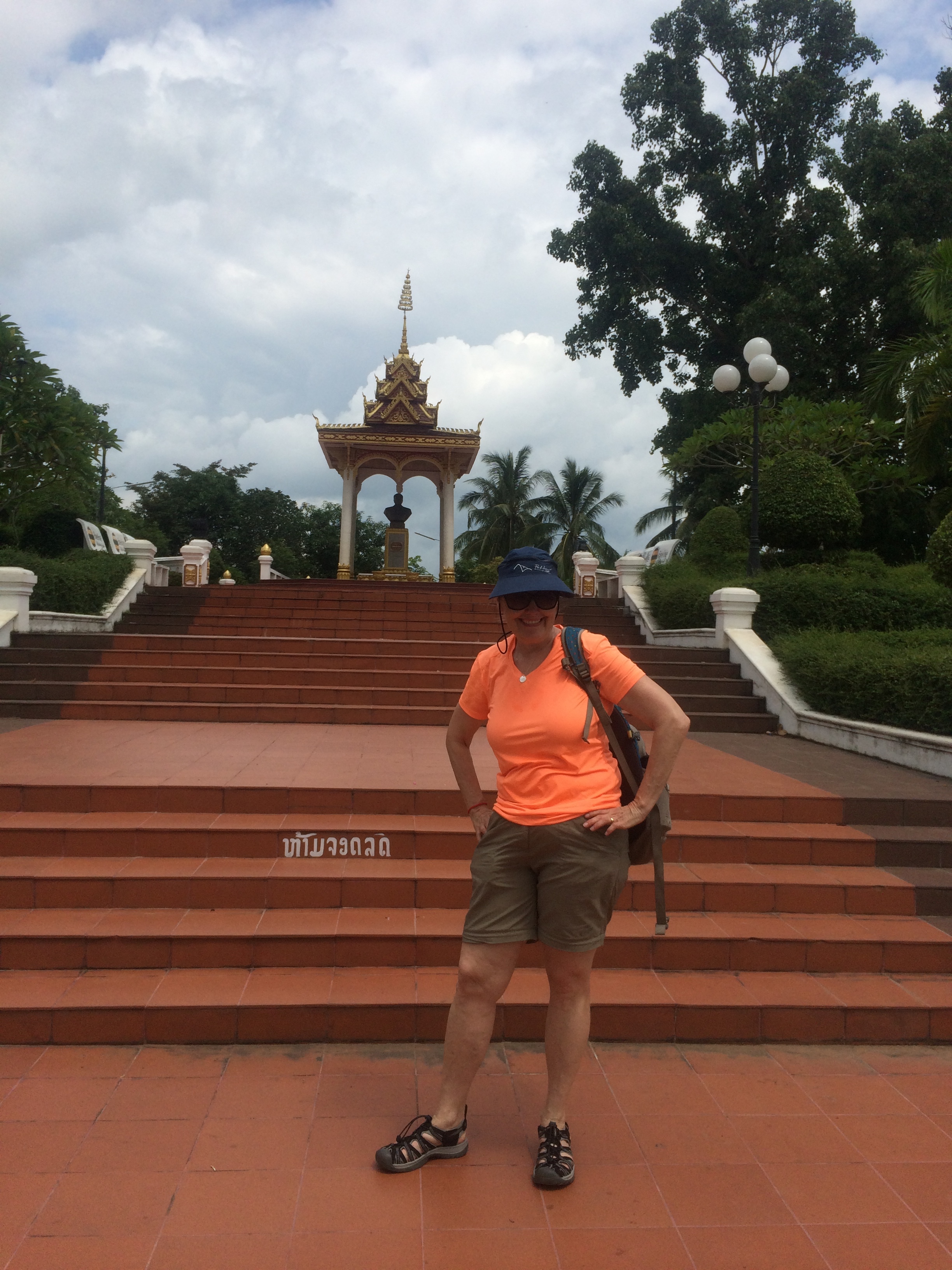
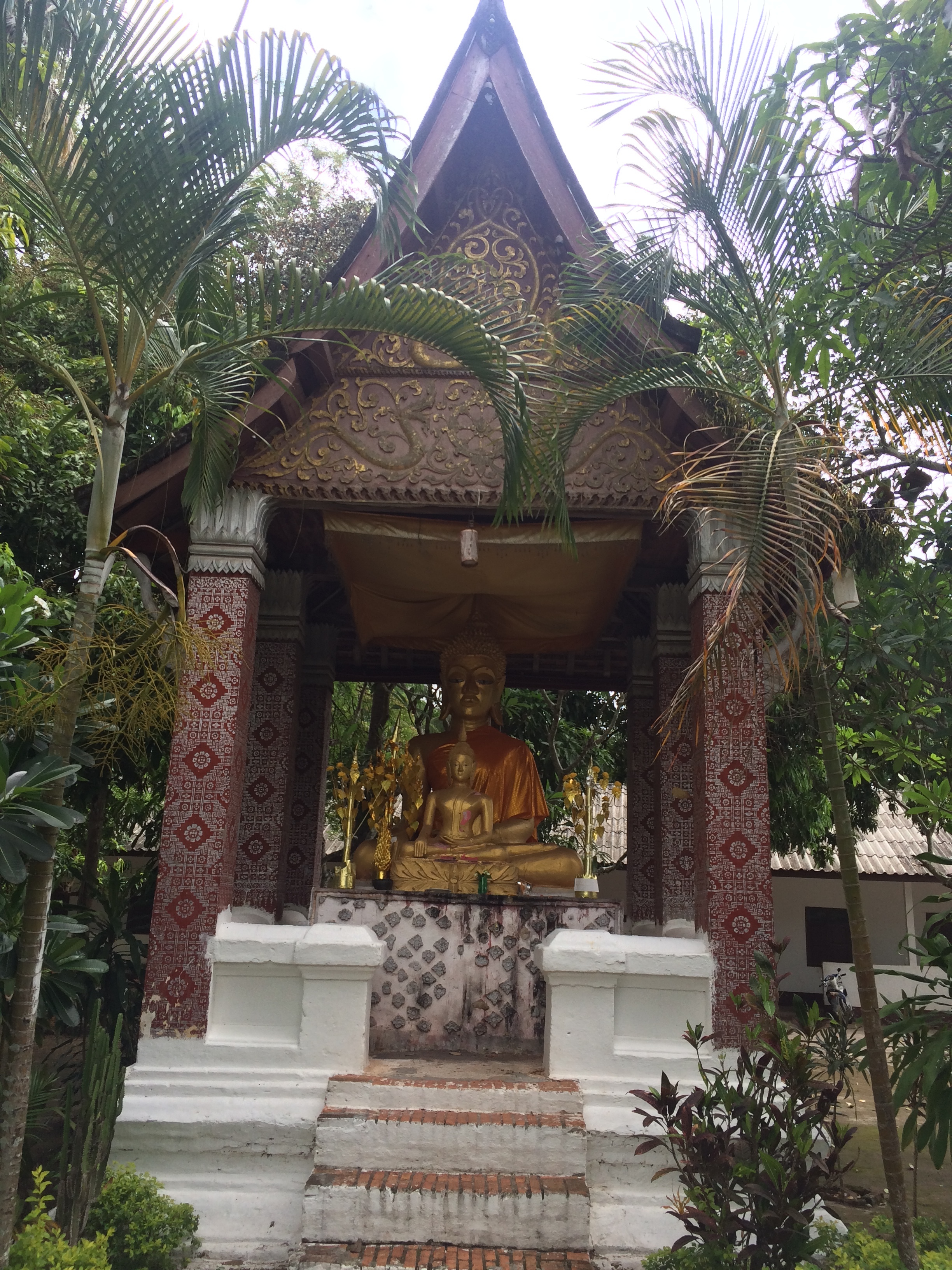
Luang Prabang is a UNESCO-protected city with 33 Buddhist temples, the former royal palace built in 1904, and most interestingly, several streets along the river with French colonial buildings. In the 1800’s the French were colonizing throughout Indochina and as this was the residence of the “King Vong” they landed here.  After WWI, it was France that again concentrated on negotiating with Viet Nam, Myanmar (Burma), and China to create borders and form the new country Laos. France then also moved the current capital south to Vientienta. We will be there in several days. 

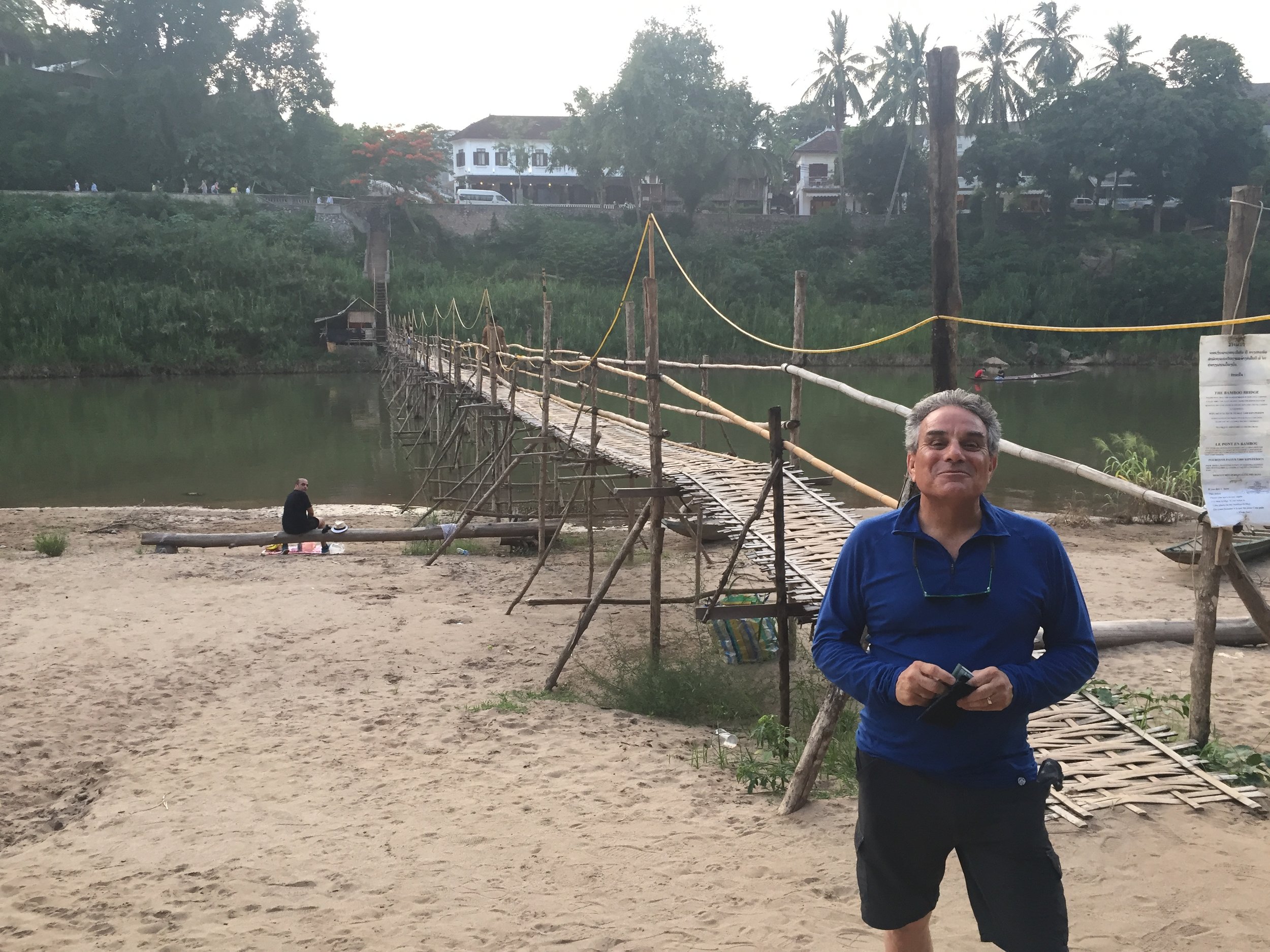
Our walk to the hotel including crossing this old bridge with our luggage

The French colonial streets are lined with Indochinese mansions that are now boutique hotels, fancy shops and elegant restaurants, with Buddha temples interlaced on these streets. It is a very peaceful setting and we enjoyed bicycling and walking around the town. We had to bike over the split tracks of the“Old Town Bridge” along side motorcycles to get around to both sides of the city. We viewed temples and riverside city parks. But at night from our Hotel Bue Villa we used the seasonal “Bamboo Bridge” to walk across the river directly to the French section for dinner. Later, a slick night market is set up on the main street, selling excellent crafts and wares under bright lights; no junk trinkets here. 

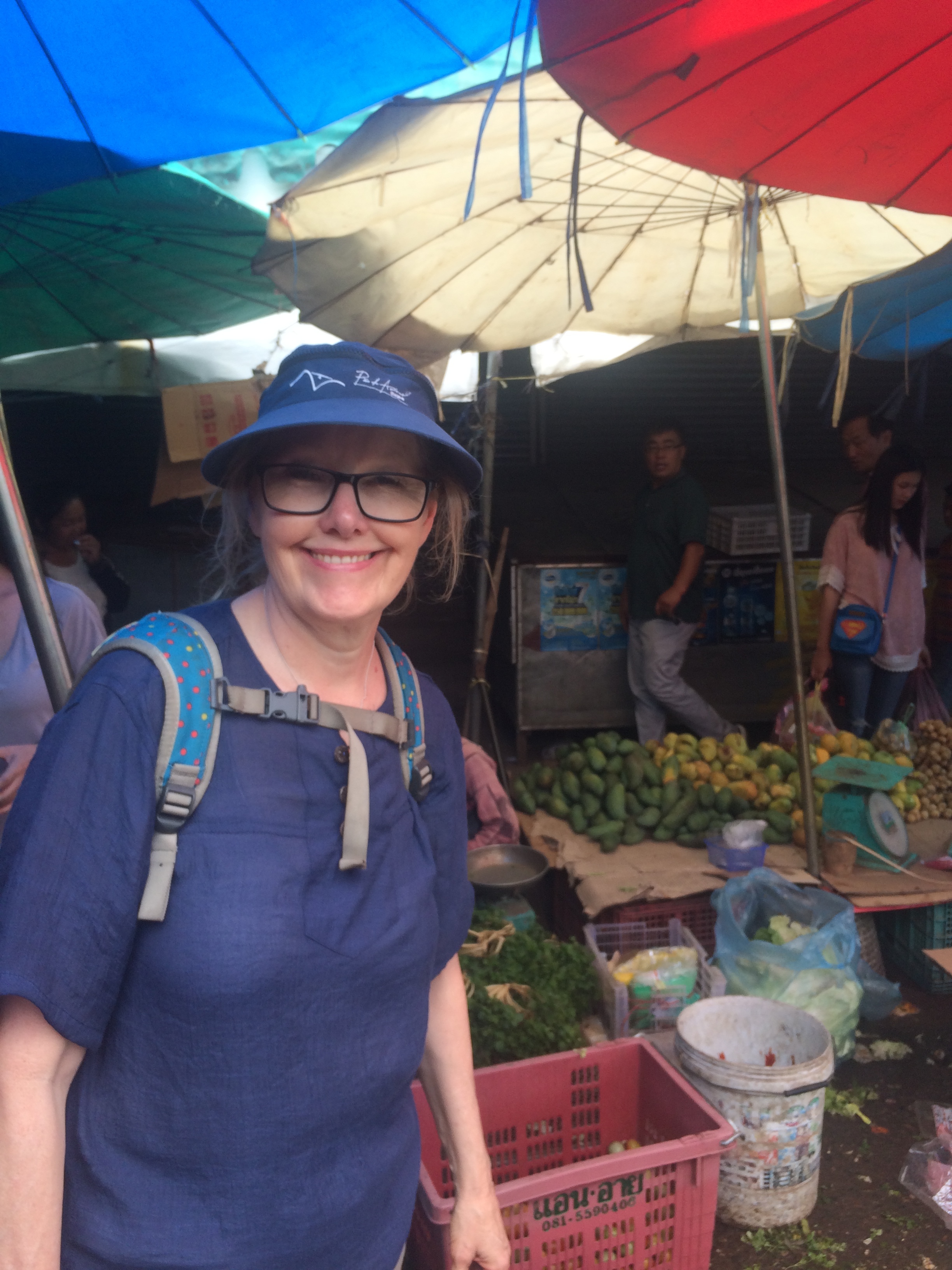
A highly regarded restaurant in the French section of town is “Tamarind”. This restaurant also offers cooking classes during the day, and a tuk-tuk trip to the food market for ingredients and general descriptions. This is a full day instruction at a classroom kitchen using gas heated woks, where the participants make 5 meals, after the instructors show seven preparations. Our instructors, Mr. Lee and Mr. Yang, were very organized and answered any questions. We got a recipe book, too. Adding to the fun was meeting our cooking companions from Japan. These 2 charming ladies who were childhood friends had met up for this vacation as one now lived in Hawaii, USA. We ate our creations for lunch before going on to other recipes. Those concoctions we boxed up and took home for later evening dinner; The hotel staff helped us plate our cuisine and it was really good too. 

The next morning we said good bye to one of our favorite towns. We took a mini van through the mountain passes south to a naturalists town named “Vang Vien”. This ride took 6 hours, not the 3 hours advertised. We chose not to forge ahead another straight 6 hours to the capital city Vientiane, but take in the mountains and natural beauty of this more rural location. 

Laos--- Epic Travel and Border crossing

The White Temple

We are traveling toward Laos. Near the border, around Chiang Rai, Thailand, we stop at the “White Temple”of Buddha, aka “Wat Rong Kuhn”.  This is an unexpected treat. This complex is gorgeous with all buildings and ornate temples in bright white, with splashes of silver, and then monuments of gold. This complex was the brain child of a very famous and religiously devote painter/architect named “Chalermchai Kositpipat”. He used his own money to seed the project, and continued to build even after an earthquake destroyed part of it.  The theme of the complex might be best described as a Buddhist version of “Dante’s Inferno with its seven levels of purgatory. The lesson: Rebirth and delusion--Be spiritual in your life and be devoted to Buddhist teachings and avoid damnation. Some modern figures are integrated into the paintings, such as Matrix, Twin Towers burning, Elvis, and Superman, among others.  We were also treated to a museum of art painted by this artist, all Buddhist themes but still beautiful and vibrant. No photos allowed however we got a few below, inside and out.

We are suppose to get back to the van in one hour; one of out troop is missing and the driver wants to go. We empty our luggage to allow him to ID the tardy guys stuff. As we do that, a soft hearted American (Frank) walks back toward the exhibit to grab the guy; he was quiet and only the American was sure he could recognize him. Tic-toc, the guide was really agitated and said he would have find a hotel for the night. Finally, the guy comes into sight and Frank yells and waves his arm so the guy starts running. When he arrives, he hears it from the guide. We think he is shell shocked. Later at dinner, after talking to a calmer guide, he comes over and thanks us.  Nice German kid named Carson. We think the whole van is feeling better about waiting for a fellow traveler. This is borne out by the camaraderie that developed among us. 

The view from our hostel, the Mekong river on the Thai side

That night we stop in a small river town called “Chiang Kong” next to the Mekong River. Our lodging is in a hostel, but we pay extra for an AirCon private room and the food is passable.  The balcony dining area overlooks this wide, fast flowing river. Our guide excitedly points across the river and shouts “Laos, Laos”. Tomorrow we pass through the immigration of at “ Huey Xai”, Laos and get a visa into Laos. 

Frank at Dinner

The truck taxi to the slow boat

Immigration is easy, filling out 2 forms, cost $35 US each, walk through to the Van that takes us to the local dock on the muddy Mekong River. 

Slow Boat in Laos


We thought this mode of transportation would be another interesting part of the trip. The Laos boats have long, shallow, wooden hulls with seating for 60-70 passengers.  It has a canopy over the seating area; sides are open to the air; think of it as a bus on water. Our boat had two seat car benches, probably salvaged, running port and starboard with a center aisle. The pilot house is in the front, the engine sits high in the rear with long swiveling power shaft for easier maneuverability on this wide river.  The head is a squat draining direct to the river. It is crowded not with other boats but floating debris.

This is fun and relaxing. The jungle scenery along the shore, and misty mountains in the background are really beautiful. The peacefulness is only occasionally broken by the whining of the high RPM engine of the “fast Boats”. Actually, we would call these “suicide boats”. We could have booked this passage; 8 hours not 2 days---but after watching these small skiff boats with oversized engines plane through the debris ridden river we knew we made the right decision. The fast boats have flat shallow hulls and the passengers sit high. You hit something at high speed—you be a goner, plus the vibration and constant bouncing on the river for 8 hours would drive most people crazy. 

The view from the boat

On the other hand, we enjoyed the slow boat. Our young buddies from the van broke out bottles of “Black Whiskey from Laos” ($5/ bottle) and Coca Cola, and then activated a portable speaker. To our surprise, first song “Jimi Hendrix’s Watch Tower”. The Group: “Carson” from Germany, “Phet” from Syracuse, NY, USA, “Kevin” from Switzerland, Dutch I from the Netherlands, “Spurs” from the Netherlands, and two ladies with non-pronounceable first names that we know as “Nice Irish girl”  from Northern Ireland, and “Smiley Girl” from Japan. This group is U 25; nice young people. They joke around and laugh while we are listening to our audiobooks and own music.


Later, “Phet”, a Penn State Grad, gets dragged into a inquiry about American politics, and then he drags us into the conversation. We are not going to go into the weeds, but the young Europeans where interested in the 2nd Amendment, worldwide immigration, border issues, and the Trump Election. By the way, we face those questions all the time.
 

We stop one night in tiny, one street “Pak Beng”, a docking stop, then we take off on the boat again to our final boating destination, the city of “Luang Prabang”. Too much debris to travel the river at night. 

Chiang Mai Thailand

Chiang Mai city center 

The Stopover 

The bus station 

The goal was to get to Bangkok, Thailand by van and have a short stopover until we got to the train station in time to take transportation to northern Thailand and the city of Chiang Mai in Northern Thailand. Our travel day started at 7:00 by van pick up in Battambang. We arrive at the bus office with several other people and then are instructed to take a tuk-tuk and luggage to somewhere else; turns out the somewhere was a bus depot out of the center of town, this place was bad, garbage all over, just a few people hanging out and really hot.

Frank on the sleeper bus

The bus arrived. To our surprise it was a sleeper bus—but not like the ones we had before where passengers are in seating that is prone or semi-cami. No, the seating is on designated bunk beds—2 in each bunk.  The sheets were clearly rumpled and dirty.  We passed the time with Netflix movies as we rocked from side to side.  Not a terrible problem for us, but others where sharing bunks with strangers. This was an unexpected blemish on Cambodia’s reputation. In the end, all went well. 


The Cambodia exit

The Cambodia exit

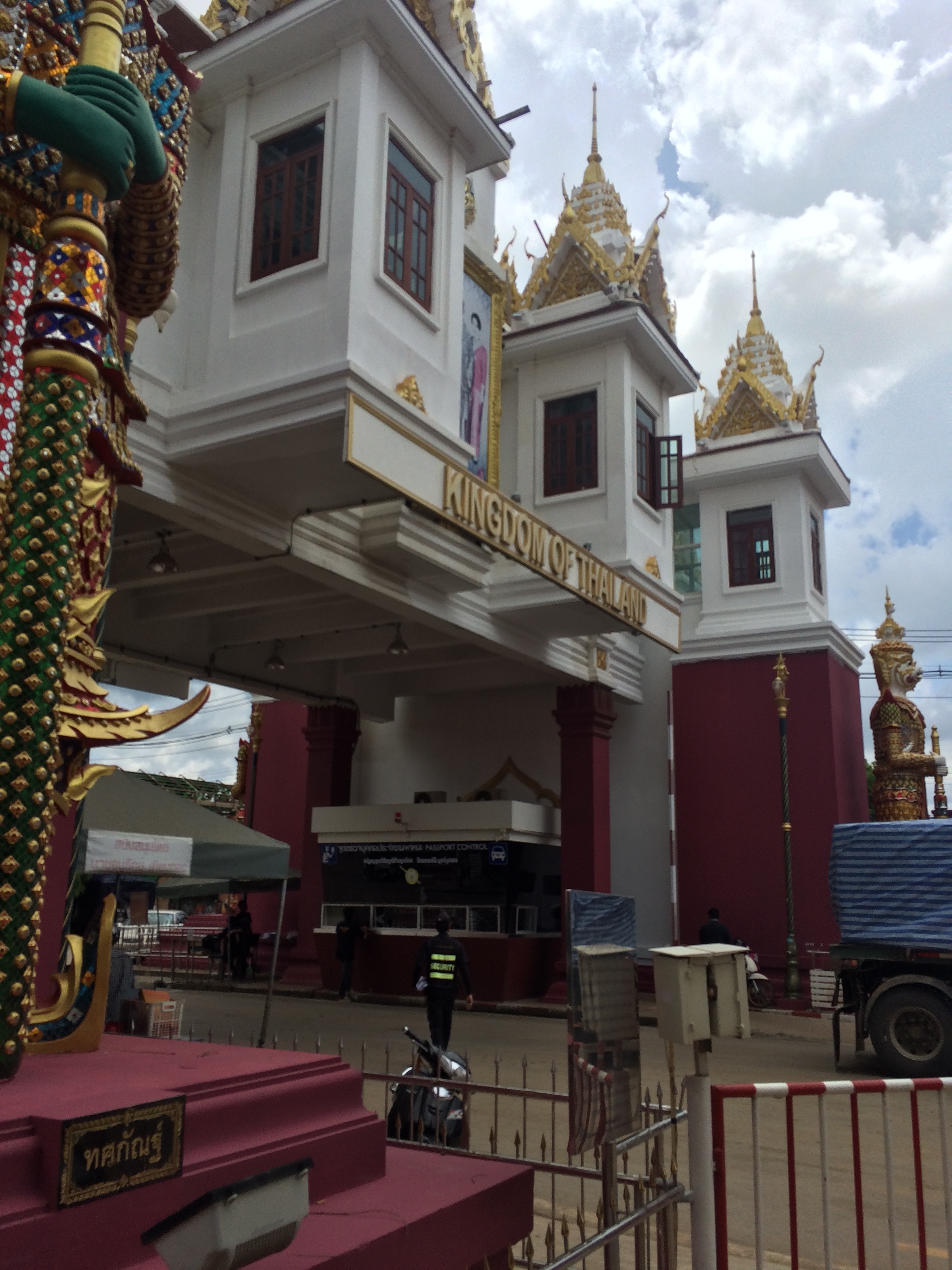
We arrived at the Cambodia/Thailand border; there was no clear directions as to the process. Our bus driver just pointed in the direction of the border and left.  This is our 90th move and 25th country so we know the drill on third world border crossings, but it is still a shock to senses to walk across a border on a dirt road with tuk-tuks, trucks, bikes and vendors shouting to you to buy their goods.

Our new 4 person informal group stuck together, that included Janet and Frank, and lovely Nevis from Ireland, and handsome Manfred from NZ. Finally, we checked through at the Cambodian border exit.  We passed through the Thailand Border control where Nevis became light headed, so we gave her food and water and another trekker carried her gigantic backpack for a while. We where now inseparable. 

Entering Thailand

Entering Thailand

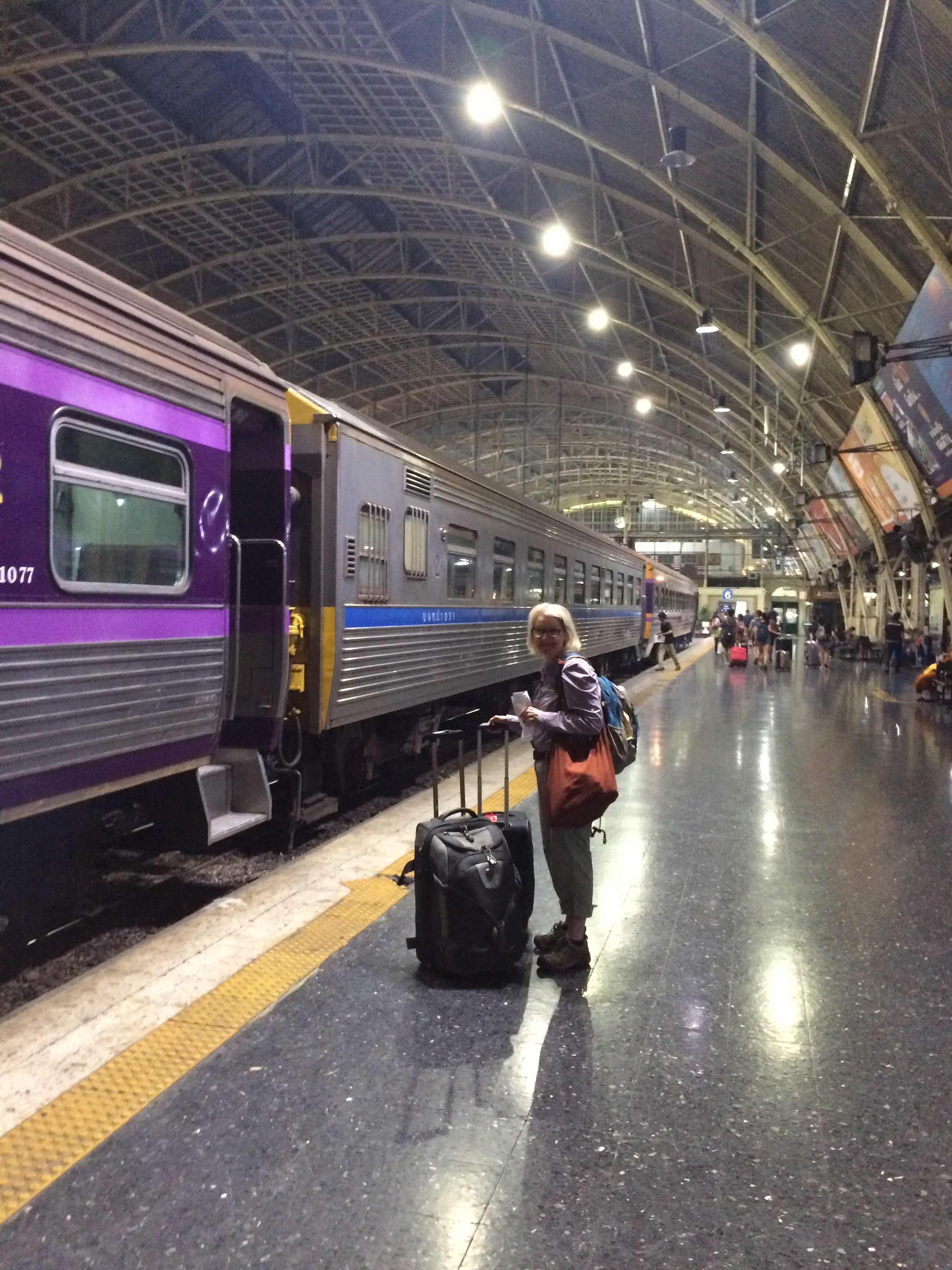
We walked to a depot where we joined 5 other Thai’s in a van for the 3 hour drive from the border to Bangkok. There was some wrangling as to the number available seat, but we got it all worked out so our group stayed together. We met our goal and we got to the train station in time. We decided to take the night sleeper train for a 12 hour ride to Chiang Mai. The train was rustic, which means the bathrooms were open to the track. We had upper bunks across the aisle from each other, they were fine and AirCon was powerful. Some new friends from Belgium, a young couple, had the bunks below us. They were very nice and in fact—big save-- found Frank's fallen Iphone on the floor.  They gave us some tips on Australia as they had just visited to Scuba at the barrier reefs. 

Chiang Mai

We arrived in Chiang Mai at 10:00 am for a total of 27 hours in 3 vans, 2 tuk-tuks, a sleeper bus and sleeper train.  Our hotel was Twenty Lodge in the city center. The city center is defined by the brick rampart and moat that circled this ancient town, which held off invaders for 7 centuries until finally conquered by Burmese. We liked the location close to the city center, the lodge,  the pool, and the hospitality.  Our host greeted us with cool towels, fresh juice and an early morning check in.  After a quick nap, great lunch and a dip in the pool we were ready to go again.
 

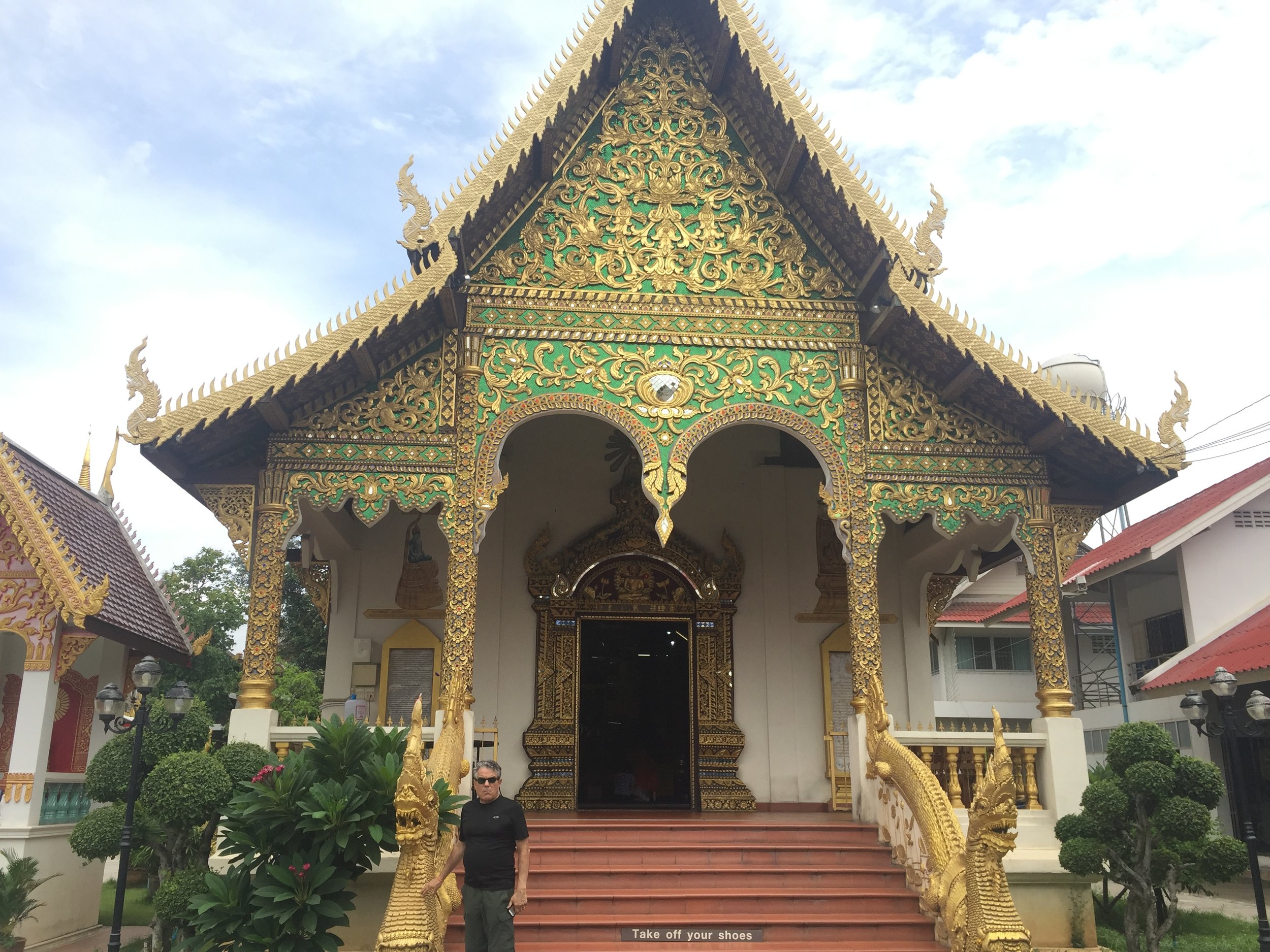
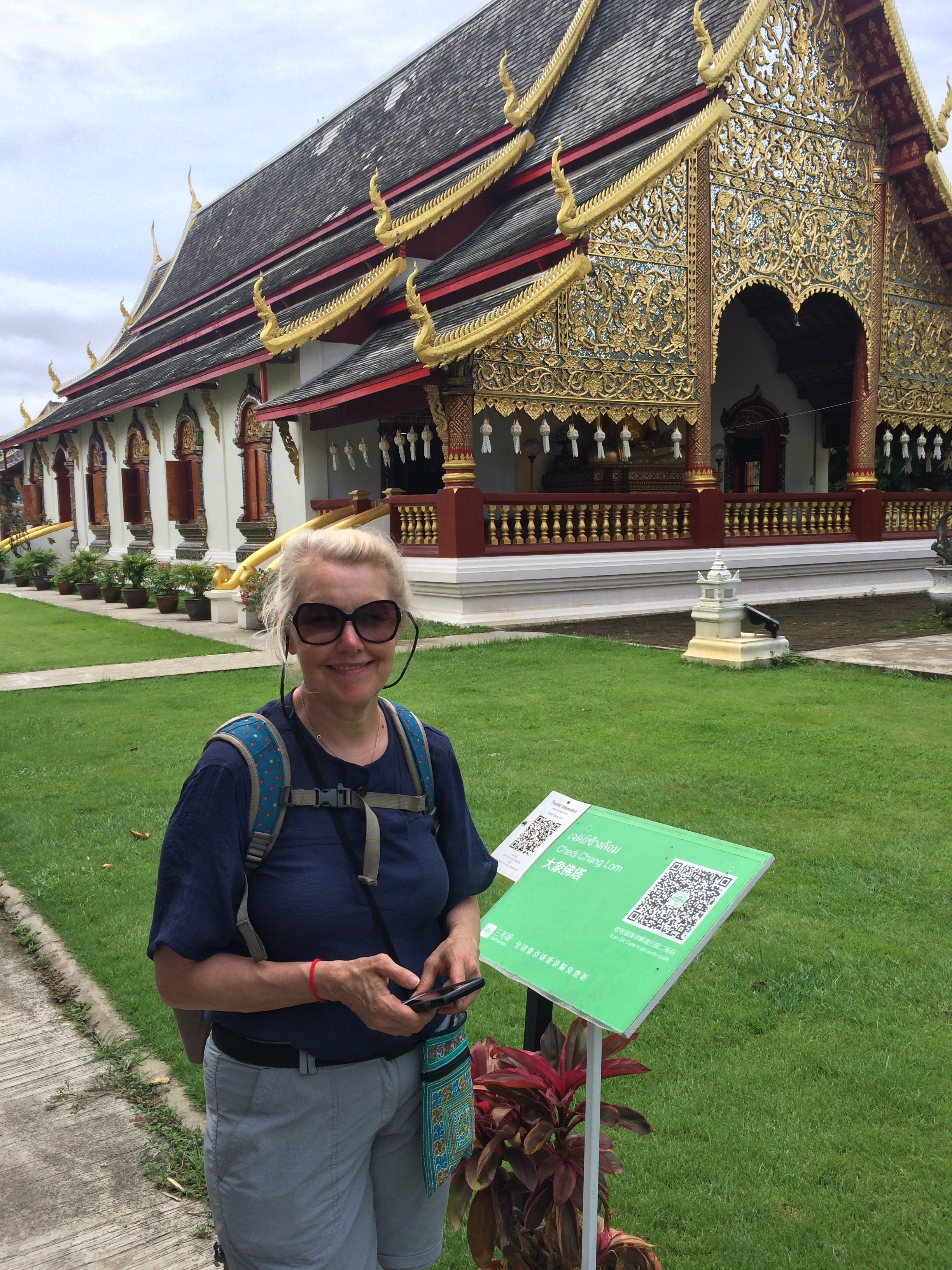
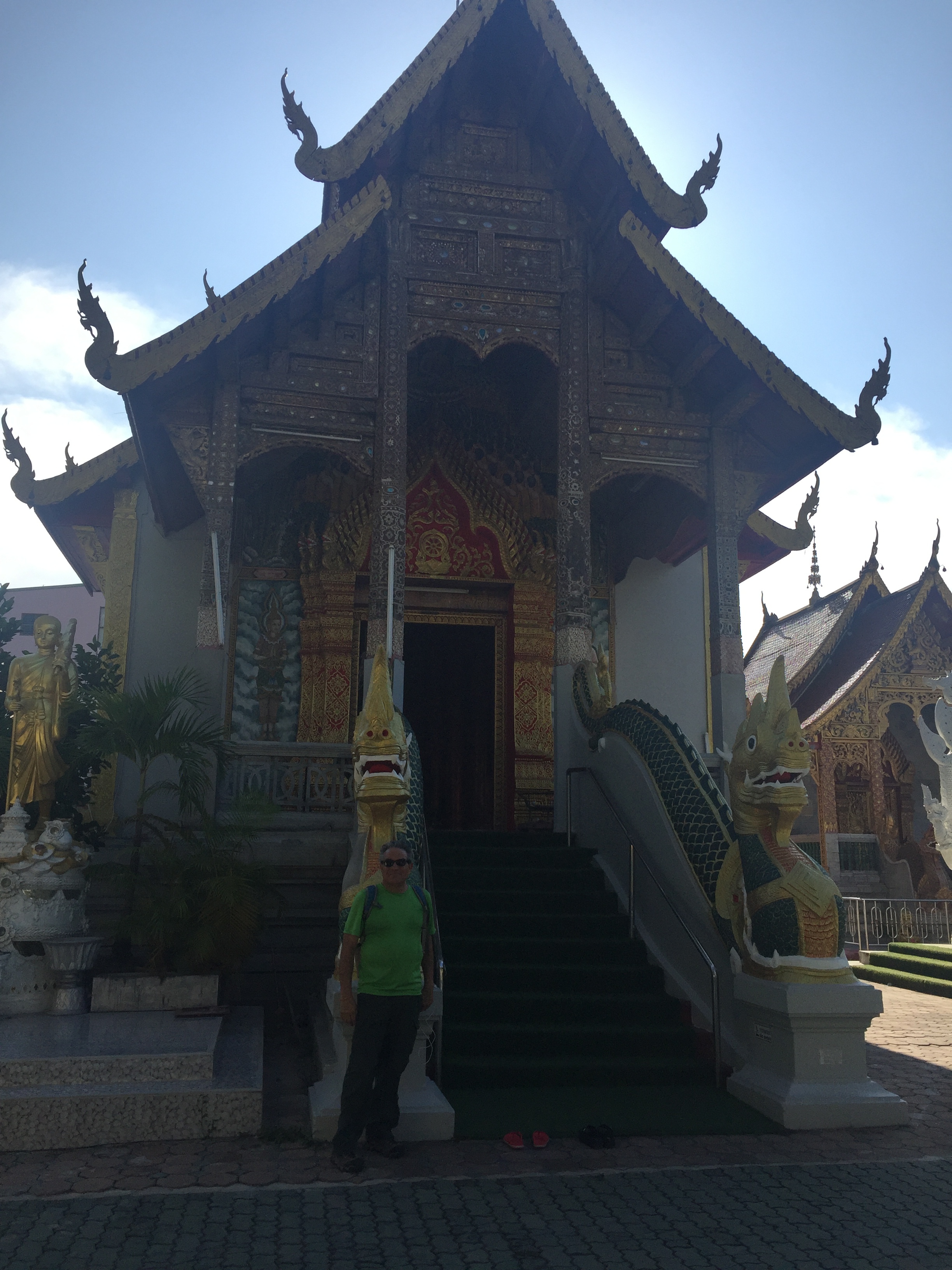
Chiang Mai is a very religious center with 120 Buddhist temples in the area along with many monasteries for monks. Each is decorated in glorious fashion with bright colors and protective dragons, and of course a large main Buddha figure surrounded by other Buddha in various states of reflection. The interior walls of the temples are usually painted with holy figures and murals. From our hotel we trekked around town to view seven (7) temples. Several where having a celebration on this day so it was a lively scene. At the city center was a wonderful sculpture called the ”Three Kings”. (see top photo above) This commemorated the early leaders that established northern Thailand independent of Burmese invaders. This part of Thailand was governed by the”Lanna” tribe. Here are some photos about the temples, and especially the protective dragons. 

We did take a ½ day tour up to the peak of the mountain towering over the city. Here, we experienced another grand temple and spectacular views. Driving down the mountain we stopped at a small village with beautiful gardens and waterfall; also some nice shop—we bought some goodies. The most excitement really came from the van driver who obviously dreamed of growing up and being a “Formula One” driver. This is the second time in Thailand that we broke out some “Dramamine” to forestall motion sickness.


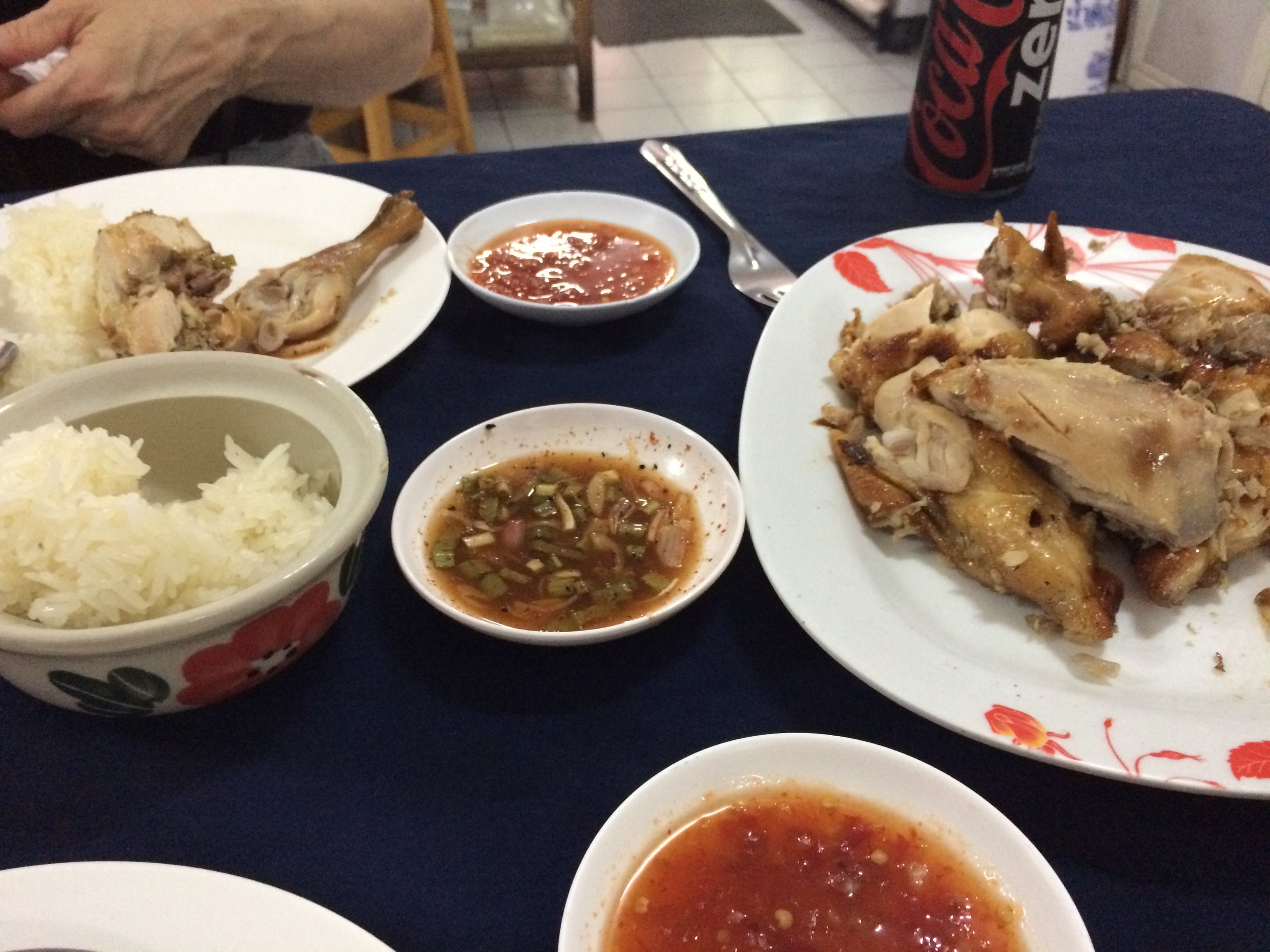
The food here is excellent. We ate at one restaurant twice; it was close, had specialized selection,  and good ratings from Trip Adviser. We also ate at JP Chicken Shack. Small hens rotating on a spit then cleaved into smaller parts. Very good. 

We walked to the Travel Hub offices to purchase tickets to the proverbial ”slow boat” to Laos (not China). This will be a new adventure. The tour group picks us up by van and transports us near to the Thailand/Laos border.  This was a very short trip into Thailand.  We will be back in 10 days when we meet the kids in Bangkok for much more fun.

Battambang Cambodia

Our hotel with pool

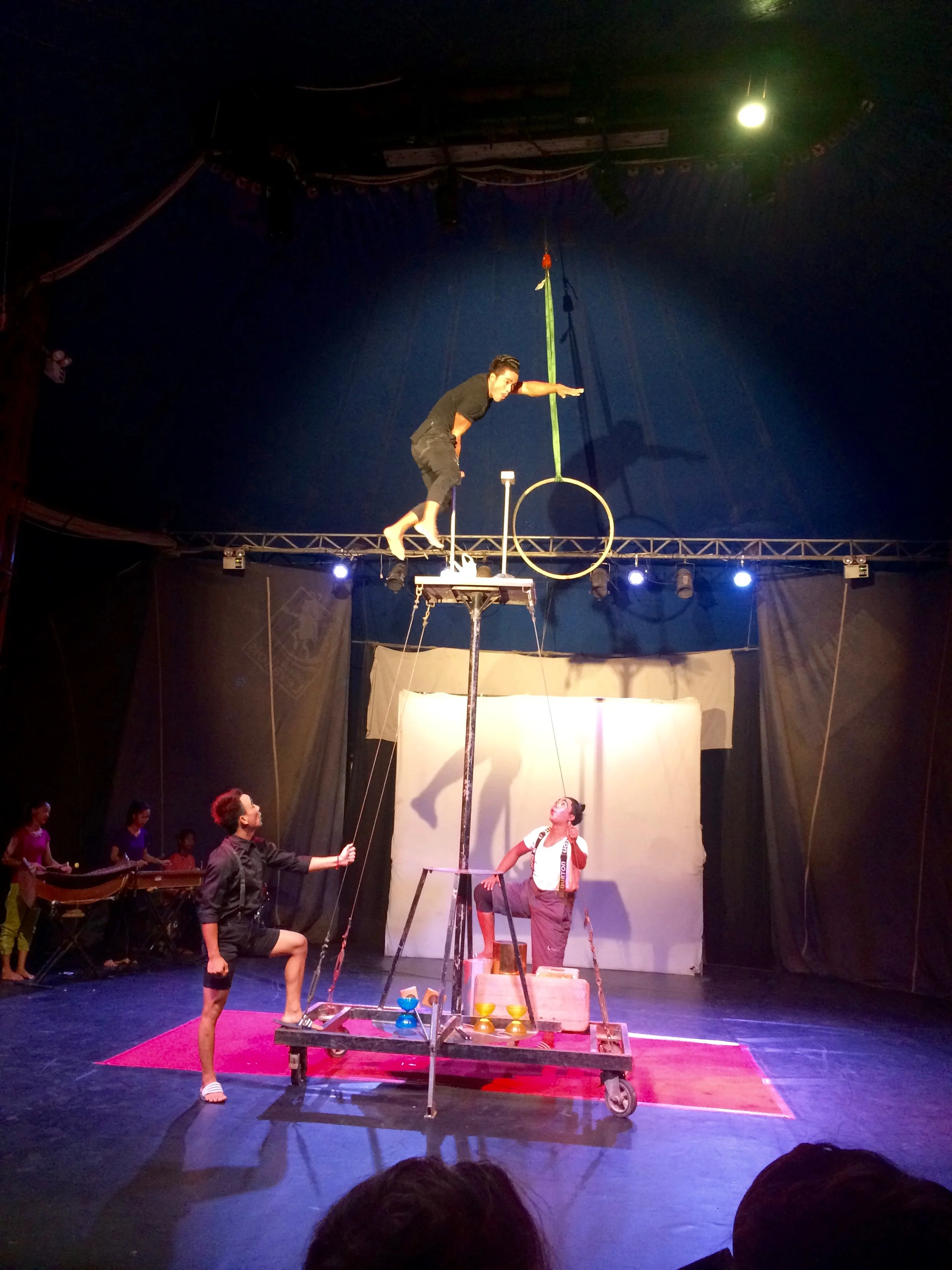
This town is located Northwest of Siem Reap and is considered more rural but with a population of 140,000. We booked another hotel with a pool—love afternoon cool-downs and hung out at the pool all afternoon.. That evening we enjoyed the Battambang Circus. This is the training ground for future stars, but they already show professionalism.  The traditional Cambodian dance routines were well done with the right amount of grace, strength, and comedic relief expressed by the group of eight dressed in colorful garb. Next the clowns and gymnasts went through strenuous routines of high flying, balancing, and acrobatics.  They were all very good and received much applause from the mostly westerner audience.   

Flying without a harness

Flying without a harness


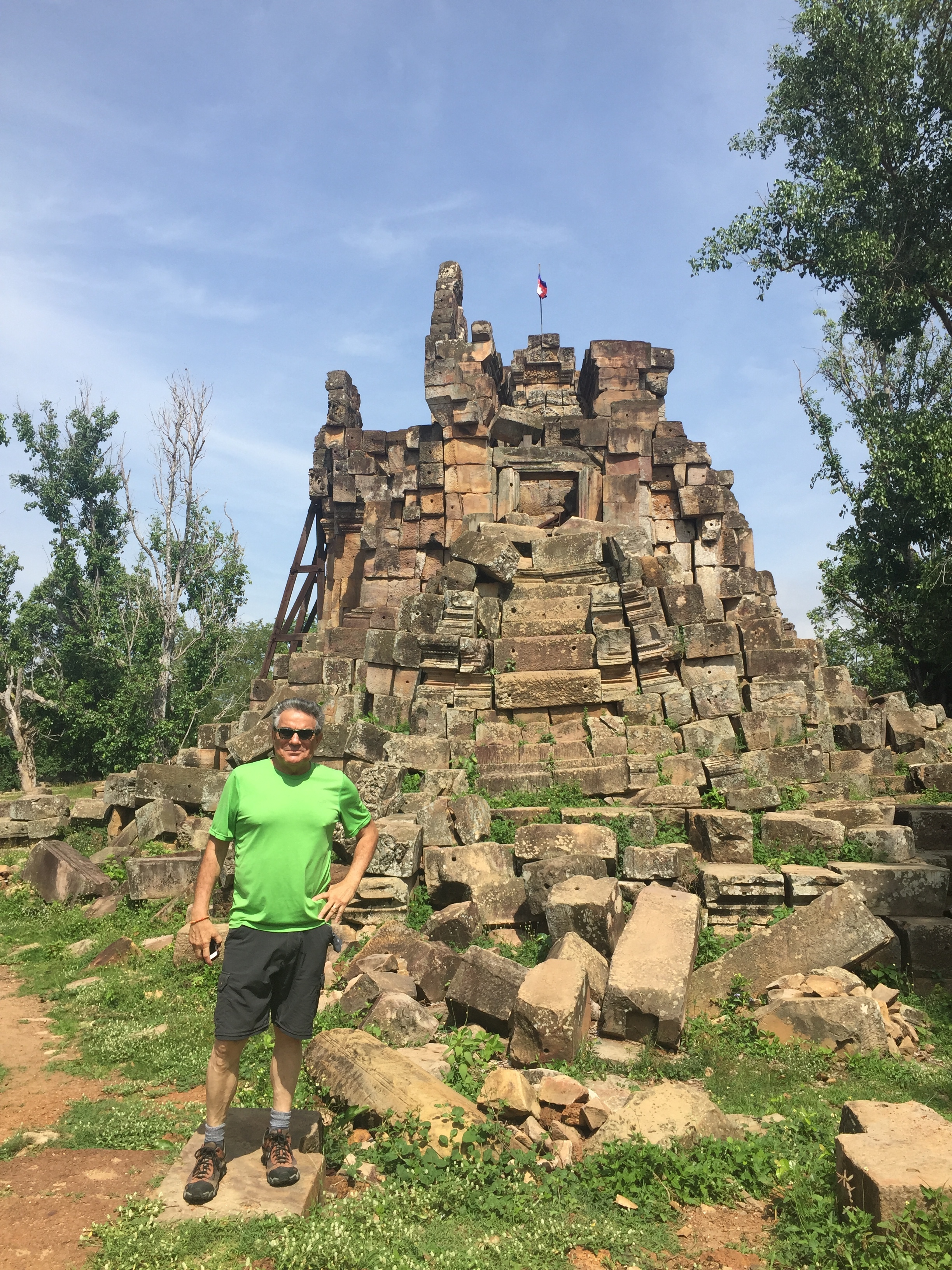
The next day we enjoyed the countryside excursions. Yes, there are small ancient temple which are interesting in there own right, such as “Ek Phnom Temple” (100 years older than Angkor Wat), but the add-on of the Craft Shop Tour suggested by our tuk-tuk driver Mr. Blue, made the longish drive even more worthwhile. See the photos of the temples below

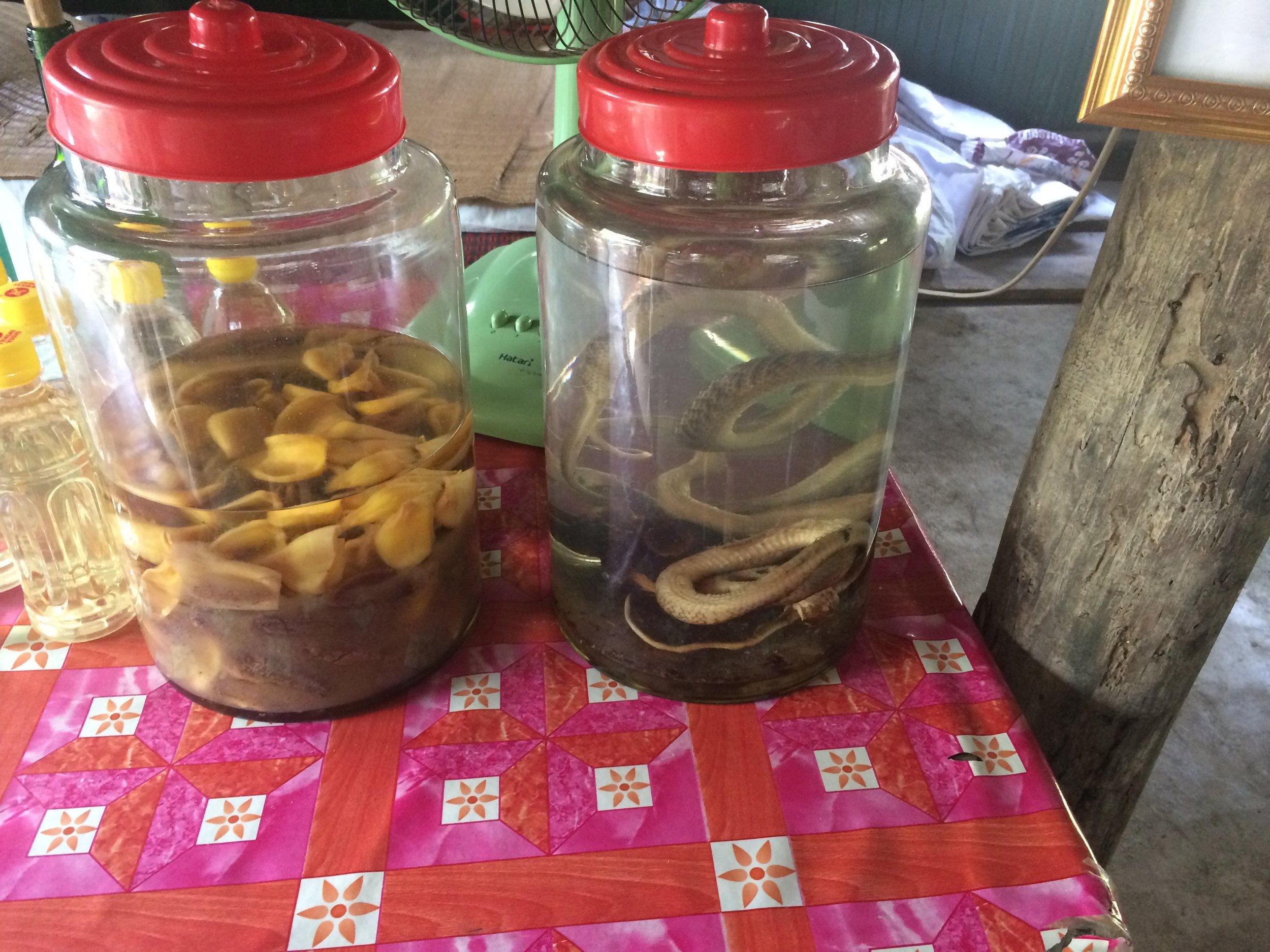
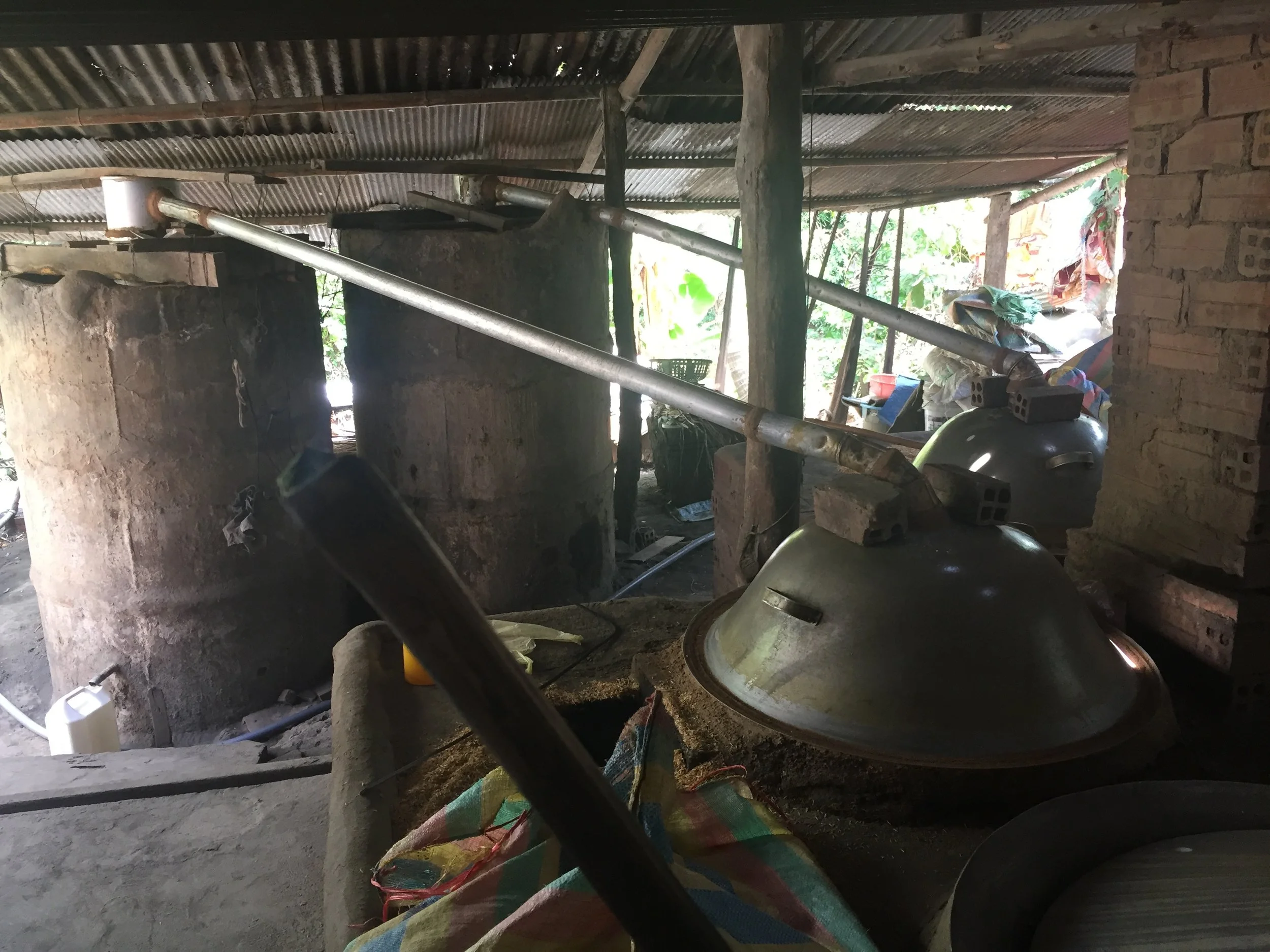
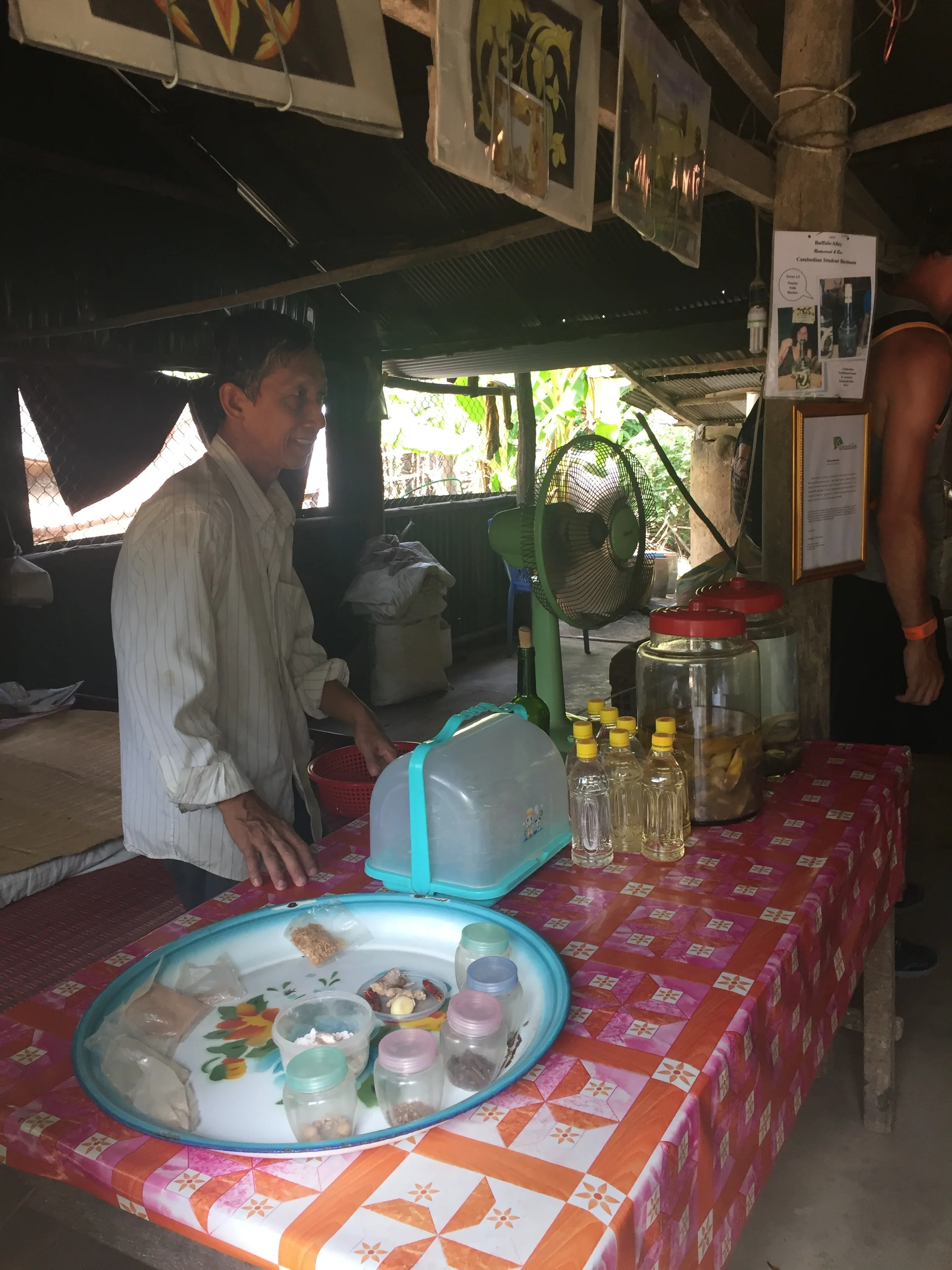
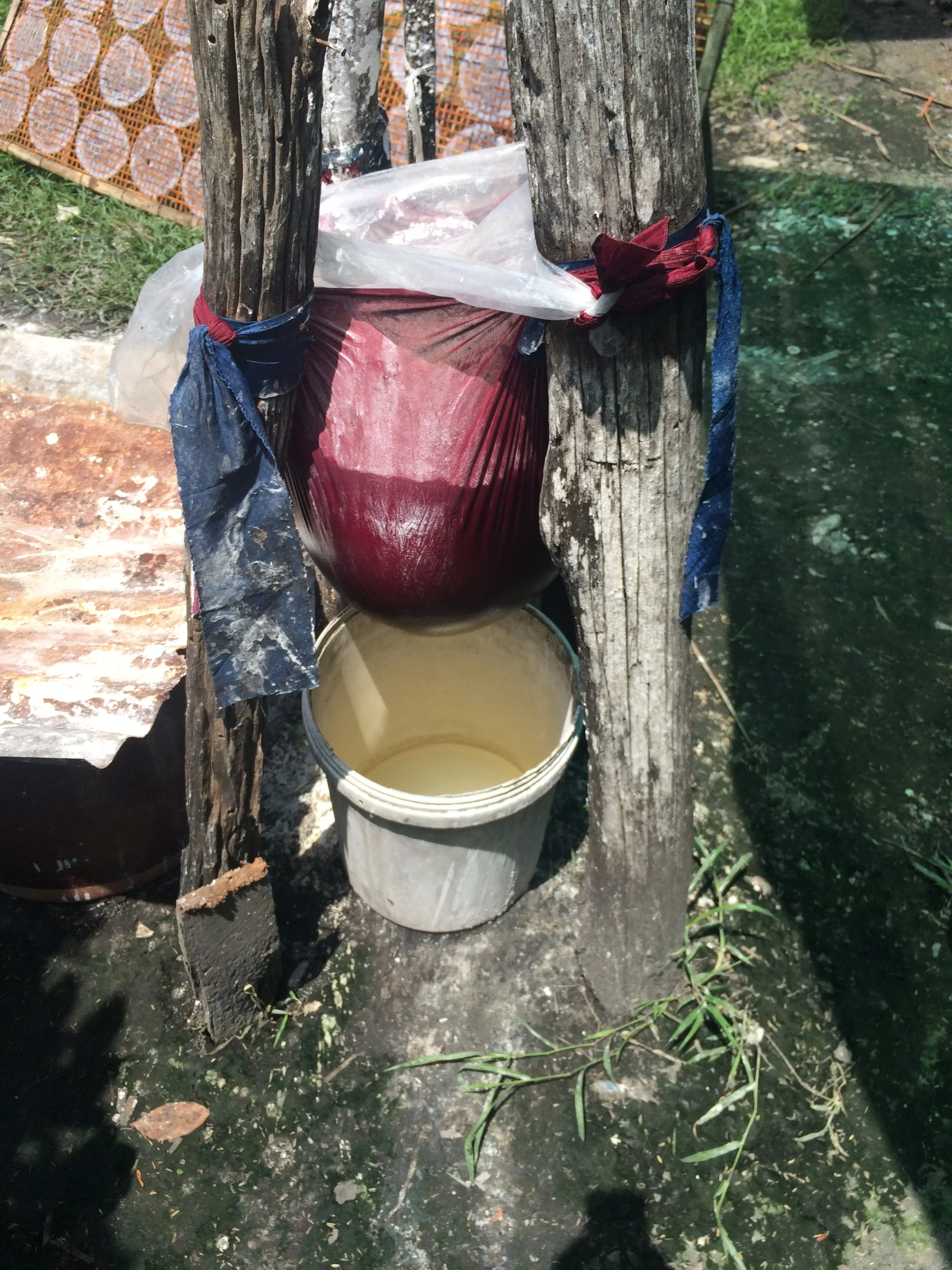
Our driver took us to 3 village locations, starting with a rice wine maker,  really it is "moonshine" and we loved it.  The of rice wine which is about 40-50 proof and can be purchased straight up, or with fruit flavors, or even with cobra snake juices (for those with sore backs!).  No purchase by us, but drinking the free shots of booze offered was appreciated.  See photos below of the Cobra snake, the distillery and the owner/salesman. 


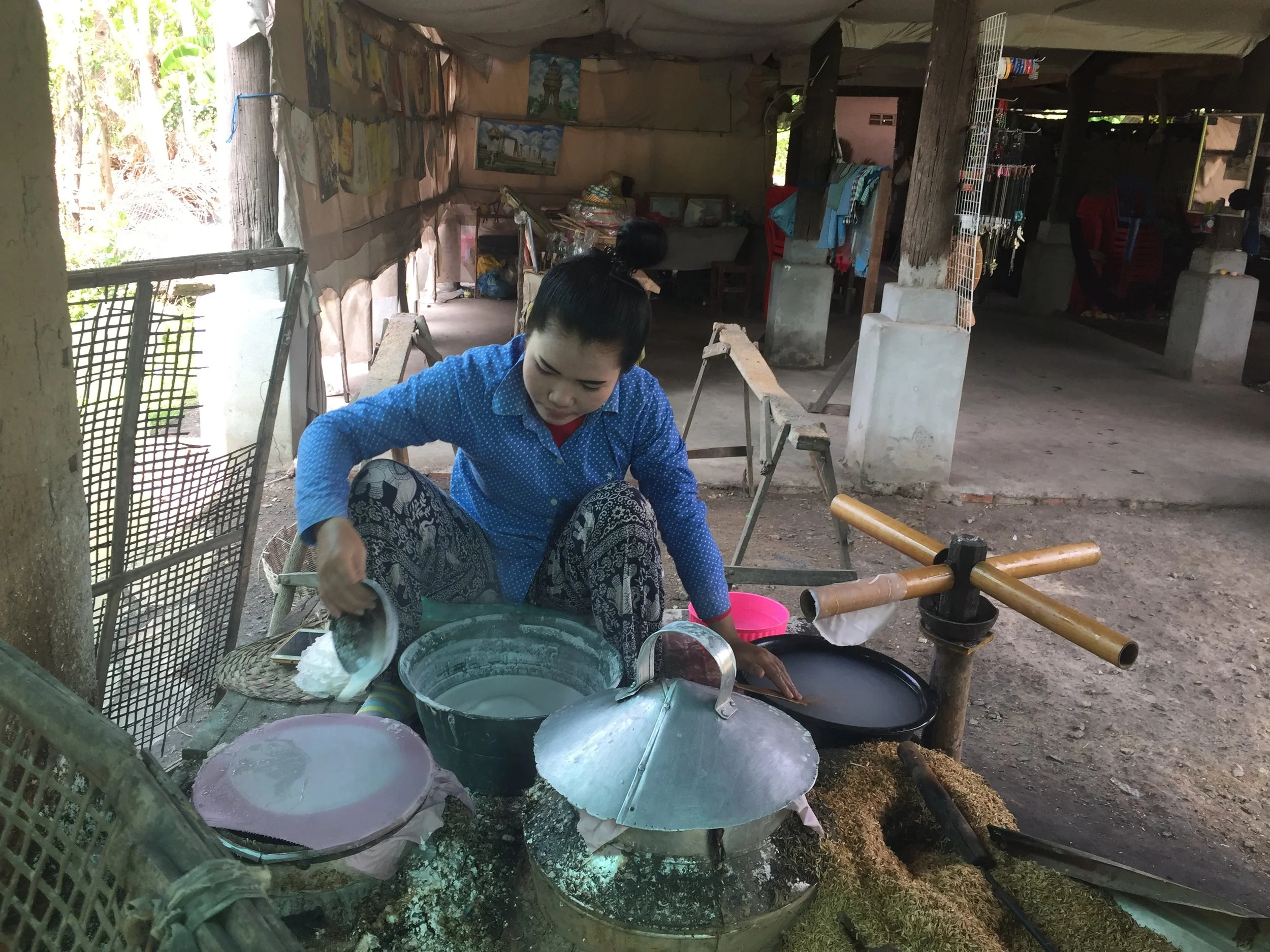
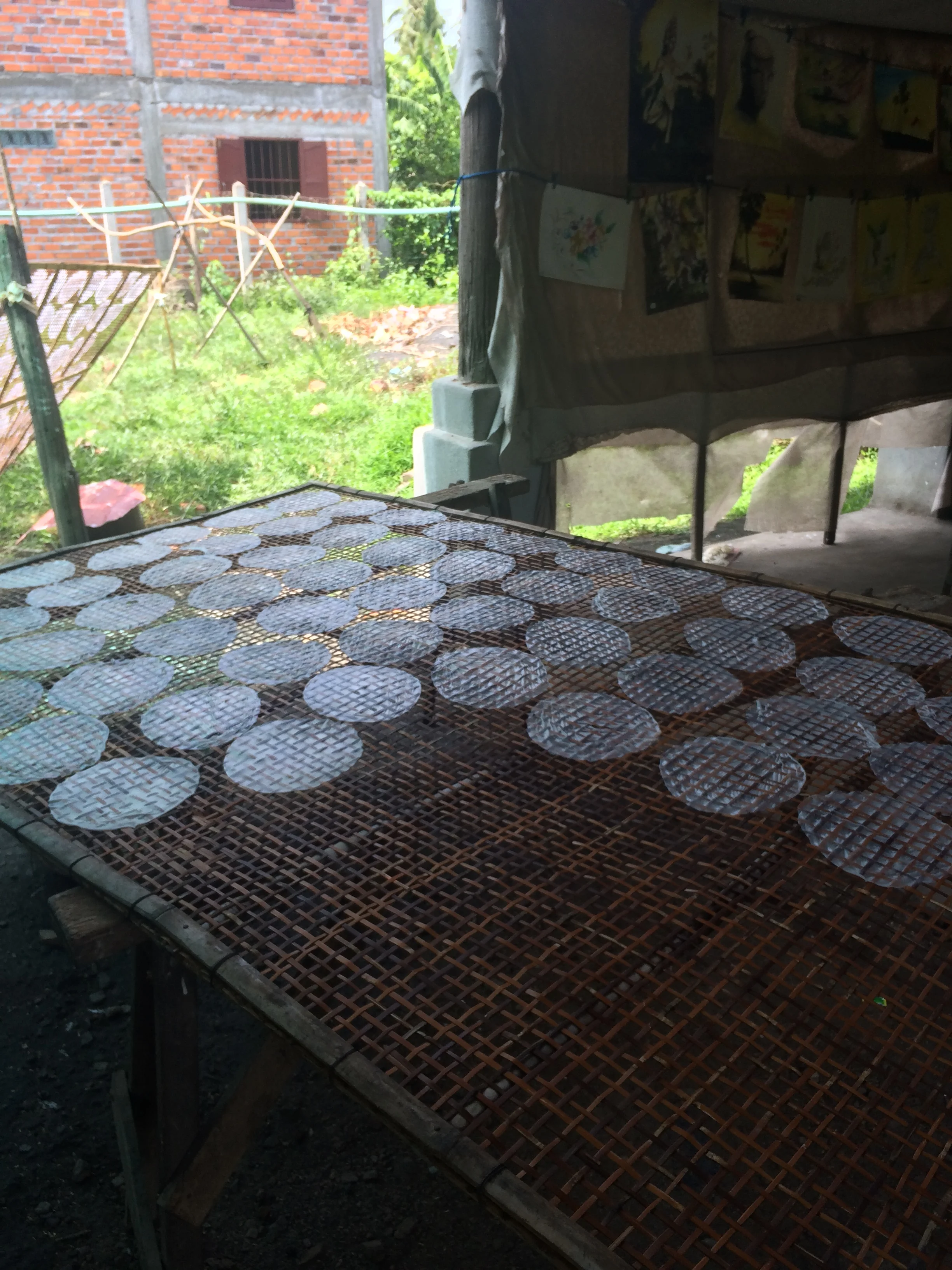
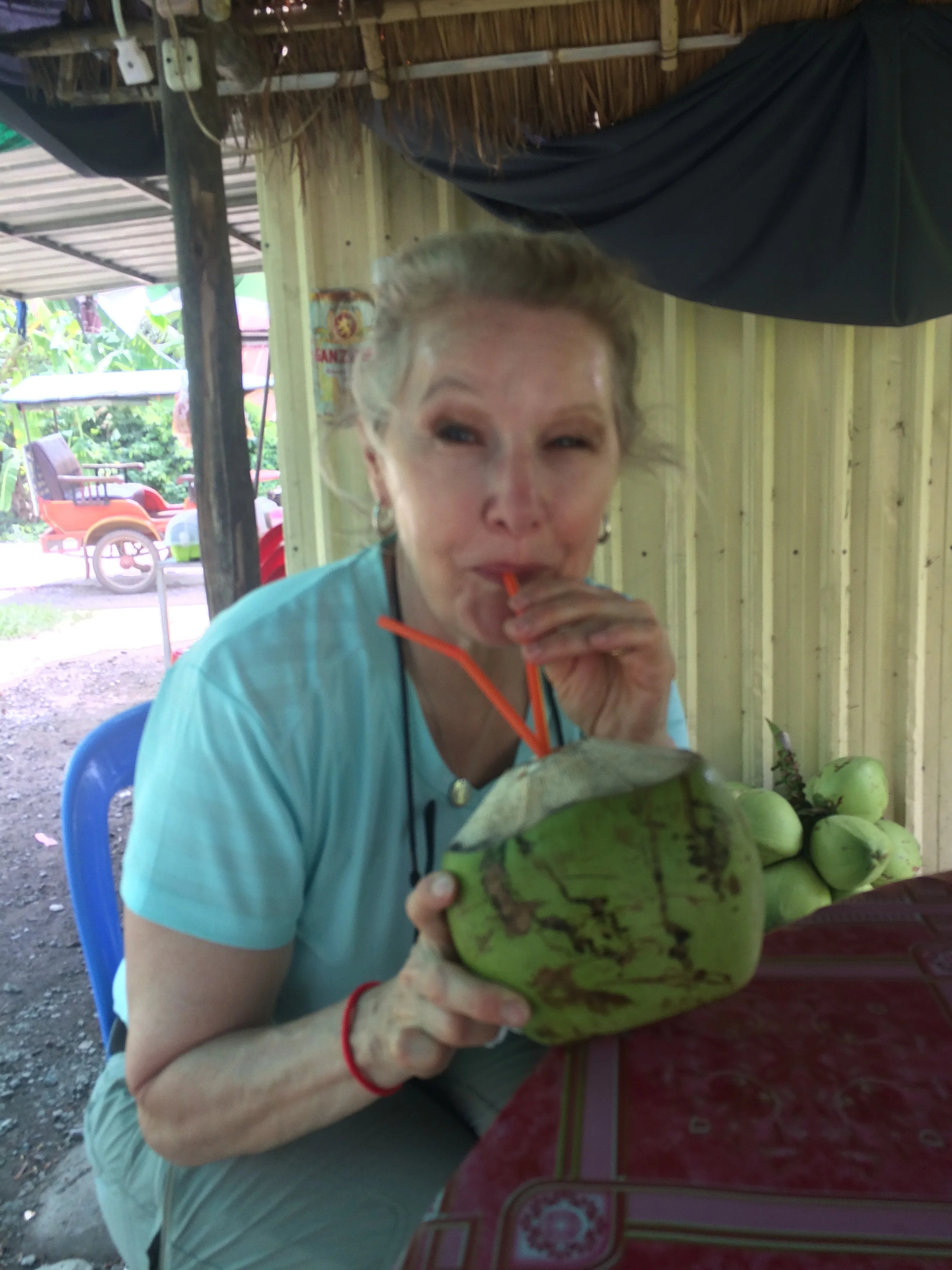
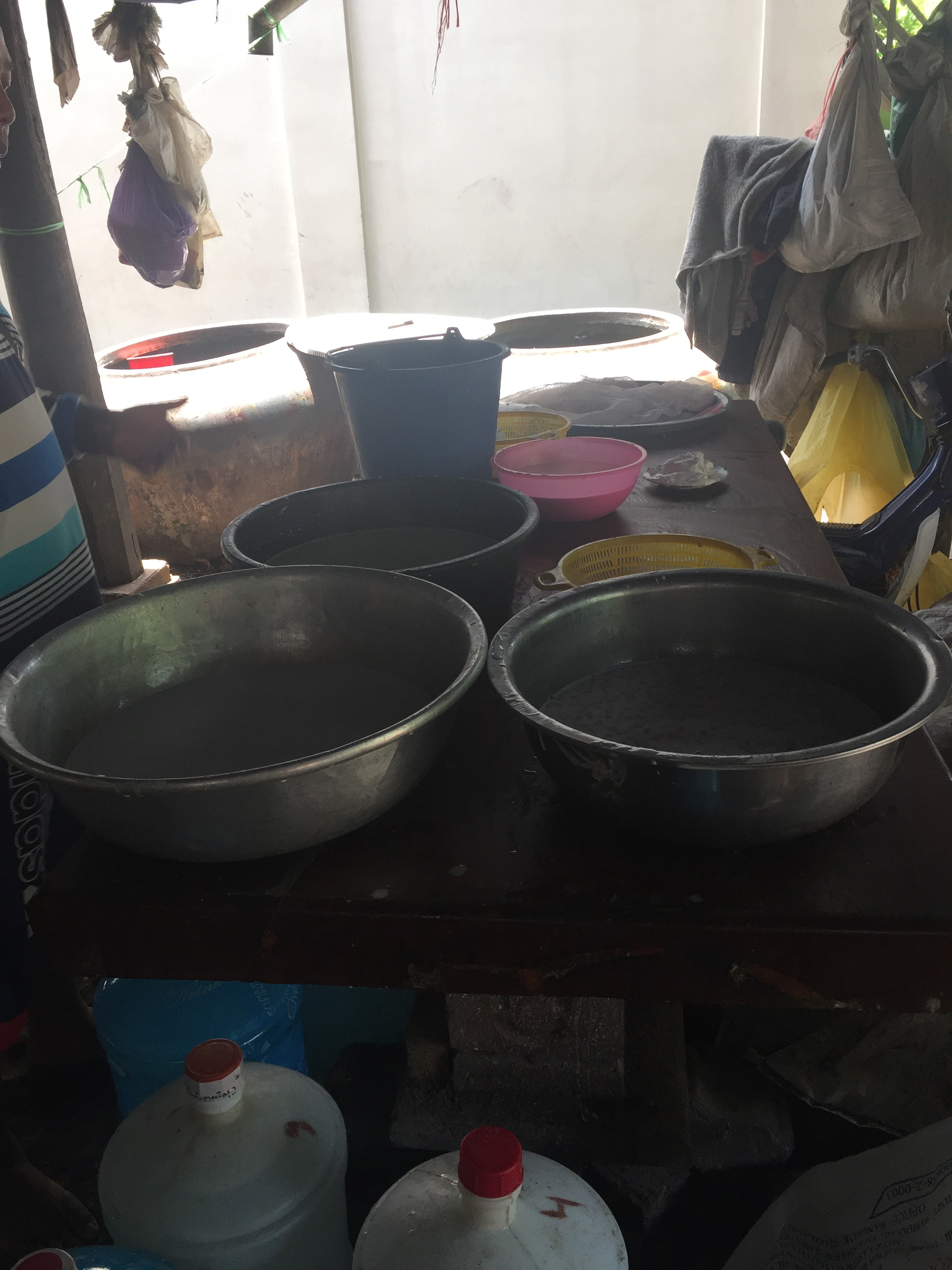
Next we stopped to watch a rural production line of 2 people make/cook “circular rice paper” for spring rolls over a charcoal stove. The process has 3-4 steps. Stoke the fire which heats the circular pan, spoon the rice mixture onto the pan and spread it in a circular pattern; let the batter heat for a matter of seconds and place the cooked rice circle on to a round bamboo rod; remove the rod from its holder and roll the rice paper onto a large mesh drying sheet. The mesh sheet holds 80 pieces.  Our guide told us the family can make 1,000 per day and get around $100 for it.  The girls making it do not go to school and stay with the family business until they marry.  While they worked we drank natural milk out of a fresh coconut; once the milk was sucked up, they split the coconut open so we could spoon out the soft coconut meat. Really good in a natural way; but not sweet like processed coconut for candies.

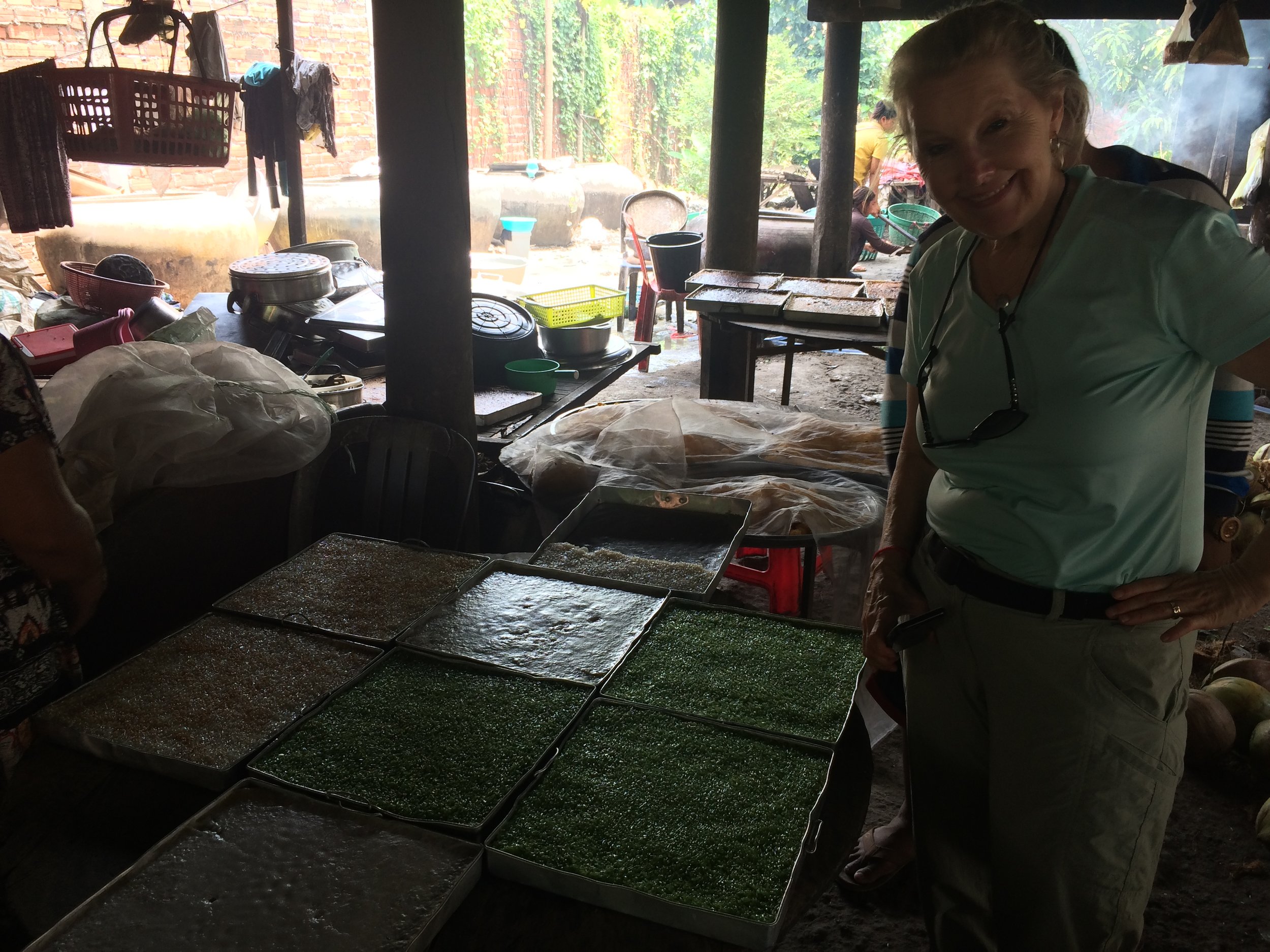
The third craft shop was at an outdoor bakery of sorts with about 10 employees cutting, mixing, baking and wrapping prepared coconut cakes about 2 inches high and 8 inches square in a variety of colors. This was a manual factory, maybe with some wholesale. We did not taste any coconut cake, but the size of this operation in the open under a corrugated tin roof was impressive.

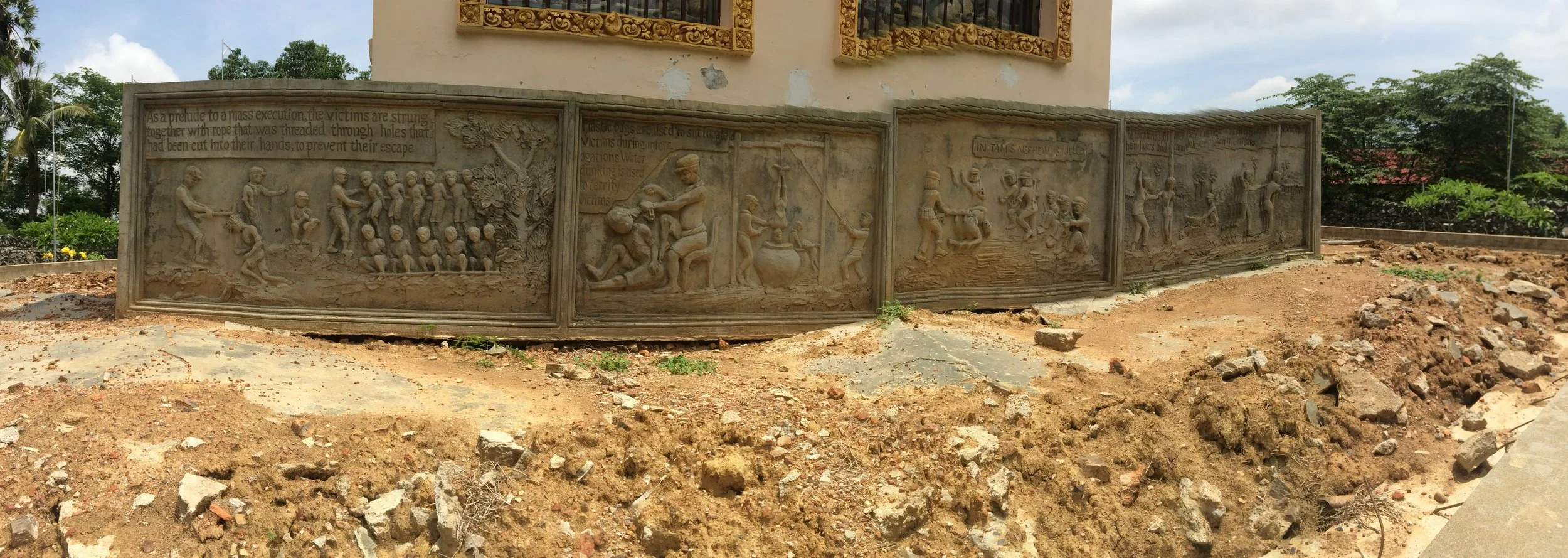
We also stopped at another “ Killing Field” at a temple called “ Wat Samrong Kuong” which had been converted into a small prison and torture center of the Khmer Rouge. There are 300 killing fields in Cambodia and by the end of this day we will have experienced 3 sites. There is a memorial here with the display of human bones, but even more striking is the artistic relief sculptures surrounding the base of the memorial.  Here, the brutality is graphically depicted; very depressing.

The murals of the killing field monument 

The murals of the killing field monument 


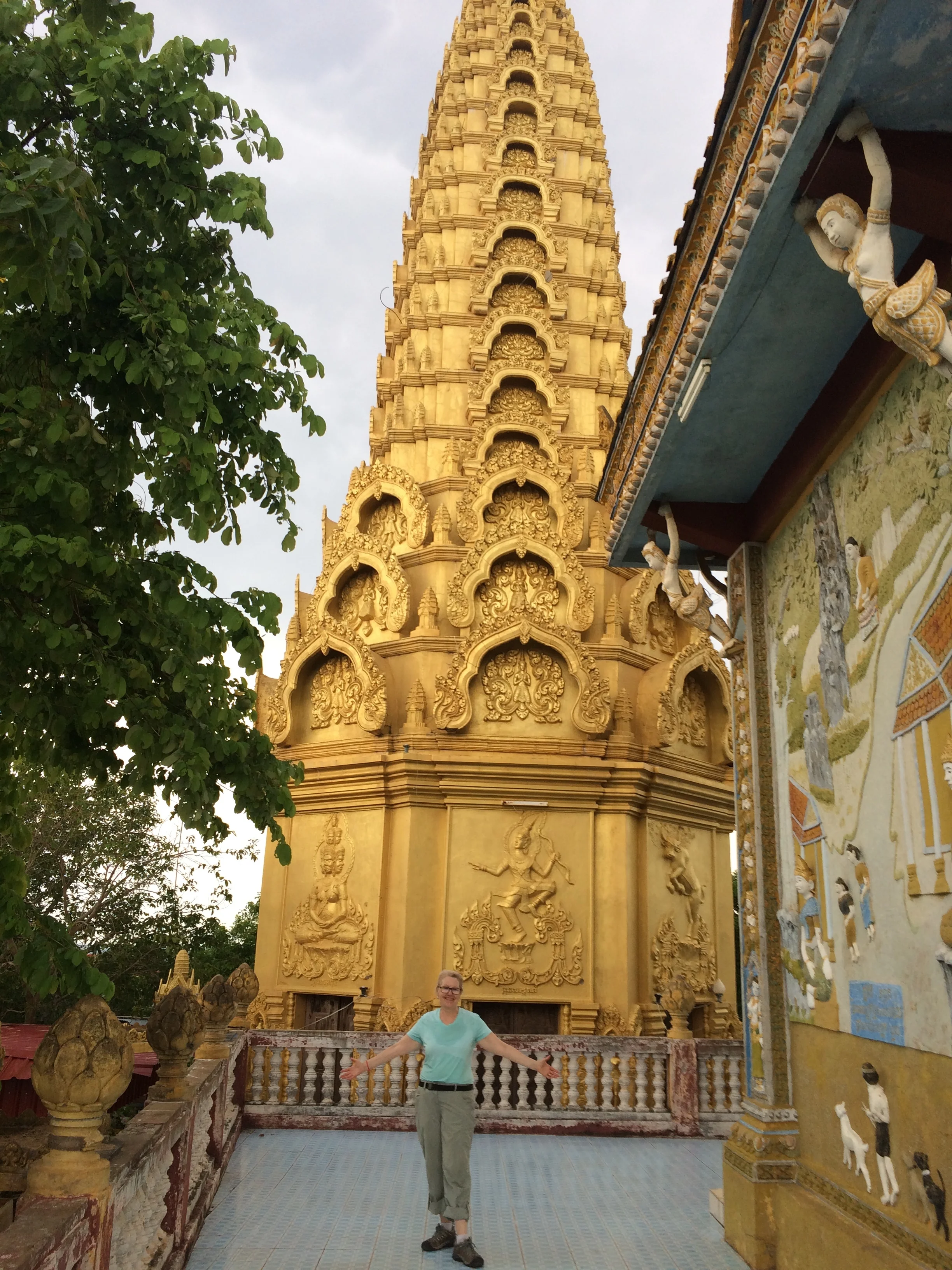
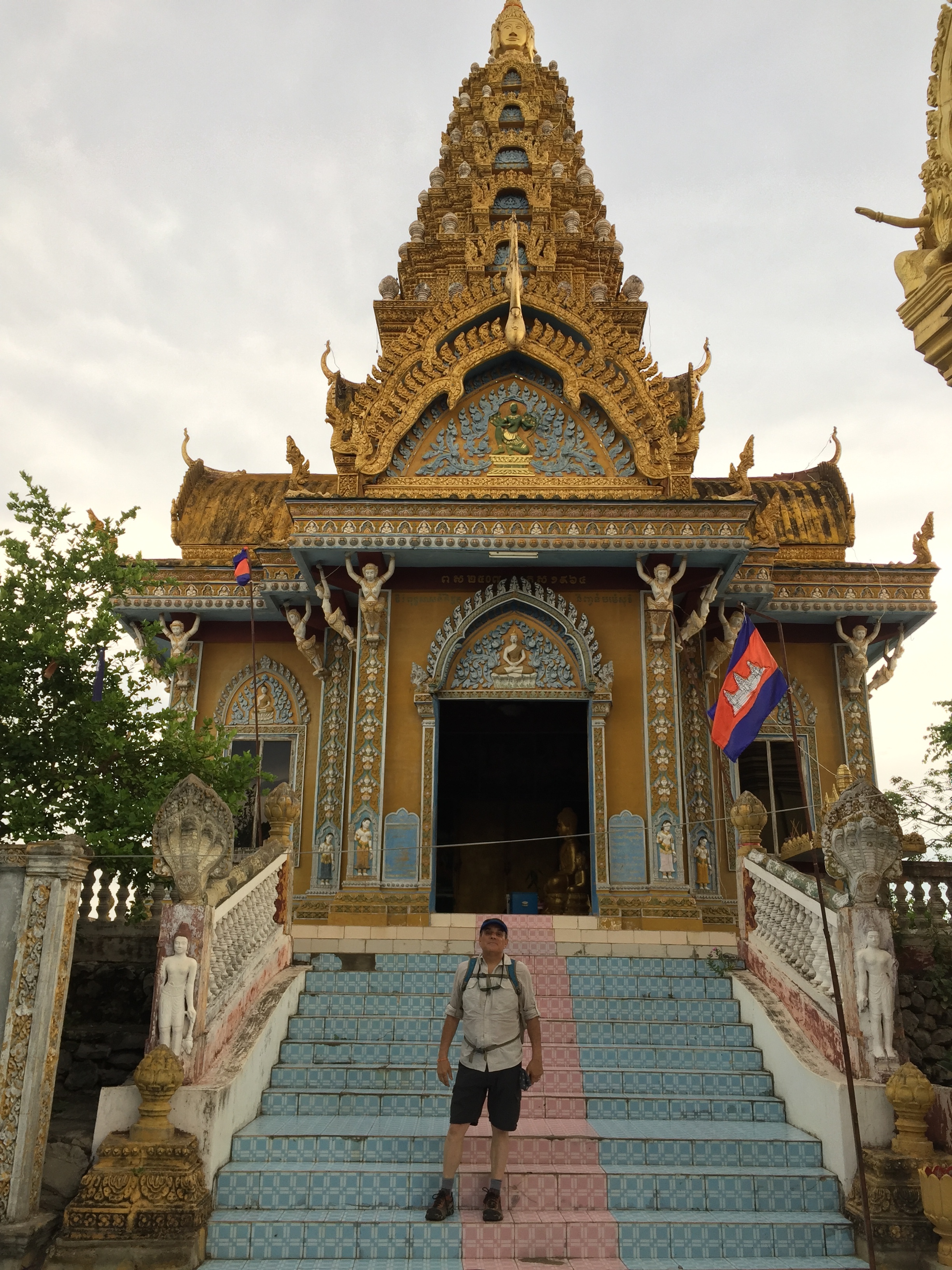
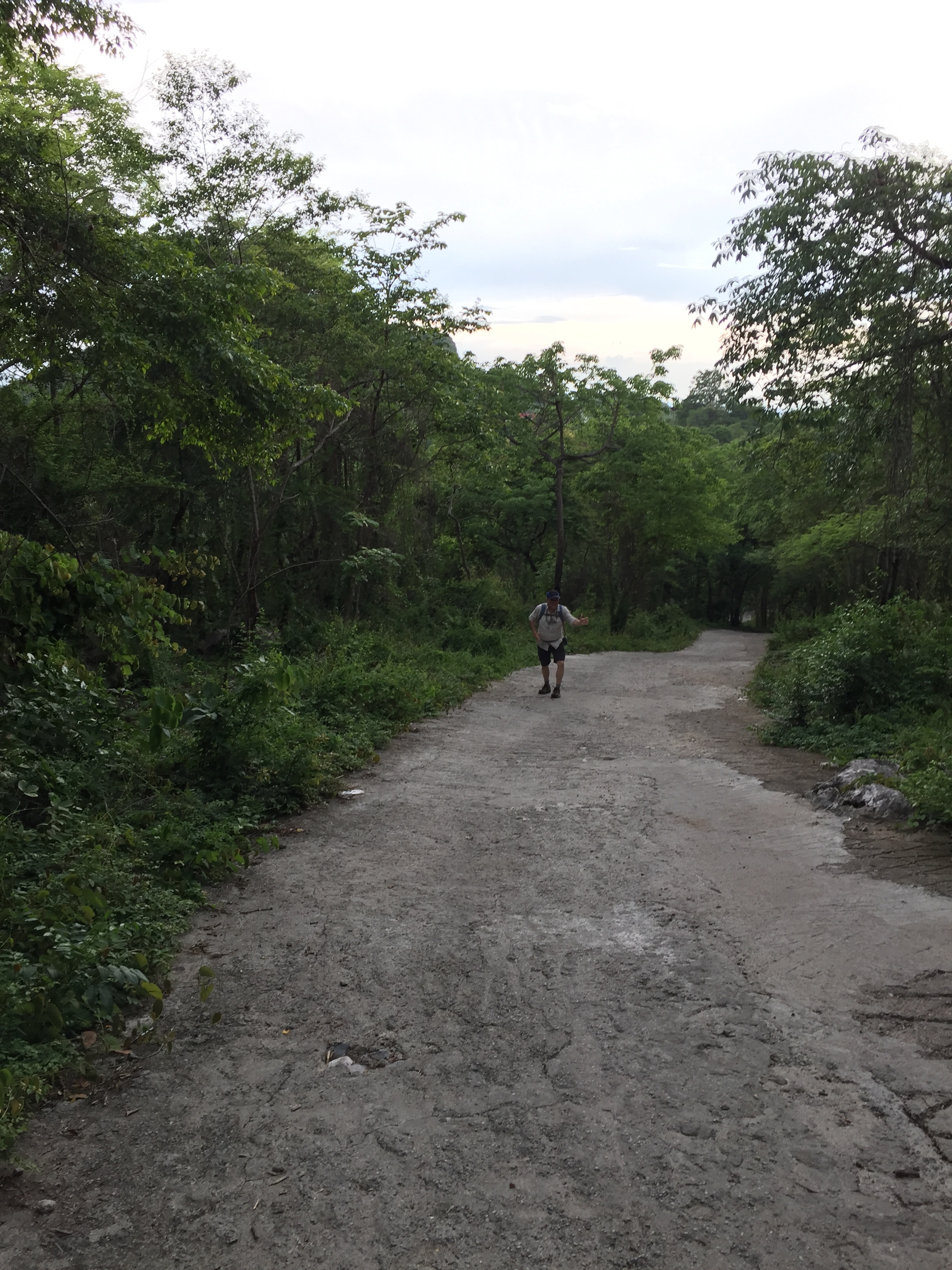
We then went to the mountain top Temple of Phnom Sampov. We walked up a very steep road to get to the top where this beautiful Buddhist temple sits overlooking miles and miles of farmlands in the surrounding plain and the small village below. There are several structures including Pagodas, all connected by tree lined terraces which are populated by swinging monkeys. That is the good part.


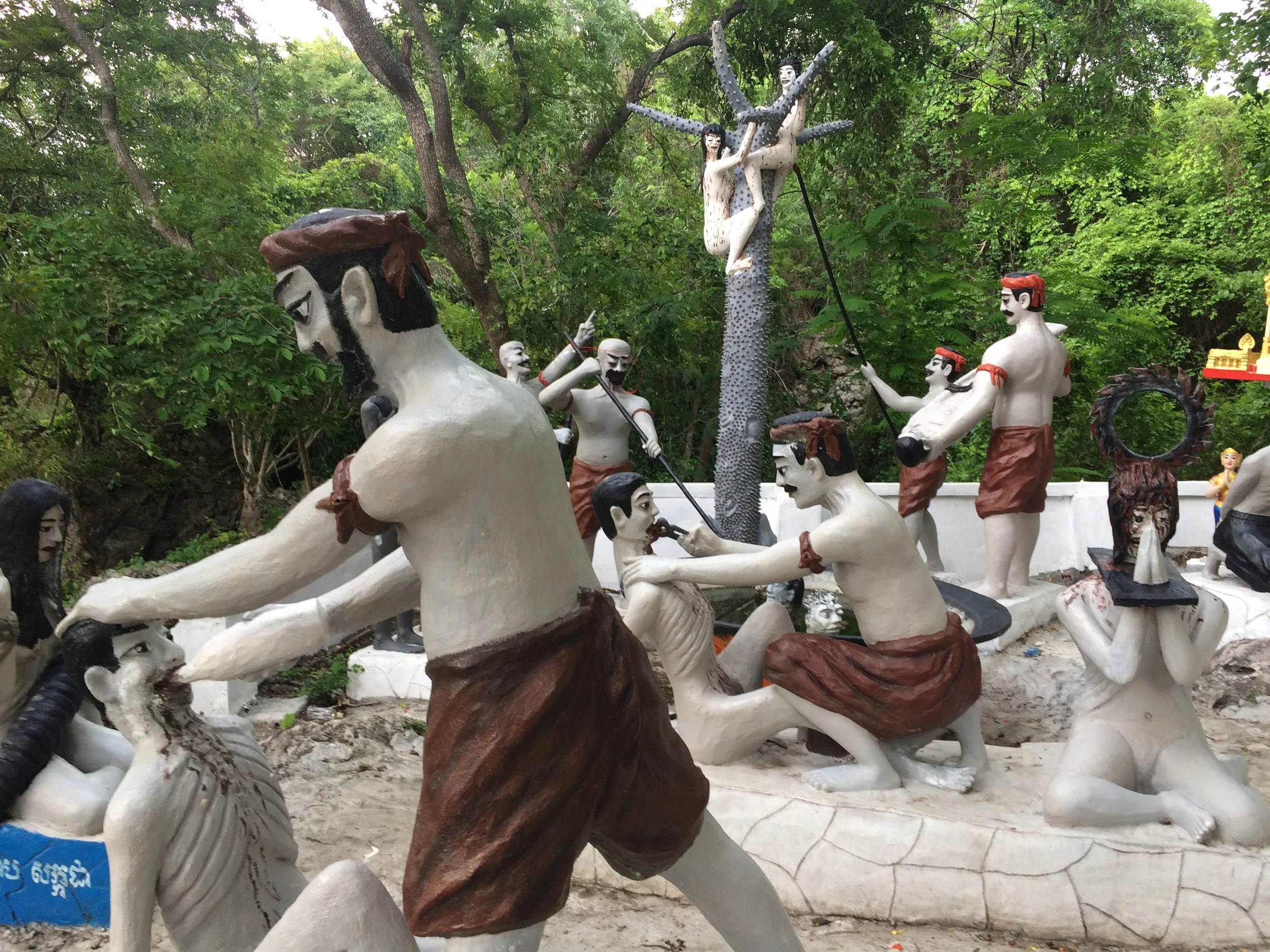
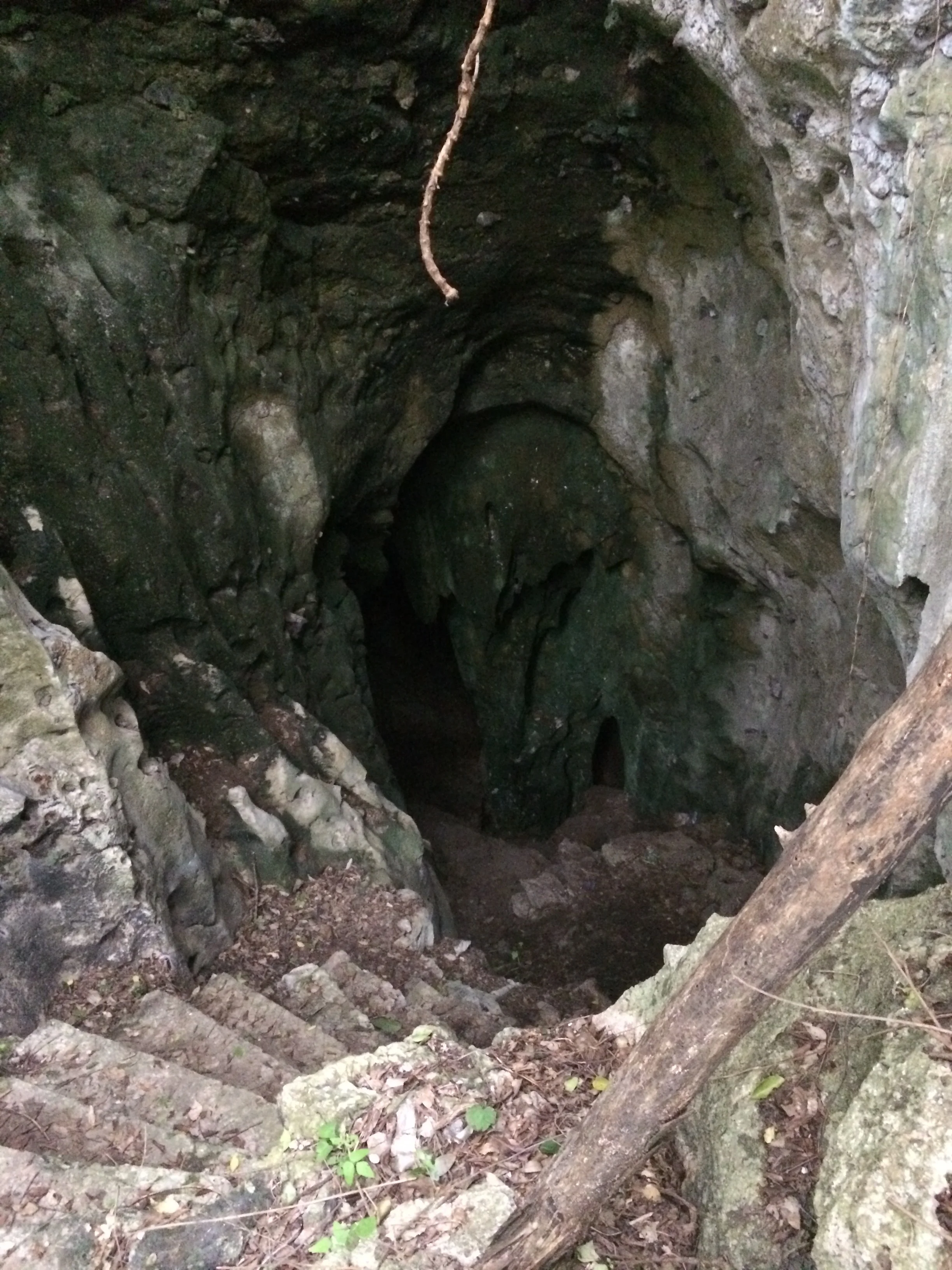
On the way to the top there are some pathways to large cave openings. Here, the Khmer Rouge strike again. Instead of the usual memorial, a rather graphic display of torture techniques is portrayed. In the enormous cave, there are pits and walkways, now a small Buddhist alter, and a cage with human bones. Look up and you can see an opening in the cave ceiling where apparently victims where pushed and dropped to their death. The Khmer Rouge were pure evil—they tortured people for false confessions knowing they would be killing them no matter what. It is a tragic history of this country which has been repeated time and again by foreign invaders and domestic perpetrators.


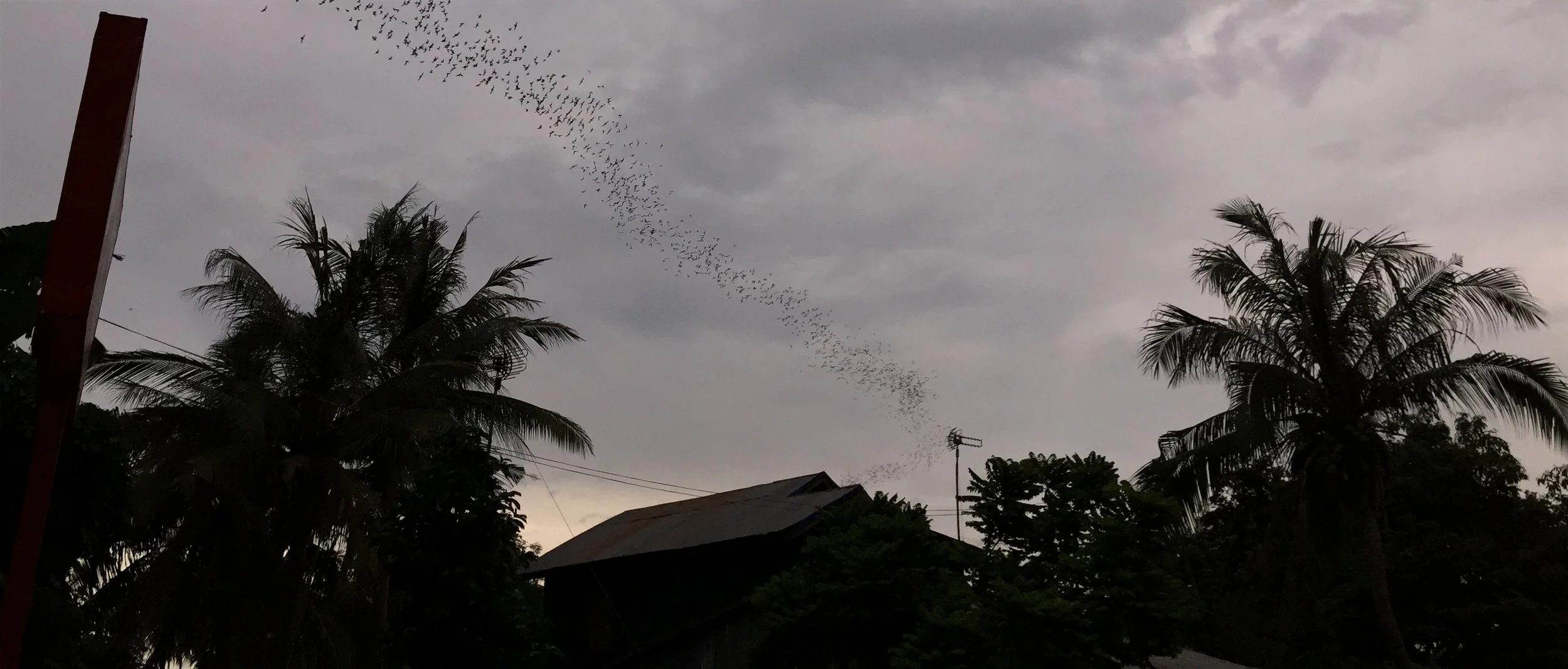
Finally, we walked down from the hilltop back to the small one street village. Here was another cave opening some 50 feet above the street, and it is about 100 feet in length.  There is a buzzing sound coming from the cave. As sunset approaches, at about 5:30 PM, the buzz increases and then thousands of “Wrinkled-lip Bats” emergein groups from the cave. The sky becomes blackened as the bats fly to the rural fields in the area. It looks like each group has a leader and they head in pre-determined directions. After watching for about ½ hour we drive home in the tuk-tuk watching the various groups flying on the wind currents incredibly high and far. It was really a great experience for our last day in Battambang. Tomorrow, we take a bus to the border of Thailand, cross over, and then bus to Bangkok, Thailand. We really have enjoyed Cambodia; the people are very friendly, not pushy, have reasonable english skills, almost all drive motorcycles, they are fair dealing, and their history and culture is fascinating.

The nightly flight of the bats

The nightly flight of the bats

The Black Buddha is the city namesake

Siem Reap Cambodia

Relaxing at the pool with happy hour

Siem Reap

We arrived at Siem Reap by bus. The trip was 6 hours from Phnom Penh. The countryside was flat, lower than the road, clearly sectioned into rice patties, some wet and others not. There was also some small trees, soft wooded trees, reminded me of Florida.  As we entered the city it seemed smaller than we imagined, but with wide roadways and set back stores. Later we would take the tuk-tuk to the Hotel Billinal and did pass more narrow active streets. One street had the place maker sign: “Pub Street”; we will have to return there. This boutique hotel is really nice, with a great big pool with covered poolside cabana and nice landscaping. Our host Julia set up our licensed tour guide and the tuk-tuk driver, for the next several days. We had happy hour drinks, massages and dinner at the hotel; We would certainly recommend the Hotel Billinal and really enjoyed doing business with Julie and her staff. Now, early to bed for the first Circuit of Temples.

8th Wonder of the World 

Siem Reap is the perfect base of operation from which to visit the temples of Angkor, considered the eight wonder of the world. Here, the Cambodian culture and spiritual devotion fused, making this area one of the most impressive ancient sites on earth. The fusion arises from the merger of the Hindu faith of India influences and the Buddhist faith of China influences. These temples were created by Jayavarman II and Jayavarman VII, (aka Jaya II and Jaya VII), and Suryavarman II (Sury II)

The Large Circuit

You purchase your tickets in town at a large complex 

The large circuit of temples is farther away from the hotel and city than the blockbuster Angkor Wat. We opted to follow a route advised by Lonely Planet, start with the small temples.  It surprised us as to the distance, but riding in a tuk-tuk in the cooler morning air is actually refreshing; the heat was to come later. We arrived at the central ticket office which is modern and flamboyant in architecture. The 3 day pass is $62 each;  Also, we wanted to make sure Janet was recuperating so wanted a more relaxed pace.

The entire area, roadways and entrances, has control points where you must stop and display your ticket to security personnel, our guide tells us that this keeps the areas safe and free from pickpockets.  As we drive we pass massive stone walls running many miles.           

To reach our ur first stop we enter from a massive gate with soldiers that are pulling the gate, it was a great way to enter into this mysterious world.  The first temple was at Preah Khan (Sacred Sword).  This is a fusion temple dedicated to Buddha, and the Hindu’s Brahma, Shiva and Vishnu. This is where we first got a small handle on how these religions were accepted and merged in Cambodia, causing the sculptures and carvings to take on the characteristics favored by each faith. Of note here are the immense corridors that act like an unending hall of mirrors. 


We would have 5 additional stops throughout the morning, our tuk-tuk driver did a great job on the route and information.  The sites varied from small to mid size, all impressive.
 

It was really hot by the third stop. We where sweating badly in the hard sun. We decided to go back to the hotel to freshen up, just a short stop over, talked to Julia about the projected “Sunrise” excursion for tomorrow, and headed off to the downtown district called the “Alley”. This is the location of Pub Street and our restaurant of choice, “the Red Piano”; also Tomb Raider Angelina Jolie’s favorite we heard. The Cambodian food was tasty and the $1 Angkor draft beers quenched the thirst. Enjoyable was a singing duet, actually performing across the street at another open bar, with a female vocalist who was superb. The tune selection was varied so both of us heard some favorites. We saw then up close at dinner several days later.


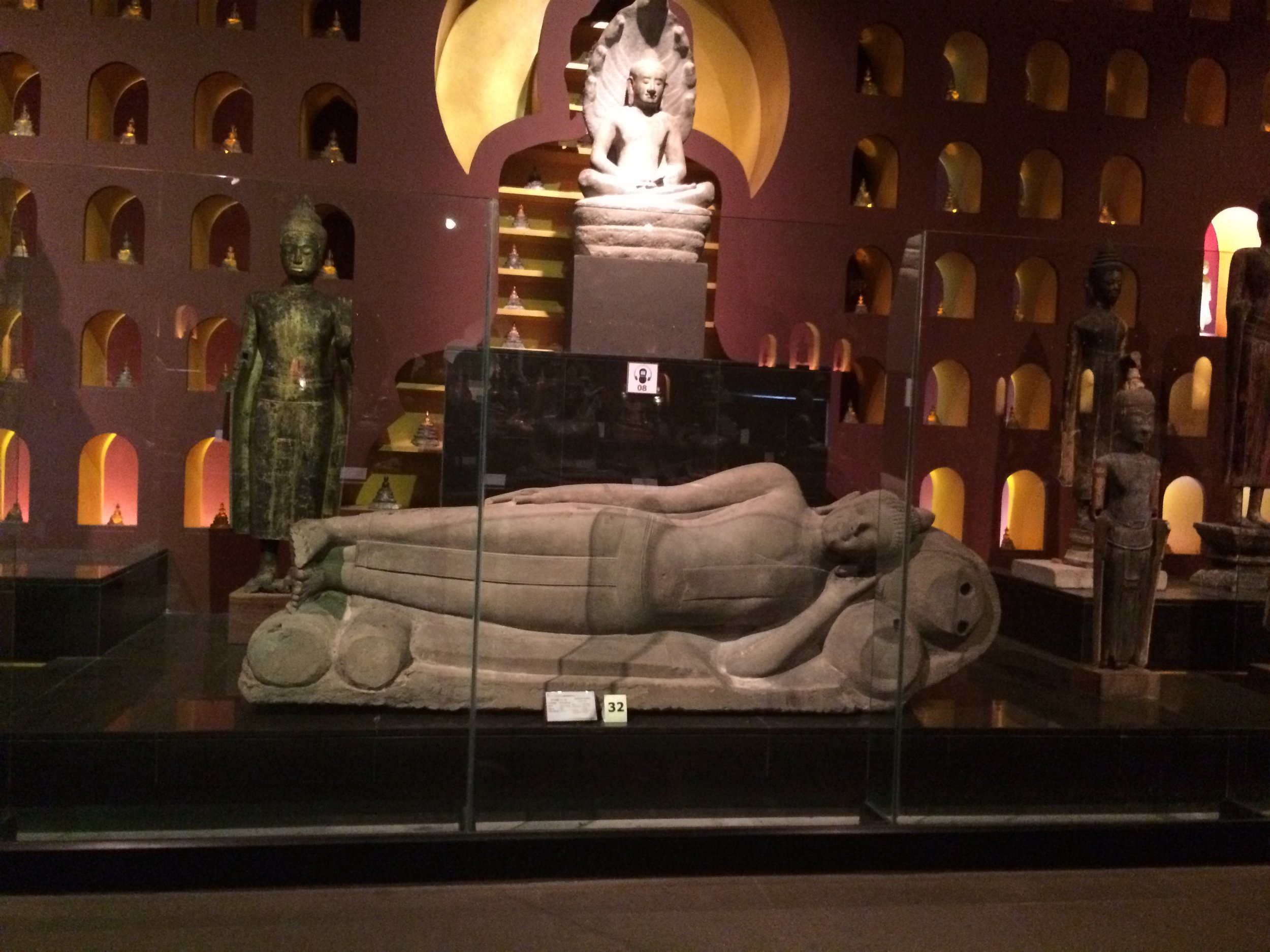
Now , we would spend the afternoon at the National Museum of Angkor. This was a new high tech museum dealing creatively with the ancient cultures of the area. No photos were allowed, but our secret cameraman was pretty sneaky. Some of the information imparted is set forth in the preamble. The audio guide was really good describing the religious aspects of the Hindu faith. Surprising to us, was the audio narrator had an indisputable American female voice, no twang but rather a precise delivery; no Brit or Aussie accent.


Traditional meal at the hotel

We returned home for a dip in the wonderful pool and happy hour refreshments. We decided to do some writing and planning, and then again had dinner at the hotel. The young chef had graduated from the local culinary school and turned out another flavorful dinner. 


Angkor Wat

Angkor Wat at sunrise


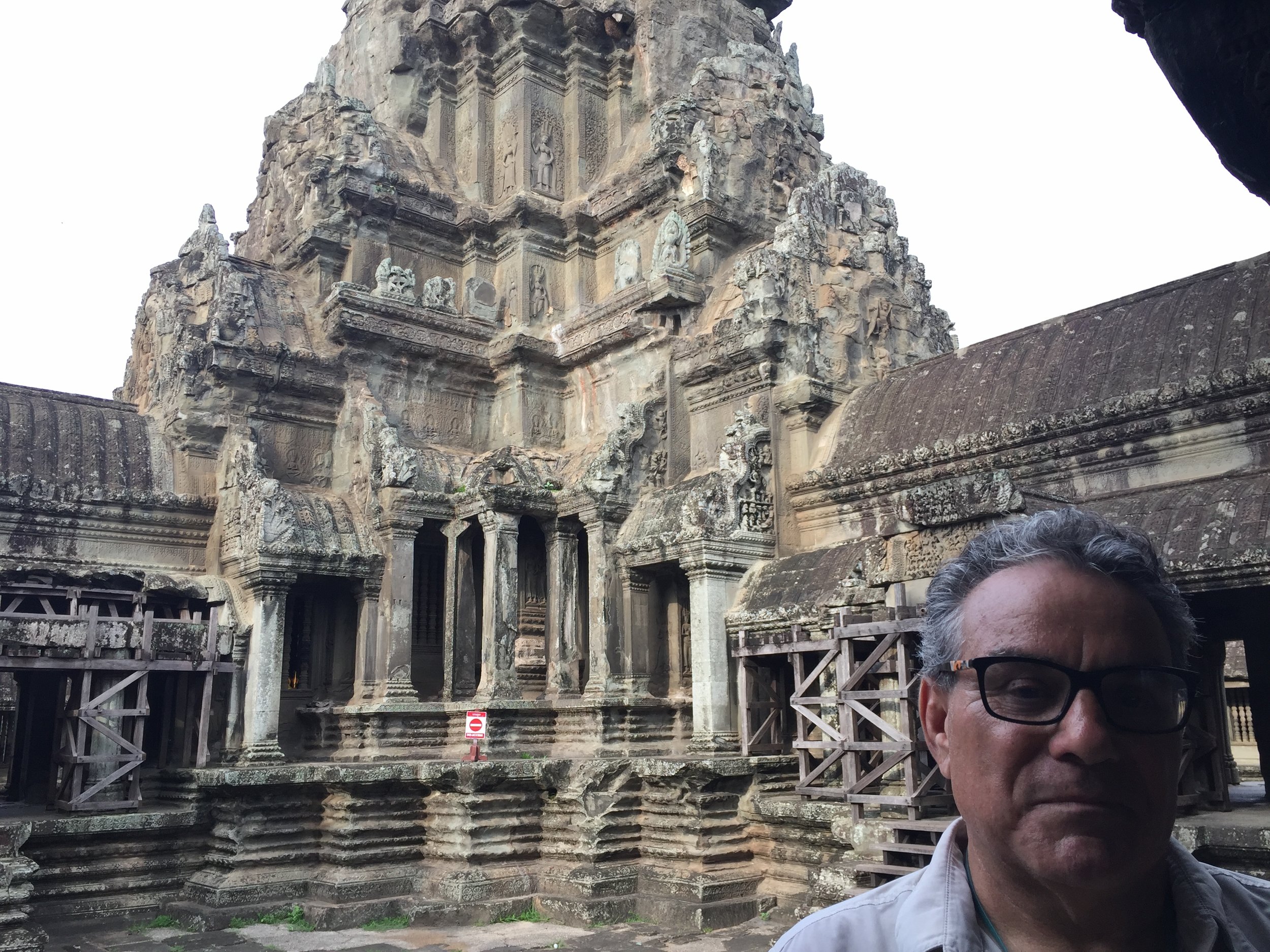
The architecture at this site is the pinnacle of Cambodian glorification of the Hindu faith. The King, Jayman VII, decreed the massive construction of this temple in reverence of the God Vishnu. Later King Sury II decreed expansions of Angkor Wat to revere and merge his Buddhist faith into the temple. Such construction also sought to reinforce the power of the Kings. The site size is 1350 x 1500 meters, once surrounded by a watery moat. It is argued that it's splendor allowed it to survive and to remain intact after the country turned to Buddhism.  It remains a pilgrimage site for Buddhist monks.

The sunrise view is slightly tarnished by clouds, but as the bright sun rises slightly it hangs above this superstructure like a brilliant orb. The pinnacle towers and sun reflect in the decorative pools. We joined many folks that sat at the waters edge; some sat further back up upon the Library structures of which there are four in this temple complex. After the sunrise we walked from one end to the other of this massive structure. Our guide took us in the side entrance to avoid the beginning mass of visitors. The entrance lead us into long covered miranda with elaborate carvings running in a horizontal direction that spelled out the great events in King Java VII’s life.

See the great pics below of the site


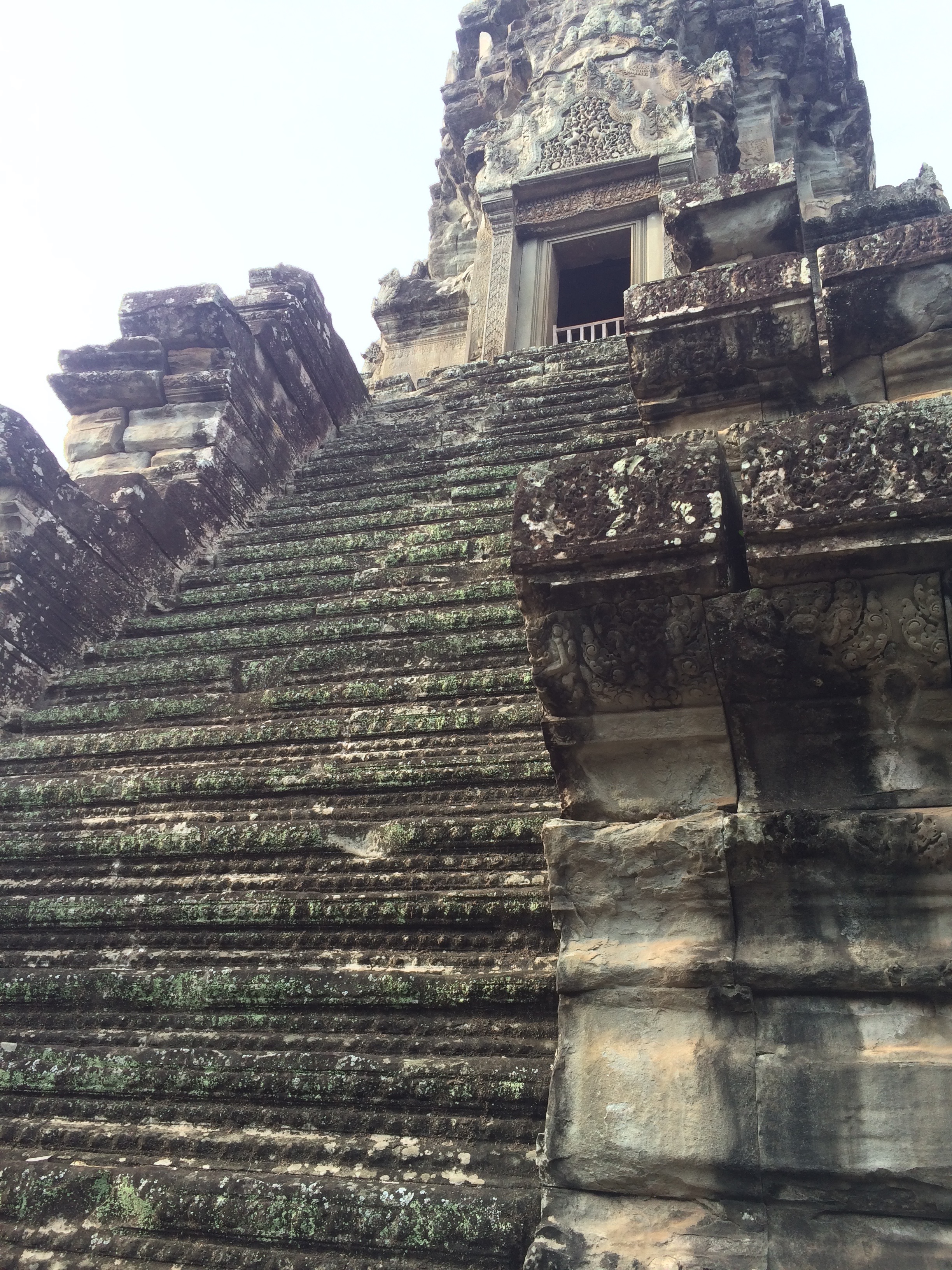
Climbing to the top. As we meandered into open courtyards we noticed the height of the pinnacle towers is amazing. The grandest is the middle tower which we were able to climb up. The super steep and narrow steps had been fortified with metal rails. The security guides control the number of climbers.  Once at the top, you are welcomed into the high temple which now displays a large Buddha figure. This chamber has stone walls that are filled with symmetrical holes that once displayed brilliant gems. The panoramic view of the entire complex from this height and vantage point is amazing. There are so many interesting architectural details in this complex; the shear size of the sandstone blocks, the intricate site plan, the artistic carvings, the reflective pools of water, and the statutes of religious figures and the protectors. Most everything presented here deals with religion, first about “Vishnu” ---the protector, and then about “ Shiva”--- the destroyer, aka the after life. Eventually, the merger of the Buddhist faith with the Hindu faith caused the addition of Buddhist figures into the complex. It will take us a lot more study about the Hindu and Buddhist faiths to make the greatest sense of this wonderful tribute by a King to his religion.


Angkor Thom


Angkor Thom is 4 times bigger then Angkor Wat, at about 10 Sq. KM.  It was the last great capital built for the Khmer empire by Jaya VII, protected by formidable walls and surrounding moat, partly in response to earlier invasions of the Cham tribe of southern Vietnam.  The entrance gates are flanked by 54 demons and 54 gods engaged in an epic tug of war. This competition deals with the religious act called “Churning the Ocean of Milk”. We will have to get back to you on why that is important.

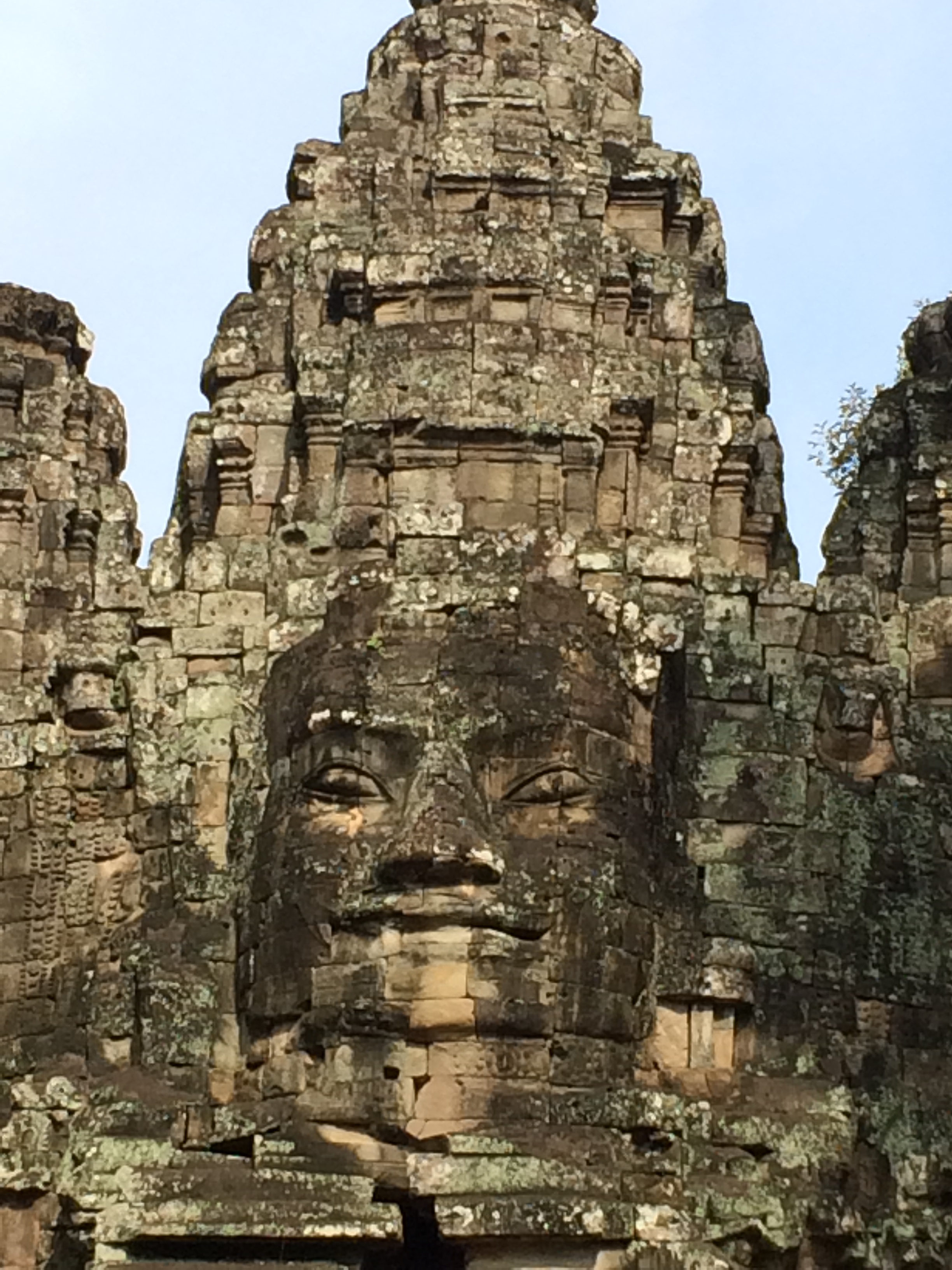
Right in the middle of Angkor Thom is the temple of “Bayon”, representing the legendary King Jayavarman VII ( Jaya VII), who was considered a great leader and warrior, who also had an inflated ego. Bayon has 54 gothic towers decorated with 216 enormousfaces of the gods that have a resemblance to the King. These are impressive. Maybe more so, is the 1.2 KM “bas-relief”carvings on the outer wall that incorporates 11,000 figures that portray everyday life in 12th century Cambodia and the successes of King Jaya VII. 


It was also interesting to see the “ Terrace of the Elephants”, a 350 m long grand stand and wall decorated with parading elephants that abuts the central square. Here is where elephants were trained and also where they were paraded along with horse drawn chariots and infantry. The imagination envisions a spectacular display.


The “Terrace of the Leper King” was memorable because of the height of the retaining walls, some 7 meters, that surround the central pavilion and are decorated with 5 tiers of meticulous carvings, some have avoided the elements and are very fresh looking. The terrace pavilion displays a replica statue of “ Yama” the god of death, and this site is now believed to have been a crematorium.

Tomb Raider Temple, aka “Ta Prohm”

  On the third day we started at the tomb raider temple where the movie with Angelina Jolie was filmed. This is a smaller temple site built bye Jaya VII in 1186, but really elegant.  The amazing part is that nature has been allowed to reclaim the site and stones throughout these ruins with gigantic trees and vegetation growing up and down over the temple walls. It is really magical.

After a long visit we said good bye to Tomb Raider. We then got on the tuk-tuk and drove 21 KM to the Rolous temple area.  The earliest built temple by the Khmer is called “Preah Ko”dedicated to Shiva in AD 877.

This was then the capital of the empire under King Indravarman I. Of note, it has elaborate inscriptions and ancient Angkorian plasterwork that has survived and is beautiful.

However, hands down the most amazing temple nearby is “Banteay Srei”, meaning “Citadel Of Women”, which is cut from pinkish stone and includes the finest, most detailedstone carvings anywhere in Cambodia, some say in the world and some say only women could have done the art work. This temple was begun in AD 967 but not commissioned by a king , but rather by “Brahman”, a rich tutor of lesser known King Jaya V. The art work was beautiful and this visit was a great way to end the tour.


Fire in the City.

That evening we prepared for our move to Battambang, a northern western city. As we stepped out for dinner it became apparent from the smell of ash that a fire had occurred. Apparently, the house across the street from the hotel had been burning and while the owner and fire department negotiated the price for extinguishment, the structure collapsed. Our host Julie was very concerned about smoldering ash and the spread of fire to next door homes and possibly her hotel. Our host also knew the owners of the destroyed property, who were Aussies that had just purchased the property. No one knew if insurance was in place---unlikely. A fellow guest and new friend Jerry  from (Cleveland living in Australia) had taken photos of the fire and trucks. He too has been traveling many months. We wish him well.

Phnom Penh Cambodia

Phnom Penh

Fancy border crossing was easy

We traveled from Vietnam to Phnom Penh on a new bus company, “Giant Ibis”; nice seats, AC, some WiFi, box lunch, but most importantly the Bus Steward processes the visa applications for the passengers and walks us through the border crossing from Vietnam into Cambodia. The travel takes 6-7 hours to get to Phenom Penh, the capital of Cambodia. We exchanged some money for Cambodian Reals; $1 equals 4000_R. Similar to Ecuador, Cambodia wants and prices all things in US dollars, but also takes its own Reals.

this is what $50 looks like in Cambodia

The countryside is lush green and flat.  Occasionally, a spiked hill of craggy stone will shoot up. When we get to the out skirts of the city we notice the glimmering spires of Buddhist temples, the bright saffron robes of monks, the wide Mekong River, signs written in Khama letters that are not decipherable, whereas Vietnam uses the english alphabet. Use of english language is widespread, but not at the level of Vietnam. The population is very young and have features more like people from India; the monuments are well maintained, and the temples are much more elaborate and colorful then the ones in Vietnam. The religion is a more even mix and fusion of Hindu and Buddhism. Cambodia does not have the the “Happy” Buddha of Vietnam and China. You can see why some authors had called this City the “Pearl of Asia”, though its recent revolutions have tarnished the image. See our first sites from the bus of the cit

View from the tuk tuk

We come to a Central Park where the Ibis bus stops. A manager for the tuk tuk crew asks if we needed a ride to the Hotel. We did ; he assigned us to a driver who surprisingly spoke pretty good english. We don't know exactly what is happening in the USA, but when a lowly tuk-tuk driver not affiliated to any hotel but working at the bus station asks: “Why did Trump fire the FBI”—things have to be pretty crazy.  The tuk-tuk is a covered passenger cart affixed to a small cc motorcycle. This is the major tourist mode of transportation around the city. There are relatively few cars, but a lot of scooters and small cc moto-bikes. The tuk-tuks seem to have the right of way, at least when we have ridden they pullout in front of everyone, cross lanes of ongoing traffic, and divert the path of those many “motos” running on either side; we have closed our eyes often.


Check in is a sit down affair with a wet towel and welcome drink in Asia

Check in is a sit down affair with a wet towel and welcome drink in Asia

Our hotel is rather elegant with darkly varnished wood and a circular stairway next to the pool and bar. The room had a nice balcony; the bath was a pretty cool one square room of polished concrete walls and sink with the shower head in the middle—you showered without tub or curtain, but it was not ghetto. Our hosts are also young, maybe a little intimidated by us, but full of smiles and efficient enough. (We both thought this place needs some Vietnamese Girl Hostesses to really crank up the hospitality).

That evening we sought dinner at a highly rated Cambodian restaurant on this certain street, but neither us or the driver could find it in the dark, so we selected the well lite “Brooklyn Pizzeria” run by two Australian guys it turned out. The place was modern and packed with Cambodians; Nice Greek Salad and Meat Monster Pizza.


We hired the hotel tut-tut driver aka Mr. Vang for all day; $25; he delivered us to the various sites, waited for us, and drove us to the next stop and home. Many times we had our eyes closed.

Frank and our tuk tuk and driver

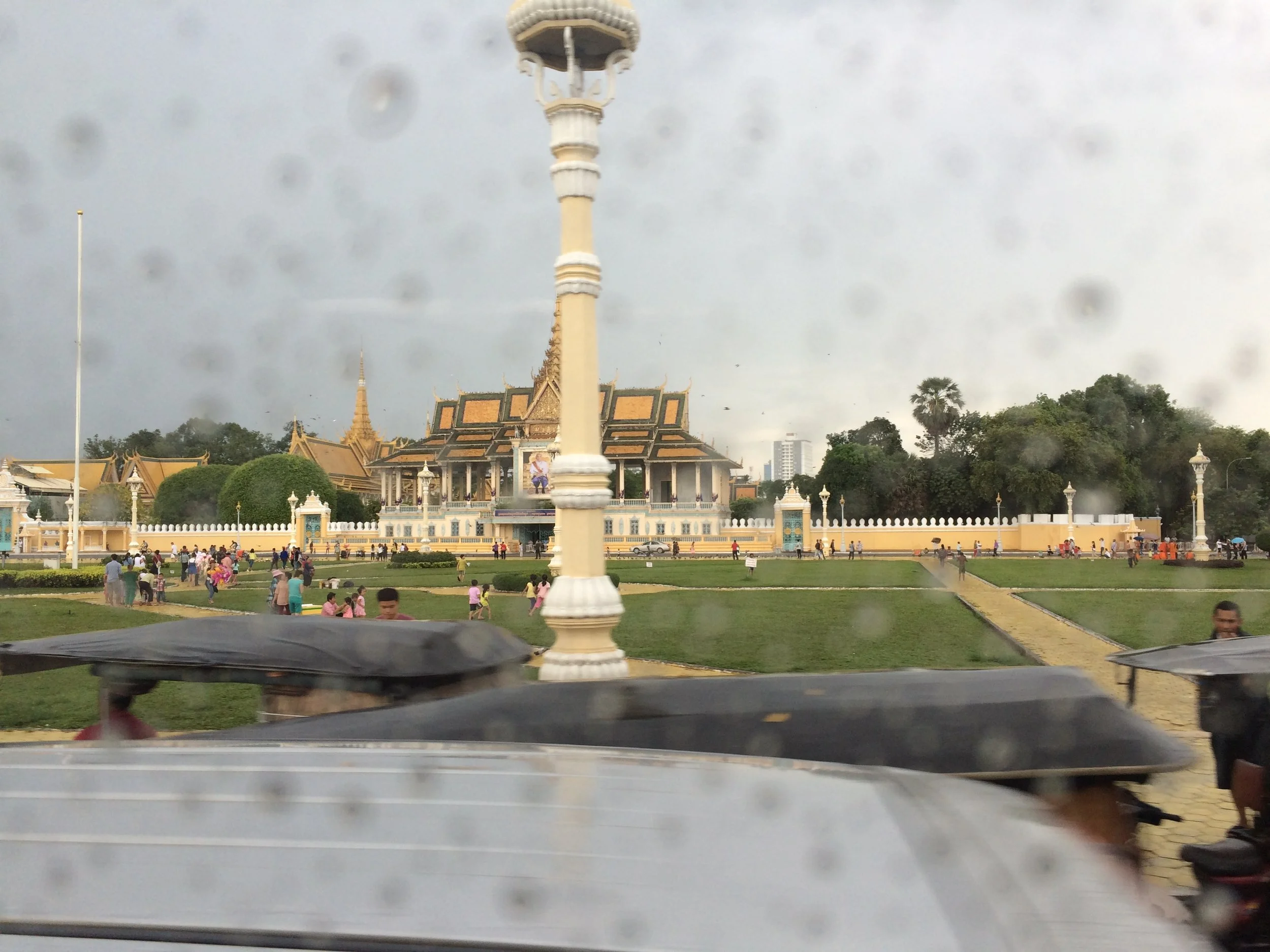
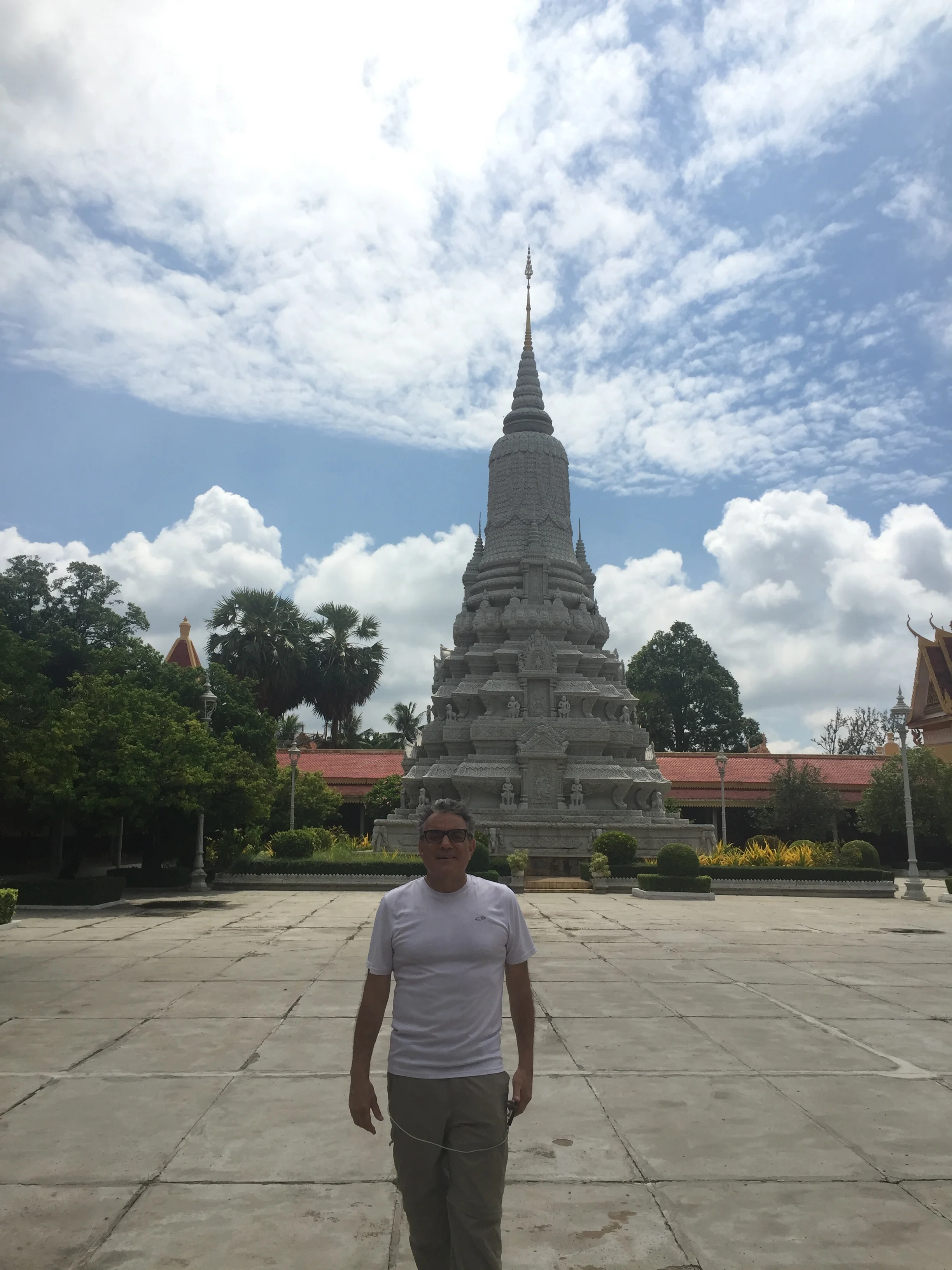
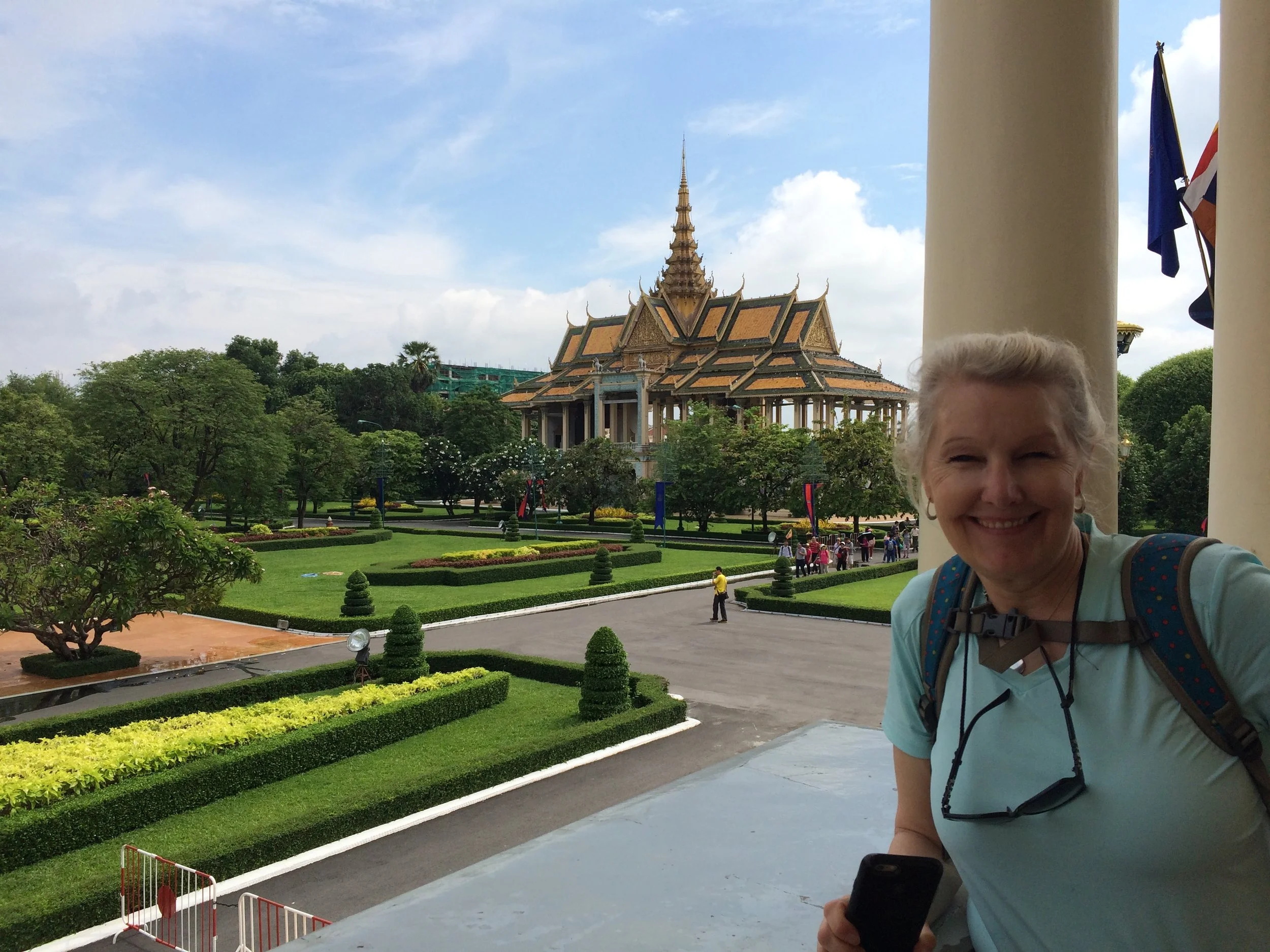
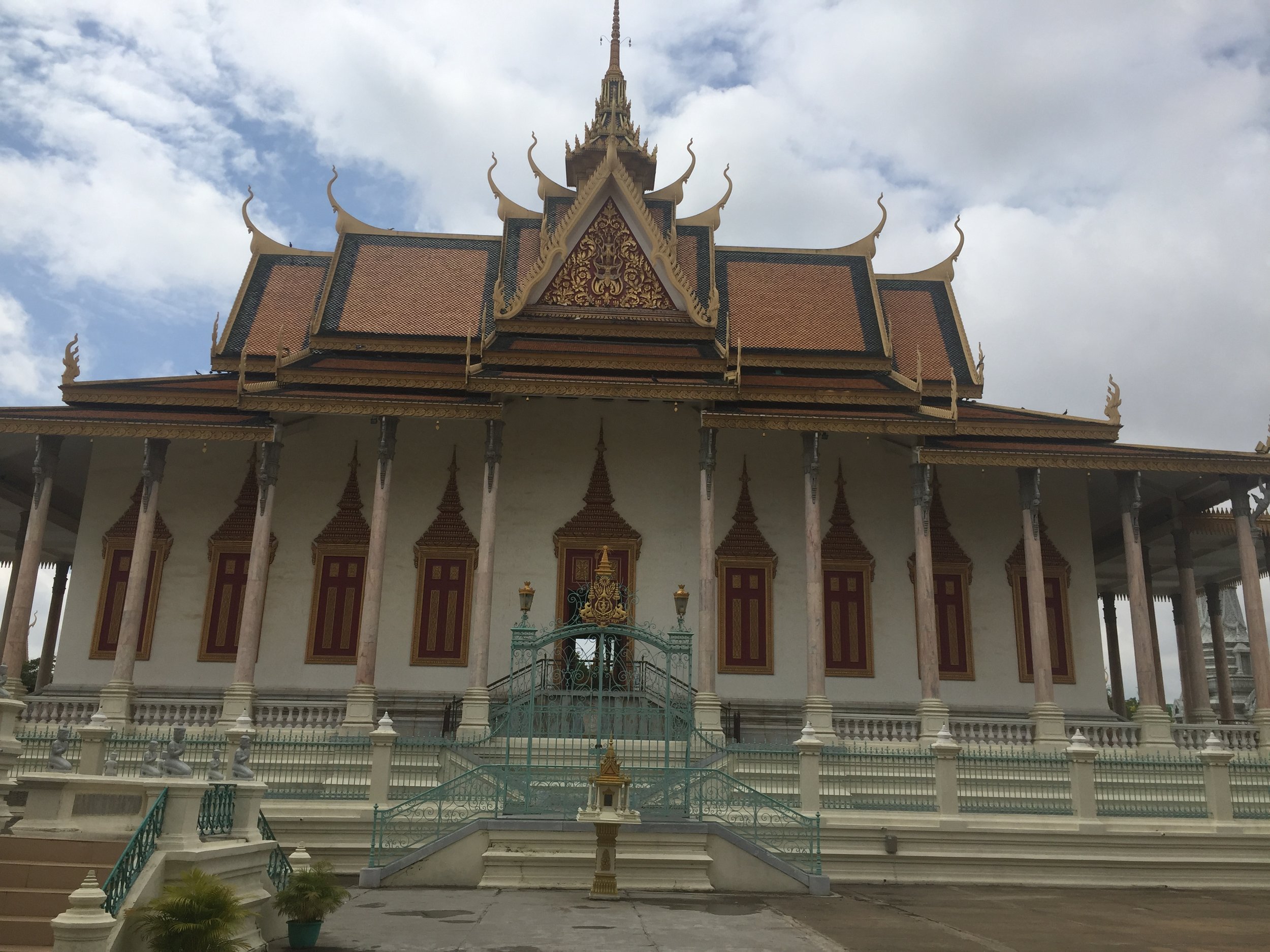
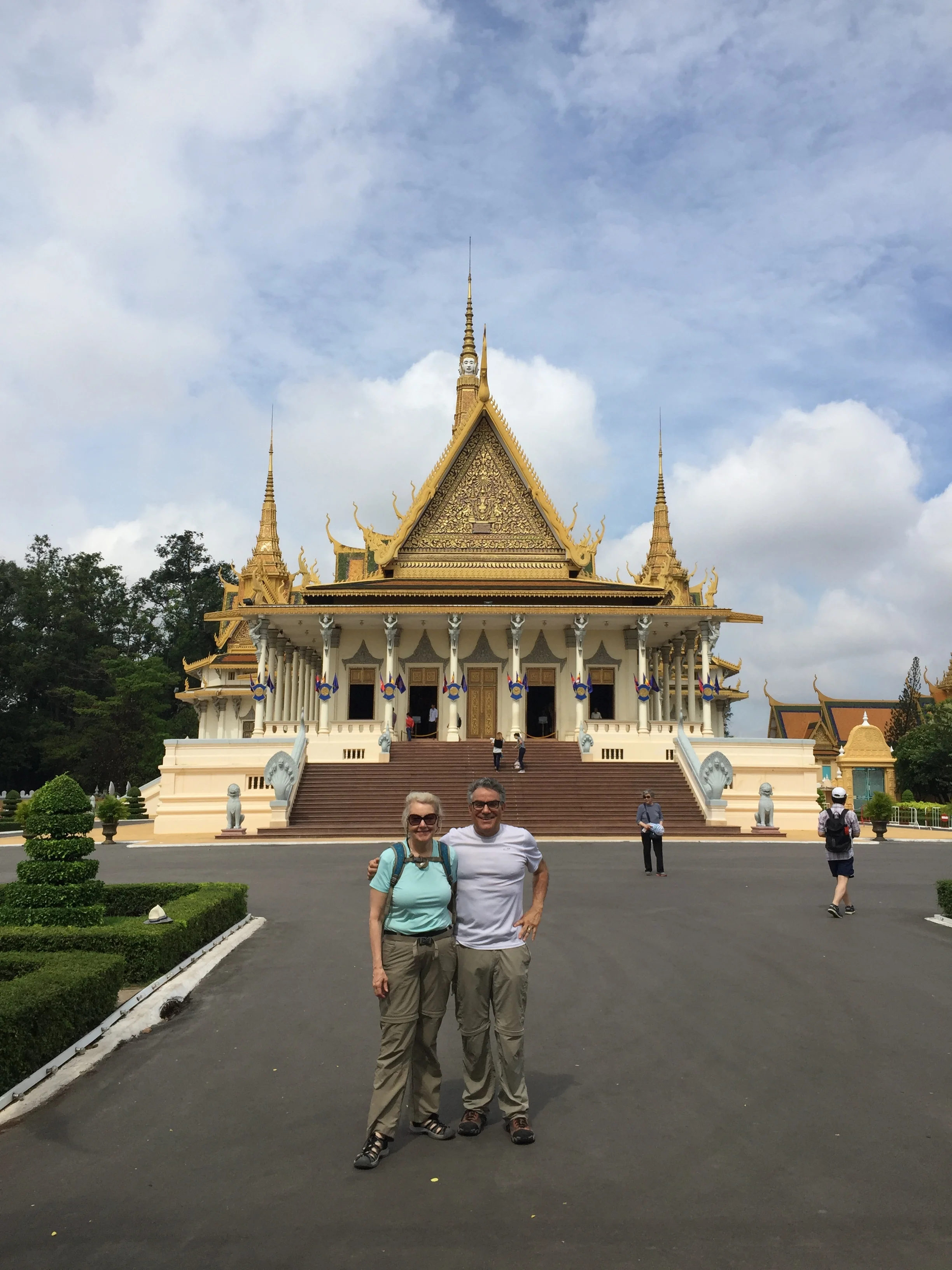
We selected 4 sites to tour on day one.  The sites where interesting, especially the Royal Palace and Silver Pagoda. Since 1866, the palace serves as the King’s residence, a venue for court ceremony and as the symbol of the Kingdom. The buildings are brilliant in the light and the grounds are manicured. Attached to the Palace compound is the Silver Pagoda, so named because the floors are lined with silver tiles riveted into place. Here, the King meets with monks, royal ceremonies are conducted and the bejeweled Buddhas and other historical objects are displayed. The Royal Library Building, and Stupa for various deceased royalty are on the grounds. From the main thoroughfare you can observe the beautiful “Moonlight Pavilion” that serves as venue for the Royal Dancers, and proudly displays the portrait of the King..

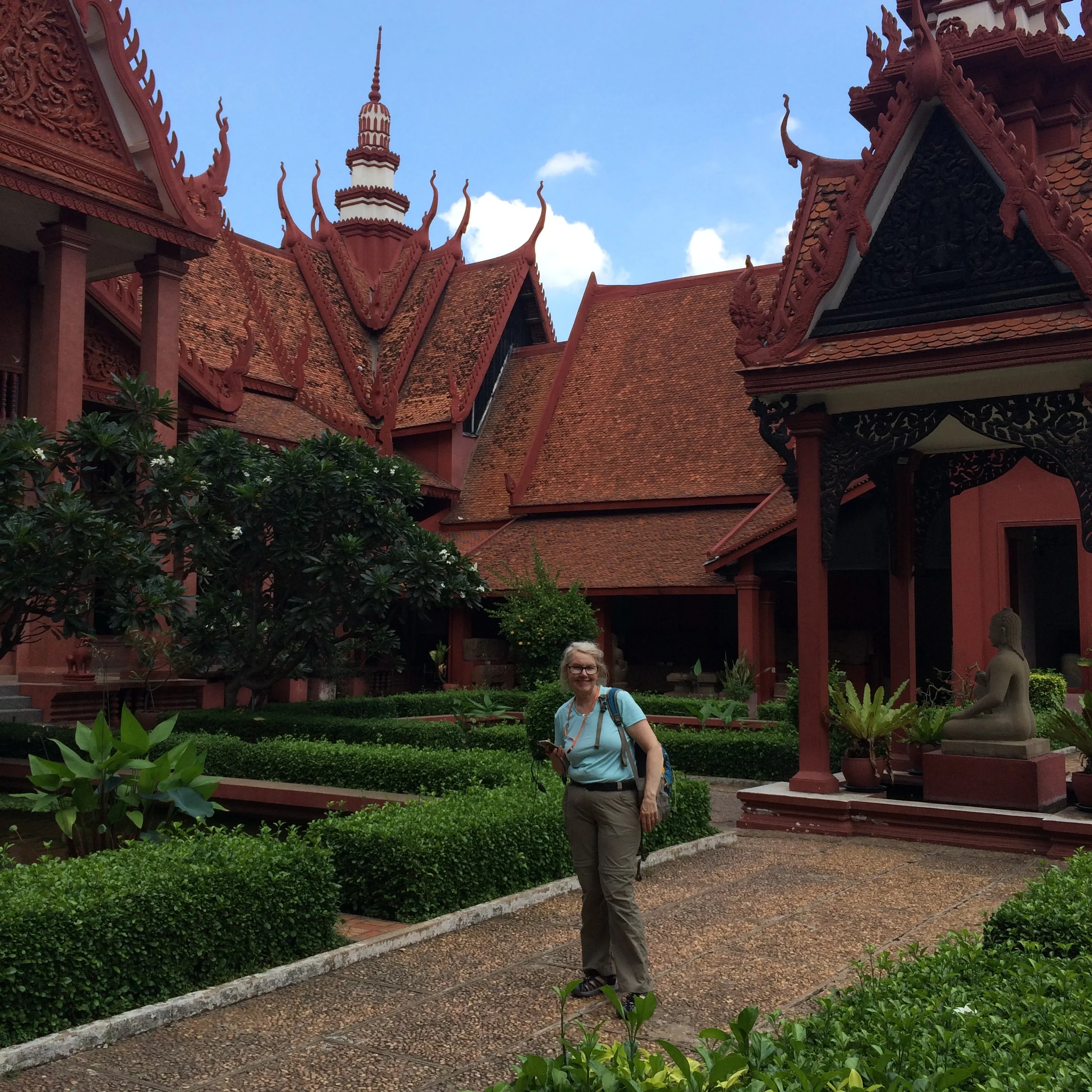
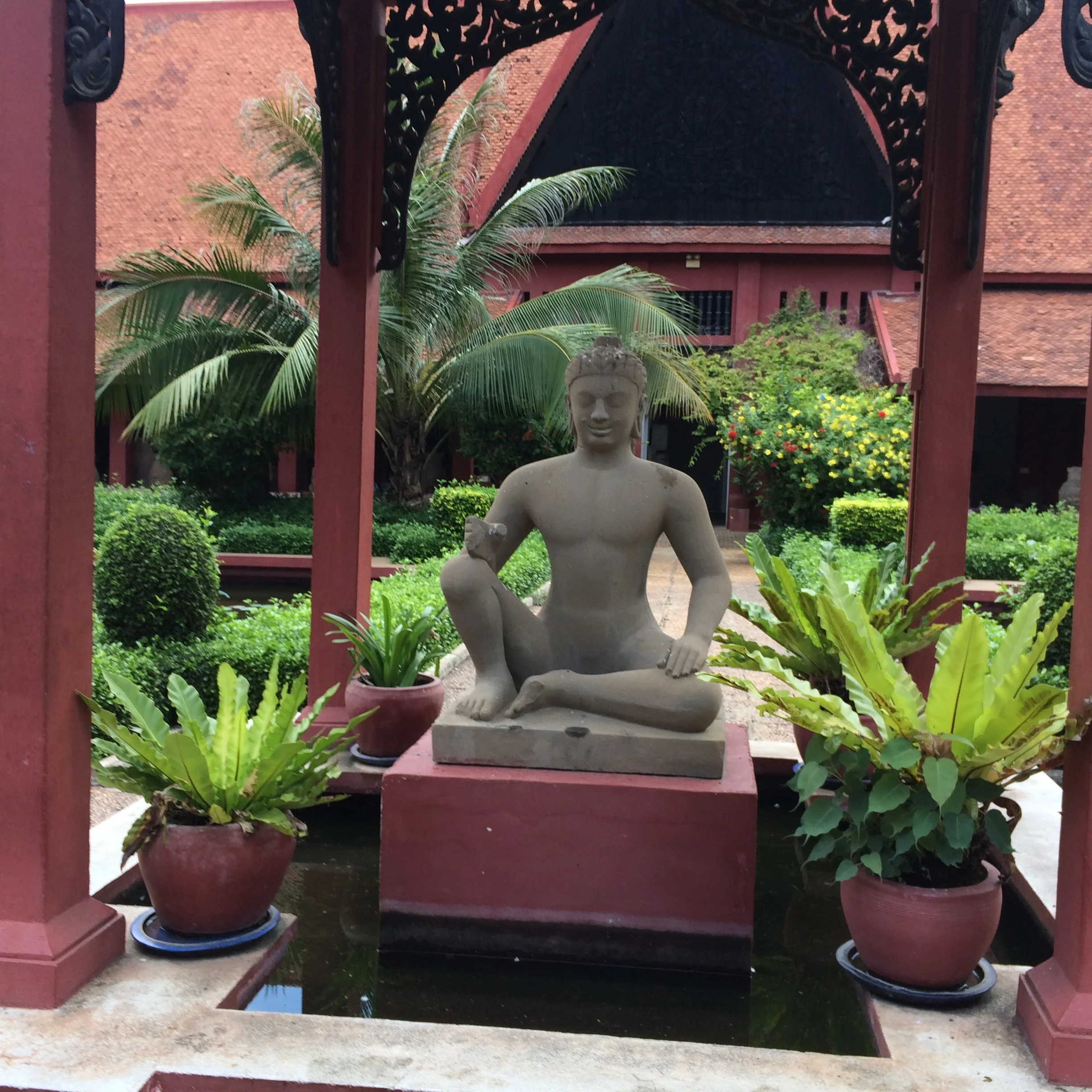
We also went to the National Historic Culture Museum. This is the safe haven for Khmer Art, mostly statues and artifacts from the Pre-Angkorian and Angkorian era. The Angkoians were the tribes and culture that controlled Cambodia from AD 802 through 1432. They decide to move the capital to Angkor and their devotion to the Hindu deity Vishnu caused the Angkor Wat complex to be built. They also were involved in wars with “Vietnam” and “Champa”( Champa were an India-like population that lived in the most southern part of Vietnam). A later king who was a devote Buddhist, built “Angkor Thom”. This may be why Hindu and Buddhist belief has merged in Cambodia. Much of the art of the country was destroyed by the revolutionary “Year Zero” fanatics. Still, it was interesting for us to walk through, noticing the similarity to the Egyptian statuary we had seen before.  See the photos of the lovely courtyard below


The hilltop pagoda of “Wat Phnom” was, by legend, the birth place of the City. Built by an elder lady who discovered 4 Buddha statues, she decided tohave a hill and small temple constructed to house them. From that start the city grew and was founded.  The large Pagoda now on site is ornate and filled with religious artifacts; open to the public to look or pray.

We passed the soaring Independence Monument on our way to lunch. It was built to celebrate the 1953 Cambodian independence from France. 

Frank at Independence Monument


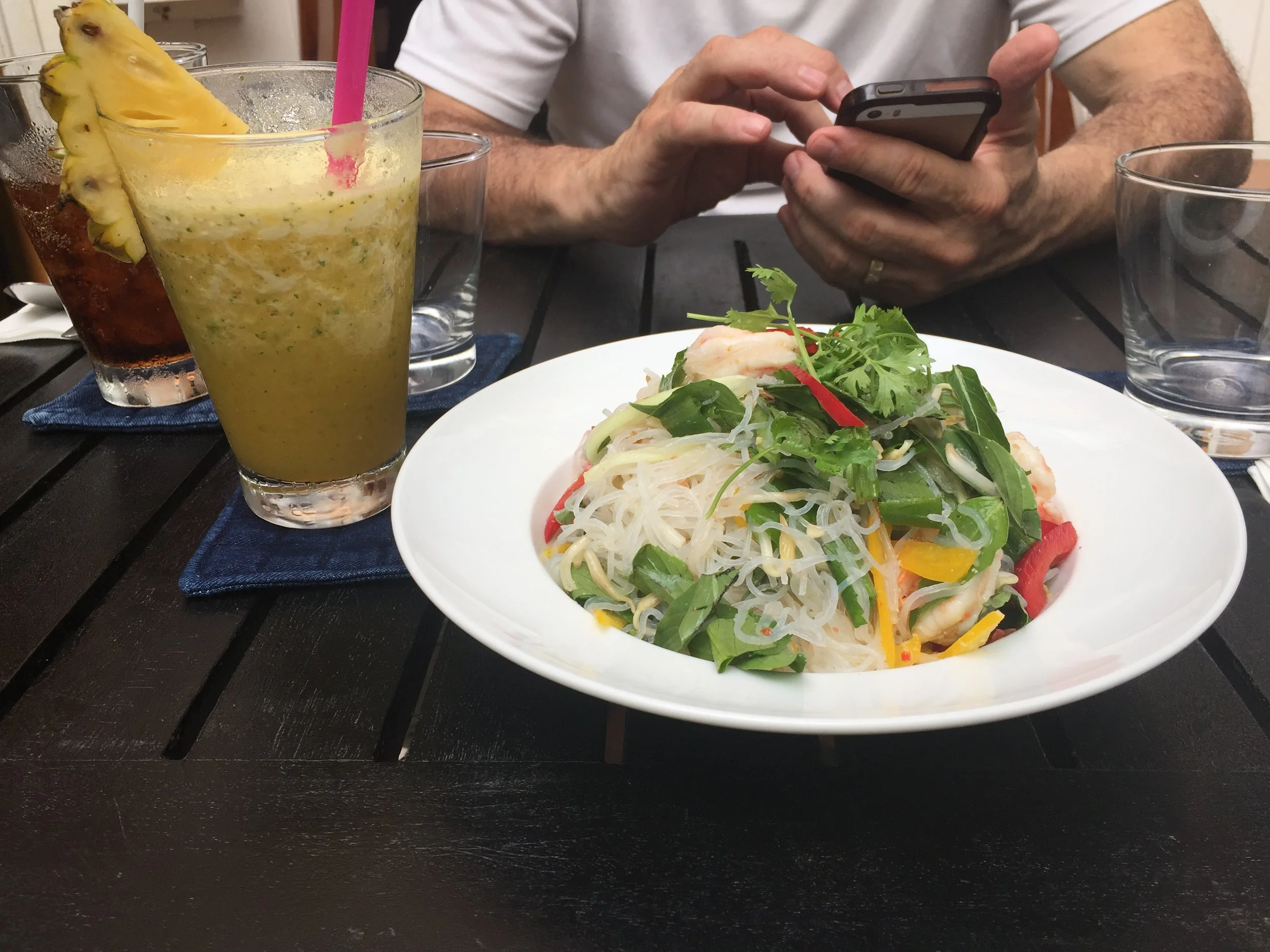
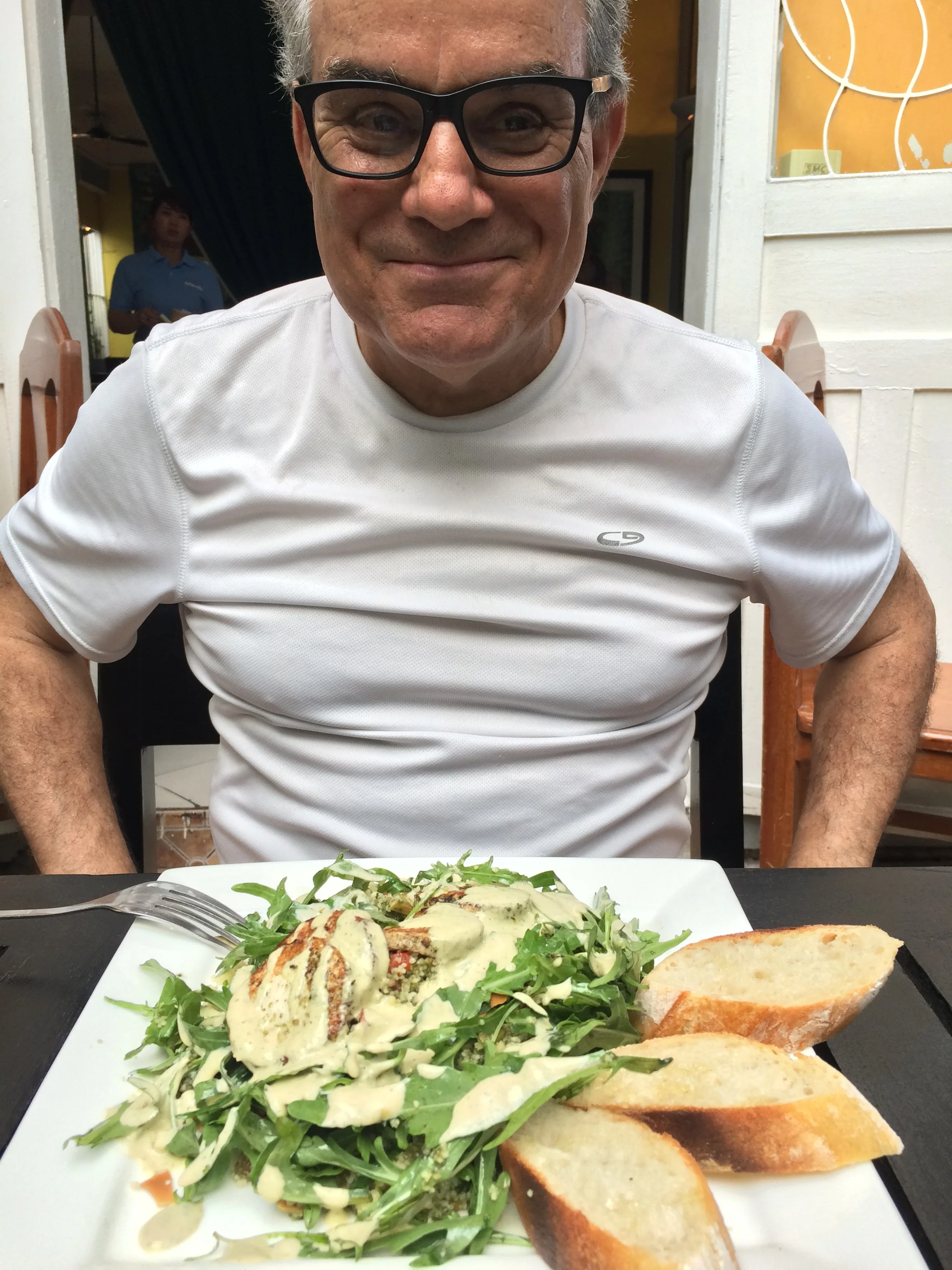
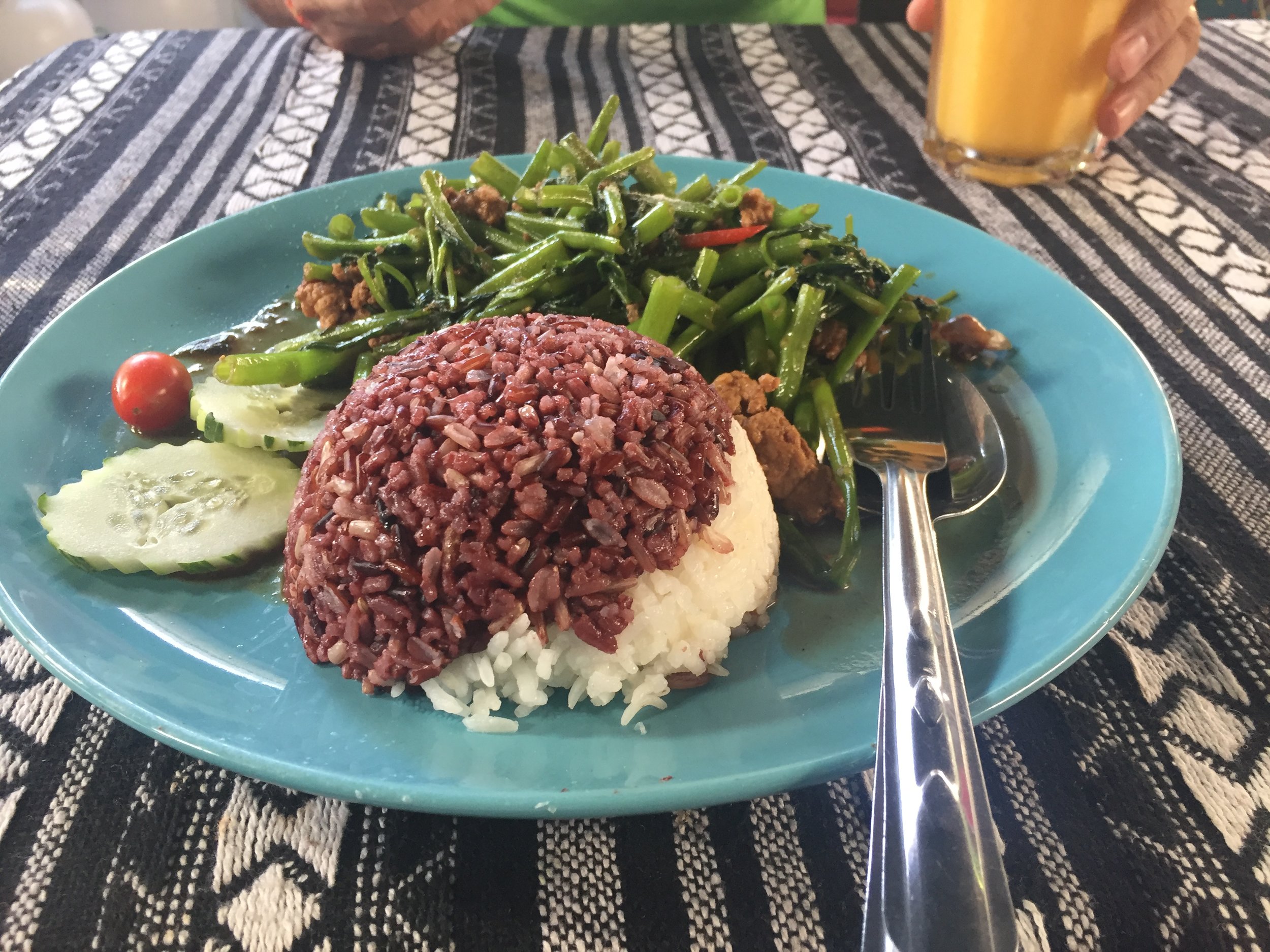
We lunched at the “Government tech intern program eatery. The food had great taste; surprise we went vegetarian. Frank and grilled Tofu medallions over cuscus and rocket lettuce with white sauce; Janet had a salad of glass noodles.  The food was outstanding.

We finished the day by going the so called Russian Market, named for foreigners who where predominantly Russians in the 1980’s. This is a collection of kitchen stuff, clothing, and art. We found some nice acrylics paintings for our collection and memories.

That evening we ate at a Korean restaurant near the hotel. We shared “Bish U”. This is the most scrumptious bowl of flavored ices with cut mango, shaved almonds, scoop of ice cream on top and secret cream sauce.

Panic in the middle of the night. Janet is sick as a dog. The next morning she wants to recover and sleep. She sends Frank alone to the prearranged tour stops. These are very important and tragic sites arising from revolution of the “Khmer Rouge”. The ancient Cambodian are known as the Khmer, the Rouge (red) is symbolic of Communism.


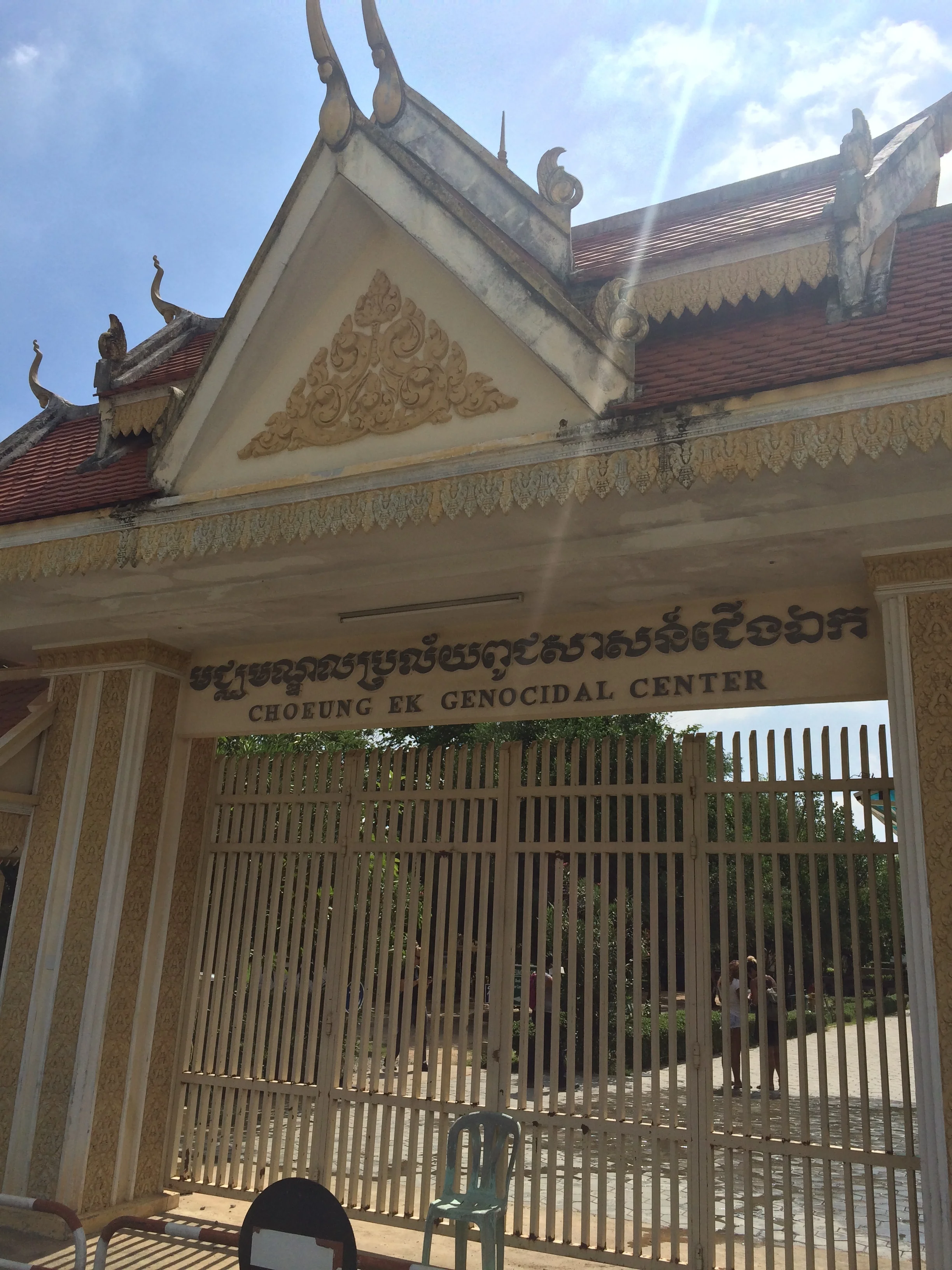
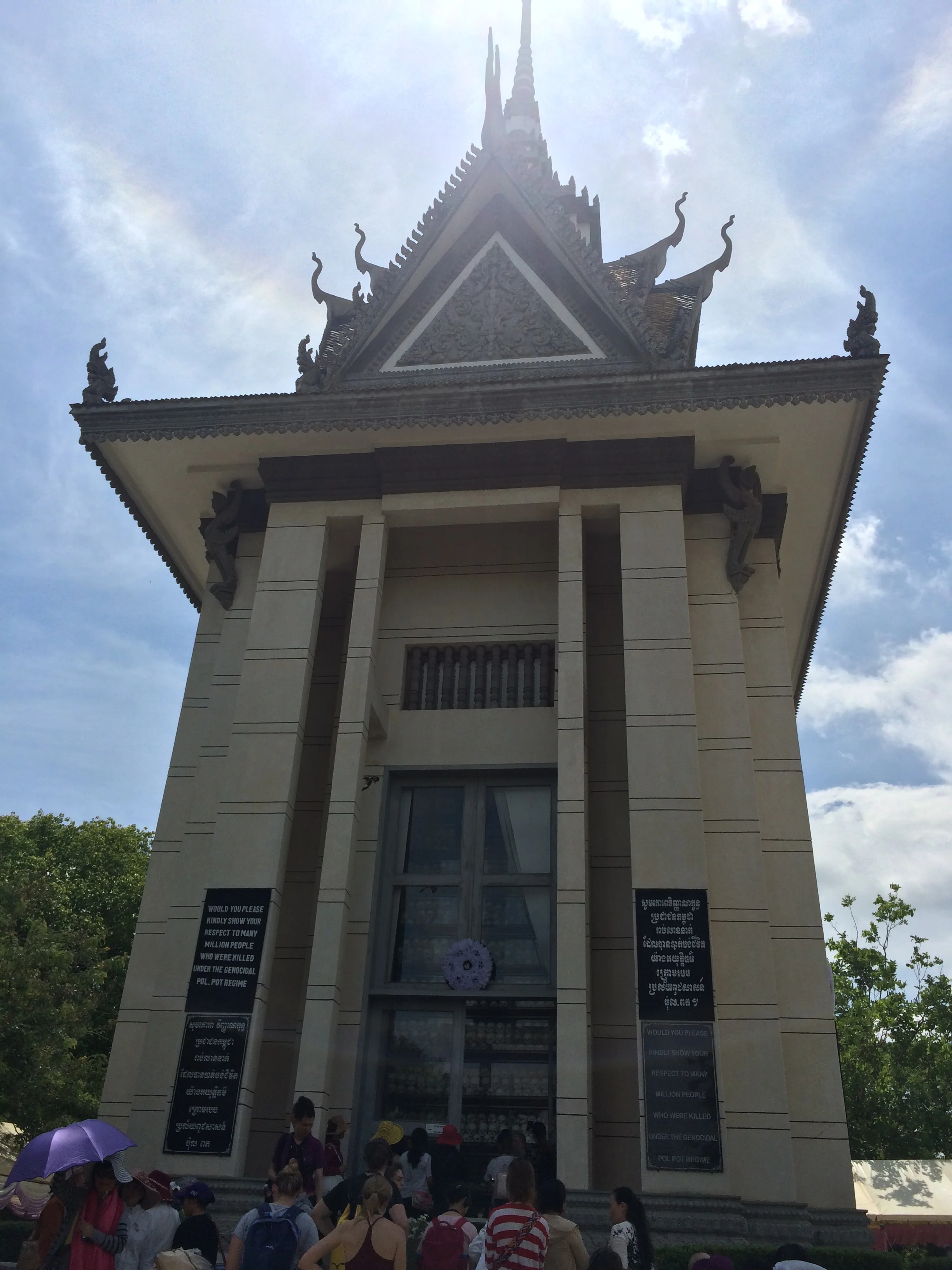
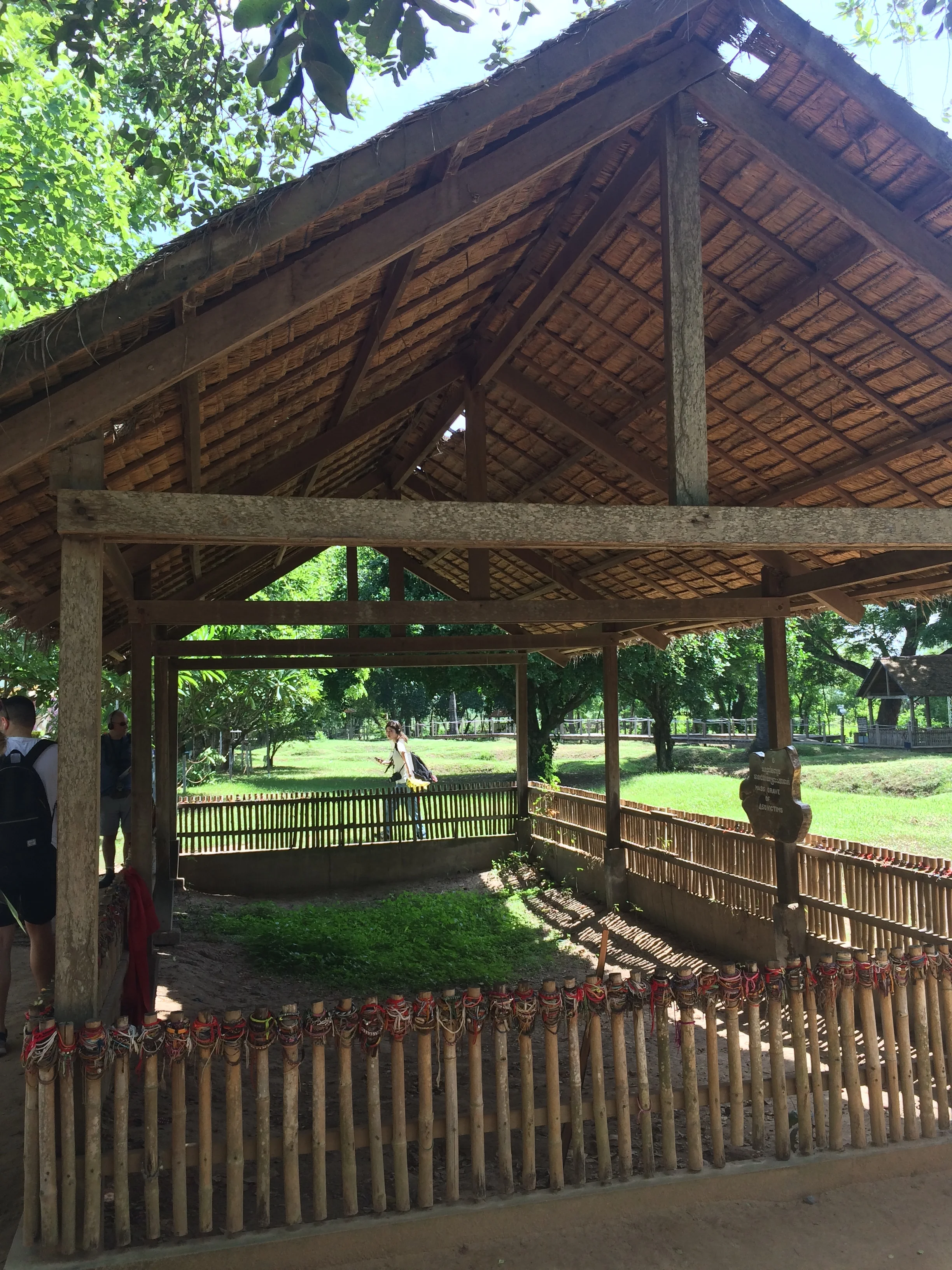
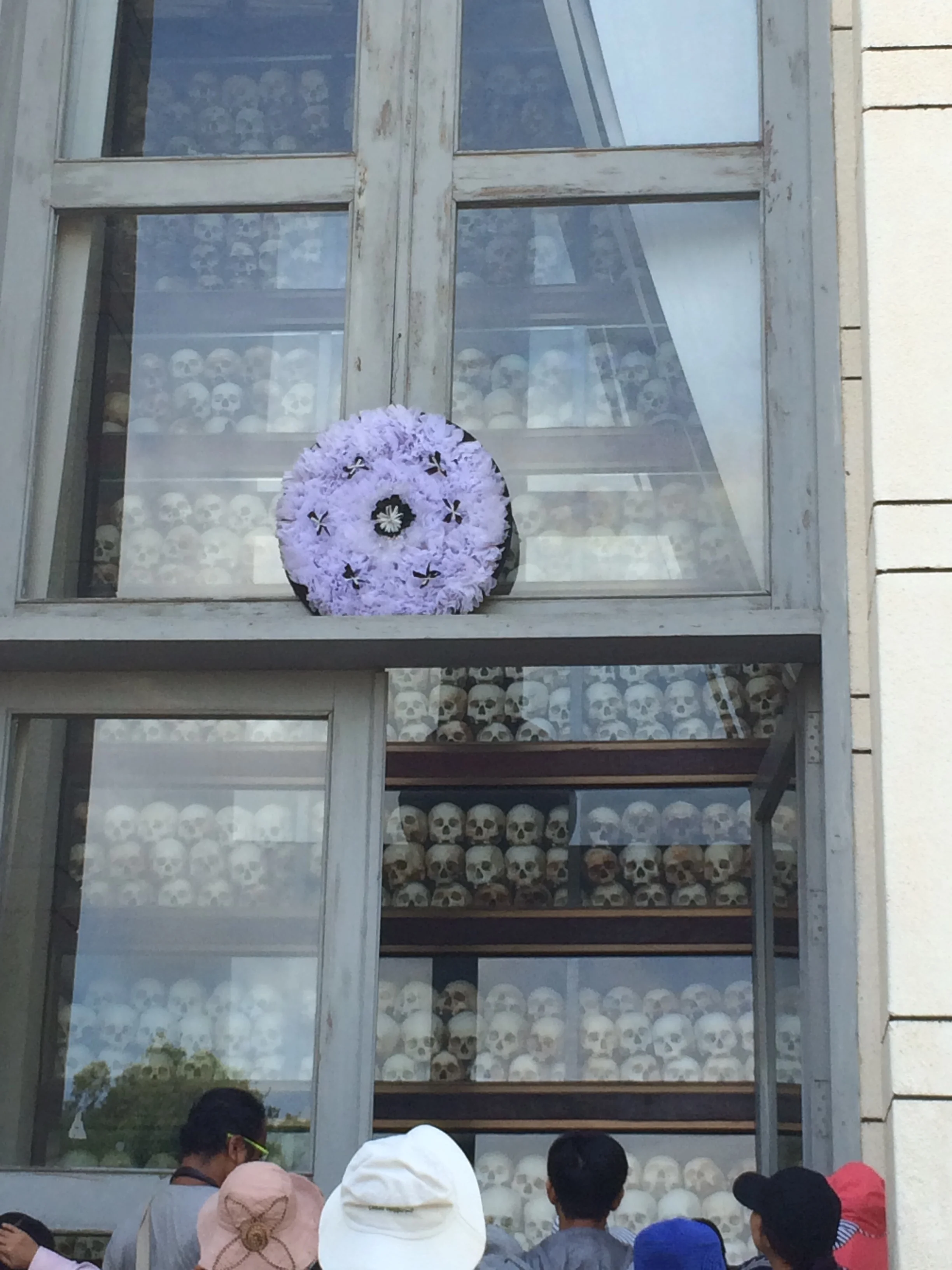
Mr. Vang transports me 50KM out of the city to a “Killing Field” memorial. There are about 300 execution areas in the country, this was the closest to Phenom Penh. Once a Chinese cemetery, it became the final resting place for “perceived” enemies of the state, mostly educated city dwellers.


The leader was called “Pol Pot” and he instituted a genocide policy called “Year Zero”, which sought to return Cambodia to an agrarian society. All families of intellectuals, or those meeting the low standard of persons with glasses or soft hands were executed.  The slogan, “to kill the weeds you must pull out the roots” allowed indiscriminate killing of children and babies.  Of course, Pol Pot treated the farmers badly; making them work in forced labor camps. The memorial site is a spewwith craters of dug out mass craves and has a tall Stupa that tearfully displays rows of Human skulls and bones. This killing field is marked with site references and some displays of particularly heinous activity, surprisingly now abutting a lovely natural pond. The key to this place was the stellar audio tour.


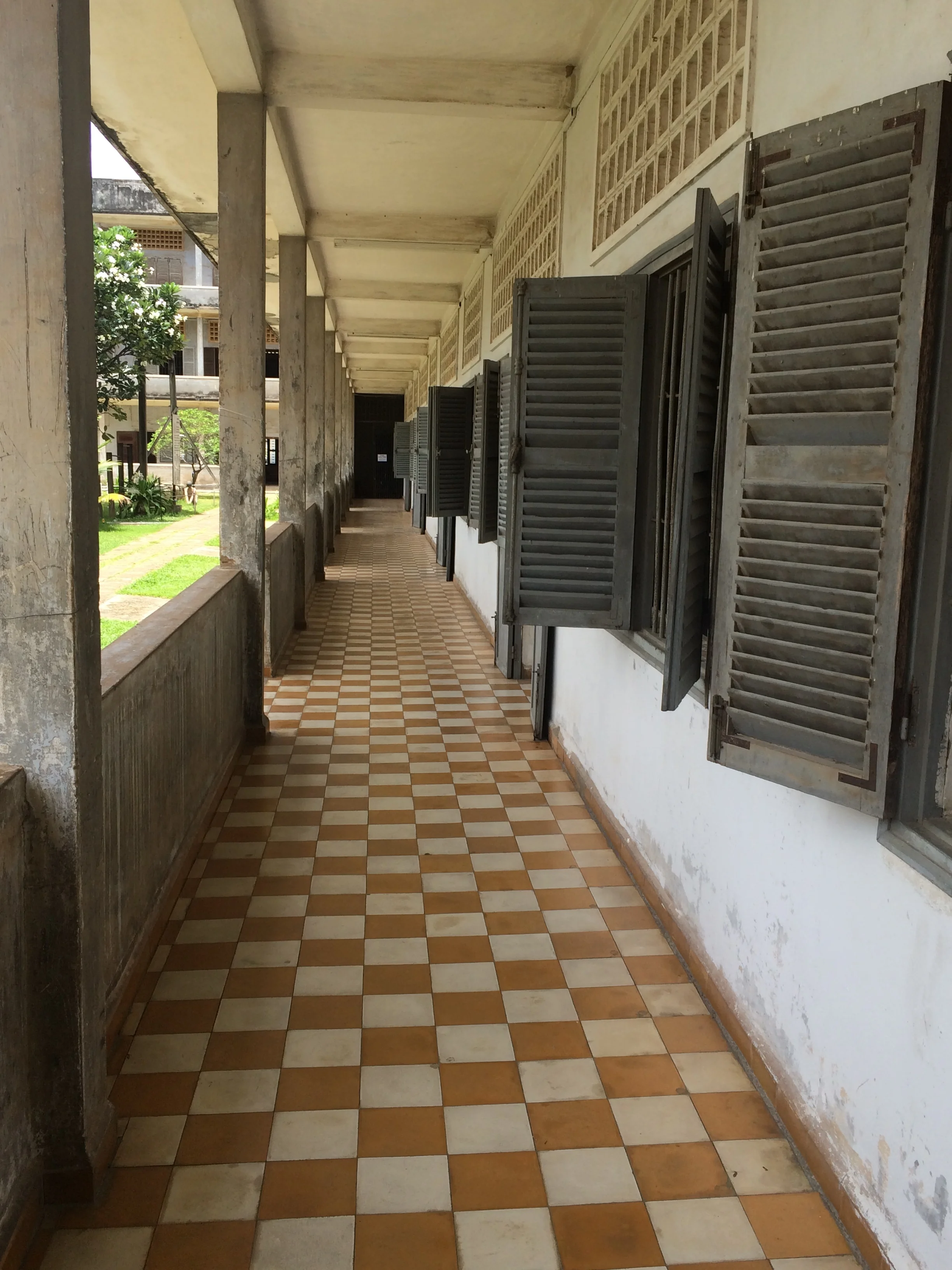
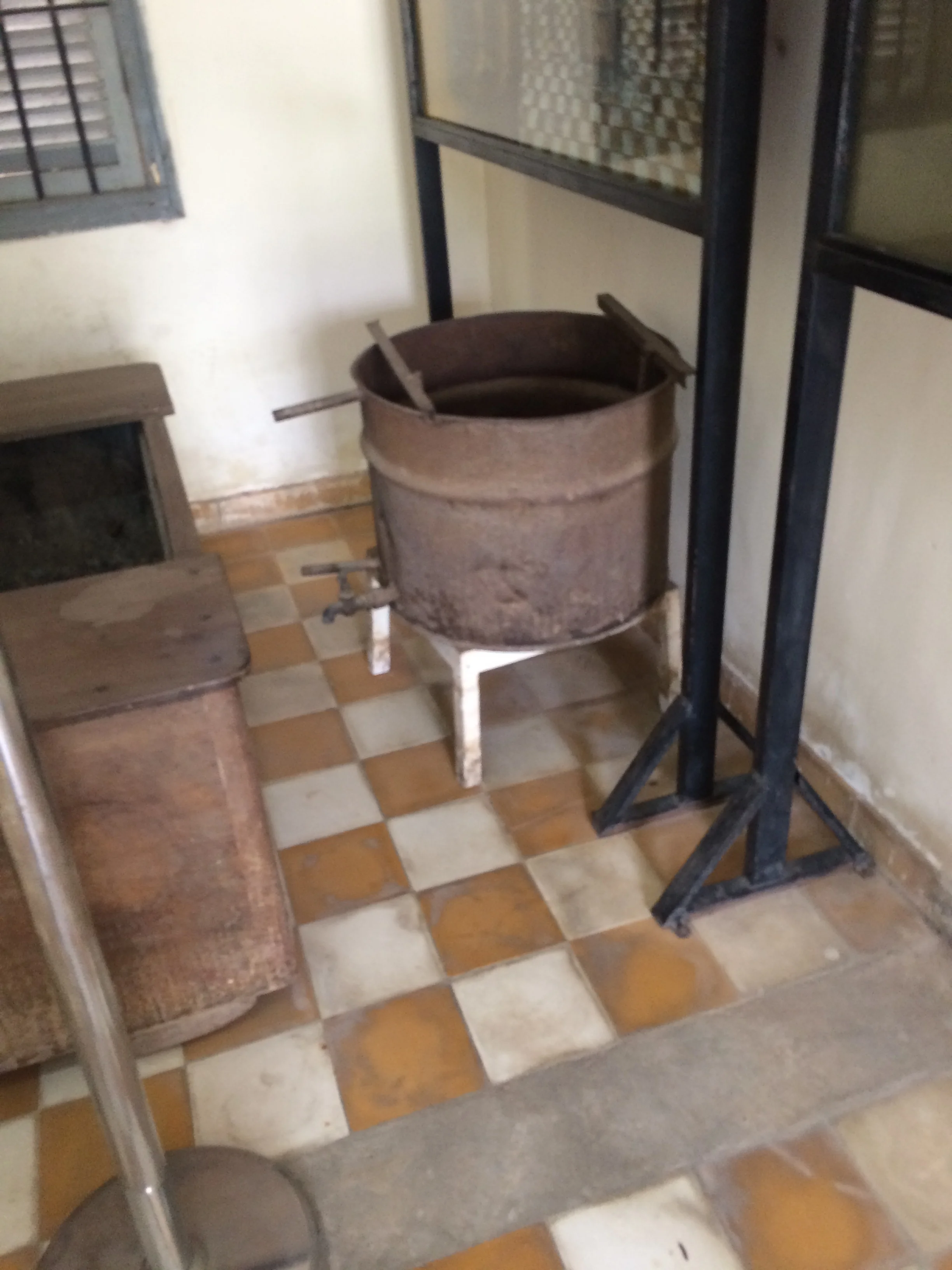
In order to continue this insight into the Khmer Rouge, the next stop was back in the city at “District 21 High School”, now known as “The Genocide Museum.”  S-21 was converted into a prisonand interrogation facility run by Pol Pot’s henchman “Duch” Eva, and processed 17,000 people. This is a gloomy place which used torture to extract the desired confessions from men and women. Virtually all prisoners were executed and buried at the “Choeung Ek” location discussed above.  Torture equipment and metal beds are displayed. Photos and records were kept of the prisoners. The processing was similar to the Nazi methods. Again the audio tour is outstanding.

When I returned to the hotel Janet was still bed ridden. We decided to get medical help and went to “SOS International Doctors”. Janet was familiar with the group. Our Doc was from Holland.  After 2 hours of IV fluids, an injection and 3 prescription drugs, Janet was released.

She slept deeply and though we missed our Traditional Dance Show, we did not miss the morning bus to Siem Reap, the site of “Angkor Wat”.

Ho Chi Minh City Vietnam

Another quick flight and airport pickup. We are staying at Madame Cuc 127, which is not as impressive as our other recent boutique hotels, Janet wanted to go cheaper and as always we relied on our trusty Lonely Planet for good cheap places, this time they were wrong!  Janet then wanted to move. (editors note, the place was a dump see photo of tub!) No way; we can stay for 2 nights.
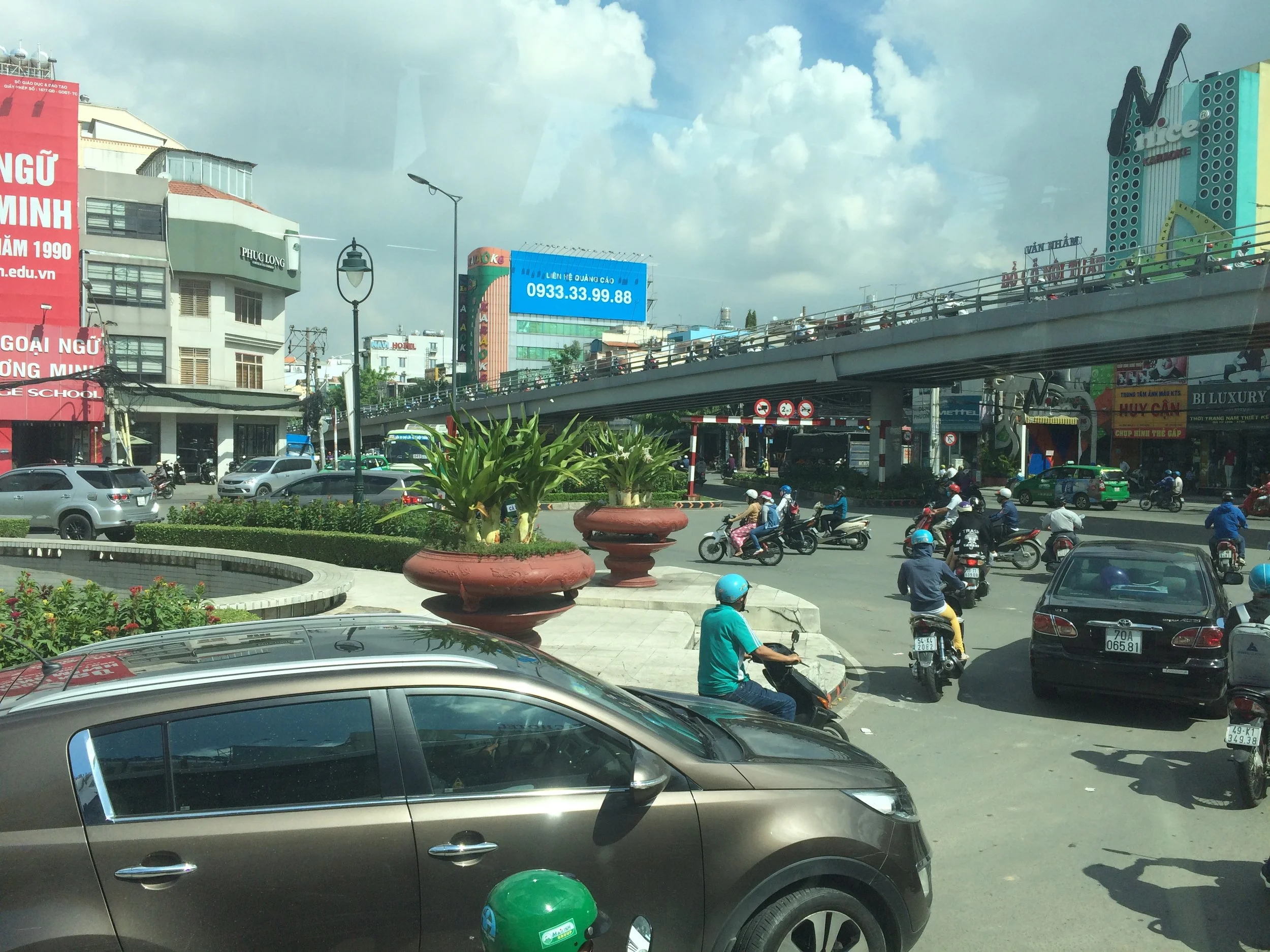
Some writers say Saigon is “…great”. We are not as enthralled. Saigon is massive; far bigger than Hanoi, but also grittier. We did not like the look of the street where the Hotel is located.

The main drag


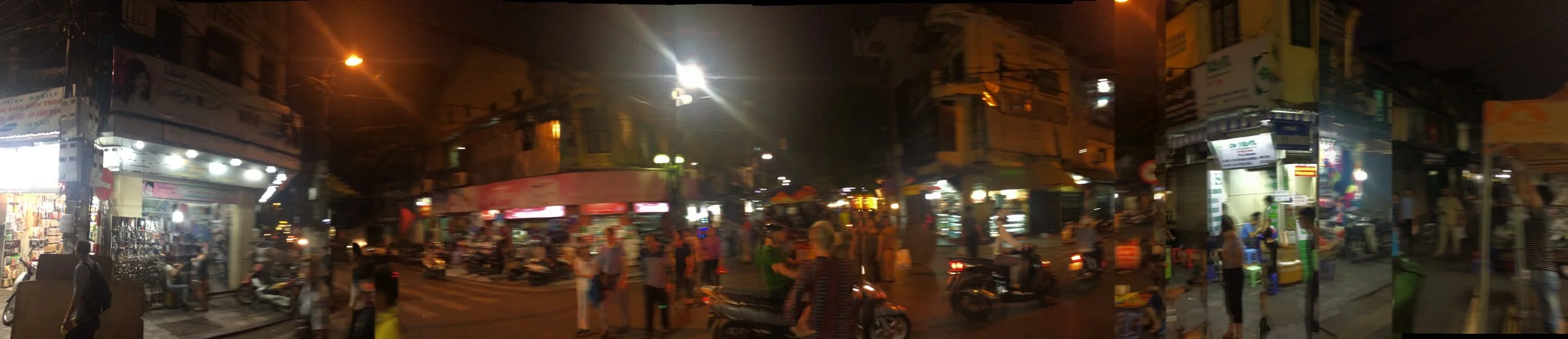
The next evening we found that the Restaurant Row was ½ block away at the 1st left. The city is more flashy in the evening dark.

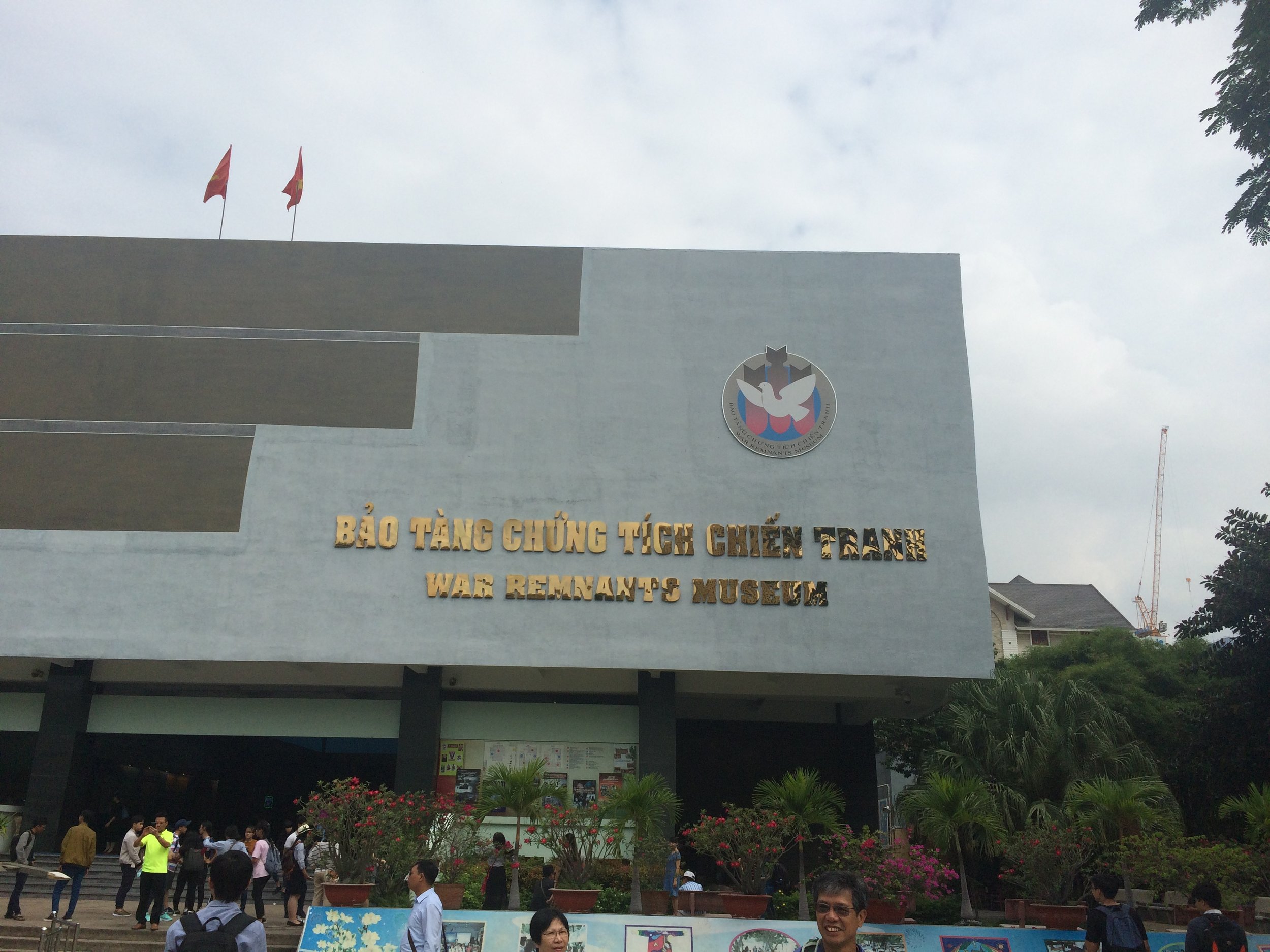
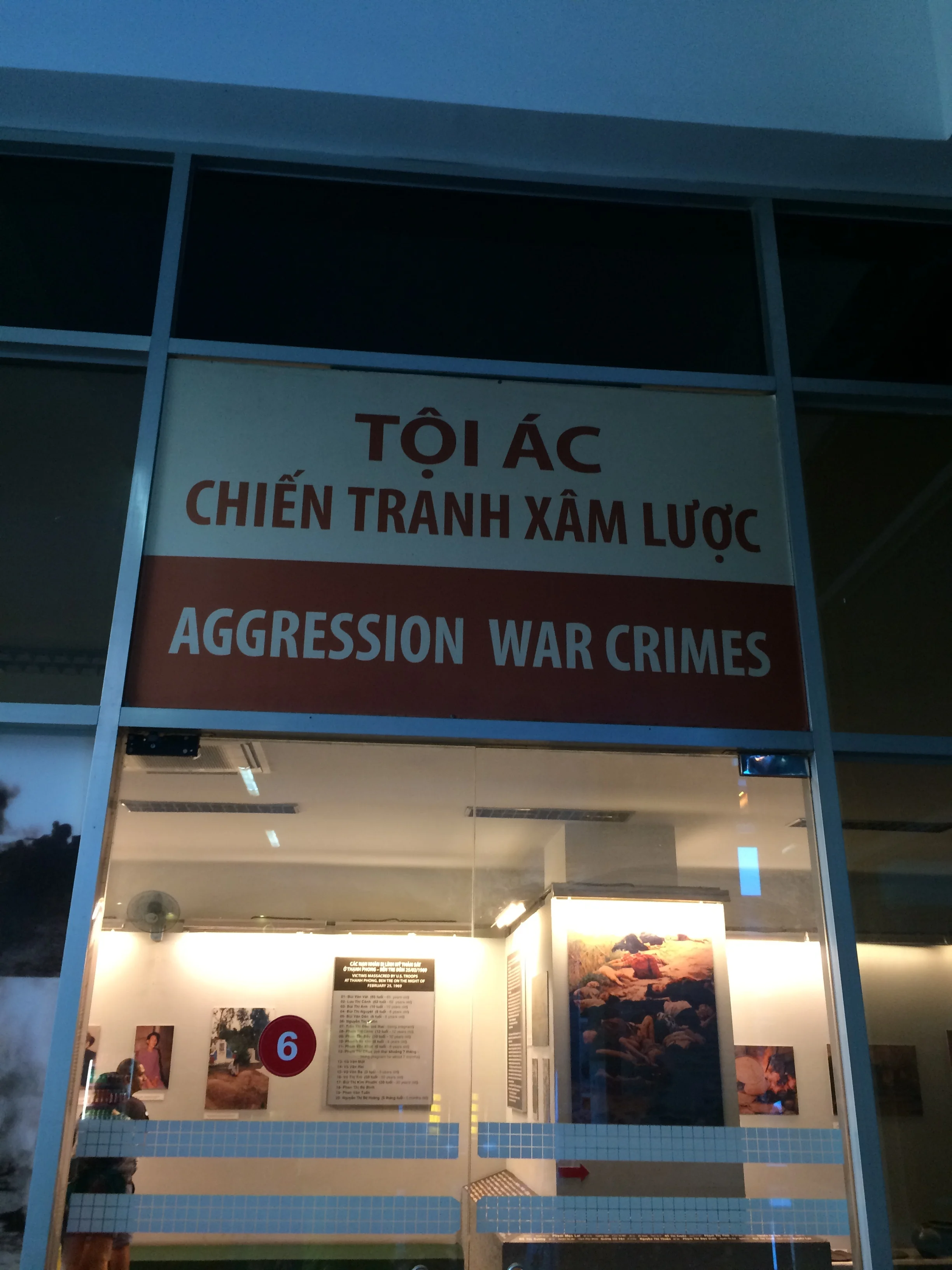
We decided to take a full day out that was divided into separate a parts. First a half day city tour. We start at the “War Remembrance Museum” This was a three story building filled with unabashed propaganda. The Americans were described as the “Henchmen” of the puppet government in the South.  The Americans had supplied the French post WW II, and then had stepped in for a more direct role as advisers and then as direct combatants. There is no discussion of the communist threat from the North, after all, here the Viet Cong are considered Freedom Fighters. This museum is filled with War Photography from some of the most renowned war photographers of the era. A special photographic exhibition assembled in the US was donated to the museum, given as an offer of “…reconciliation and understanding.”

The Photos were captivating, poignant, often brutal, but not gory, as if you are viewing the scene a moment before the anticipated act of finality.  The Vietnamese and French also provided photographs. The outside court yard displays actual US planes , tanks , helicopters and other military hardware. As Americans, we are optimistic and like winners. This museum was hard to take. We wondered what the younger European visitors thought. We felt sad. 

We next stopped at a Chinese Assembly Hall, much larger and more ornate than the ones we saw in Hoi An City, but the same concept with the same Patron of the Sailors. But this day was really about the way Ho Chi Minh’s government reports on the War.

The line into the tunnel area


The second part of the tour starts with a 3 hour bus ride to the area known as “CU CHI ”. This is a very difficult journey for us.  Cu Chi is the large forested district surrounded by rice patty
where the Vietcong tremendously expanded a preexisting complex of underground caves and tunnels near the American military lines. A launching point for Vietcong sneak attacks and a sanctuary upon return, the US bombed and attacked this area many times. The results were mixed.

Strategically, the rice patty were often purposely flooded to detain the GIs. The areas around the cave openings where bobbie-trapped with snares, spike pits, and triggered devises. These devises of mayhem are displayed at this exhibit. Our guide demonstrates the trigger action.
An example of a jungle trap

We are invited to enter the real tunnels used by the Vietnamese (not the sanitized replicas created for Chinese tourists).  One tunnel is lighted for visitors. The tunnel is 3 to 4 feet in diameter. You must bend over and crouch to get through. The walls turn sharply to block the view and compartmentalize the spaces. The exit points are small and camouflaged. The air vents are hidden, for example, in large jungle termite hills arising from the ground. The complex has 3 levels in order to resist bombing. The young Europeans took advantage of this strange opportunity, but seemed appropriately somber. There was 150 feet of tunnel open to the public, with exits every 30 feet.
Frank enters the tunnel

Visitors can, if they wish to pay, fire live ammo from AK 47 rifles and other ordinance. Visitors can also climb into a burned and stripped tank that was disabled by a land mine and trapped in the mud. A few Europeans in the group experienced the shooting range.

Our guide entertained the group by discussing the history of the war and this area. He was matter of fact about the French and then American interventions. He prefixed his talk by asking, “…do you want the truth or the government position?” We didn't know what to expect. We are sure the speech was not comprehensive, but he did advise that after the French were expelled, South Vietnam was impatient for government reforms from Ho Chi Minh which did not come quickly and the South turned toward other leaders.  This angered Ho Chi Minh, and his northern forces invaded the the south around1959 and then 1961, and were repelled. Then again in 1962, the northern forces of Ho Chi Minh attacked and continue to escalate the war contributing to the Americans deeper involvement. Where he may have got off track was stating the original Cu Chi tunnels were occupied by farmers trying to hide from the war, but American attacks caused resentment to grow and the Viet Cong to be welcomed.

In any event, we think the observations and emotions we experienced today were important and allowed us to reflect on those chilling times in America’s past.

Down the trails to the tunnels

The day finished well. We returned from the excursion and had dinner with our new friends trying different Viet dishes. They were really charming. No surprise, another nice couple from Australia; these guys where from Melbourne, where most of are other friends live more north around Sydney.
Tomorrow we bus to another unique foreign country---Cambodia.

Coffee break on the tour with our new friends from Melbourne

Frank in the crazy market