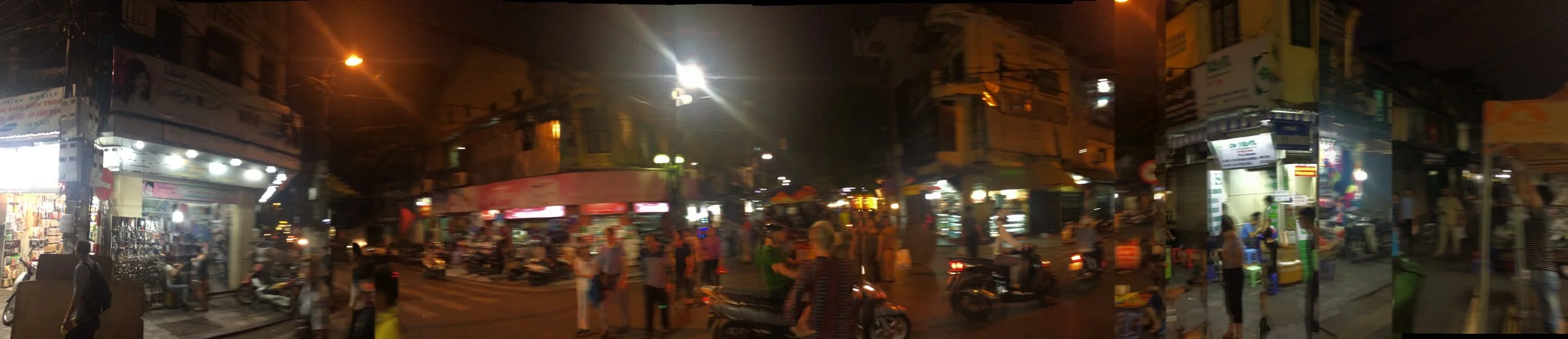
Mandalay Myanmar

Mandalay is the second biggest city in Myanmar with a population of 1 million. It is booming economically and is culturally vibrant.  It became the capital of the Burmese empire in 1861 but that was short lived after British occupation in 1886. On our bus ride into town we passed the Mandalay Royal Palace which is fantastically large with high walls and wide surrounding moat. This will have to be one of our first attractions. The Triumph Hotel is very nice. We are in a connected bungalow type room across from the pool and restaurant. The staff is very chipper, quick to smile and say hello. They were very helpful in putting together our 30th wedding anniversary celebration: flowers, massage and spa trip, transports, fancy dinner, and hotel store of nice clothing.

The best sights in Mandalay are spread out around town and in the surrounding areas which where the historic locations of the country’s capital. We hired a driver Mr. Winn, for 2 days. He was great, both following our itinerary and making good suggestions to enhance the experience.  

On our first, we left at 8:30 am to hit the main sites starting with “Starving Buddha” pavilion. This represented the time when Buddha apparently fasted for 6 years to challenge his spirituality. Then we went to the huge “Reclining Buddha” figure with holy symbols carved into the feet of the Buddha.  

Next we made a quick stop to see and understand how gold leaf is made.  Is is an important tradition for the men to purchase packets of gold leaf and add it to the Buddha temples.  Making the leaf is done by hand and is hot hard work

Pounding gold leaf by hand.  The bowl of water is a type of timing when the smaller bowl sinks the pounding time is up

Next went to the famous “ Mahamuni Pagoda where the 13 ft tall main Buddha figure believed to be 2000 years old and is covered each day with more Gold Leaf,  

Our next stop was the large royal palace.  All but 2 building burned down in WWII but the grounds are very nice and there is a newer replica palace.

Replica of the Palace

Next we went to the temple of the “largest Book in the world”, called Sandra Muni Paya. This is a complex of hundreds of one story pagoda set out in straight rows each containing carved stone tablets setting forth the teachings of Buddha. The sitting King of Siam thought the British invaders would burn the paper books of Buddha’s teachings but that they would appreciate the architecture of this site and spare it from ruin; It worked—the teachings were cleverly preserved. 
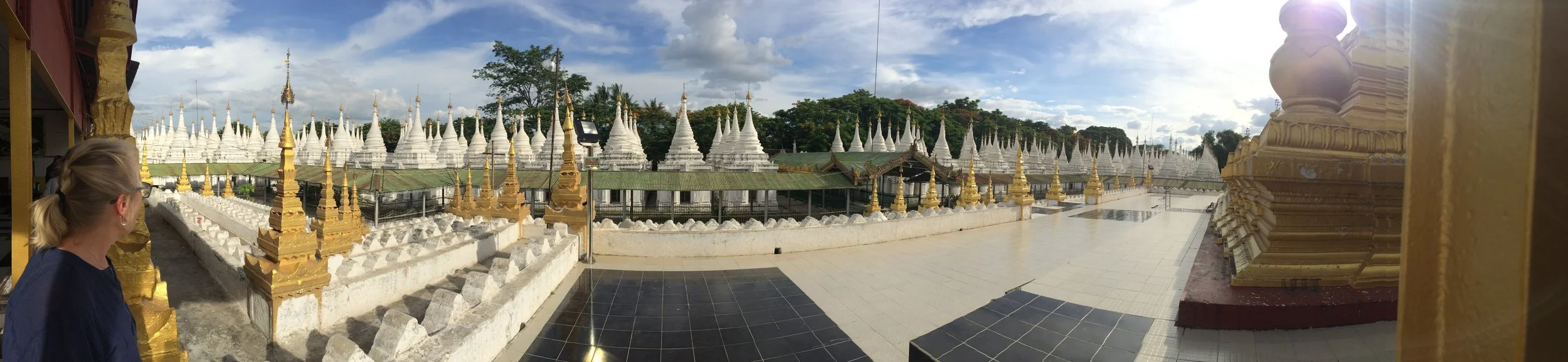
Each Pagoda has a stone carved tablet, the grounds are huge, this is just one side of it

Each Pagoda has a stone carved tablet, the grounds are huge, this is just one side of it

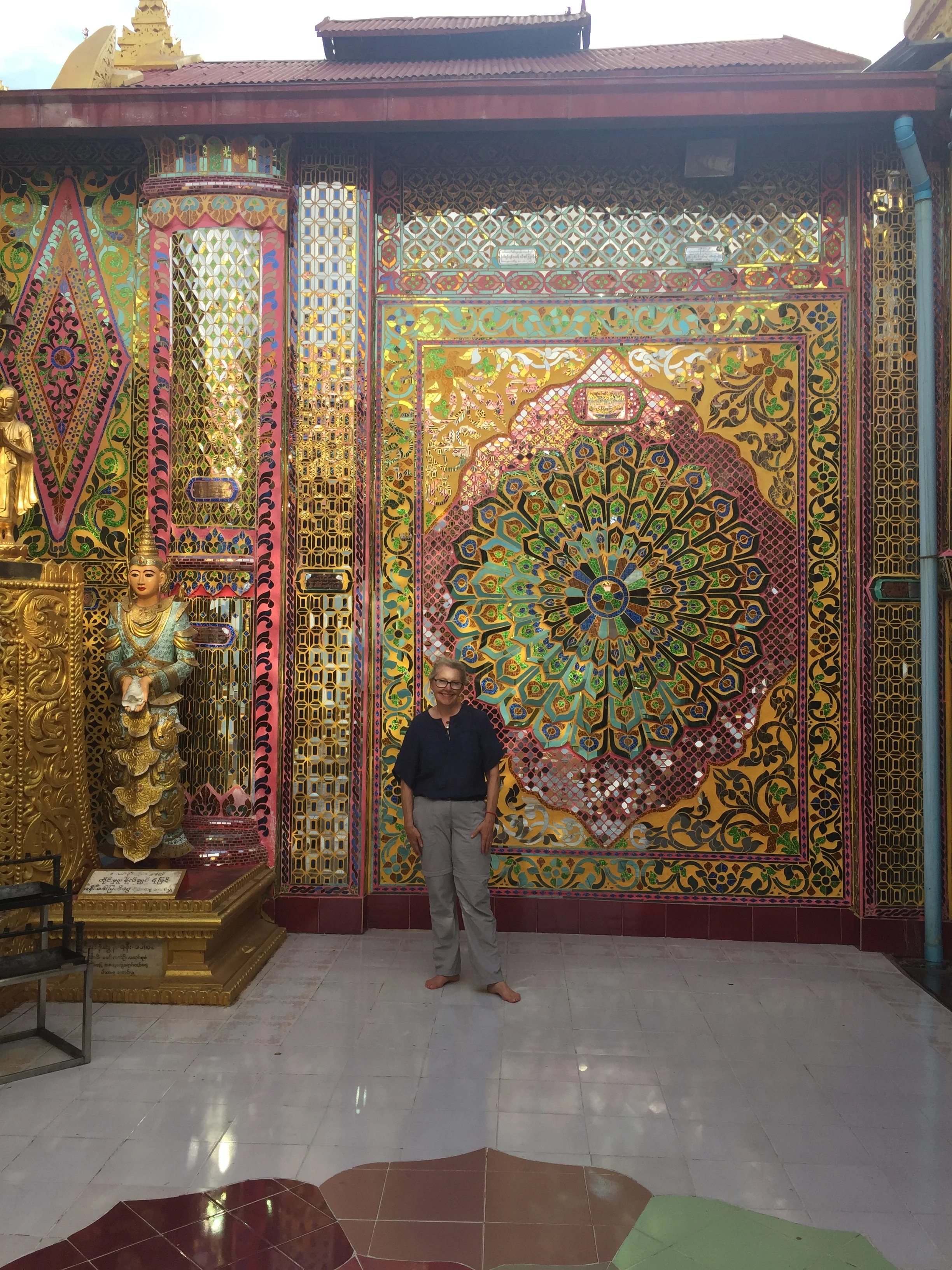
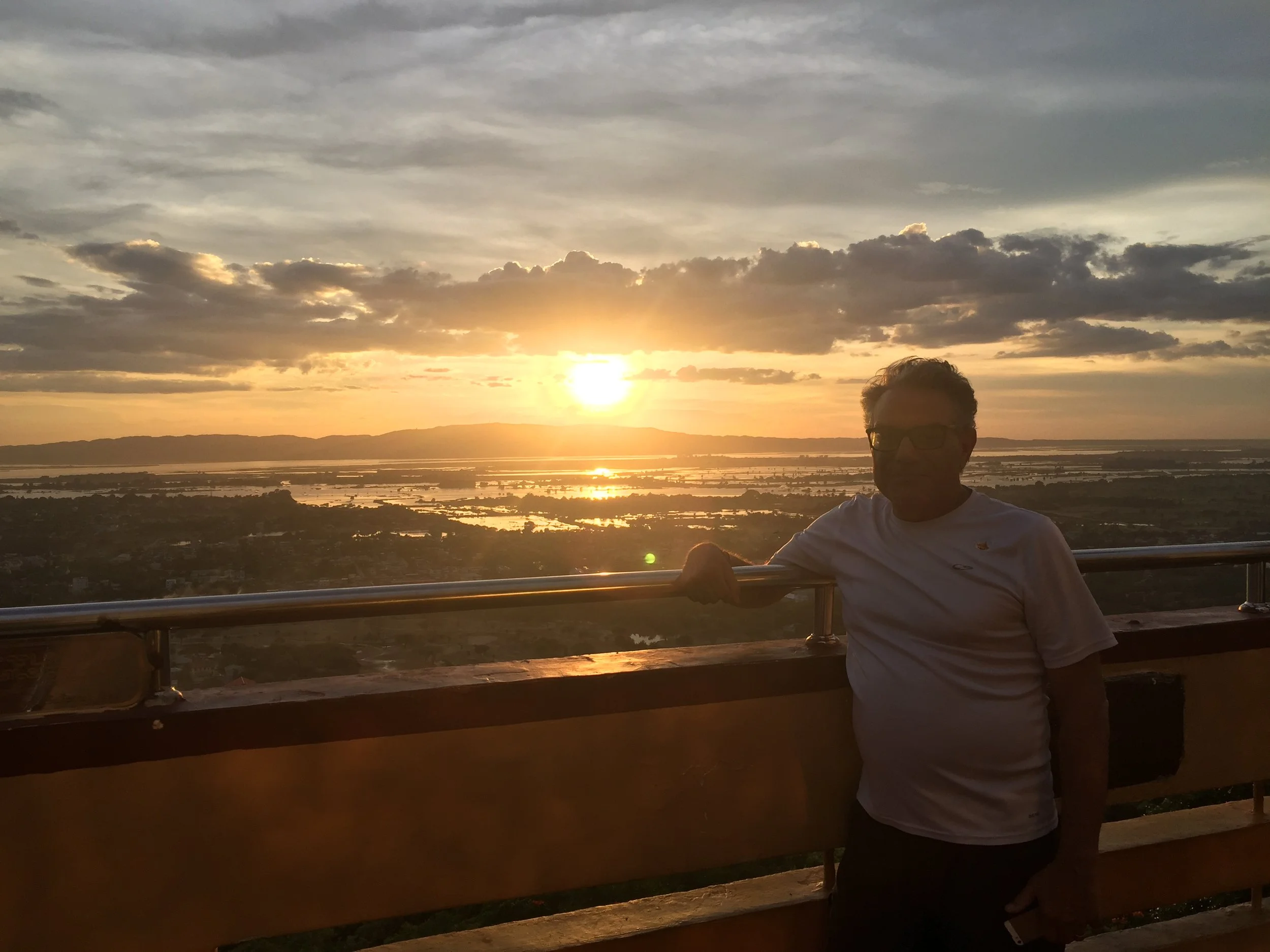
By lunch is is over 100 degrees again and we head back for a rest.  After our siesta, we drove to the top of Mandalay Hill, the 760 ft high site overlooking the sprawl of Mandalay. We enjoyed overlooking the countryside and watching the sunset from the  the summit and did converse with a young monk who wanted to practice his English speaking skills. He was actually a very good speaker.  We headed home at dusk and decided on eating at the hotel. Check out the photos.
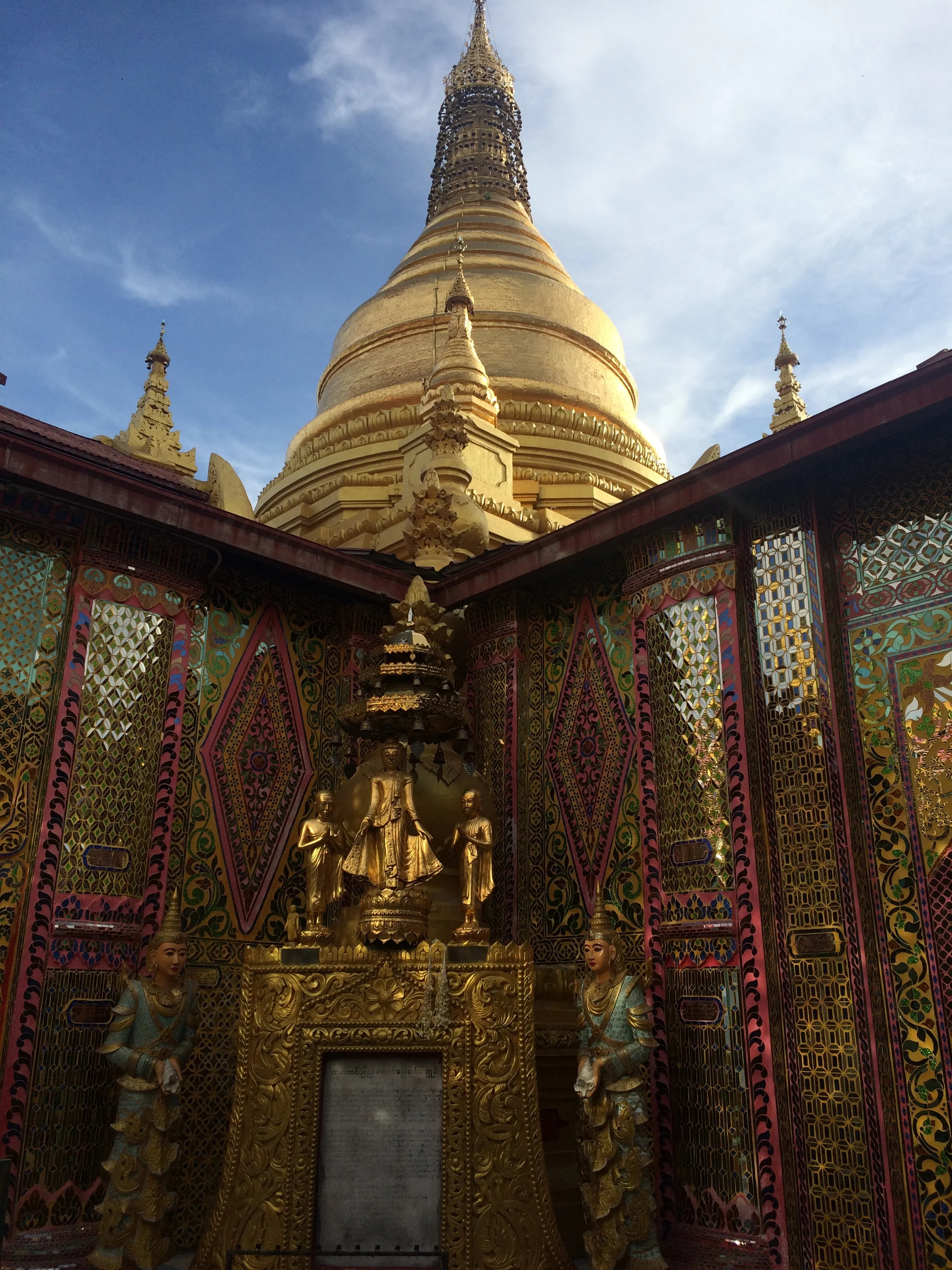
On the 2nd day we left the city and took a day trip to the 4 ancient cities close to Mandalay.

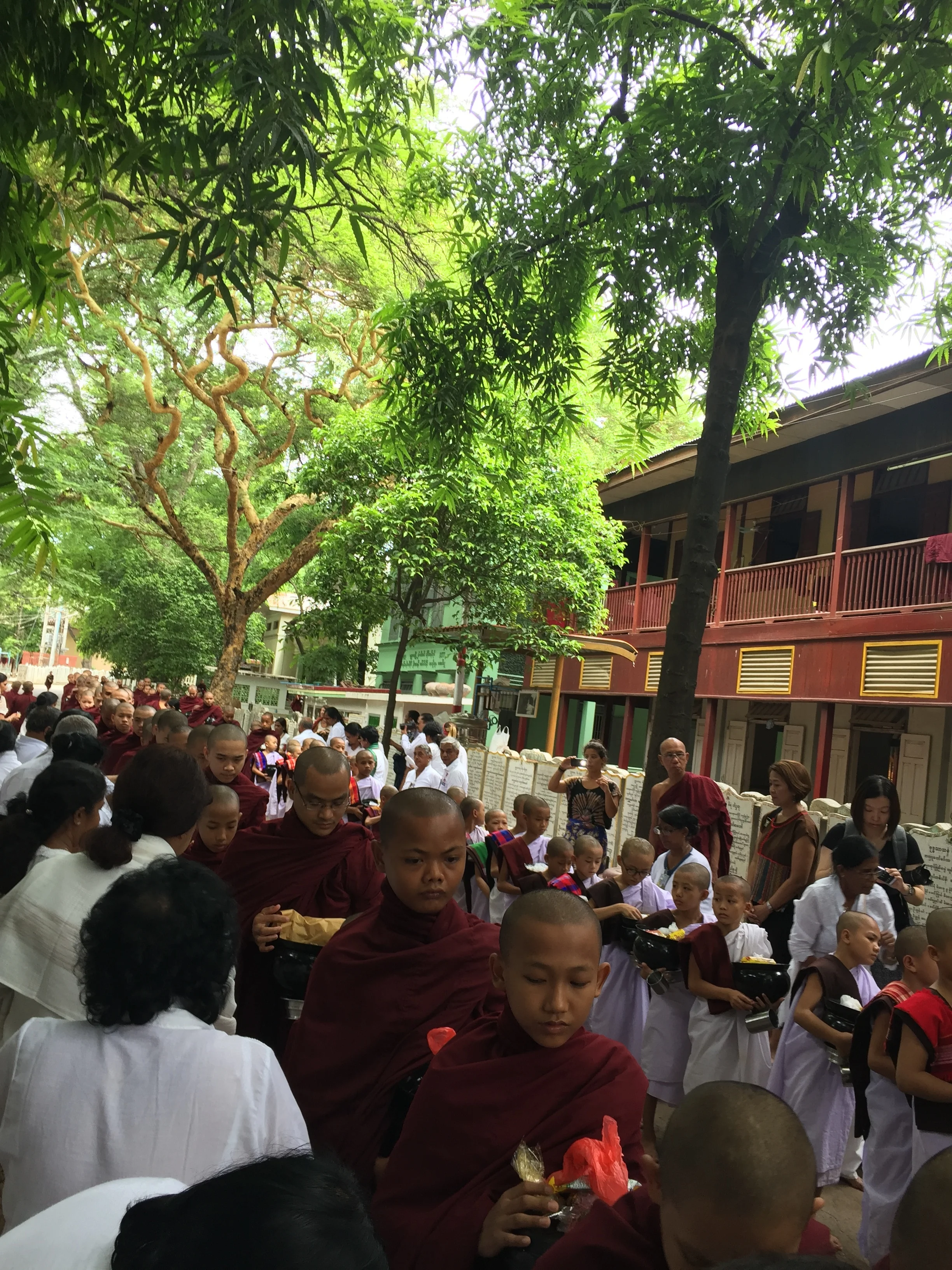
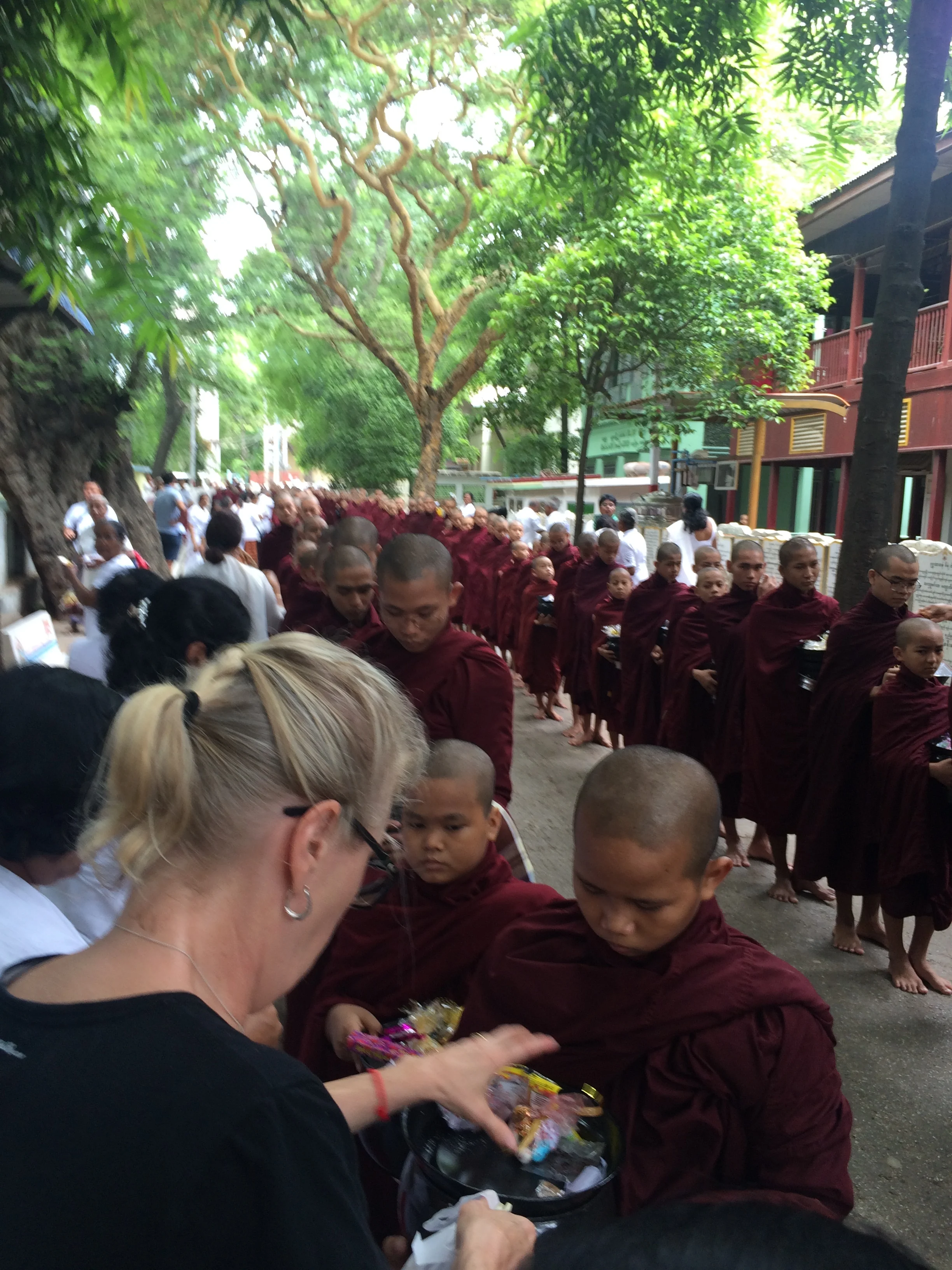
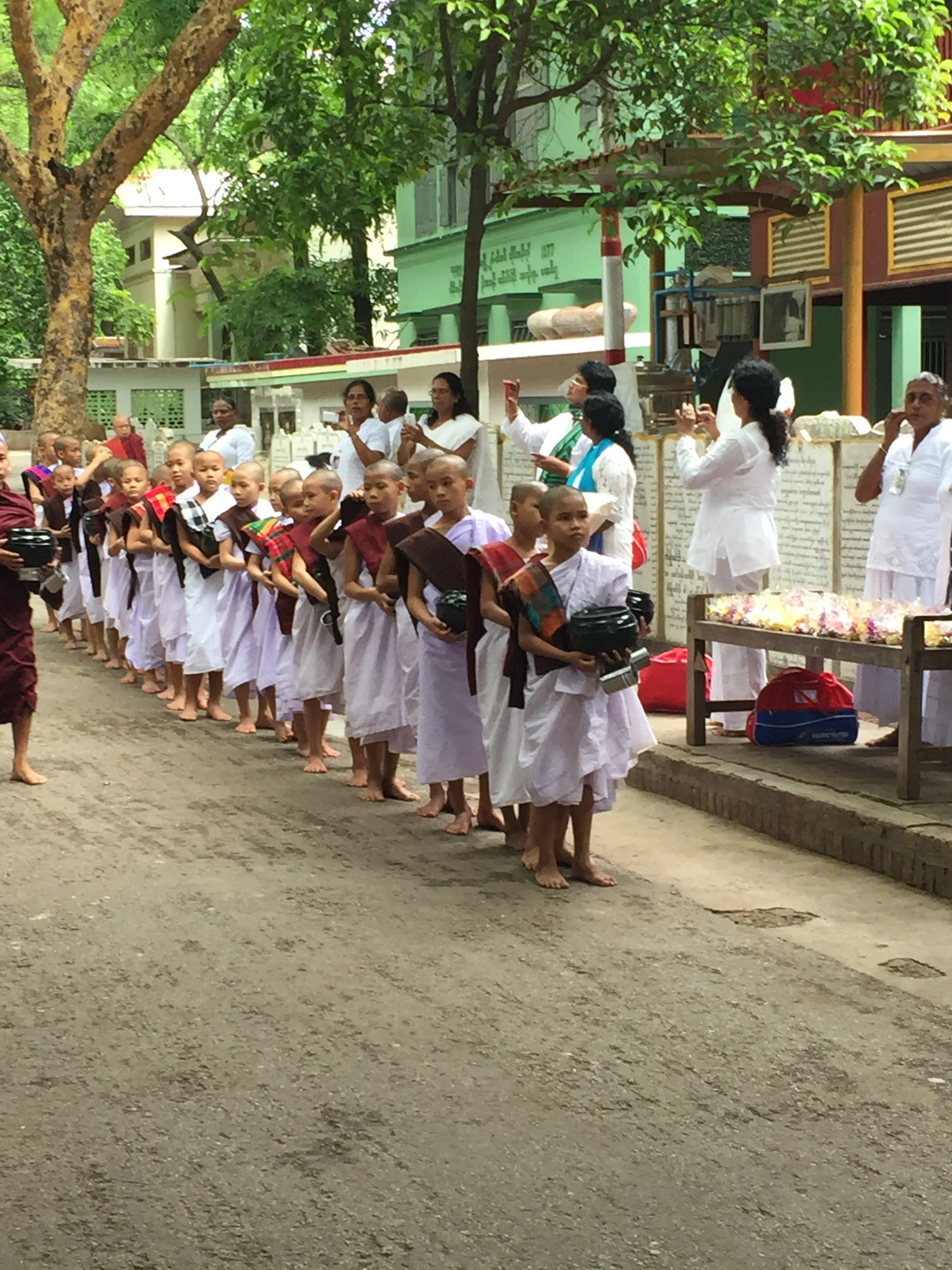
We started and ended in “Amarapura’ aka the “City of Immortality”. First stop is a visit to the prestigious monastery “Maha Ganayon Kyaung. Here, we see an inspiring sight where hundreds of the brightest young novices and student monks breakfast at 10:30 am by walking with their bowls through a gauntlet of visitors who give offerings to each monk as they proceed to the mess tables. They are all wrapped in purple robes, with shaved heads and bare feet. It is hard to explain the emotional shock that overwhelms when you realize the depth of spirituality that is surrounding you. Imagine, for example how you would feel if hundreds of young men, Christian priests or ministers to be, walked passed relying on your generosity for food and sustenance. We where invited to stand with a group of lovely ladies from Sri Lanka, all dressed in white, who allowed us to share their offerings with the monks. Their obvious reverence for these young men added to our respect and spirit.  Just a beautiful experience. 
During the late morning and early afternoon we traveled to Mingun and Sagaing.

Mingun: The trip to the riverside village of Mingun requires roller coasting along the rural roads through small, longstanding hamlets of bamboo houses, where farm animals roam on the streets. The draw here is the “what it could have been” inquiry. The Mingun Paya is the remains of a gigantic brick structure that was a planned 492 ft Stupa that suffered multiple earthquakes; the entrance walkway from the river was guarded by 2, three story high lions that also suffered damage. To understand the size of this broken structure, know that the displayed Mingun Bell is the world’s largest uncracked bell. 


Next to Sagaing: Across the Ava Bridge is the Stupa laden hilltops where Burmese Buddhists come to meditate and relax. The key Monasteries are on Sagaing Hill. Here the views are so stunning that we just sat at the top for an hour and overlooked the rolling hills

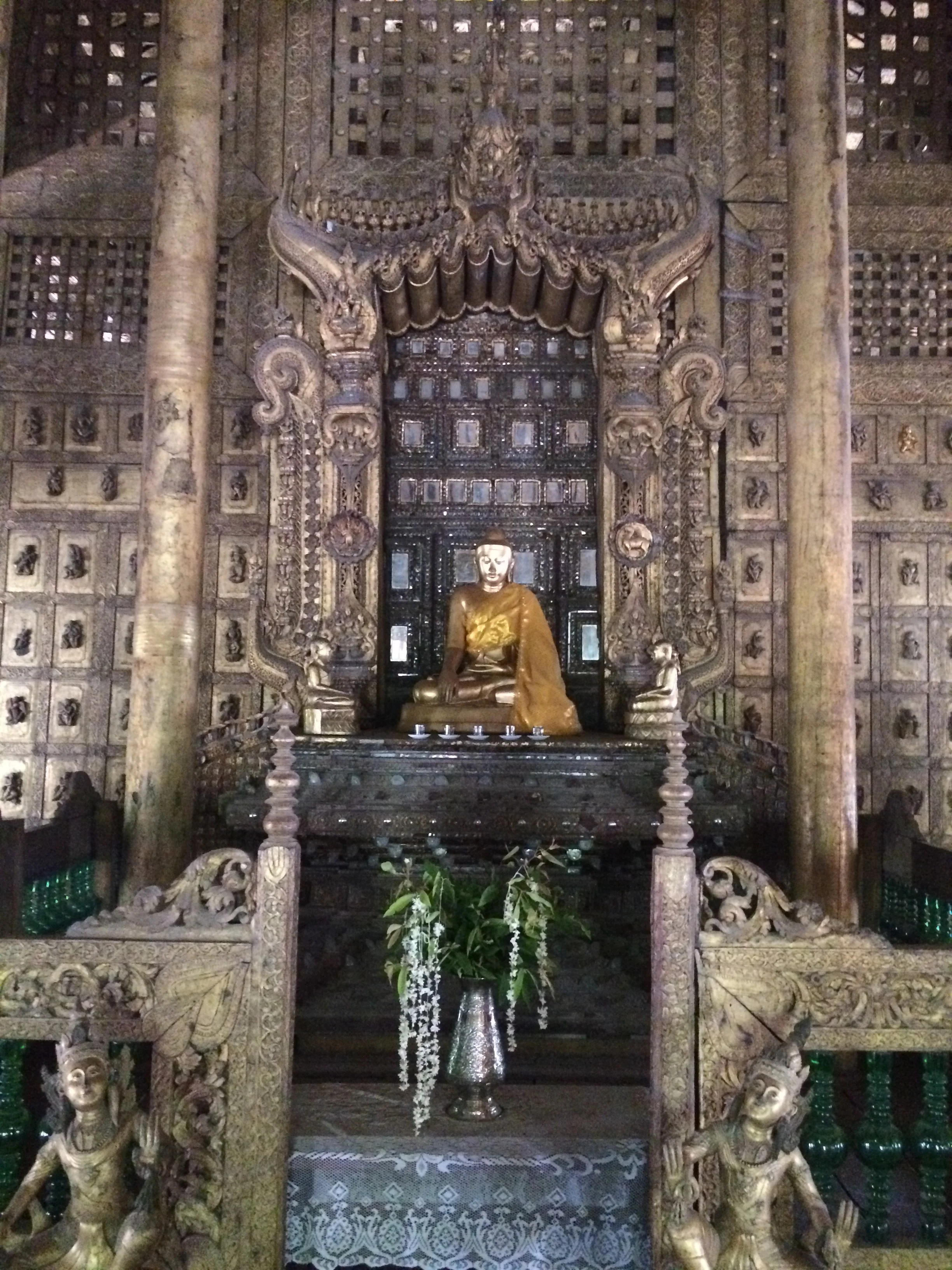
In the later afternoon we traveled to Inwa (called Ava by the Brits). This area is cutoff by rivers and canals, but was the capital of the country for 4 centuries. Our driver dropped us at a jetty where we took a small boat across to the river to the remaining village. Upon arrival we hired a horse cart to make a two hour loop around Inwa’s beaten two track dirt roads to visit the crumbling ancient sites, including the towering 1834 Teak monastery supported by 267 posts and covered by intricate carved figures. This structure was really an unexpected treasure to see. 
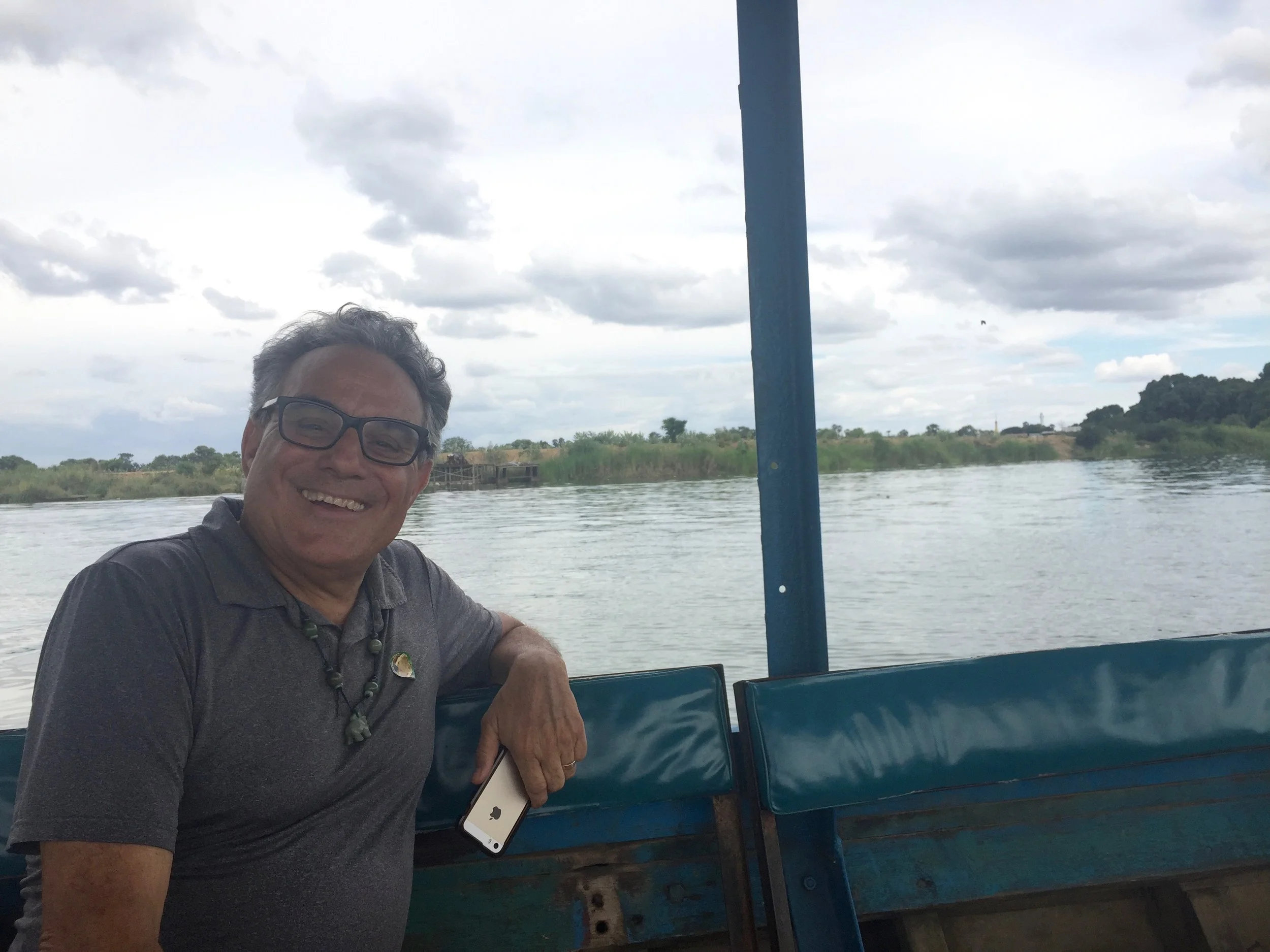
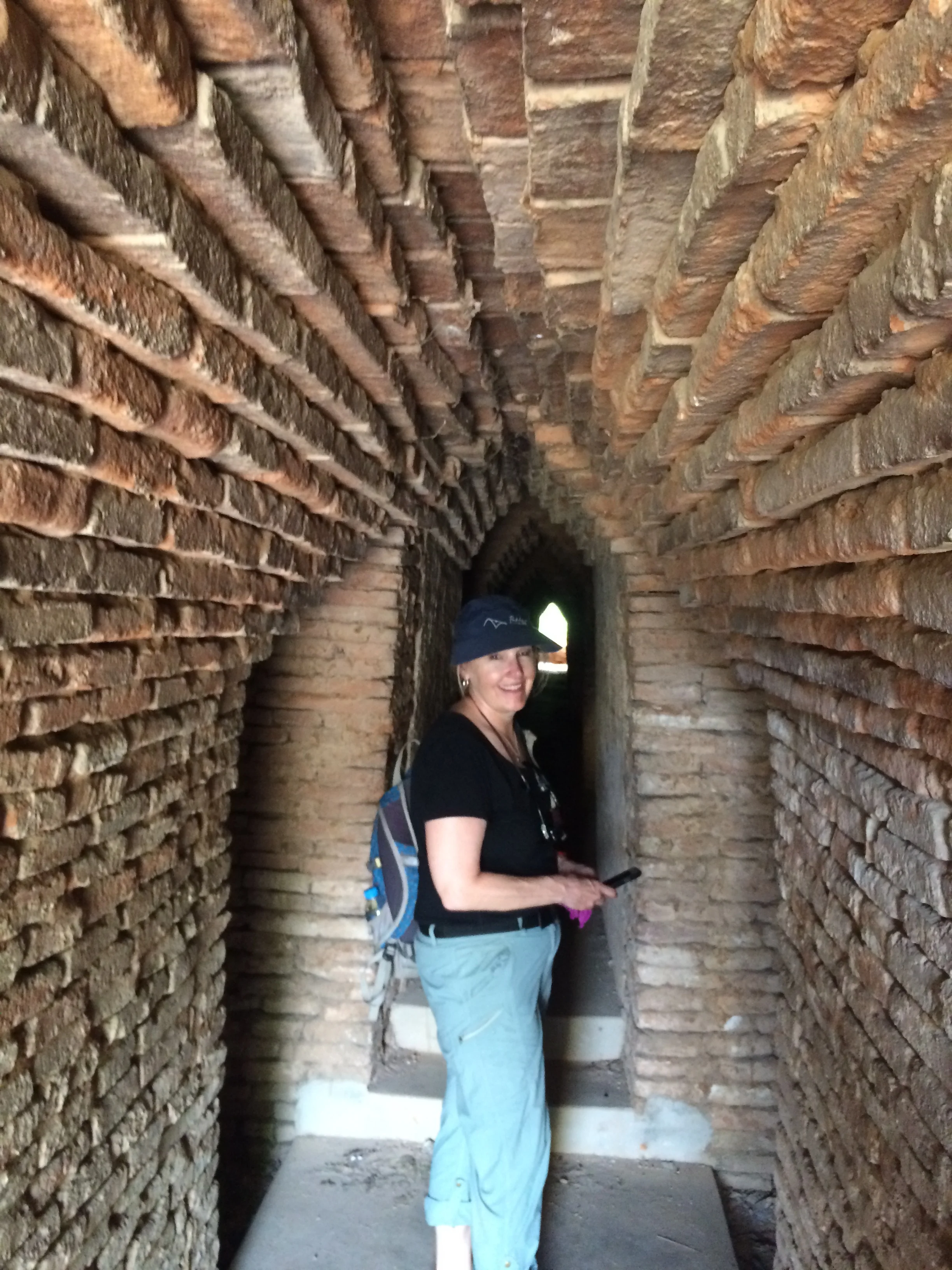
Another "Tomb Raider" site

Another "Tomb Raider" site

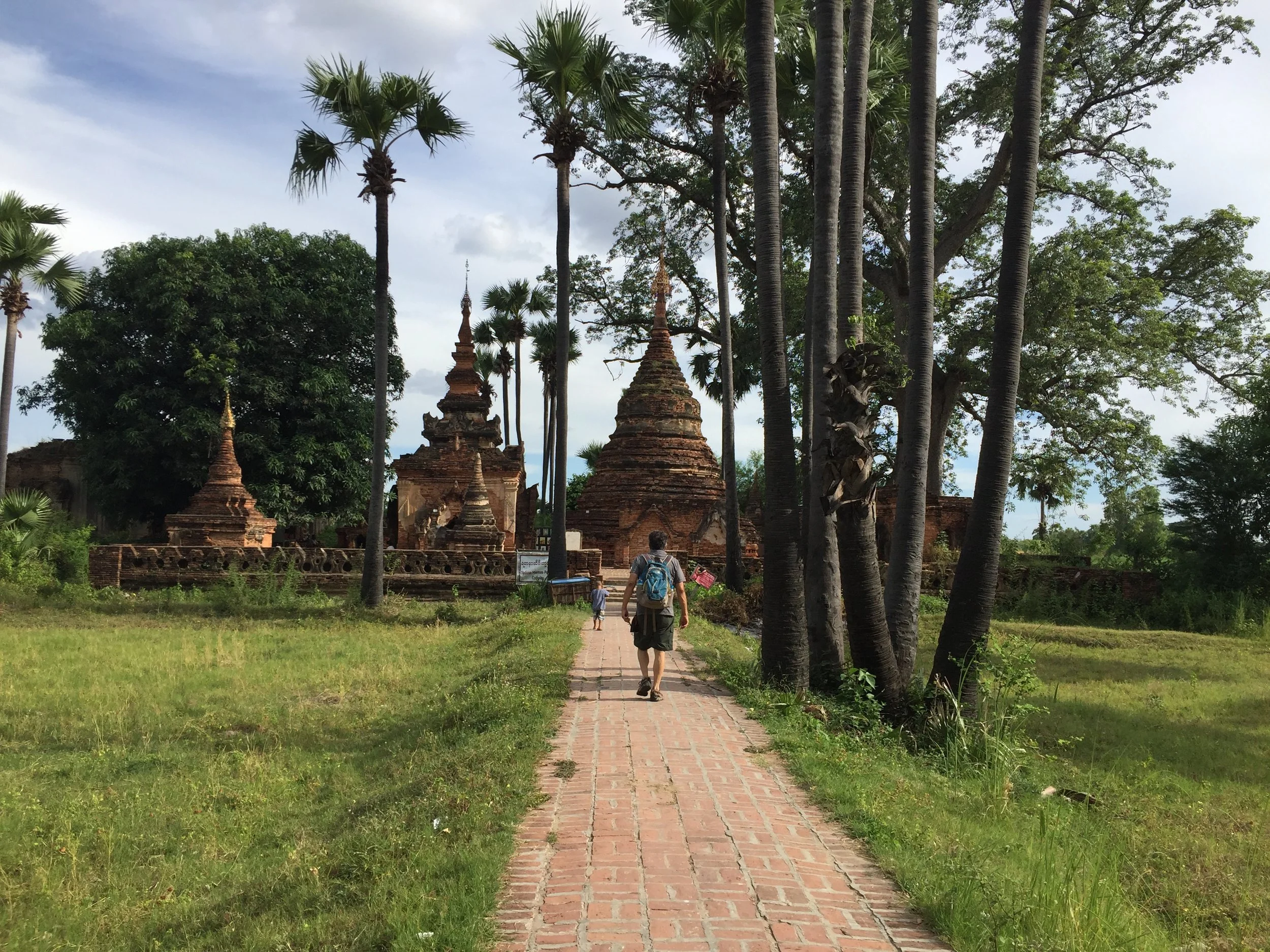
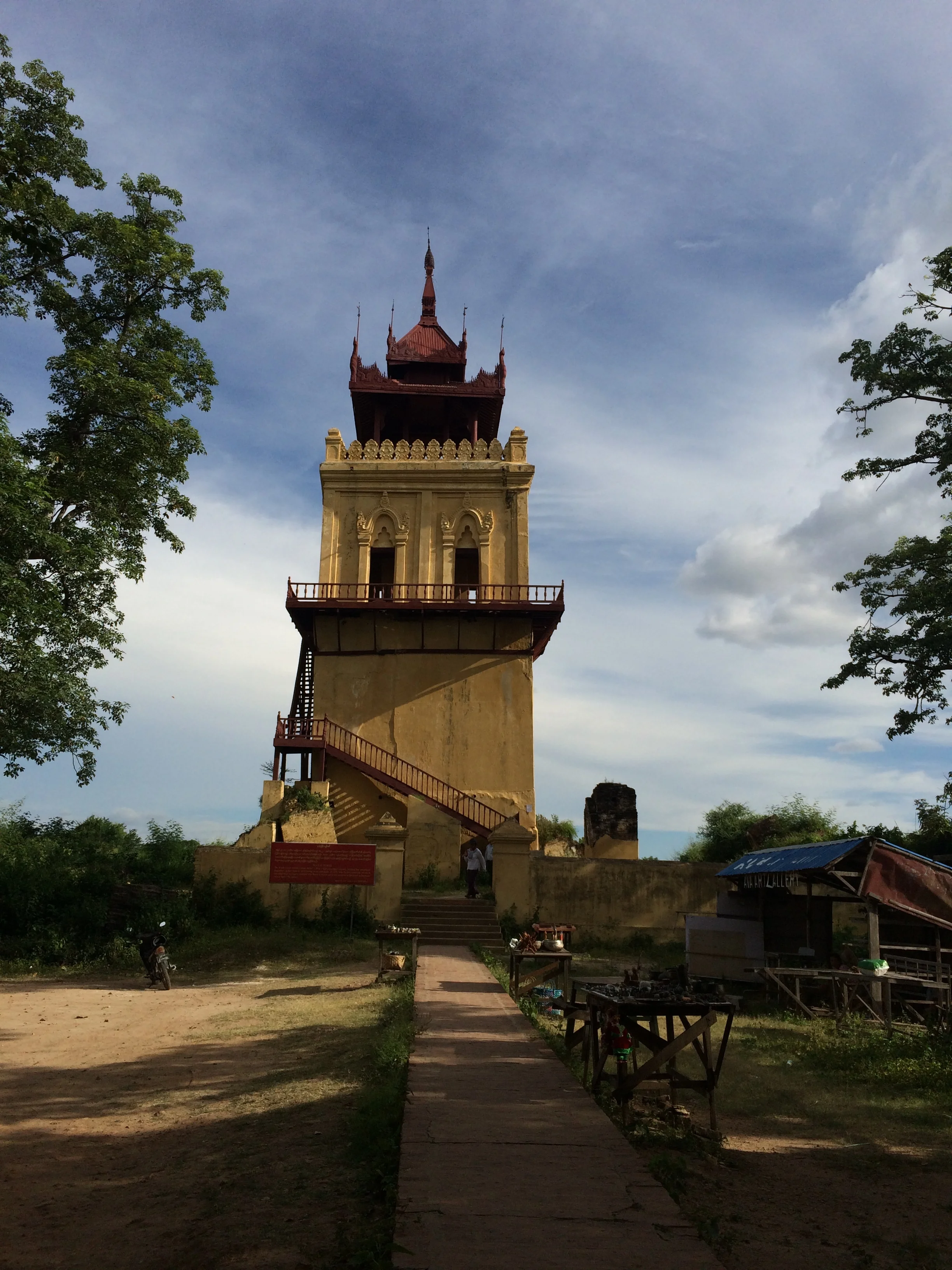
We also enjoyed the 1822 “Ok Kyaung” brick and stucco monastery that was in disrepair but beautiful anyway—we felt like tomb raiders again. Finally we saw the 88 ft “Nanmyin” watch tower that was once simply a corner of a great palace that no longer exists. It leans badly, so climbing up the stairs is prohibited. The bumpy, swaying  road took us through the banana fields and small villages lined with platform houses, and cattle, horses, and chickens, finally reaching the jetty.  As we waited for our boat, we noticed that another boat dragging a dead cow carcass, stiff with legs straight up, as it passed the dock where women where washing clothes and bathing children. That was weird. In any event, we rejoined our driver to go to the teak bridge for sunset. 

At the end of the day we returned to Amarapura to view the sunset from the “U Bein” bridge, apparently the world’s longest teak wood bridge at 1300 yards. The solar reflection off the river filled with small transport boats was another treat. At the end of the long day, we were hot and tired but greatly inspired by the excursion.

The next day we celebrated our 30th wedding anniversary by relaxing at the pool and spa, eating a creamy cake ordered from the hotel, smelling the roses, with a great dinner after dressing  up.    

Sunset at the bamboo bridge

Bagan Myanmar

After one action packed day in Yangon we flew to Bagan, Myanmar. This was a prop plane seating 60, but only 6 were on board. They were waiting for us as we let time get away in a coffee shop.

We almost missed our first plane flight in a tiny airport with no people in it, again I guess we are just to casual about all these planes, trains, buses and automobiles. We arrived in 1 hour; and like every other flight in Asia we have a full meal offered by lovely Myanmar stewardess. The dress of the women throughout the country is very fashionable. We think Myanmar women may have taken first place for most naturally lovely in SE Asia over Thailand.  See some pics below.

Upon landing, we immediately recognized that this country is more poor than the other SE Asia countries we visited. The average salary is $66 US per month. Across the river you can see hills, but Bagan is flat, dry and dusty.  It is very hot, over 95 everyday.  They have no rainy season here, it is the desert. Most of the roads are dirt.  The construction trucks have an open engine that reminds us of something out of Mad Max.

A truck in front of our hotel, they are diesel, very noisy with lots of black smoke

A truck in front of our hotel, they are diesel, very noisy with lots of black smoke

Bagan is the land of 4000 temples, commissioned in a 230 year building frenzy by Bagan’s Kings. This is an area of 26 square miles with several main paved roads criss-crossing the area. It is formerly known as “ Bagan Archaeological Zone”—entrance fee $15.  There is Old Bagan, New Bagan, and the  Nyaung U  suburb. The old town is surrounded by a fortress wall shaped like a semi circle with the ends meeting the river shore. This space is filled with temples, but outside the walls there are even more pagodas, stupas, and temples. 

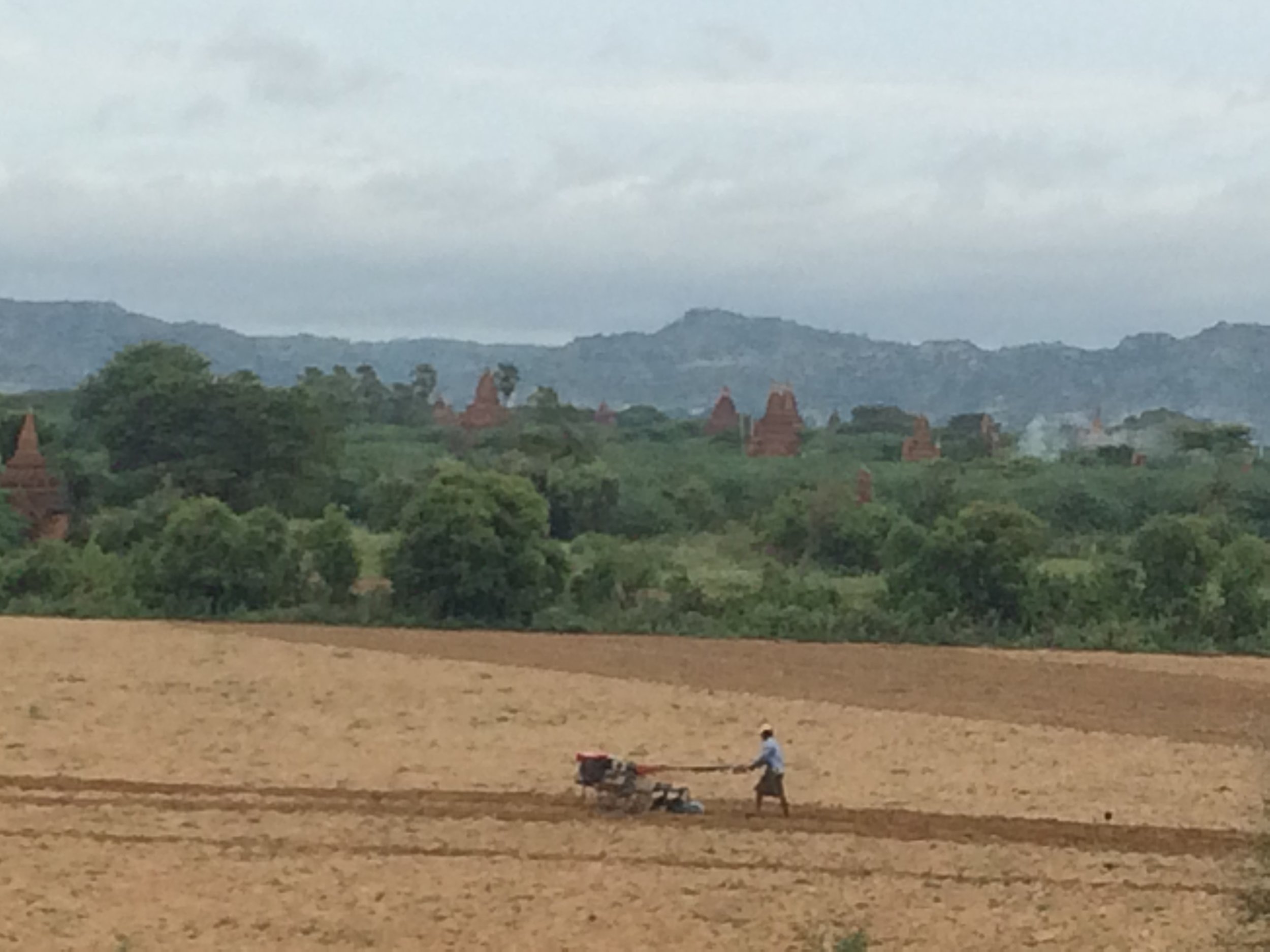
The fields with the temples, river and hills in background

The fields with the temples, river and hills in background

This place is a Disney ride for cyclist. This includes bicycles, e-bikes, and low cc motos. We, as novice bikers loved the electric -bikes (scooters). We have old buddies that we think would just love to revive their “motorcycle jones” by driving 150-250 cc gas dirt bikes on the roads and pathways between these amazing structures. The traffic is light in this city and all cars and trucks accommodate tourist bikers.

Frank at a temple that is being restored, the sandstone has been cleaned back to the original white color

We decide to split our time in Bagan up starting between traditional bikes and ebikes.  Day one we are with a bicycled  guided group of 4 and peddled 22KM to 10 of the biggest Pagodas. Everywhere we went there were smaller monuments and Buddha temples to see.  We peddled with some great companions. Tim and Susan have really lived a fairy tale life. They met in England but live in the Caribbean on the independent island state of Grenadier near South America. They traveled extensively in Asia and will conclude this trip by visiting family in the UK. They were fun to be with, shared beers, and did not say the NFL was rubbish like some Brits. We wished them well and urged them to go to Patagonia and enjoy the rigors of the “Towers of Pain” trek. They were certainly super fit enough to do it.         

The next two days we took the e-bikes and sought out many of the other incredible temples that sprinkle every mile of this region; still many unseen but we were satisfied with our search. The top temples are near or inside the fortress wall; three of these are Anada Pashto, Dhammayangyi, and Thatbyinnyu Pashto. We probably had the most fun exploring the dirt trails and coming upon abandoned temples with plant growth and bamboo supports—feeling like tomb raiders. We rode to a modern observation silo for panoramic views, damn ugly. As we traveled the back roads we were invited into a rural native village by an enterprising young lady that spoke superb english. She walked us around the village introducing us to craftsman and inviting us into her home to meet her newborn. Yes, we found some unique stuff to buy—which was probably her intent, but the visit was so pleasant that we felt good about transacting business—with some tea and bartering thrown in. 

Our hotel is very nice. The food is this region is really good. The specialty “ National Tea Leaf Salad” with peanuts and some “magic” sauce is our favorite. The fresh squeezed fruit drinks are equally addictive, especially at mid-day when the heat is extreme. We our in siesta mode—get up early, play, then siesta at 2:00, then to the pool in the later afternoon, back out at night.

Frank at a perfect small temple

At one road side lunch, we met a traveler from Singapore, our next destination. He was a nice young man, who joked about speaking customary english to us, but that he would change up his english dialect to a Singapore accent when he went home—for business purposes he said. He cautioned that Singapore is very expensive, which we knew, and mentioned with tempered pride that people work crazy hours to both meet the cost of living, but also to travel in cheaper countries for months at a time.  We have a planned 3 day layover in Singapore to check out that mega-modern independent island country. Our final dinner was sitting with a sunset view of the Ayeyarwady River. As the sun went down the skies darkened and heavy rains swept the patio causing many people to move farther indoors. We prayed that the rain would stop soon as we had rode up on the e-bikes. It did, and our ride home with headlights was uneventful. Tomorrow we leave for Mandalay  

Yangon Myanmar

After our goodbyes to the kids at the Bangkok airport we had breakfast and waited for the ticket counter to open, we were one of the first at the counter, and then our plans blew up.  They would not let us board, telling us we needed a pre-visa letter.  Our research on the visa was that foreigners could get a visa upon arrival at the Myanmar airport. True, but not so if you are a citizen of the United States.  This is our 99 move, perhaps we are just getting careless, but we will say that the Myanmar info on the web is not clear!!

Myanmar is an important country for us and we have three other flights purchased all contingent on getting to Yangon.  We had to scramble and get an expedited “letter of Invitation” over the internet, on Sunday.   Rescheduled our flight for 7:15 PM the next day and get another night at a airport hotel.  24 hours later got the letter (for $370), which was a bullshit one page document with our names and a watermark seal, and got on the plane. Upon arriving at Myanmar airport, right there--sitting out front of passport control was a booth “Visas on Arrival”. Traveling with your spouse everyday can be a challenge , this issue tested both of us, and thankfully it all worked out, on the upside, with this crisis we did not go through on normal depression after leaving the kids.

Frank on a walkway over a major street, the locals just braved the traffic and did not use it.

We are now in a new country that for centuries had been known as Burma; colonized by Britain and occupied by Japan in the 20th Century. Recently, it had opened to foreign travelers after decades of military rule and isolation. Myanmar has that third world vibe. We landed in Yangon, the former capital. It has some large British government buildings, but it is mostly composed of 4 story cement buildings on narrow street discolored with mold from the constant rain and humidity, and neglect.

Simple meal of noodles, greens and rice from our hostel

Our hotel in the old town section, was more like a hostel, but the rooms were clean and the staff very helpful. We walked around the neighborhood to get the lay of the land and had a simple dinner.  Right away we see major differences from our other SE Asia countries. The men wear sarongs and short sleeve dress shirts to work, all the women are in long skirts, no pants.  It is gritty, loud and we love it.

Typical dress of a man on the way to work

Selling Durian on the train.  They are ripe and have a very strong smell - nicknamed the "stinky fruit"

Selling Durian on the train.  They are ripe and have a very strong smell - nicknamed the "stinky fruit"

The next morning, for a buck each, we rode the rickety Yangon train that circles the city in order to experience the local folks. This 3 hour slow train, stopping 24 times, was just a hoot. One of the best in-country experiences we have ever had. The train cars were purchased used from Japan decades ago and have open windows and door. Passengers and sales merchants. Here people carry on fruits, snacks, and “betel” for sale. Others bring on boxes and bags of veggies of all types to transport to other stops. Young and old ride this train. They were friendly to us and offered us fruit and smiles, some frowns or puzzled looks, but all was ok. The photos were very cool and the video below shows the market and people from our train window.

Selling Betel on the train

Selling Betel on the train

“Betel” is a weird “chew” that the Burmese have used for centuries; it starts with a betel leaf coated with slaked lime, that looks like white slime, then sprinkled or painted with Areca nuts, and mixed with some tobacco and spices for flavor. This is a stimulant. The chew turns to RED goo in the mouth and has seriously affected the dental enamel. There is red blotches of spit all over the sidewalks. Three leafs cost 10 cents and an average user chews 10+ per day, it is a very disgusting habit.        


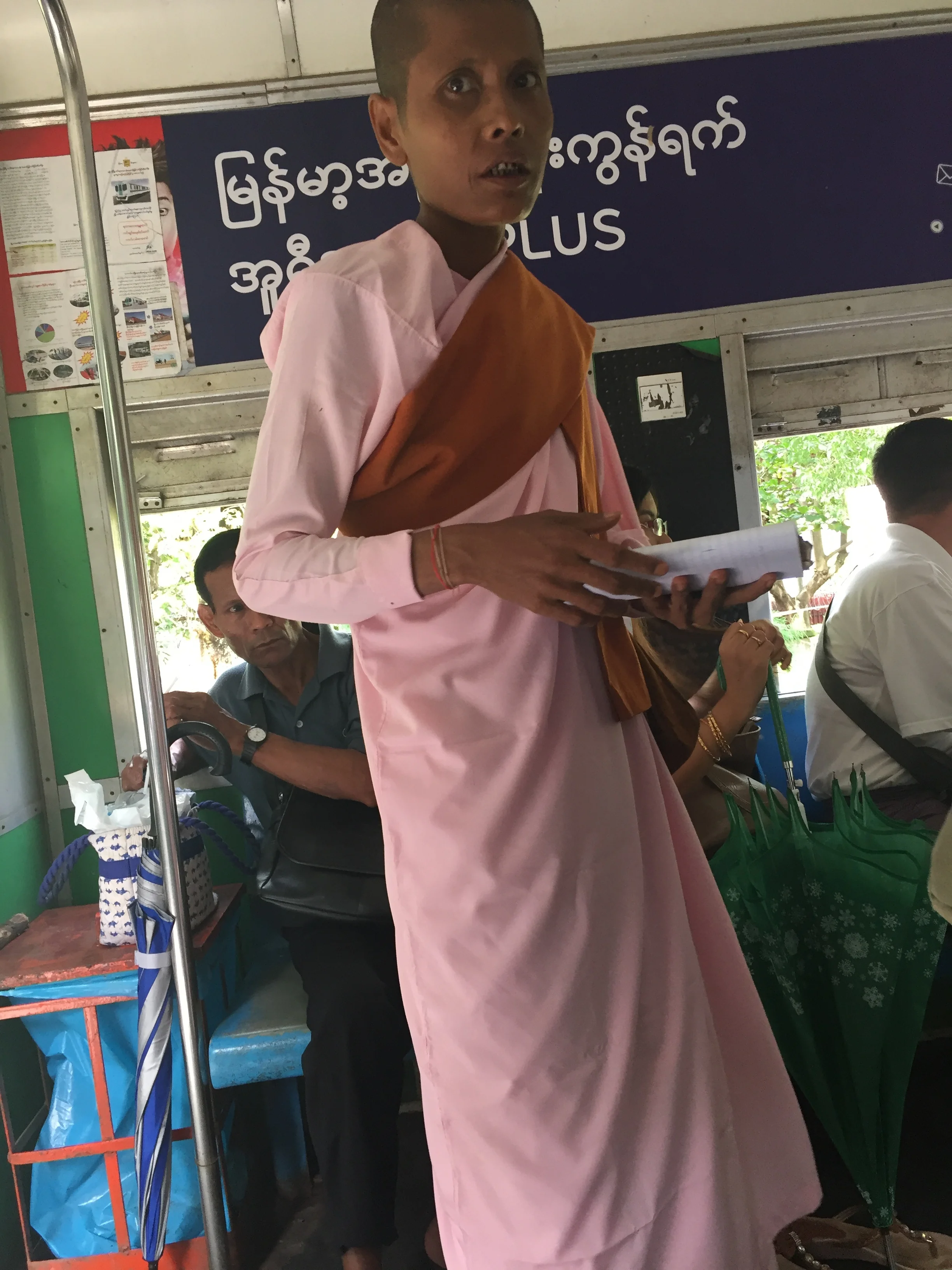
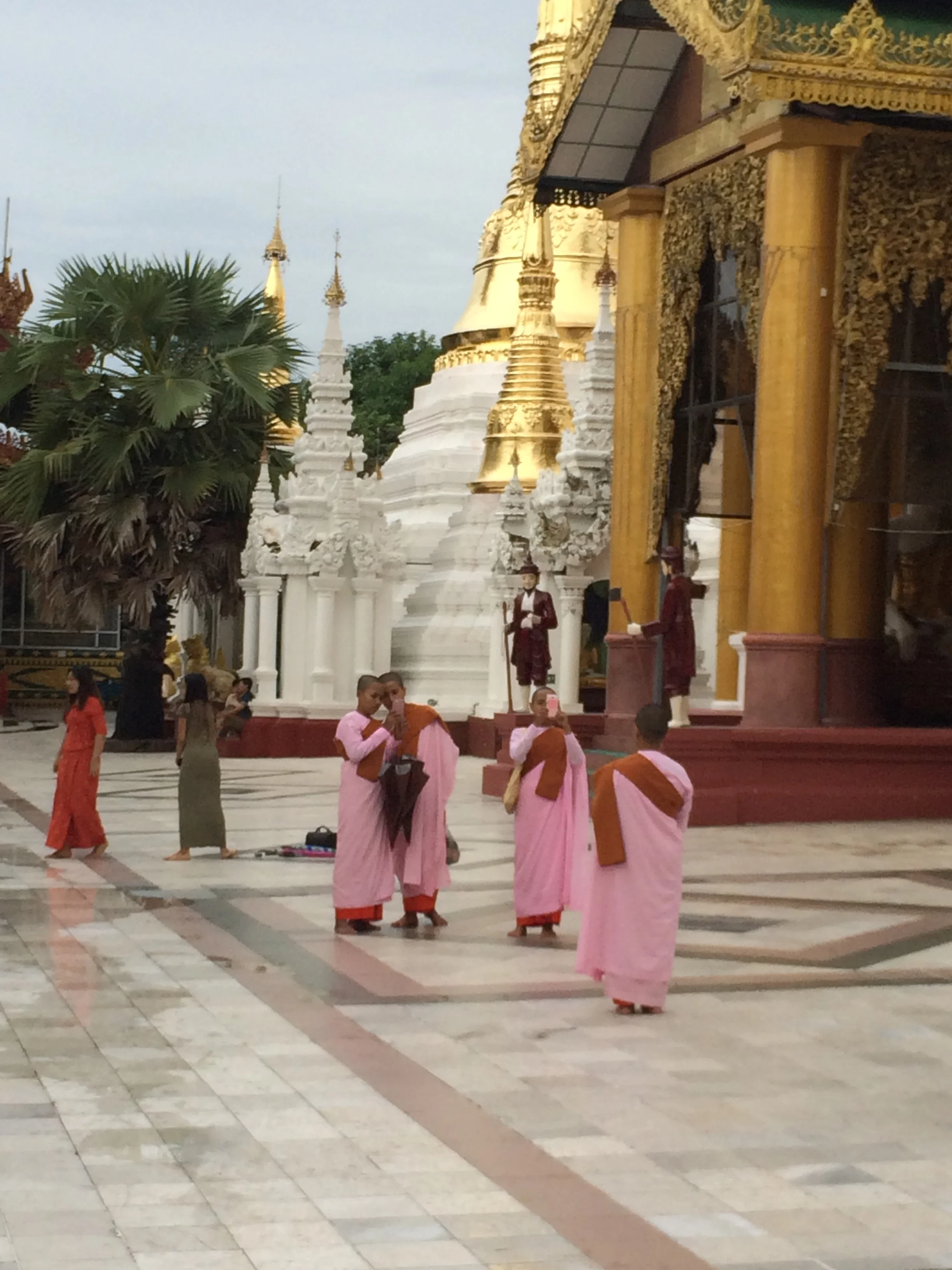
The women of Myanmar almost always display a special mixture of makeup on their cheeks. It is a pasty substance that is derived from the Sandalwood bark mixed with water and lightly painted by brush or fingers on their cheeks and sometimes forehead. It is not unattractive, but unusual, with the purpose of protecting the skin from the hard sun.  Myanmar is not as devote to Buddhism than the other countries we have visited. But they do have women Monks called “Damas”. They wear “pink” over the customary orange robes. On the train they sought offerings—not morning food—but hard cash—smart girls.

That afternoon we hired a taxi to take us to 4 local religious sites; cost 6000 kip/hour. That's $5/hr. The first 2 stops were magnificent. The Pho temple was fantastically large. We took escalators up 2 stories to the entry way of this conglomeration of Buddha buildings of real Gold Leaf covered towers on top of this mountain.. It was a massive, colorful place with 4 separate entrances-north,south,east and west. See a few photos. 

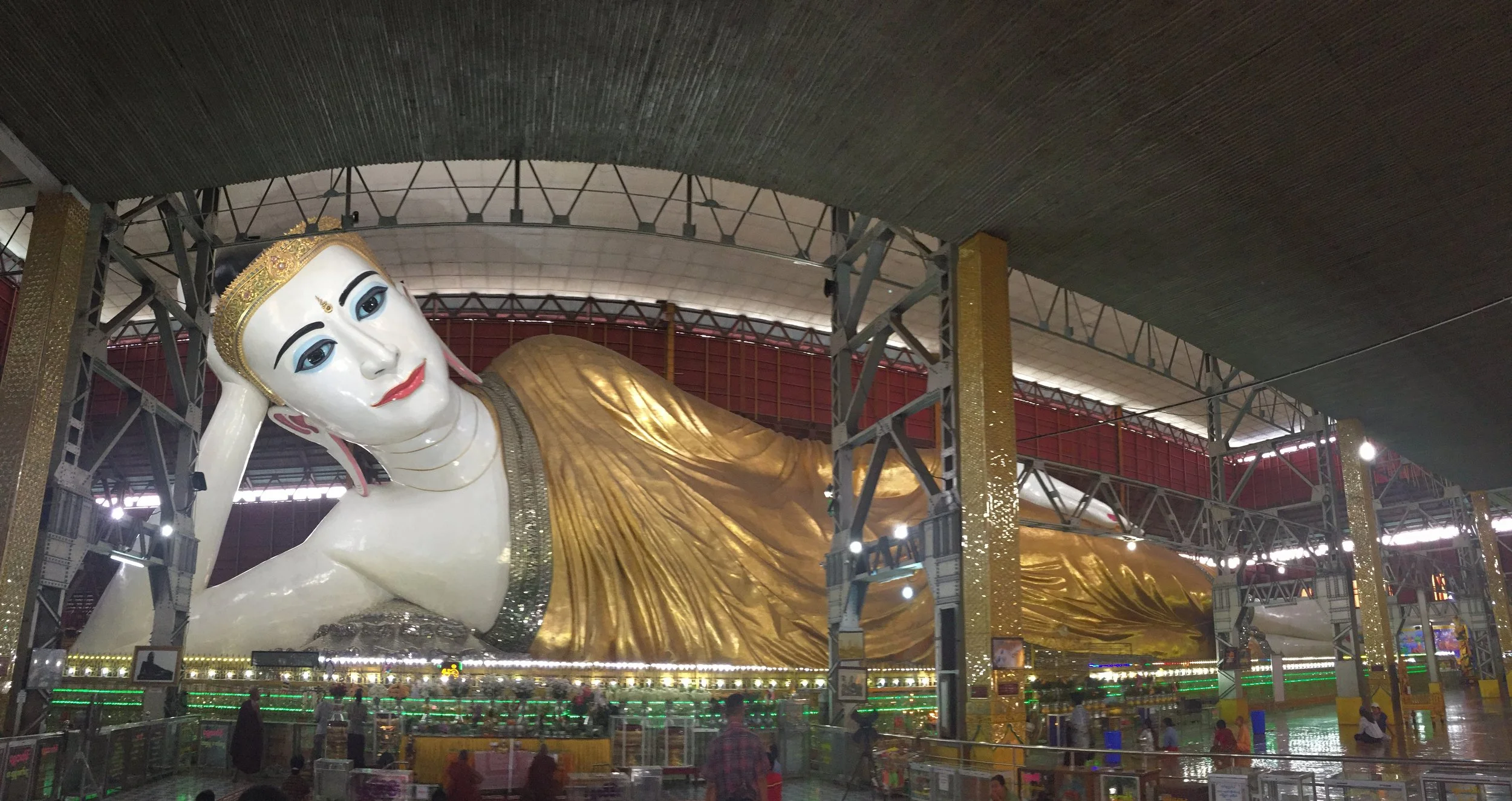
We then went to the separate pavilion of the “Reclining Buddha”. This one figure is massive and impressive, Similar but bigger then the reclining Buddha we saw in Thailand, it has painted white skin, open eyes with long eyelashes and maybe a little more feminine. It is interesting to see Buddha figures in different countries—they have different girth, plumpness, and shapeliness; some are feminine looking, but only in Danang, Vietnam did we see an openly female Buddha, a towering white sculpture 3 stories high. 

Pano of reclining buddha

Pano of reclining buddha

We stopped at one more pagoda, but the rain was so hard that we gave up and ran to the taxi. We had enough—take us home. The excursion was 2.5 hours. That's was it for Yangon . We stayed in that night and did planning, checked visa requirements, and reviewed photos. 

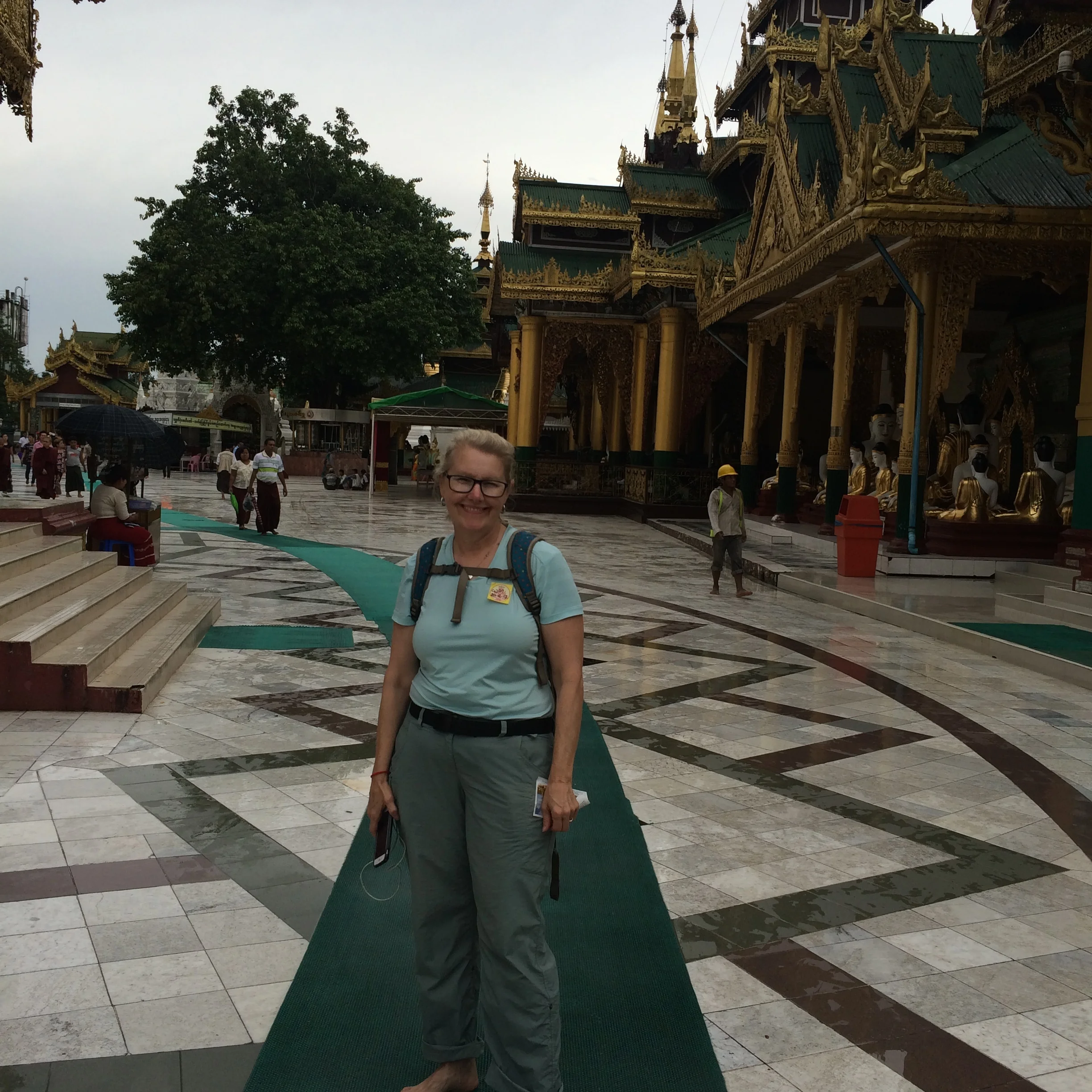
Walking barefoot on marble in the rain, so far no falls

Phuket Thailand

After 2 days in Bangkok we took a short one hour flight to the island of Phuket.  As cool as Bangkok is, Phuket Island is a welcomed vacation spot with the high energy party vibe, the great beaches and the nearby islands. There are resort areas on both sides of the Phuket. We decided to stay in the “Patong” area rather than Phuket Town. Though our hotel was very nice with its pools and large rooms, we planned to make the most of our opportunity with excursions traveling around the other islands.  Our hotel is just what we were looking for, a nice pool, nice rooms and a friendly staff.

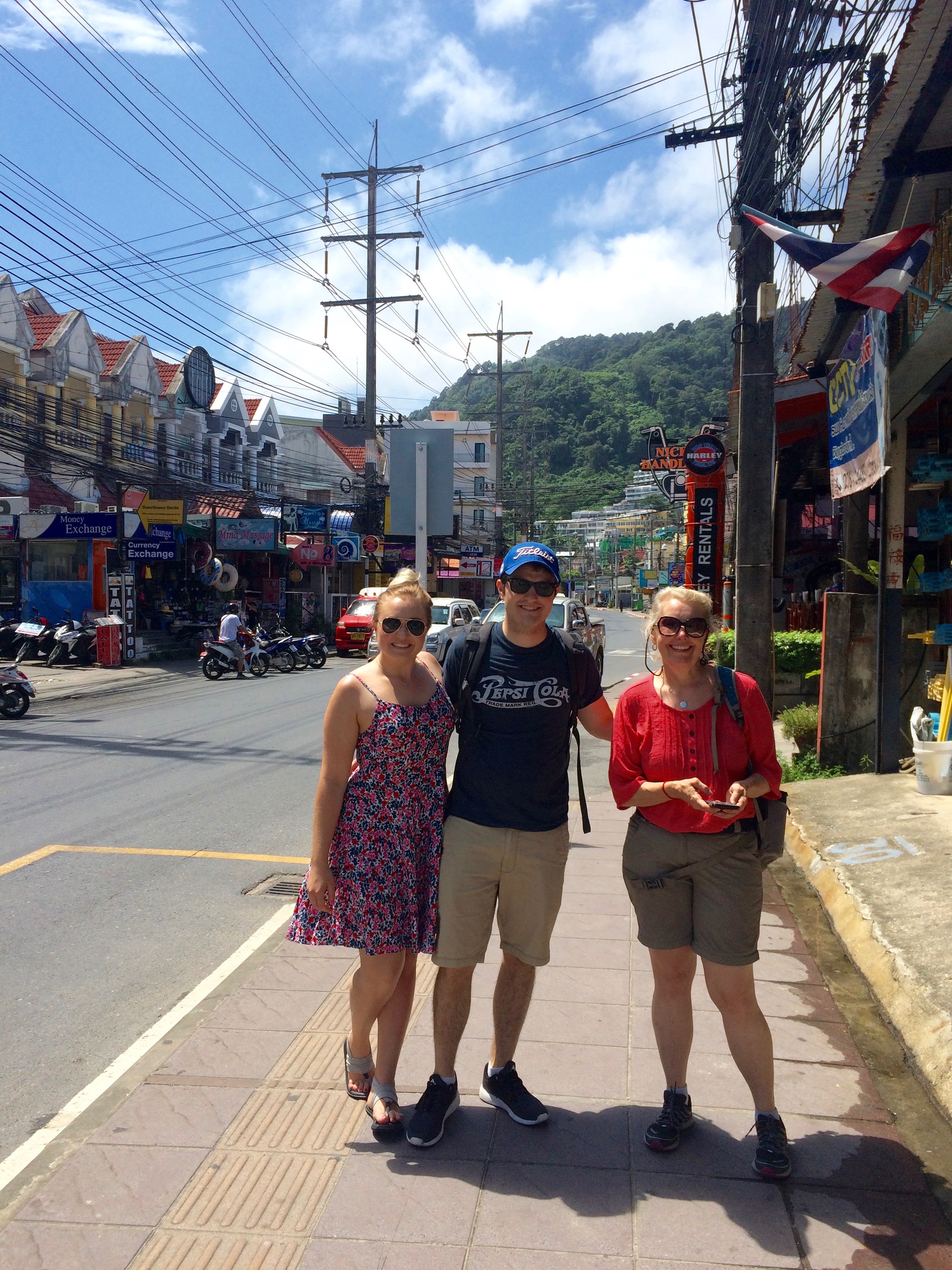
Putong beach - Charlie, Gabbi and Janet are on the right

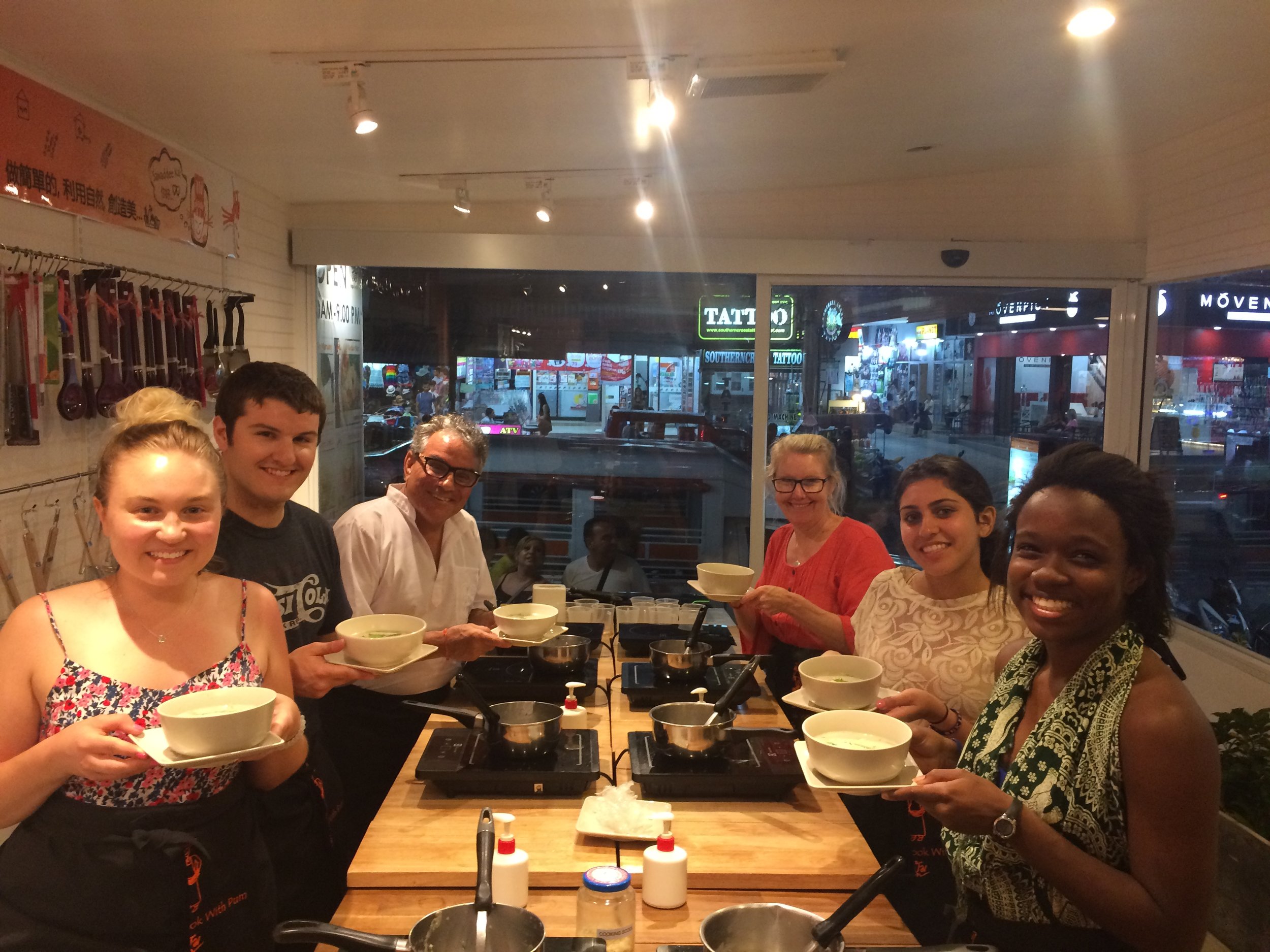
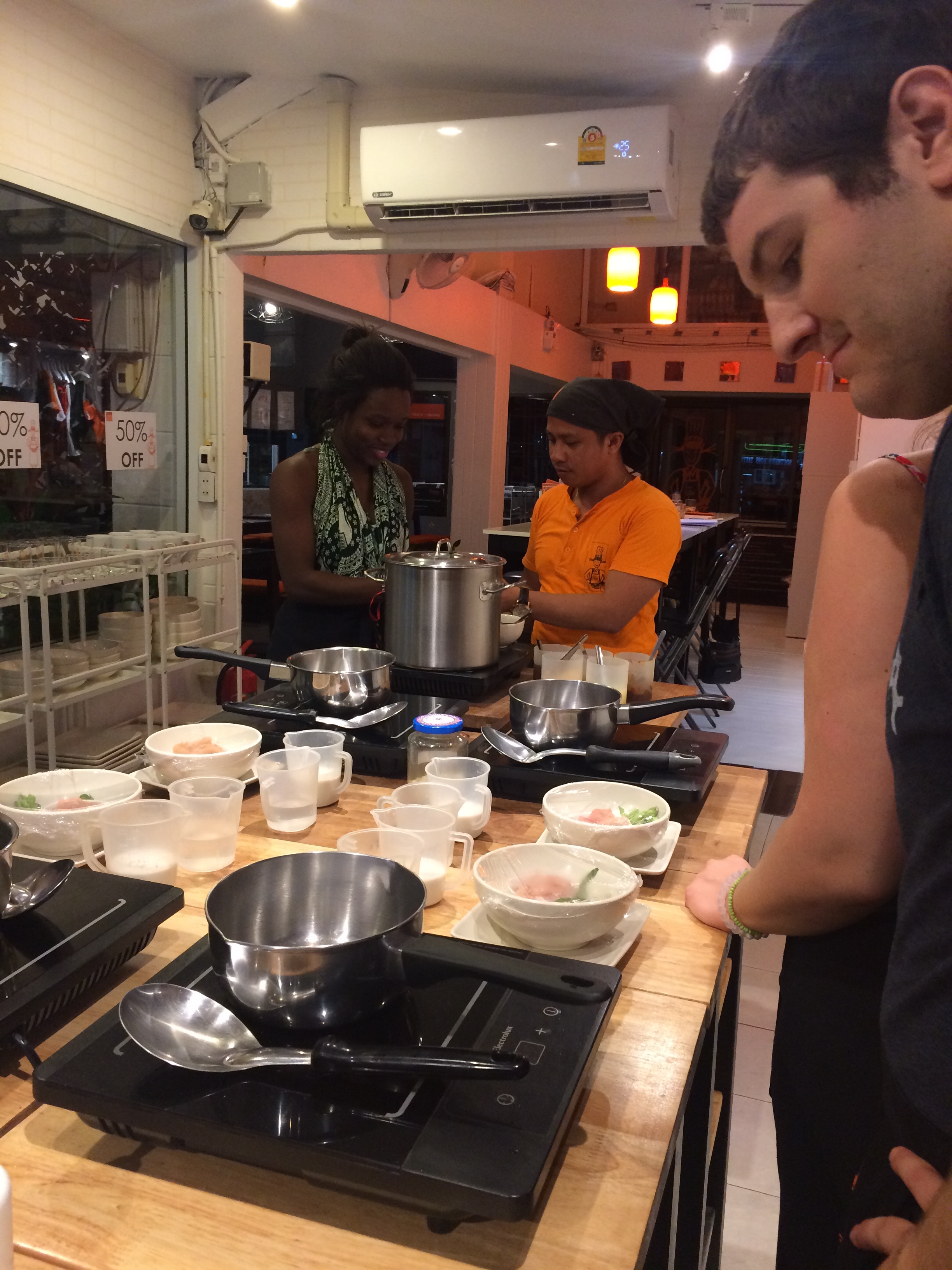
Once we check in we are off to the tailor shop, Frank and Charlie are getting custom suits, then we find a great beach bar with live music.  Great conversation, music and view.  Our last stop for the day is a Thai cooking class.  The Chef was a funny guy. Our class including a review of the primary Thai tastes, spices to use and how to mix and match sweet/sour/bitter/spicy/salty.  Next we made our own curry paste and finally cooked and ate three dishes.  Again great fun, great food and company.

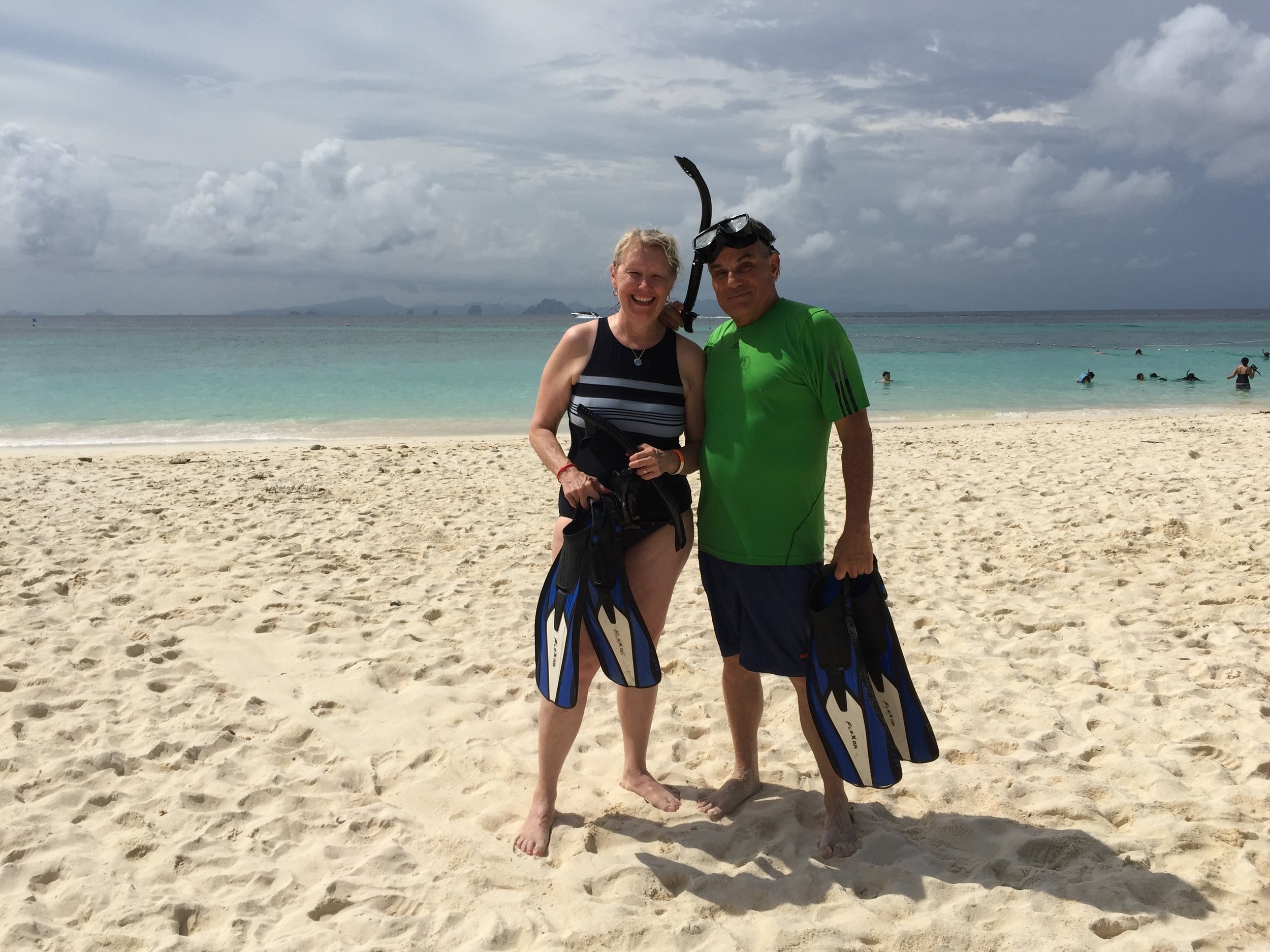
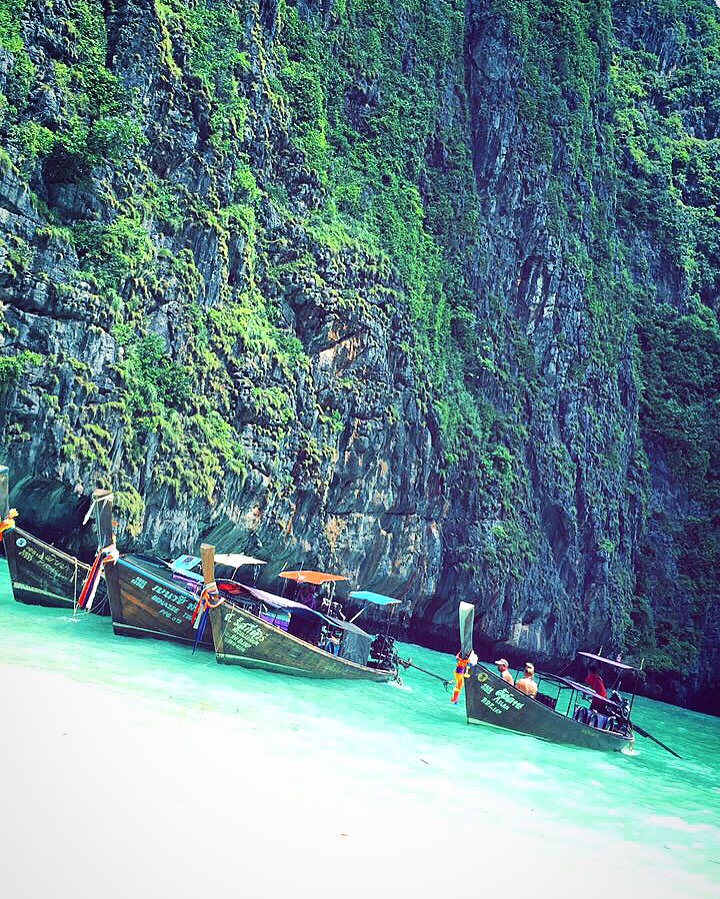
On our first full day on the island we  started our adventures with a fast boat trip to “Ko Phi-Phi” island for swimming, snorkeling, and beach combing. The views are spectacular. This is where the movie “the Beach” was filmed. Our boat carried 45 passengers and had 3 Honda 250 outboard engines and did we fly toward the out bound islands. There are many vendors, but we were really pleased with “SeaStar”that provided all the amenities and equipment when needed. Our tour director, stage name “Latte”, was a real hoot. The snorkeling was really fun, the coral had colorful fish, but there were also some jellyfish which we needed to avoid.  Jumping off the boat at various locations was fun too.  Charlie and Gabbi have a GoPro and get some great underwater shots.  

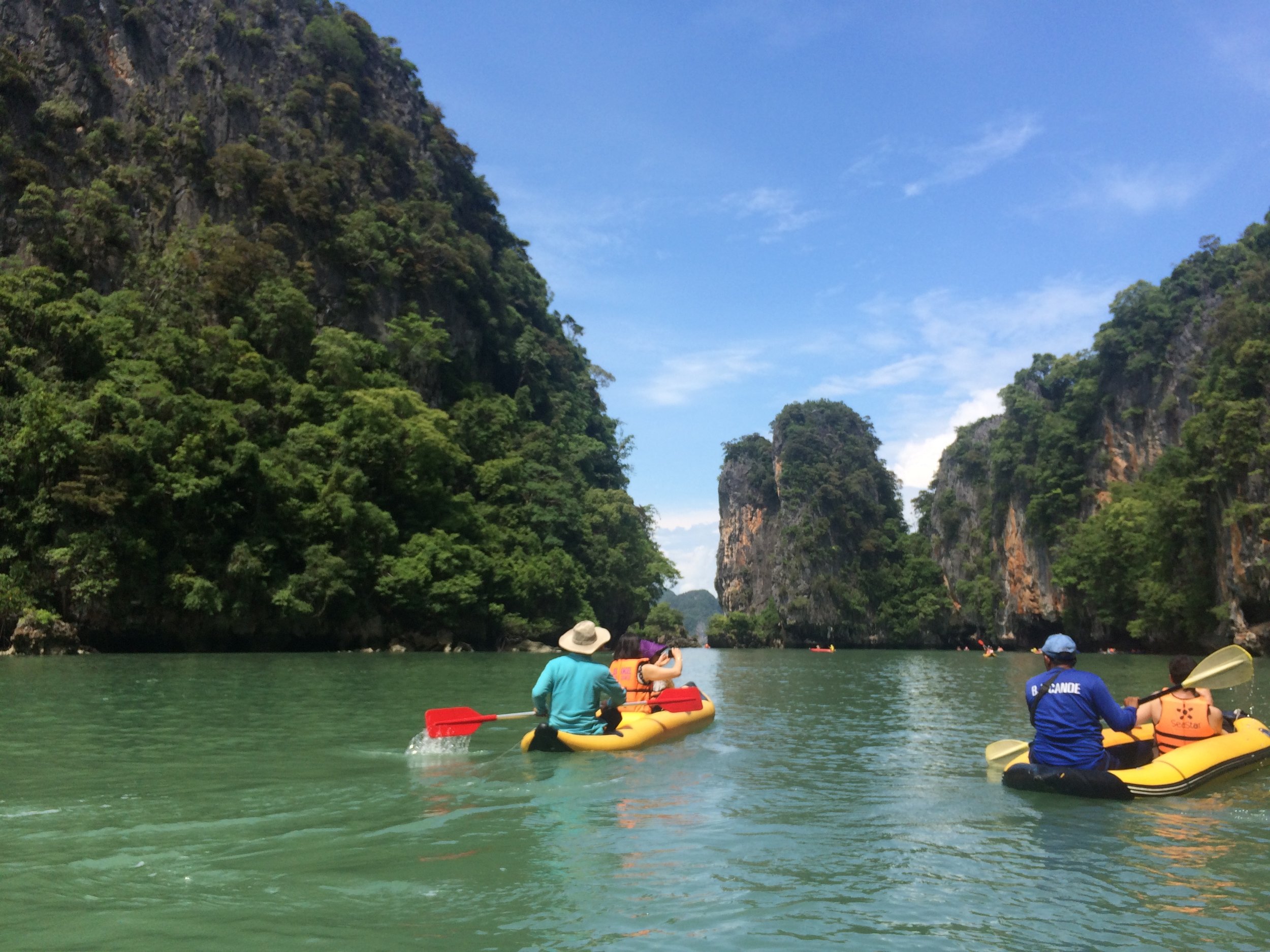
The area around James Bond Island

Charlie with the Floating Mountain 

We enjoyed ourselves so much that we signed up with SeaStar for a second day of island hopping, this time going to “James Bond” Island first and then other islands that are home for “Water World” type communities. James Bond has this obelisk shaped companion rock spire that defies gravity—think the “Floating Mountains” of the Avatar Movie. The water bound communities adjoined a small island where their temple was built; the homes and schools were on stilts with docking areas. The multi-room primary school housed loads of cute little kids; most attentive and some on recess playing tag on the floating playground. There were other islet beaches to stretch out upon and swim. The sun was gleaming.

Our starters, this is the first cheese we have had since being in SE Asia


Back in town we are back to the tailor for fittings and dinner.  After much discussion we all agree that we need a break from the Asian food so we pick an Italian place; what a surprise the food was outstanding some of the best we have had, and of course great conversation.


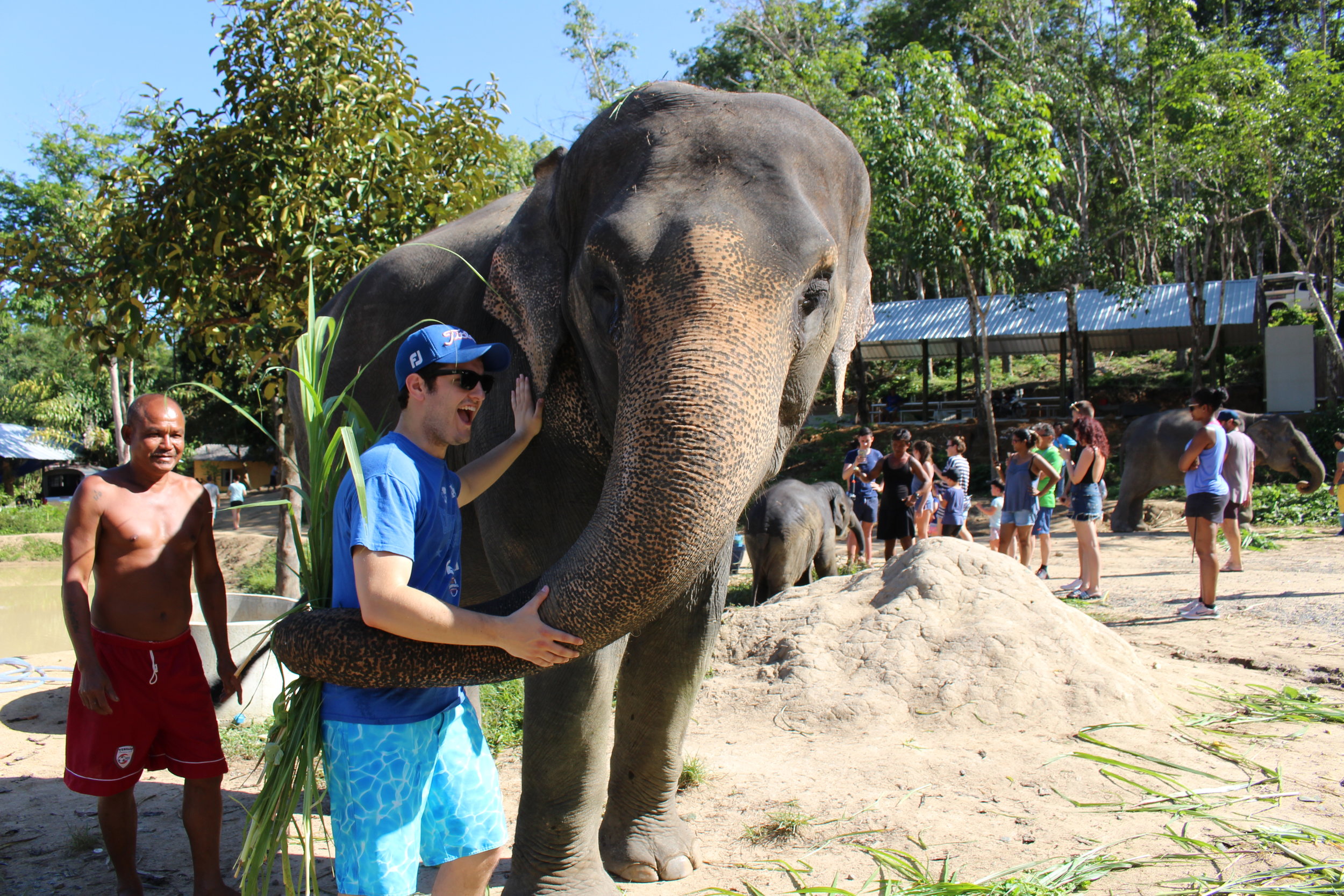
The next day we are up extra early for an outing at the Elephant Jungle Sanctuary.  Here we experienced the feeding, bathing, mudding, and washing of about 8 Indian Elephants including a one year old baby boy. To be so close and unimpeded was fantastic. They would plop into the mud pit and allow us to rub the goo into their sides. Some would move there legs as if swimming. Some would fart; some would cause us all to back away by doing other bathroom stuff. The baby played like one and mother would control him with her trunk.  This Sanctuary does not allow riding. Thailand has an abundance of elephants once used in the timber industry, but now by law they are spared that work.  After our hard work of playing and scrubbing, the sanctuary provided an outstanding buffet lunch and handcraft gifts.  See our pics below

After a good scrub and some rest we have a fun night out starting with a great Thai dinner and go to a musical/dance  extravaganza called “SeaSation”. This night was a treat to us from Charlie and Gabbi, an early anniversary present, we have a big anniversary next week.  The dinner was great, the show was good but it had a few elephant acts with riding and tricks.  After a day of playing with elephants that have been rescued, we don't see this as entertainment anymore.  

Our anniversary dinner out 

Our last day on the island is for relaxing at the pool, picking up our tailored suits.  In the late afternoon we fly back to Bangkok and stay in an airport hotel to help with our early morning flights, the kids fly home to Chicago, and we fly to Myanmar (formerly Burma).  It has been a great trip.  What was our favorite things?

  • Charlie and Gabbi - Our guide in Bangkok and the Elephants
  • Frank - the canals of Bangkok, suit shopping with Charlie
  • Janet - the cooking class, and snorkeling

We say goodbye to the kids at security our flight is not checking in yet.  Frank and Janet's favorite thing, seeing our kids.  Only 45 days left before we are home again with all of our kids and our wonderful family - Love you all

Saying goodbye at the airport

Bangkok Thailand

A typical shrine for the deceased King found in every building 

When you arrive in Bangkok you cannot help but see the hundreds of mural portraits and shrines of the recently deceased King of Thailand, namely Bhumibol Adulyadej. His name is unpronounceable, but you can’t help being caught up in the respect, even worship, for him among the people. He was the longest reigning king in Thai history. The King was renowned for his behind the scene politicking which kept the Kingdom out of direct wars and allowed international money to flow to Thailand. His son, Prince Vajiralongkorn, age 68, will assume the throne formerly upon the final cremation of the King’s body scheduled for October; a giant crematorium pagoda is currently being erected near the palace. 

The pool at our Airbnb

The pool at our Airbnb

We started our stay by booking an Airbnb efficiency apartment in a 37 story, pyramid shaped  high rise. This place was gorgeous, with work out room and a zero edge pool on the seventh floor right next to our unit. We think we were the only westerners there, but in any event everyone was polite. There was a sign instructing owners not to rent apartments. We were a little concerned about that issue as we stood out, but we were friendly to the security lady and she would greet us: “how are my friends”. We brought her ice cream on hot afternoons.
Biking the streets of China Town

Biking the streets of China Town

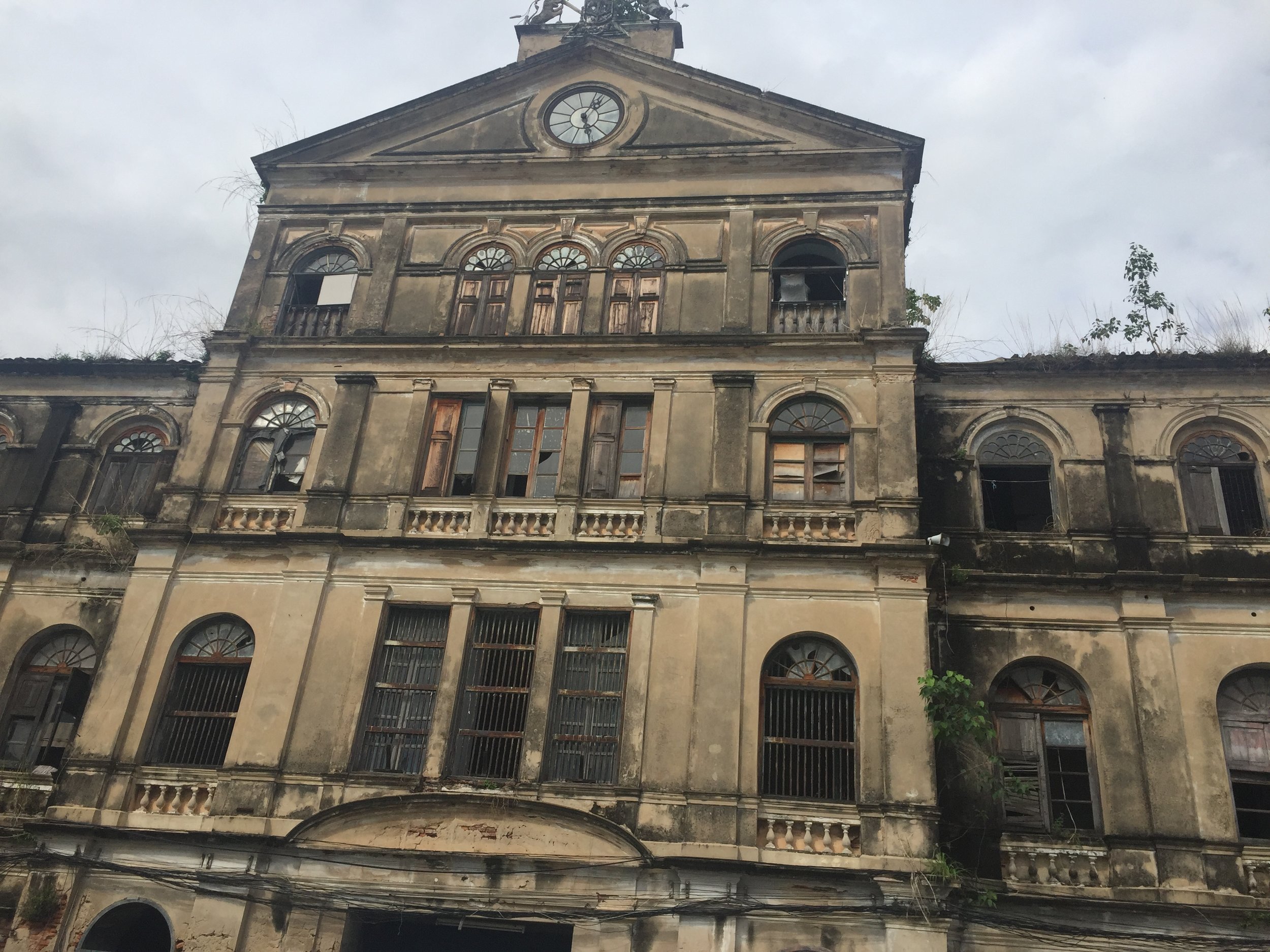
Hot afternoons are the way of life here. At 2:00 pm., getting into the shade is a must. We started our explorations in the morning and then continued after 4:00 pm. We could easily walk through the neighborhoods and then spend time in China Town. Here, we did some shopping and ordered tailored clothing. We also really had fun with a “Bicycle Tour”.  Our guide directed us through the narrow backstreets of the China Town residences, through the waterfront areas, and of course, through a slew of Buddhists Temples and schools. The historic “Customs House”, once the gateway to Thailand for levying taxes on traders arriving on the waterfront is now dilapidated, but apparently  will be renovated as a luxury hotel.           

Renovation and new construction is flourishing all over this gigantic city, which is divided by the Mae Nam Chao River, but conjoined by a frantic ferry system and some bridges. There is also a network of canals throughout the city, which in the past was the main highway. The front door of the famous “Jim Thompson” House was situated on a canal. We really enjoyed this compound of 5 houses owned by this American silk entrepreneur and art collector. He was born in Delaware and was stationed in Thailand during WW II. He settled in Bangkok after the war and built a worldwide business for his neighbor’s handmade silk. He has a splendid Asian art collection which we really enjoyed. Mysteriously, he disappeared in Malaysia in 1967.

The Jim Thompson House

There is still so much to see and experience in this city. We are waiting for the kids, Charlie and Gabbi, to arrive for a more widespread visit.      

We moved to a boutique hotel and greeted our kids, they left Chicago after work on Friday and arrived early Sunday morning in Bangkok.  We are now in the more northern riverfront district near the Grand Palace and What Pho. Our hotel was directly on the river, and more conveniently, the water ferry stop was at the next door pier-- We relax by the pool, eat breakfast on the riverside patio, walk the deck and step onto the ferry pier for the beginning of our royal excursions.

We hired Mr. Alex to guide us through a whirlwind 2 day schedule. This guy was very impressive. He had a military presence about him as he had been an officer, but was funny and very organized. 

The "Hangover Two Hotel"

The river is very wide, mud brown color, and curls like a snake. The shoreline is peppered on both sides with high rise hotels, office buildings, but also some 4 story residences that harken back to a third world status. The modern structures display magnificent design and architecture, rivaling anything in the USA. Oh yeh, the “Hangover Two” hotel with the gold dome is also prominent, but it is more traditional—the new stuff, like the “Rubic Cube” tower blows your mind. There is the Skyline; the above ground-2 level-rapid transit, with modern trains, that connects the various areas of the city, and of course, traffic jammed expressways of cars, motos, and tuk-tuks. This is an incredible city—that like NY, may never sleep.


The ferry stopped at the docking entrance of the Palace. This was our first day of excursions with the kids. Mr. Alex took us to to The Royal Palace, the royal temple aka Wat Pho and the temple of the reclining Buddha; Canal tour, Temple of Dawn and the flower and vegetable market. The canal tour was a blast. The wooden canopied boat sped along these residential canal where the homes, somewhat dilapidated, stood on weathered wood posts, many in need of replacement. Large long lizards basked in the sun on the canal walls. We fed bread to schools of catfish that approached the boat. They were 2 feet long and would plop on top of each other in their feeding frenzy. The most fun was to see the wide eyed face of a young tourist boy who came upon the scene from another boat—he did not have bait.

At the Royal Palace

At the Royal Palace

Surprise with the flowers market; here is sold the packaged offerings for the thousands of Buddha stands and pagodas around the city. In other words, food, drinks, and flowers are set before the Buddha statues sitting in place atop religious tables, and then replaced every several days. 

That evening we decided to visit the China town district of Bangkok for “Chinese” not Thai food. We used Uber to get to this glittering area reminding us of a poor man’sTimes Square. We used Trip Advisor to get to the highest ranked place. The food was good, not spectacular, the service great. 

On day two the four of us and Mr. Alex saw the Old City, including the monk’s bowl community called Baan Bat. Here, brass and copper smiths make the “offering bowls” the monks use every morning. Monks survive by the food and supplies given by the public before noon. We also visited the Mahakan Fort, Golden Mount Temple, the Giant Swing, and strolled the vibrant “ Ratchadamneon Avenue of shops and restaurants.

Gabbi and Charlie making music with the monk's bowls

Later, in New City of Bangkok we saw the high-rises up close. Visited  shopping malls. Rode the Public bus system, the Skyline transit trains, the canal taxi and then the express boat to home.

We ate at the food court in the shopping center and bought some souvenirs. The kids tried the really hot and spicy stuff; us--not so much. We took the water taxi again, enjoying the congested river way. Tomorrow we were excited about traveling together to the Island of Phuket for beaches, sun and fun.  See below a great photo galley that Gabbi put together for us.

Vientiane Laos

The VIP transport we take to Vientiane is very nice. The driver is a more conservative driver, so no F-1 racer moves. We are sitting next to a lovely young lady from Toronto, Canada, who had recently been in Bangkok. Since we are putting the finishing touches on our plans, her suggestions were very welcomed. Janet and Christina talked for most of the trip, exchanged addresses, and shared some flu medications. 

Janet was a little under the weather again so when we get to the hotel, she slept. Frank went to the pharmacy to get cold medicines and refills on the Malaria pills. As the afternoon approaches, It is steamy hot, but we are hungry and head to a café and bakery that serves massive sized cups of coffee, great soups, BLTs, and desserts. The desserts are a nice, traditional hold over from the French colonization of this area. We went back to the hotel for a swim and some future planning. Tomorrow, we will take a walking tour of the city sights. 

Today we ordered a tuk-tuk to visit some temples and capital city sights. We started at “Pha That Luang” which is the national temple complex. It has many glorious buildings on site, but the golden Pagoda is the most striking and is in fact the emblem of the country. 

We then drove to the Patuxay. This imposing structure is a loose clone of the Paris Arch De Triumph. The walk up the circular stairway to the 7th level gives exceptional views of the city, which for a capital is rather small city. 

We then stopped at the side by side Wat Phra Keo Temple and Wat Si Saket Temple.  Of note, the first has intricate carved wooden doors from the 1560 and other relics. The latter is an extremely old monastery, now a museum, that has a collection of Buddhas and very worn and rustic paintings on planks of wood.


We finished the day by visiting the COPE center, a historic museum of sorts dealing with the Laotian aftermath as affected by the US/Vietnamese conflict. The COPE foundation was founded by Americans concerned about helping amputees injured from unexploded war ordinance (UXO-bombs) in the fields that can still detonate and injure civilians. The US Air Force data quoted describes the thousands of Cluster Bombing sorties over Laos to disrupt the supply lines commonly known as the “Ho Chi Minh Trail”. This was a legitimate war tactic, but still providing for the medical needs of current civilians accidentally injured is the goal of COPE. 

We left the museum and decided to walk through downtown. There is a lot of high rise construction here. Our path took us pass a large new shopping mall so we stopped in for air con, to look around, and eat lunch. It is multi-story with open core and a food court. We ate a light meal, checked to see if the cinema was timely showing any movies in english-- no, and now refreshed we walked back to the hotel.  We spent the afternoon reviewing flight plans for future journeys both before and after we depart from Thailand. Our time in Laos is at an end. We will take a van across the border to Thailand and to the airport to fly to Bangkok. 
Vang Vieng Laos


To travel south in Laos, we knew the road would pass through the rural mountains. That means switch backs and narrow passages. We are traveling in a mini van but this time we get the rear seat. We decide to split some Dramamine before the trip starts and also roast from the heat in the van while waiting for others to load. The rear hatch is up, and we think we hear the hail of our names. We look back but no faces seem familiar, then Phet and Carson step up. We are always glad to see these young men who we met on the slow boat. They get the last seats. We also have Aussie Keith from the boat join us. An unusual wrinkle in Asia are the two American gals who ride with us. They work for the World Health Organization, had just finished an assignment in Africa, and were taking a holiday. They were from Cleveland, Ohio. Coincidentally, we had just read that the WHO had just appointed the new worldwide director, Dr. Tedros from Ethiopia . So we had stuff to talk about when we were not listening to our newest Audio book.

Our mountain view from the van

We knew that Vang Vieng was a naturalist area with kayaking, tubing, swimming, caving, mountain biking, hang gliding, and trekking. It had cleaned up its reputation for drug use and hedonism. We planned ahead, deciding a 6 hour van ride was a sufficient day of travel. Our place, the Laos Haven, was basic but had a pool and had decent Aircon. (PS. In Asia, no one says just AC). After our pool time, we had dinner at the #1 restaurant in town according to Trip Advisors—that would be Gary’s Irish Pub. This was only the first or second time we ate cheese burgers on this trip, and drank “Mexican Beer” with lime. 

The view from our hotel as we head out to dinner

The view from our hotel as we head out to dinner

We went kayaking on the ”Nam Song” river. It was a beautiful coarse snaking through the mountains with just enough rapid water and boulders to make the trip more fun. We had a group of 4 two man kayaks. We travelled about 11 km, watching the native Laotians fish and swim in this very blue mountain water. Frank and Janet teamed up and rocked along by pushing out say 5½ horsepower.   The group took an unofficial break and docked at a waterside open air storefront for some cold beer. We've got to thank our group Chinese guy for leading the way to the bar. As we got closer to town we noticed many new hotels being built. This place is going to explode with tourism. We came at the right, rustic, time. We finished at about noon. We did not want to be on the river during the high heat of the afternoon. When the temperature is at 96F, the humidity makes it feel like 104F. 

We then chose to go to the Blue Lagoon. This place is a natural Laotian water park—rather small, but with rope swings and jumping platforms in giant trees for some cannonballs into the cool waters. You can also zip line, repel, and explore caves. When we arrived our guide gave us a tasty box lunch. We sat at a table under a shady tree and just then were joined by the gals from Cleveland who came from zip lining. These girls were fearless and jumped from the highest platform. Not wanting to show them up, we jumped in from the lowest platform. 

As we took another break in the shade, to our surprise the slow boat guys, Phet and Carson, showed up. They had been motorcycling around the city and area and decided to see the Blue Lagoon.  We all joked around. The weirdest thing was we asked how they liked their Hostel, “Backbackers I”. They really liked it, except for the fact some one had stolen several peoples valuables because there was not nearly enough safes. Also, one of the perps was captured after he crawled into bed and groped a female traveler.  With small hotels costing less than $30 a night we think we will stay out of hostels in SE Asia.  

On our open truck ride back to town we see lots of ATV's


At 2:00 we all  headed back to the hotel. The guys still had some motorcycling to do. Phet promised to contact us for the MSU/Penn State football game. Hope he does. We were certainly cooled down from the Blue Lagoon, so did not need the pool. We sat on the open air balcony and worked on travel plans. The hotel was nice enough to set up a fan next to us.  We finished the evening by eating at an open air restaurant near the river that served Thai food. It was really, really great, and for both of us with beer and a pineapple shake totaled $8. Tomorrow, we head for the Capital of Laos,  Vientiane. We paid for the VIP transport—hope there is some aircon and leg room. 

A local Wat we passed on the way to dinner